
Last-Minute Travel Savings for Short-Notice Trips

It’s Thursday afternoon. Your flight to your cousin’s Saturday wedding just got canceled, the airline app is offering a replacement that lands two hours after the ceremony starts, and the hotel you booked three months ago now shows a rate you wouldn’t have agreed to. You have nine browser tabs open and every one of them creates another decision. Real last-minute travel savings don’t come from finding the single lowest new price in that mess. They come from rebuilding a trip that still works—and refusing to pay for the parts that no longer fit.

Short-notice travel can be cheaper than planning ahead. It can also be considerably more expensive, or roughly the same, or cheap in one category and painful in another. Airfare might drop while hotels near a convention triple. There is no rule that rewards you for waiting.

Protect the Reason for the Trip First

So start with one principle: protect the reason for the trip first, then rebuild everything else around that fixed commitment.

Before you search anything, answer five questions:

  • What genuinely cannot change?
  • What can change?
  • What money may already be recoverable?
  • Which replacement piece will be hardest to find?
  • Is the trip still worth taking at the new total cost?

Traveler comparing last-minute flights, hotels, rental cars, and backup travel plans

Decide Whether This Is a Flexible Trip or a Fixed Trip

These two situations look similar in a search box and behave nothing alike.

Flexible last-minute trip

You have a free weekend, unexpected time off, or a vague urge to go somewhere. You may be able to change the destination, dates, departure airport, trip length, hotel type, neighborhood, transportation, and activities. Search broadly. Let price and availability suggest the answer.

Fixed last-minute trip

You need to reach a specific city by a specific hour—a funeral, a wedding, a cruise departure, a medical appointment, a work obligation, a tour with a permit that can’t be moved. Here, broad searching wastes time. Your job is to protect the nonnegotiable commitment and reduce spending everywhere else.

Ask This Before Searching

What is the one part of this trip that cannot move?

Every later decision gets measured against that answer.

If you’re the flexible type, it helps to choose a destination that fits your available time and budget before you start comparing fares. And if you have a few minutes to spare, you can browse the complete travel-planning library for the pieces you’ll need next.

Write Down the Fixed and Flexible Parts

Do this on paper or in a notes app. It takes four minutes and prevents an hour of circular searching.

Fixed

Fixed may include: the event date, required arrival time, destination, number of travelers, passport status, required return date, accessibility needs, existing nonrefundable reservations, school or work schedules, medication or medical-equipment needs.

Flexible

Flexible may include: departure time, a nearby airport, trip length, hotel neighborhood, room type, rental-car duration, public transportation, optional activities, one night before or after the event, or driving part of the route.

If you can move even one significant detail, your options widen. A Saturday afternoon ceremony is fixed—but flying Friday morning instead of Friday evening, or returning Monday instead of Sunday, may open itineraries that weren’t there before. That doesn’t mean shifting dates always lowers the price. Sometimes it costs more and simply works better. Both outcomes are worth knowing.

Check What You Already Own Before Buying Again

This is the step rushed travelers skip, and it’s usually where the money is.

Before you pay for anything new, review:

  • Your original airline ticket and any airline-provided replacement
  • Refund eligibility versus credit or voucher
  • Rebooking options offered by the carrier
  • Hotel cancellation terms
  • Rental-car cancellation terms
  • Airport transfer, parking, tour, and event ticket terms
  • Credit-card benefits and any travel-insurance policy you hold
  • Loyalty points, certificates, or existing flexible reservations

Do not tap “accept” on the first credit the app displays. A credit and a refund are not the same thing, and once you take one, your options may narrow. Before accepting, find out whether a refund may be available, when the credit expires, whether it’s transferable, whether it’s restricted by route or name, whether blackout dates apply, who actually issued it, and whether your ticket was purchased directly or through a third-party seller.

For federal rules on when refunds are owed, read the Department of Transportation airline refund guidance directly and check it against your specific reservation. Refund rights and voluntary airline accommodations are separate issues, and guidance changes—verify the current version rather than relying on what someone told you last year.

One more thing: airline rules do not automatically extend to hotels, rental cars, parking reservations, tours, vacation rentals, private transfers, or event tickets. Each of those follows its own contract. And nothing here is individualized legal or insurance advice; your policy documents and provider terms control.

Recalculate the Complete Trip Cost

A cheap replacement flight can produce an expensive replacement trip.

Add up everything: new airfare, baggage, seat fees, hotel rate, mandatory property fees, parking, rental car, fuel, tolls, airport transfers, meals during a longer travel day, an overnight connection, prepaid reservations you’ll lose, new activity costs, cancellation charges, a changed trip length, and transportation from an alternate airport.

Then compare five numbers:

  • What the original trip cost you
  • What is recoverable
  • What the replacement costs
  • Your new total out-of-pocket amount
  • What it costs to simply cancel the trip

It helps to compare the complete cost of the replacement trip side by side rather than judging one line item at a time. The cheapest component rarely produces the cheapest trip.

Look at Last-Minute Flights Without Chasing a Magic Fare

Short-notice airfare moves in both directions. Some routes soften; others climb as seats thin out. Treat every fare as information, not as a verdict.

Compare:

  • Nonstop versus connecting options
  • Nearby departure and arrival airports
  • Early morning versus late evening departures
  • One-way tickets, including two one-ways from different carriers
  • Different return dates
  • Driving to a larger hub airport
  • Train or driving alternatives
  • Total door-to-door time, not just flight time
  • Arrival time relative to your fixed commitment
  • Baggage and seat costs
  • Change and cancellation terms
  • The operating airline (not just the one that sold the ticket)
  • How you’ll get from the airport to where you’re sleeping

A useful example: a flight that saves you money but lands at midnight may require a taxi instead of transit, an extra hotel night, or a rental counter that closed hours earlier. That “cheaper” ticket can quietly cost more than the nonstop.

If you want the mechanics behind why fares behave the way they do, it’s worth taking a few minutes to understand how airline prices change and to compare practical cheap-flight strategies. Flexible travelers with no fixed destination can also browse flight destination guidance for ideas that match the airports they can actually reach.

One caution: skip hidden-city or throwaway ticketing. It may violate carrier rules and can create problems you don’t want during a disruption.

Compare Nearby Airports Carefully

An alternate airport may give you more flights, better arrival times, a nonstop route, more rental inventory, or simply a workable itinerary when your home airport has none.

It may also add a long drive, parking, fuel, tolls, train fare, a one-way rental fee, a taxi ride, an extra hotel night, awkward return transportation, and hours of travel time.

Use a simple framework:

Calculate the Real Airport Change

Fare difference + transportation to or from the alternate airport + parking, fuel, tolls, or lodging + added travel time = the real comparison.

That last term matters. Two hours of extra driving after a canceled flight is not free, even if no one charges you for it. To size up the ground piece properly, compare airport and destination transportation costs before you commit. Saving money on a ticket does not necessarily save money on a trip.

Understand the Airline’s Current Booking and Cancellation Terms

Before you pay, read the fare rules for the specific ticket in front of you. Check refundability, travel-credit terms, change fees, fare differences, same-day change options, standby rules, baggage, seat assignments, the operating airline, the missed-flight policy, restrictions that apply to third-party bookings, and the deadline for using any cancellation option that exists.

Two official references worth reading directly: the Department of Transportation guidance on buying an airline ticket and the Department of Transportation 24-hour reservation guidance.

The 24-hour provision gets flattened into “you can always cancel free within a day,” and that’s not accurate. Verify the current rule and its conditions before relying on it, because:

  • It has eligibility conditions.
  • It may depend on how far in advance of departure the reservation was made—which matters enormously for same-week travel booking.
  • It does not necessarily apply when you buy through a third-party seller.
  • Holding a reservation without payment and canceling a purchased ticket are different compliance options, and airlines may choose between them.
  • Individual airlines may offer more flexibility than the minimum rule requires.

Read the terms on the page where you’re actually paying.
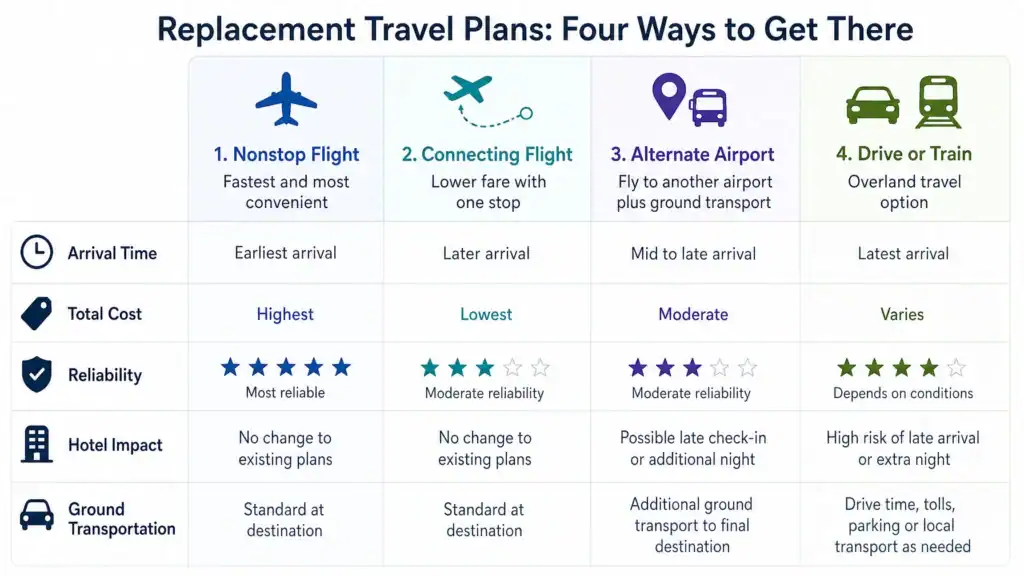
Comparison of last-minute flight, alternate airport, driving, and train replacement options

Check Airline Disruption Commitments Separately From Refund Rights

At the gate, travelers tend to blend several unrelated questions into one: Will they rebook me? Will they feed me? Will they cover a hotel? Can I get my money back? Can I decide not to travel at all? Will a different airline accept my ticket? And what happens to the hotel and rental car I already paid for?

Those have different answers. Check the Department of Transportation airline cancellation and delay dashboard for what individual carriers have committed to, and the Department of Transportation airline refund guidance for refund questions.

Keep these distinctions in mind:

  • Commitments differ from airline to airline.
  • The cause of the disruption may change the outcome, and controllable events are often treated differently from uncontrollable ones.
  • A refund is not the same as meals, lodging, or ground transportation.
  • The dashboard reflects each airline’s own commitments and should be checked on the day you need it.
  • Your hotel, rental car, transfer, and event tickets are governed entirely by their own terms.

Once you know what the airline will and won’t do, you can coordinate replacement airport, hotel, and rental-car arrangements around the itinerary you actually end up with.

Use a Structured Flight-Rebooking Process

When you’re tired, a sequence beats improvisation.

  1. Confirm the flight’s current status with the operating airline.
  2. Review the replacement the airline has already offered.
  3. Write down the latest arrival time that still works.
  4. Search the same route at different times of day.
  5. Check nearby airports.
  6. Compare one-way options.
  7. Compare driving or rail if it’s realistic.
  8. Calculate the complete replacement cost.
  9. Review refund, credit, and cancellation terms before paying.
  10. Protect the hotel, rental car, and ground transportation.
  11. Save the new confirmation offline.
  12. Cancel duplicates you no longer need.

Avoid holding several overlapping nonrefundable reservations unless you fully understand what each one costs and when you can still cancel it.

Search for Last-Minute Lodging by Area, Not Just Property

Short-notice hotel availability varies wildly by neighborhood. A city can look sold out while a transit-connected district two miles away has rooms.

Compare the area around your event, the central business district, airport hotels, transit-connected neighborhoods, nearby towns, suburbs, properties near an alternate airport, and hotels near a train station. Also consider a different room type, a shorter or longer stay, or splitting the stay between two properties if that’s practical.

Then check the details that decide the real price: total stay cost, required property fees, parking, breakfast, cancellation terms, prepayment, check-in time, late-arrival procedure, occupancy limits, bed configuration, distance from the reason you’re traveling, and daily transportation cost.

That last cluster matters more than people expect. A family needing one room that sleeps five doesn’t benefit from a long list of rooms that sleep two. And a hotel twenty minutes out may lose its advantage after two late-night rides and a parking charge.

Worth reading before you book: how to understand the complete hotel price, how to choose a practical hotel location, a set of practical hotel savings tips, and destination-based hotel guidance if you’re still deciding where to stay.

Contact the Hotel When the Arrival Time Changes

A delay or a rebuilt itinerary can affect check-in, late-arrival handling, no-show status, airport shuttle service, luggage storage, parking, room availability, required payment, and whether your reservation is treated as guaranteed.

So call the property itself—not a general reservations line if you can avoid it. Give them your new expected arrival time, ask that the reservation be noted, confirm front-desk or after-hours procedures, ask whether the airport shuttle still runs that late, keep the direct phone number in your phone, and save any written confirmation you receive.

This won’t guarantee the room is held. The property’s own reservation terms control that. But a noted late arrival is far better than silence, and it takes three minutes at the gate.

Compare Last-Minute Rental Cars by Location and Vehicle Class

Availability on short notice can differ sharply between airport counters, consolidated rental centers, off-airport branches, downtown offices, neighborhood locations, nearby airports, and train stations.

Compare total price, taxes and fees, operating hours, pickup location, the cost of reaching that location, vehicle class, luggage capacity, child-restraint needs, deposit or authorization holds, payment requirements, one-way charges, fuel policy, toll program, parking at your destination, cancellation terms, and the return location.

Operating hours deserve special attention during disruptions. Booking a cheaper off-airport branch that closes at 6 p.m. is a problem when your replacement flight lands at 10:40.

For the mechanics, see how to understand rental-car pricing, review practical car rental savings tips, compare airport rental-car strategies, or check destination-based rental-car guidance. The Federal Trade Commission guidance for renting a car is a good plain-language overview of charges and add-ons. Coverage questions depend on your own policies and cards, so ask your insurer or card issuer rather than guessing at the counter.

Consider Whether You Still Need a Rental Car

A shortened or rerouted trip often changes the transportation math entirely.

Alternatives worth pricing: an airport train, a taxi, rideshare, a hotel shuttle, local public transportation, a private transfer, a shorter rental period, a rental for one day only, walking from a central hotel, a train between cities, or driving the whole way from home.

A four-day rental made sense for the original itinerary. After a cancellation trims the trip to two nights in a walkable, transit-connected neighborhood, it may be pure cost. Group travelers sometimes find the reverse: one private transfer for six people can beat several separate rides.

Run the numbers both ways and compare rental cars, transit, shuttles, and rideshare before defaulting to what you originally booked.

Reduce the Trip Before Replacing Every Part

The instinct is to rebuild the original itinerary exactly. That’s usually the most expensive path available.

Consider instead:

  • Shortening the trip by one night
  • Keeping one major activity and dropping the rest
  • Cancelling low-priority reservations
  • Staying in a single hotel instead of two
  • Eliminating the rental car
  • Choosing one neighborhood
  • Replacing several day trips with local activities
  • Driving instead of flying
  • Substituting a nearby destination
  • Moving the trip to a later date when that’s genuinely possible

A canceled four-night trip with three excursions can become a workable three-night trip built around the one thing that mattered. A couple whose weekend flight vanishes may find a manageable driving trip to a closer destination more pleasant than a scramble through two connections.

Simplifying reduces replacement costs, cancellation exposure, transportation, parking, baggage, stress, and—importantly—the number of reservations that can fail.

Compare Driving, Train, and Air Travel

Flying isn’t automatically the answer on short notice.

Compare total travel time, true door-to-door time, number of travelers, fuel, tolls, parking, any overnight hotel, train fares, seat reservations, baggage, whether you’ll need a car after arrival, weather, driver fatigue, and schedule reliability.

No universal winners here. Driving is not always cheaper for a group once lodging and fatigue enter the picture. Rail is not always more reliable. But a two-connection itinerary with a four-hour layover can consume nearly as much of your day as driving or taking a train once you count airport arrival time, security, and transfers on both ends. If you’re weighing options, it’s worth reviewing practical flight alternatives and fare strategies alongside the drive time.

Handle Last-Minute International Travel Carefully

International short-notice travel adds a whole category of risk that has nothing to do with price.

Verify passport validity, whether the passport is physically available, visa or travel-authorization requirements, entry and exit rules, transit-country rules, the destination advisory, health information, return-entry requirements, airline document rules, documentation for children, medication restrictions, and whether your phone and payment methods will work.

Start with the State Department international travel planning guidance and the State Department travel advisories.

Requirements change, and they differ by destination, nationality, route, and individual circumstances. Confirm your specific situation with official sources—the airline, the destination’s embassy or consulate, and government advisories—rather than a summary written for someone else.

Use Official Urgent Passport Services

A last-minute international ticket does not solve a missing, expired, or damaged passport. That’s a separate problem with its own timeline.

Use the State Department guidance for getting a passport quickly and the official passport agency appointment information, and verify the current eligibility windows, documentation, fees, and appointment process yourself—those details are updated periodically.

A few things to understand going in:

  • Urgent service has eligibility requirements.
  • Proof of imminent travel may be required.
  • Passport agencies and centers require an appointment.
  • Appointment availability is not guaranteed.
  • Official appointment scheduling does not carry a separate fee just to hold a slot.
  • Don’t pay an unofficial service for an appointment.
  • No third party can guarantee that a passport will be issued by a particular date.

If the passport timeline is uncertain, factor that into whether you buy the ticket at all.

Avoid Last-Minute Travel Scams

Rushed travelers are easier targets. That’s not alarmism; it’s just how urgency works.

Watch for copycat airline websites, fake hotel and rental-car “support” numbers, vacation-rental listings that don’t exist, paid passport-appointment services, unofficial visa or travel-authorization sites, event-ticket resale scams, unsolicited transportation offers in arrivals halls, and search advertisements dressed up as official customer service. Pressure to pay by wire transfer, gift card, payment app, or cryptocurrency is a strong warning sign.

Practical habits that help:

  • Type the official web address yourself rather than clicking an ad.
  • Use the phone number printed on your existing confirmation.
  • Check the domain character by character before entering payment details.
  • Search the company name along with “scam,” “review,” or “complaint.”
  • Confirm vacation-rental addresses and ownership independently.
  • Never pay anyone for an official passport appointment.
  • Save receipts, confirmation numbers, and screenshots.

The Federal Trade Commission guidance for avoiding travel scams and the FTC guidance for avoiding travel website scams are both worth a quick read. None of this means an unfamiliar provider is automatically fraudulent—plenty of small, legitimate operators exist. It means verify before you pay.

Protect Essential Accessibility and Family Arrangements

Some things are simply scarce on short notice: accessible hotel rooms, wheelchair assistance, accessible transfers, hand controls, accessible rental vehicles, connecting rooms, cribs, child restraints, large vehicles, in-room refrigerators for medication, service-animal arrangements, mobility-equipment handling, and group transportation.

If any of these are essential:

  • Contact providers directly rather than relying on a booking field.
  • Ask explicitly whether the arrangement is confirmed or only requested.
  • Get it in writing and keep the documentation.
  • Reconfirm before departure.
  • Don’t cancel a confirmed arrangement until the replacement is secured.
  • Build a backup where one exists.

For seating, restraints, and schedule questions with kids in tow, the family travel planning tips guide covers the details that get overlooked at 11 p.m. Short notice can’t guarantee availability of an essential request, which is exactly why the confirmed-versus-requested question matters.

Pack for the Replacement Plan, Not the Original Plan

A changed itinerary can change weather, trip length, baggage allowance, airline, airport, transportation, hotel amenities, whether you need formal clothes, whether outdoor activities survived, medication timing, and what belongs in your carry-on.

Recheck the operating airline’s baggage rules, your identification against TSA acceptable-identification guidance, your documents, the new weather forecast, carry-on essentials, medication, chargers, a power bank, offline confirmations, one change of clothing, hotel and rental contact details, and the exact addresses for your transportation. The TSA What Can I Bring tool settles the “can this go in my bag” arguments quickly.

The packing and travel timing tips guide is a useful second pass once the new itinerary is locked.

Create a 72-Hour Last-Minute Travel Plan

Treat this as a framework, not a set of deadlines. Compress it if you’re leaving tomorrow.

Within the first hour

  • Identify the fixed commitment.
  • Confirm the current status of every affected reservation.
  • Review refund and rebooking options before buying.
  • Protect the hotel or event reservation.
  • Write down the latest acceptable arrival time.
  • Resist buying several overlapping replacements.

Within 24 hours

  • Compare replacement flights and alternate airports.
  • Compare hotel availability and total cost.
  • Confirm ground transportation in both directions.
  • Check rental-car availability and counter hours.
  • Verify documents.
  • Confirm accessibility or family arrangements.
  • Save all terms and cancellation deadlines.

Within 48 hours

  • Recheck schedules.
  • Confirm lodging directly with the property.
  • Confirm the rental or transfer.
  • Review the weather.
  • Pack for the revised itinerary.
  • Download confirmations and offline maps.
  • Cancel duplicate reservations before their deadlines.

Final day

  • Check flight status, traffic, transit, and weather.
  • Confirm the terminal and operating airline.
  • Reconfirm late-arrival arrangements.
  • Charge devices and the power bank.
  • Put documents and medication in the carry-on.
  • Review the airport-to-hotel plan.
  • Keep provider phone numbers where you can reach them offline.

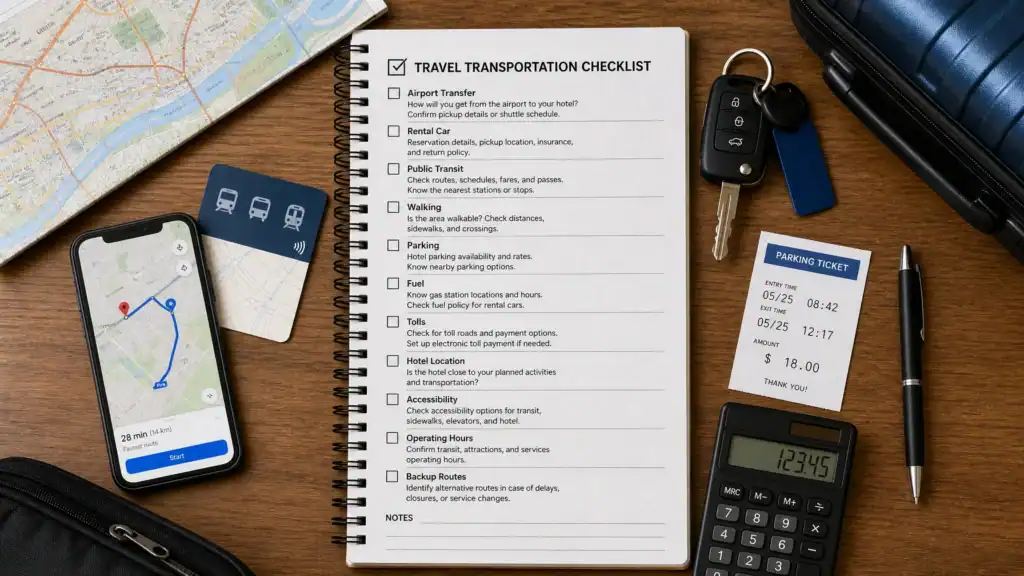
Last-minute travel checklist for flights, hotels, rental cars, documents, refunds, and backup plans

Last-Minute Replacement Options Compared

Replacement optionTotal costs to includeWhen it may workRisks or limitations
Same-airline replacementFare difference, baggage, seats, any hotel-night changeDisruption is the airline’s to fix; you want one point of contactOffered arrival time may miss the event; first offer isn’t always the best available
Different flight, same routeNew fare, seat and bag fees, lost prepaid itemsA later or earlier departure still meets your deadlineFare difference may be significant; original ticket terms may limit changes
Connecting flightFare, meals during a long day, possible overnightNonstops are full or priced beyond reachMore failure points; a missed connection can cost you the event
Alternate departure airportFare difference, drive time, parking, fuel, tolls, transit fareMore departures or a nonstop you can’t get at homeReturn transportation is often the hard part; parking accumulates
Alternate arrival airportFare, transfer to the destination, possible one-way rentalBetter schedule or more rental inventoryLate arrival plus long transfer can require an extra hotel night
One-way ticketBoth legs priced separately, baggage on each carrierOutbound and return needs differ after a disruptionTwo separate tickets mean no protected connection between them
DrivingFuel, tolls, parking, overnight lodging, fatigueModerate distance, several travelers, need for a car on arrivalWeather and traffic risk; not automatically cheaper for a group
TrainFares, seat reservations, station transfers, baggage limitsWell-served corridor, city-center-to-city-center tripNot always faster or more reliable; limited routes
Shorter tripFewer hotel nights, shorter rental, dropped activitiesReplacement prices are high but the event still mattersLost prepaid nights or nonrefundable tours
Different hotel areaRoom rate, property fees, parking, daily transportationEvent-adjacent hotels are full or expensiveNightly transportation and late-night rides can erase savings
Airport hotelRate, fees, shuttle availability, transport to the eventVery late arrival or very early departureMay be far from the reason you traveled
Short rental carDaily rate, fees, parking, branch hoursYou need a vehicle for one specific day onlyBranch may close before arrival; limited inventory on short notice
Transit or rideshare planPer-ride costs across the whole stay, airport transfersCentral hotel in a transit-connected cityCosts add up with a group; accessibility options may be limited
Postponing the tripCancellation charges, credit expiration, recoverable amountsThe commitment can genuinely moveCredits expire and carry restrictions; the reason for the trip may not wait

Common Last-Minute Travel Mistakes

Buying the first replacement before checking refund options

Five minutes reviewing your original reservation can change what you need to buy—or whether you need to buy at all. Once you’ve paid for a replacement, your leverage on the original often shrinks.

Accepting a credit without understanding the terms

Credits expire, may be restricted to certain routes or travelers, and are not money back. A refund and a credit are different products. Understand which one you’re eligible for before you click.

Comparing only the replacement airfare

The airfare is one line. Hotel nights, transfers, parking, baggage, and a changed trip length are the rest of the bill.

Choosing an alternate airport without planning the transfer

An inexpensive fare into a distant airport can cost more after a one-way rental, a long taxi ride, or an unplanned hotel night. Price the ground connection in both directions.

Booking a hotel too far from the fixed commitment

Distance shows up daily. Two rides a day for three days, plus parking, plus a late-night surcharge, often exceeds the nightly difference—and adds a reliability risk on the morning that matters most.

Assuming the rental counter will remain open

Confirm the specific branch’s hours and after-hours procedure directly. Airport locations and neighborhood branches operate on different schedules.

Recreating every part of the original trip

The original itinerary was built for conditions that no longer exist. A simpler replacement usually costs less and fails less often.

Holding several nonrefundable reservations

Parallel bookings feel safe at 1 a.m. and produce duplicate charges by Friday. If you hold options, write down every cancellation deadline immediately.

Waiting to tell the hotel about a late arrival

Call the property directly with your new arrival time and ask that it be noted. It doesn’t guarantee the room, but silence helps no one.

Ignoring child-restraint or accessibility availability

Specialized inventory is limited, and “requested” is not “confirmed.” Handle these before optimizing anything about price.

Booking through an official-looking search advertisement

Copycat sites are built to look right. Type the address yourself, verify the domain, and use contact details from an existing confirmation.

Paying for a passport appointment

Use official scheduling information only. No paid intermediary can guarantee an appointment or an issuance date.

Forgetting to cancel the original rental, transfer, or parking

Changing your flight does not cancel anything else. Airport parking, private transfers, tours, and rentals each need their own cancellation.

Keeping the original packing plan after the itinerary changes

A different airline means different baggage rules. A different destination or season means different clothing. A shorter trip means less of everything.

A Simple Last-Minute Travel Savings Process

  1. Identify the one commitment that cannot move.
  2. Separate the fixed details from the flexible ones.
  3. Review existing reservations and recoverable money.
  4. Check official disruption, refund, or cancellation information.
  5. Set the latest acceptable arrival time.
  6. Compare replacement flights and alternate airports.
  7. Compare driving, rail, and shorter-trip options.
  8. Recalculate the complete trip cost.
  9. Protect the hotel and other anchor reservations.
  10. Confirm rental-car or ground-transportation availability.
  11. Simplify the itinerary where practical.
  12. Verify documents and international requirements.
  13. Confirm family, accessibility, and medical arrangements.
  14. Verify the provider and website before paying.
  15. Save every new confirmation offline.
  16. Add cancellation deadlines to your calendar.
  17. Cancel duplicate or unusable reservations.
  18. Recheck the complete plan before departure.

Once the plan holds together, use it to coordinate airport, hotel, and rental-car preparation for the revised arrival time. And when the trip is behind you, you can browse more practical travel-planning guides to make the next one easier.

Last-Minute Travel Savings Checklist

  • ✅ The trip’s fixed commitment is identified
  • ✅ Flexible dates, airports, and trip length are listed
  • ✅ Existing reservations have been reviewed
  • ✅ Refund, credit, and rebooking options are understood
  • ✅ The latest acceptable arrival time is clear
  • ✅ Replacement flights are compared by total cost
  • ✅ Nearby airports are evaluated with ground transportation included
  • ✅ Driving and rail alternatives are considered
  • ✅ Hotel price includes fees, parking, and transportation
  • ✅ Hotel late-arrival procedure is confirmed
  • ✅ Rental-car location and operating hours are checked
  • ✅ Short-rental and no-rental options are compared
  • ✅ Airport transportation is confirmed in both directions
  • ✅ Simplifying or shortening the trip has been considered
  • ✅ Passport and entry documents are verified
  • ✅ Official urgent passport information is used where applicable
  • ✅ Provider websites and contact numbers are verified
  • ✅ Unusual payment demands are avoided
  • ✅ Accessibility and family arrangements are confirmed
  • ✅ The revised packing plan matches the new itinerary
  • ✅ Confirmations and terms are saved offline
  • ✅ Cancellation deadlines are on the calendar
  • ✅ Duplicate reservations are canceled
  • ✅ Original parking, transfers, and rentals are reviewed
  • ✅ Backup transportation is identified
  • ✅ Final flight, weather, traffic, and transit checks are planned

Frequently Asked Questions About Last-Minute Travel Savings

Is it cheaper to book travel at the last minute?

Sometimes, and sometimes not. Short-notice pricing depends on demand, remaining inventory, the destination, the season, local events, and how flexible you can be. A quiet route in a slow week may be affordable days out. A city hosting a convention or holiday festival may be expensive in every category at once. You may also find cheap airfare paired with costly lodging, which produces a more expensive trip overall. Compare the full cost each time rather than assuming a direction.

How can I save money on a last-minute flight?

Widen the search before you narrow it. Check different departure times, nearby departure and arrival airports, one-way combinations, and different return dates. Compare total door-to-door time, not just the fare, and include baggage and seat fees. Confirm the arrival time still meets your commitment. If you’re flexible about where you’re going, let availability guide the destination. And read the change and cancellation terms before paying, since short-notice plans often change again.

Should I wait for a last-minute airfare to drop?

Waiting is a gamble, not a strategy. Prices can fall, hold steady, or rise as departure approaches, and suitable inventory—the right arrival time, enough seats together, a nonstop—can disappear while you watch. If you have a fixed commitment, the cost of losing a workable itinerary usually outweighs a possible fare reduction. If you’re genuinely flexible with no deadline, you can afford to watch a while, but decide based on what fits your trip rather than on a hoped-for drop.

Are nearby airports worth checking?

Usually worth checking, not always worth using. An alternate airport may offer more departures, a nonstop, better arrival times, or more rental inventory. But add the drive, parking, fuel, tolls, transit fare, any one-way rental charge, and the return trip. Then add travel time, which is a real cost even when nobody bills you for it. If the total still comes out ahead and the connection is reliable in both directions, it’s a good option.

Is it cheaper to drive than fly at the last minute?

It depends heavily on distance and how many people are traveling. Driving costs roughly the same whether one person or four are in the car, while airfare multiplies per traveler—so groups sometimes come out ahead. But add fuel, tolls, parking at the destination, any overnight hotel along the way, and the value of your time. For a solo traveler covering a long distance, flying often wins. Compare complete door-to-door cost and time, not fuel versus fare.

How can I find a last-minute hotel?

Search by area rather than by property. Check the neighborhood around your commitment, the central business district, airport hotels, transit-connected areas, nearby towns, and districts near an alternate airport. Compare the total stay price with mandatory fees, parking, and daily transportation included. Confirm occupancy limits and bed configuration if you’re traveling with family—one room that sleeps five is a different search than any available room. Also review cancellation terms and prepayment before you book.

Should I call the hotel directly?

Direct contact is useful for confirming things a booking page can’t. You can verify late-arrival procedures, after-hours check-in, shuttle operating times, parking, luggage storage, room configuration, and accessibility details. You can also ask that a delayed arrival be noted on your reservation. What direct contact does not reliably produce is a lower rate—sometimes it does, often it doesn’t. Call for accuracy and reassurance, and treat any price improvement as a bonus.

How do I find a last-minute rental car?

Check several pickup locations, not just the main airport counter: consolidated rental centers, off-airport branches, downtown offices, nearby airports, and train stations. Compare total charges including taxes and fees, and confirm the specific branch’s operating hours against your actual arrival time. Verify vehicle class, luggage capacity, deposit or authorization requirements, fuel and toll policies, and the return location. If inventory is thin, consider whether a shorter rental or no rental at all would work.

What should I do when my flight is canceled?

Start by confirming the flight’s current status with the operating airline and reviewing whatever replacement it has offered. Write down the latest arrival time that still works for your commitment. Then check your refund, credit, and rebooking options before purchasing anything new, and protect your hotel and other anchor reservations. Search alternatives in parallel—same route at other times, nearby airports, driving or rail—and compare complete cost. Finally, cancel whatever you no longer need before its deadline.

Should I accept an airline credit or request a refund?

That decision depends on your circumstances, so compare the terms rather than defaulting to whichever appears first. Look at whether a refund is available under current rules and your fare conditions, then examine the credit’s expiration date, transferability, route or name restrictions, blackout periods, and how it interacts with any rebooking. Consider how likely you are to travel again on that airline within the window. Review the DOT refund guidance and your own reservation terms before choosing.

Does the airline have to pay for my hotel after a cancellation?

It varies. Airline commitments differ from carrier to carrier, and the cause of the disruption often matters—controllable events are frequently treated differently from weather or air-traffic issues. Meals, lodging, and ground transportation are also separate questions from refund rights, and one does not imply the other. Check the DOT airline cancellation and delay dashboard for what your airline has committed to, and confirm with the airline directly at the time of the disruption.

What happens to my hotel when my flight is canceled?

Nothing automatic. Your hotel reservation is governed entirely by the property’s own terms, not by the airline’s actions. Depending on those terms, you may be able to cancel without charge, you may face a penalty, or the night may be nonrefundable. Some properties are accommodating when a flight disruption is documented, but that’s discretionary rather than guaranteed. Contact the hotel as soon as you know your plans changed, and check the cancellation deadline before it passes.

How do I protect a hotel reservation after a delay?

Call the property directly, ideally while you’re still at the airport. Give them your new expected arrival time, ask that the delay be noted on the reservation, and confirm how after-hours check-in works. Ask whether the airport shuttle will still be running when you land, and get the front desk’s direct number. Save any written confirmation, including an email or text. This improves your position considerably, though the property’s reservation terms still control the outcome.

Can I get a passport for urgent travel?

Expedited and urgent-travel options exist, but they come with eligibility requirements, documentation, appointment availability limits, and processing realities that change over time. Start with the State Department fast-passport guidance and the official appointment information and verify the current requirements yourself. Proof of imminent travel may be required, appointments aren’t guaranteed, and no service can promise issuance by a specific date. Never pay a third party to obtain an official appointment.

How do I avoid last-minute travel scams?

Slow down for the sixty seconds it takes to verify. Type official web addresses yourself instead of clicking search ads, and use phone numbers printed on an existing confirmation rather than numbers found through a quick search. Read the domain carefully. Search a company’s name with “scam” or “complaint.” Confirm vacation-rental addresses independently. Treat demands for wire transfers, gift cards, payment apps, or cryptocurrency as a stop signal. The FTC travel-scam guidance covers the common patterns well.

Should I shorten a trip when replacement prices are high?

It’s often the most sensible adjustment available. Price three versions: the full rebuilt trip, a shortened version centered on the one thing that matters most, and cancelling entirely with whatever is recoverable. Include lost prepaid nights and cancellation charges in each. A three-night trip that protects the wedding, the ceremony, or the meeting may deliver almost everything you needed for meaningfully less than a four-night reconstruction with excursions you were lukewarm about anyway.

What should I keep in my carry-on during disrupted travel?

Assume you may be separated from checked bags for a day or more. Keep medication with you, along with identification and travel documents, a phone charger and a power bank, offline copies of every confirmation, one change of clothing, basic toiletries, anything you’d need for the event itself, and phone numbers for your hotel, rental company, and transportation. If a formal event is the reason for the trip, seriously consider carrying that outfit on board.

How do I plan last-minute travel for a family?

Handle the scarce things first: a room with the right occupancy and bed configuration, seats together if that matters, child restraints, cribs, and a vehicle large enough for everyone and their luggage. Confirm these directly with providers and ask whether each arrangement is confirmed or only requested. Then work on price. Build in more buffer time than you would traveling alone, pack snacks and entertainment for delays, and keep the itinerary simpler than the original—fewer moving parts means fewer things to go wrong.

What should I do if accessible transportation is unavailable?

Contact providers directly rather than relying on an online booking field, and ask specifically what is confirmed versus requested. Try multiple providers, including the airport’s own accessibility services, the hotel, local accessible-taxi or paratransit operators, and rental companies that supply adapted vehicles. Ask about lead times and after-hours coverage. Keep any existing confirmed arrangement in place until a replacement is secured, document everything in writing, and build a backup option where one exists. Availability on short notice can’t be assumed.

Bringing It Together

Last-minute travel savings come from a short list of unglamorous habits: protecting the reason for the trip, knowing exactly what can change, reviewing what you already own before buying again, understanding the difference between a refund and a credit, comparing total replacement cost rather than one fare, pricing alternate airports with their ground transportation included, simplifying the itinerary, confirming the arrangements that are genuinely essential, verifying providers before paying, and keeping confirmations and a backup plan where you can reach them.

The goal isn’t to rebuild every detail of the original trip at any cost. A workable replacement trip may leave at a different hour, fly into a different airport, run one night shorter, use a different hotel area, skip the rental car entirely, and keep only the activity you actually cared about. That’s not a failure. That’s a plan that fits the situation you’re in now.

Short-notice travel rewards flexibility, but it also rewards patience. Take enough time to understand what money is recoverable, which parts truly matter, and whether the replacement plan still works from your front door all the way to the final commitment.

Continue Planning Your Trip

How to Choose the Right Travel Destination

If your dates are open and your destination isn’t fixed, this guide helps you compare places by budget, timing, transportation access, weather, and what you actually want to do.

How to Compare Travel Prices

A step-by-step way to calculate the complete cost of an original or replacement itinerary, including the fees that don’t appear in the headline price.

What to Reserve Early When Planning a Trip

Covers which reservations are hardest to replace on short notice—and therefore worth locking down first, whether you’re planning ahead or rebuilding.

Airport, Hotel, and Rental Car Preparation

How to coordinate a changed arrival time with hotel check-in, rental pickup hours, and backup ground transportation so the pieces still connect.

Family Travel Planning Tips

Seating, lodging occupancy, child restraints, realistic schedules, and carry-on essentials for traveling with kids or relatives.

Packing and Travel Timing Tips

Useful when the itinerary changes: revising what goes in the bag, airport timing, hotel checkout, and rental return windows.

Transportation Savings Tips

Compares airport transfers, rental cars, public transit, shuttles, taxis, rideshare, parking, and tolls so you can price the ground portion honestly.

Travel Tips Hub

Browse the full SavingsScoutTravel planning collection, plus our destination guides when you’re deciding where to go next.

Keep Planning Your Trip

Browse the complete SavingsScoutTravel planning collection or compare destination ideas before rebuilding your next trip.


Transportation Savings Tips for Your Next Trip

Aviator dog mascot comparing rental cars, public transportation, airport transfers, shuttles, taxis, rideshare, walking, parking, and toll costs on a trip-planning board.

The hotel looks like a bargain. The rental car has a daily rate that seems almost too reasonable. The airport shuttle is listed at a price that barely registers. Then you start adding things up—hotel parking, a tank of fuel, tolls on the way to the beach, the airport concession fee buried in the rental total, and the four rides you’ll need between your hotel and the parts of town you actually want to see.

Suddenly the “cheap” plan isn’t cheap at all.

That’s the part most people miss. Useful transportation savings tips don’t start with finding the lowest advertised fare. They start with comparing the entire transportation plan, from the moment you land to the moment you head back to the airport.

Compare the Whole Transportation Plan

Here’s the central idea worth holding onto: compare the total cost of getting from the airport to your lodging, around the destination all week, and back to the airport again. One number. Not a daily rate. Not a single ride.

And cost isn’t the only measure. A transportation plan also has to work in practical terms, which means weighing:

  • Total price for the whole trip
  • Travel time
  • Reliability
  • Operating hours
  • Luggage
  • Group size
  • Accessibility
  • Convenience
  • Flexibility
  • Parking
  • Weather
  • Arrival and departure timing

Some of those things save money. Some of them just save your sanity. Both matter.

Traveler comparing rental cars, public transportation, airport shuttles, and rideshare options

Start With the Places You Actually Need to Reach

Most people begin transportation planning by looking at what’s available. Rental cars, transit passes, shuttles, rideshare. That’s backwards.

Start with your itinerary instead. Write down every place you’ll physically need to be:

  • Arrival airport, train station, or cruise port
  • Lodging address (the actual address, not the neighborhood)
  • Main attractions
  • Restaurants or shopping areas you’ve bookmarked
  • Event or concert venues
  • A grocery store, if you’re planning to buy breakfast items
  • Day-trip destinations
  • Rental-car pickup and return locations
  • Departure airport or station
  • Any hotel changes mid-trip
  • Any rural or remote stops

Now put all of it on a map. A free mapping tool with saved pins works fine. This one step tells you more than an hour of reading generic advice.

Then ask yourself:

  • Are most of these places clustered together, or scattered?
  • Are the attractions strung along one transit line?
  • Is your hotel far from the places you actually want to visit?
  • Do your day trips fall outside the transit network entirely?
  • Does the airport connect directly to your lodging area, or does it require two transfers?
  • Will you want to return to the hotel midday for a nap or a change of clothes?
  • Are activities spread across several neighborhoods or towns?
  • Will your chosen transportation still be running when your flight lands?

A destination can be described as walkable and still leave you stranded, because “walkable” usually describes a specific core. If your hotel sits four miles from that core and your dinner reservations are in a third area, walkability doesn’t help you.

This is also why it pays to choose a destination that fits your transportation needs before you’re locked in. If you’d rather not drive on unfamiliar roads, a destination with strong rail service will feel entirely different from a sprawling resort region. You can also browse destination planning guidance to get a sense of how a place is laid out before you commit.

Calculate the Complete Transportation Cost

Once you know where you’re going, price the whole thing—not one leg of it.

Here’s a working list of what can show up in a transportation budget:

  • Airport transfer on arrival
  • Airport transfer on departure
  • Base rental rate
  • Taxes and mandatory charges
  • Airport concession or facility charges on rentals
  • Hotel and attraction parking
  • Valet parking
  • Fuel
  • EV charging
  • Tolls
  • Rental toll-program charges
  • Additional-driver fees
  • Child-restraint rental
  • One-way drop charges
  • Individual public transportation fares
  • Transit passes
  • Seat reservations on some trains
  • Shuttle fares
  • Taxi fares
  • Rideshare fares
  • Demand-based pricing during busy periods
  • Bicycle or bike-share rental
  • Ferry fares
  • Luggage charges on certain shuttle and bus services
  • Tips where customary
  • Transportation to an off-airport rental branch
  • The cost of changing plans after a delay

You won’t have every one of these. But you’ll have more of them than you expect.

Time counts too. A route that saves a modest amount but requires three transfers with two suitcases and a tired child isn’t automatically the better deal. If you’re on a five-day trip, ninety minutes lost each way is a meaningful chunk of your vacation. Convenience has real value, and pretending otherwise leads to plans people abandon on day two.

A simple way to keep yourself honest is to write down four numbers before you book anything:

  • Your preferred transportation budget
  • Your realistic expected total
  • Your maximum, above which you’d change the plan
  • A backup amount set aside for disruptions

Then compare the complete cost of your trip as one package rather than as separate purchases. It also helps to understand the complete hotel price and understand rental-car pricing, because both categories include charges that don’t appear in the headline number.

Hotel location and transportation cost are the same decision wearing two hats. Evaluate them together or you’ll get it wrong.

Compare a Rental Car With Other Transportation

There’s no universal answer here, which is exactly why the question keeps coming up. The itinerary decides it.

A rental car often makes sense when:

  • Attractions are far apart
  • The destination has limited or infrequent transit
  • Your trip includes rural areas, small towns, or national park regions
  • You’ve planned several day trips
  • You’re traveling with a larger group
  • You need to carry gear, coolers, or sports equipment
  • Your schedule needs flexibility
  • Public transportation stops running early
  • Your lodging includes practical, reasonably priced parking
  • You’re staying at several hotels along a route

A rental car is often less useful when:

  • You’re staying in a dense city center
  • Parking is expensive, scarce, or both
  • Your attractions sit along a single transit line
  • The car will sit in a garage most of the week
  • You’re not comfortable driving in unfamiliar conditions
  • The destination has narrow roads, complicated signage, or restricted zones
  • Your hotel charges a substantial nightly parking rate
  • Only one or two days of your trip actually require a vehicle

That last point is where a lot of money quietly leaks out. Plenty of travelers reserve a car for seven days because it seemed simpler, then use it twice.

You don’t have to pick one method for the whole trip. Some alternatives worth pricing:

  • Rent only for the day-trip days
  • Spend the city portion without a car, then pick one up
  • Return the car before your city stay begins
  • Combine transit with a short two-day rental
  • Take an airport transfer on arrival and rent later from a downtown branch
  • Take an intercity train between cities and rent only at the final stop

Someone spending four days in a walkable city and two days exploring wine country nearby will almost always do better with a two-day rental than a six-day one—even accounting for a downtown pickup fee.

If you do rent, a few practical car rental savings tips go a long way, and it’s worth knowing the best time to book car rentals since rental pricing moves differently from flight pricing. For location-specific quirks, you can browse destination-based rental-car guidance.

Compare the Total Rental-Car Price

Never compare daily rates. Compare totals.

Two quotes with identical daily rates can differ substantially once everything lands on the final screen. Before you book, look at:

  • The all-in total for your exact dates and times
  • Taxes
  • Required fees
  • Airport concession charges
  • Facility or customer-facility charges
  • Vehicle class and what actually fits inside it
  • Mileage terms
  • Fuel policy
  • Charging requirements for EVs
  • Toll program terms
  • Additional-driver charges
  • Young-driver charges where they apply
  • One-way drop charges
  • Child-restraint or equipment rental charges
  • Deposit or credit-card authorization hold
  • Pickup and return hours for that specific branch
  • Cancellation terms
  • Payment requirements, including debit-card rules
  • Transportation to an off-airport branch, if applicable
  • Hotel parking for every night
  • Parking at the attractions you’re visiting

The Federal Trade Commission guidance for renting a car is a genuinely useful read before your first rental. In plain terms, it encourages travelers to confirm the full price including add-on charges, read the rental agreement before signing, understand fuel and mileage terms, know what happens if you return the vehicle late or to a different location, and inspect and document the car’s condition at pickup and return. None of that is exotic advice—it’s just easy to skip when there’s a line behind you.

On optional protection products: this is a personal review, not something anyone can decide for you in an article. Look at your own personal auto policy, any benefits attached to the credit card you’ll use, the rental agreement’s terms, the destination’s requirements, and your own tolerance for risk. Coverage varies by policy, card, country, and vehicle type. Don’t assume your existing coverage transfers—confirm it with the issuer or insurer before you travel, and get the answer in writing if it matters to you.

Decide Whether an Airport Rental Location Is Worth It

Airport counters and neighborhood branches are different products at different prices.

Airport locations may offer:

  • Longer operating hours
  • Easy access right after you land
  • More vehicle inventory and more class options
  • Simpler luggage handling
  • Better handling of delayed flights

The tradeoffs may include:

  • Airport concession recovery charges
  • Customer facility charges
  • Longer counter lines during peak arrivals
  • A shuttle or train ride to a consolidated rental center
  • Return procedures that require extra time on departure day

Off-airport locations may offer:

  • Lower base rates
  • Fewer airport-specific charges
  • Shorter lines
  • Pickup close to your hotel instead of across town

The tradeoffs may include:

  • Shorter hours, sometimes closing early evening
  • A paid ride to reach the branch
  • Limited inventory, especially for larger vehicles
  • No flight tracking if you’re delayed
  • Weekend or holiday closures
  • Awkward luggage handling on the way there

The comparison that matters: airport rental total versus off-airport rental total plus the cost and time of getting to that branch, in both directions if needed. A traveler who saves on the rate and then pays for two taxi rides across town may come out even—or behind.

For a deeper look, you can compare airport and off-airport rental strategies. It also helps to coordinate airport, hotel, and rental-car preparation so pickup times, check-in times, and flight schedules don’t collide.

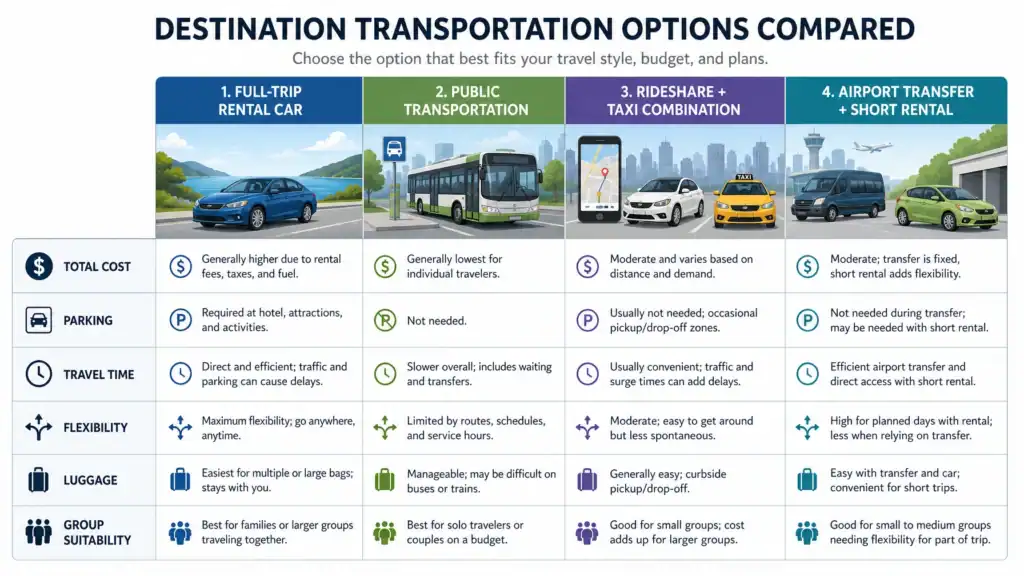
Comparison of rental cars, public transit, rideshare, taxis, and airport transfers

Use Public Transportation When It Fits the Itinerary

“Public transportation” covers a lot of ground: airport trains, metro and subway systems, local buses, streetcars, commuter rail, regional trains, ferries, and public airport shuttle routes.

Where it tends to shine:

  • No parking to find or pay for
  • No fuel or toll costs
  • Predictable, published fares
  • Direct access to city centers where driving is difficult
  • No driving required in unfamiliar conditions
  • Airport connections that drop you near your lodging

Where it can fall short:

  • Limited operating hours, especially late at night
  • Reduced weekend and holiday service
  • Transfers that add time and hassle
  • Stairs at older stations
  • Crowding at peak hours
  • Luggage restrictions on some services
  • Accessibility that varies station by station
  • Weather exposure while waiting
  • Planned or unplanned service disruptions
  • Long waits in lower-frequency suburban areas
  • Routes that simply don’t reach where you’re going

Before you rely on it, verify the details through the destination’s official transportation authority—the transit agency’s own website, the airport’s ground transportation page, or the rail or ferry operator. Look up route maps, operating hours, airport connections, the fare system, pass options, accepted payment methods, transfer rules, accessibility details, elevator outage notices, current service alerts, luggage policies, holiday schedules, and the time of the last departure.

Mapping apps are good for a rough plan. They’re not the operator’s live schedule. Check both.

Compare Individual Fares With Transit Passes

A multi-day pass feels like the frugal choice. Sometimes it isn’t.

Before buying, compare:

  • How many trips you realistically expect per day
  • The single-ride fare
  • Transfer rules (does a transfer count as a new fare?)
  • Whether a daily fare cap exists
  • Multi-day pass price
  • Airport supplements, which some systems charge separately
  • Which zones are included
  • Which transportation types the pass covers
  • Activation rules—does the clock start at purchase or first use?
  • Expiration terms
  • Reduced fares for children, seniors, or riders with disabilities
  • Whether each traveler needs a separate pass
  • Whether the pass covers the specific routes you’ll use

A three-day pass looks tidy. But if you’re taking one round trip a day and walking the rest, individual fares may cost less. On the other hand, a family bouncing across the city six times a day may clear the pass price by lunch on day one.

Run the numbers with your actual itinerary and the operator’s current published fares. Don’t guess.

Compare Airport Transportation Before Arrival

Your airport transfer is often the single most expensive transportation decision of the trip, and it’s the one people plan last.

Options usually include an airport train, a public bus, a hotel shuttle, a shared van shuttle, a taxi, a rideshare, a private transfer, a rental car, a pickup from friends or family, or—in rare airport-adjacent cases—walking.

Compare them on:

  • Total cost
  • Cost per traveler
  • Operating hours at your actual arrival time
  • Advance-reservation requirements
  • Luggage capacity
  • Child-restraint requirements
  • Accessibility
  • Where pickup happens
  • Travel time
  • Number of transfers
  • Late-night availability
  • Cancellation terms
  • Expected waiting time
  • Walking distance from the final stop to your hotel door

That last item catches people. An airport train that saves money is a poor deal if the station leaves you dragging luggage six blocks uphill in the rain.

A solo traveler landing midafternoon at an airport with direct rail service will often do best on the train. A family of five landing at 11:40 p.m. with a car seat and four suitcases usually won’t.

About hotel shuttles: don’t assume anything. Some are complimentary, some are paid, some are shared with neighboring properties, and some require a phone call or an advance reservation. Confirm directly with the hotel:

  • Whether it’s free or paid
  • Which airport and which terminals it serves
  • Operating hours
  • Exact pickup instructions and curb location
  • Whether reservations are required
  • Luggage limitations
  • Accessibility
  • Whether it makes stops at other hotels first

Then plan how you’d get to the hotel if the shuttle isn’t running when you land. To smooth out the rest of the arrival, prepare for airport arrival and hotel check-in before you go.

Use Taxis and Rideshare Strategically

Taxis and rideshare services are tools, not a default. They tend to work well for:

  • Airport transfers when transit doesn’t line up
  • Late-night trips after transit has stopped
  • Short hops that transit doesn’t serve directly
  • Groups splitting a single fare
  • Trips with luggage
  • Getting back after an evening event
  • Avoiding parking at a venue where parking is a headache

Costs and limitations to keep in mind:

  • Demand-based pricing during busy periods, bad weather, and event lets-out
  • Airport pickup surcharges at many airports
  • Tolls added to the fare
  • Waiting time before your ride arrives
  • Larger-vehicle upgrades for groups
  • Needing two vehicles instead of one
  • Child-restraint requirements
  • Thin or nonexistent service in rural areas
  • App and mobile-data requirements
  • Restricted pickup zones at airports and stadiums
  • Accessible vehicle availability that varies by market and time of day

The math is entirely about trip volume. Two rideshare trips over a weekend will almost certainly cost less than renting and parking a car for a week. Four rides a day for six days can easily flip that result. Estimate your realistic number of rides—including the ones you’ll take because you’re tired—before deciding.

Check current fare estimates in the app for your actual route and time, and use the airport’s official ground transportation page for pickup instructions, since designated zones change.

A few basic precautions, without drama: confirm the vehicle description and driver information shown in the app before getting in, use designated pickup areas, share your trip details with someone when it makes sense, don’t enter a vehicle that doesn’t match your reservation, and use official taxi queues where they exist.

Consider a Private or Shared Airport Transfer

Private transfers get dismissed as a luxury. For some travelers they’re the practical choice, and occasionally the cheaper one.

They tend to work for:

  • Large families
  • Groups traveling together
  • Anyone with a lot of luggage
  • Late-night arrivals
  • Rural resorts far from any transit
  • Cruise port transfers with tight timing
  • Travelers who need accessible transportation
  • Destinations where the transit connection involves several confusing steps
  • Anyone who wants a confirmed, named pickup waiting

Compare on:

  • Price per person
  • Total group price
  • Waiting policy after landing
  • Flight-delay policy
  • Cancellation terms
  • Vehicle size and seat count
  • Actual luggage capacity
  • Child-restraint arrangements and whether they must be requested
  • Accessibility details
  • Number of stops for shared shuttles
  • Meeting location
  • How you’ll contact the driver
  • Gratuity expectations

A private van that costs more than one train ticket may cost less per person than five train tickets plus a taxi for the luggage. Run it both ways—total and per person.

Book through the airport’s official ground transportation listings, your hotel’s recommended providers, or a company you’ve researched properly. Don’t accept unsolicited offers inside the terminal.

Let Hotel Location Reduce Transportation Costs

This is where the biggest savings usually hide, and it’s the section most people skip.

A lower nightly rate can quietly generate:

  • Daily rideshare trips in both directions
  • A rental car you wouldn’t otherwise need
  • Nightly parking charges
  • Fuel
  • Tolls
  • Long transit rides that eat your day
  • More expensive airport transfers
  • An impossible midday return to the room

A central hotel may cost more per night but allow:

  • Walking to a meaningful share of your activities
  • Shorter, cheaper transit trips
  • Skipping the rental entirely
  • Easy access to food that isn’t hotel food
  • Going back to the room midday
  • Simpler airport transportation in both directions
  • Fewer paid rides overall

Compare hotel price plus transportation, not hotel price alone.

Picture a couple weighing a downtown hotel against a suburban one that’s noticeably cheaper per night. The suburban choice requires a rental car, five nights of hotel parking, and fuel. Once all of that goes on the sheet, the downtown room—where they’d walk to dinner and take one airport train each way—can easily come out ahead, and they’d spend less time in traffic.

It doesn’t always work out that way. Sometimes the suburban hotel wins by a mile, especially when your activities are outside the city anyway. The point is to actually run it.

To make that comparison easier, choose a hotel location that reduces transportation needs, review some practical hotel savings tips, and browse destination-based hotel guidance for the specific place you’re visiting.

Include Parking in the Decision

If you’re renting a car, parking is not a footnote. It’s a line item that can rival the rental itself.

Parking may include hotel self-parking, valet, attraction lots, event parking, metered street parking, public garages, airport parking if you’re driving to your departure airport, resort parking, and overnight restrictions in residential areas.

Verify before you book:

  • Daily or nightly price
  • Whether taxes are included in the quoted figure
  • Valet gratuity expectations where applicable
  • In-and-out privileges, and whether each reentry costs extra
  • Garage height clearance if you’re renting an SUV or van
  • Operating hours of the garage
  • Reentry rules after hours
  • EV charging availability and fees
  • Security procedures
  • Whether reservations are required or recommended
  • Walking distance from the garage to the hotel or attraction
  • Overnight street parking restrictions
  • Whether the vehicle must be moved for street cleaning

Get these numbers from the hotel’s own website or front desk, the attraction’s official page, the airport’s parking page, the garage operator, or the municipal parking authority. Not from a forum post from three years ago.

Estimate Fuel, Charging, and Tolls

A rough estimate beats no estimate. Work out:

  • Expected total driving distance across the trip
  • The fuel efficiency of the class you’re renting
  • Current local fuel cost at the destination
  • Charging network access if you’re renting an EV
  • How long charging will take and where it fits in your day
  • Whether the hotel charges for charging
  • Toll roads on your planned routes
  • Bridges and tunnels with separate tolls
  • Congestion or low-emission zone charges in some cities
  • The rental company’s toll program terms
  • Administrative charges attached to that program
  • Cashless toll systems that have no cash lane at all

Toll programs are convenient—you drive through and it’s handled—but they often carry a per-day or per-use administrative charge on top of the toll. On a long trip with light toll use, that convenience fee can exceed the tolls themselves. Read the rental agreement’s toll section and check the official toll agency’s website for the roads you’ll actually use, since some agencies offer visitor payment options.

Avoiding tolls entirely is sometimes worth it and sometimes not. A five-minute detour to skip a toll is fine. A forty-minute detour through stop-and-go traffic to save a modest toll usually isn’t, once you count fuel and your own time.

Combine Transportation Methods

You are not required to pick one method and marry it. Mixed plans are often the practical answer.

Some combinations that work:

  • Airport train plus walking for a compact city stay
  • Transit on city days plus a one-day rental for a rural excursion
  • Taxi after a late arrival, transit for everything after that
  • Private van transfer for a group, then walking near the hotel
  • Rental car for the first half of a trip, intercity train for the second
  • Public transit during the day, rideshare after service ends at night
  • Hotel shuttle on arrival, downtown rental pickup two days later

The easiest way to build this is to plan transportation by day, not by trip:

  • Arrival day—how do you get from the airport to your bed?
  • City sightseeing days—what covers the day-to-day movement?
  • Day-trip days—what reaches places transit doesn’t?
  • Event days—parking, late returns, crowd dispersal
  • Departure day—early morning options, rental return timing

Then look at the seams. The transitions between methods are where plans break—the rental pickup you assumed was walkable, the transit ride to the car branch that closes at 5 p.m., the shuttle that runs hourly. Price and time each handoff, not just each method.

For intercity legs, comparing a flight against a train sometimes changes the whole structure of a trip. If you’re weighing that, understanding how airline pricing works helps you see when a short flight is genuinely competitive with ground transportation once transfers and airport time are counted.

Account for Families, Groups, and Luggage

The cheapest option for one traveler is frequently the most expensive option for five.

Think through:

  • How many fares you’re actually buying
  • How many vehicles a group requires
  • Child restraints—how many, what type, who supplies them
  • A stroller
  • A wheelchair or other mobility equipment
  • Number and size of suitcases
  • Sports or hobby equipment
  • Whether you’ll return to the hotel midday
  • Group members arriving on different flights
  • Group members with different activity plans
  • The likelihood that the group splits up during the day

Concrete comparisons that come up constantly:

  • Five train fares each way versus one van transfer
  • One rental vehicle versus two rideshare vehicles for every trip
  • A transit route with three flights of stairs and four suitcases
  • A midsize car that seats five but cannot hold five people’s luggage plus a stroller plus two car seats

That last one deserves emphasis. Seat count is not luggage capacity. A family that books a midsize sedan because it seats five may find themselves at the counter paying for an upgrade they didn’t budget for. Check the vehicle’s stated luggage capacity, and when in doubt, size up before you travel rather than at the counter.

For broader logistics, our family travel planning tips cover how transportation interacts with nap schedules, meal timing, and everything else that shapes a family trip.

On child restraints: review the NHTSA car-seat and booster-seat guidance for general information about seat types and proper installation. Requirements differ by jurisdiction, and rules for taxis, rideshare vehicles, and shuttles vary as well. Confirm the applicable law at your destination and ask each provider directly what they require and what they can supply. If a rental company offers seats, availability isn’t guaranteed—reserve early and have a plan if the seat isn’t there.

Confirm Accessibility Before Relying on a Transportation Option

If any part of your group has mobility, vision, hearing, or stamina considerations, verify the specifics rather than trusting a symbol on a map.

Research:

  • Step-free routes from entrance to platform to exit
  • Elevator locations
  • Current elevator outages
  • Which stations are designated accessible
  • Wheelchair spaces on vehicles
  • Boarding assistance procedures and whether advance notice is needed
  • Accessible taxi or rideshare availability in that market
  • Accessible rental vehicles
  • Hand-control availability
  • Shuttle accessibility, including lift-equipped vans
  • Mobility-equipment storage on transfers
  • Walking distance at each end
  • Sidewalk and curb conditions
  • Service-animal policies
  • Advance-notice requirements and deadlines

Contact the transit authority, the airport, the hotel, the rental provider, the shuttle company, the transfer operator, and the attraction. Yes, that’s a lot of phone calls. It’s less trouble than discovering the problem at 11 p.m. with your luggage on the curb.

Here’s the trap worth naming: an accessibility symbol describes a station, not a journey. A station can be fully step-free while the eight-minute walk from that station to your hotel involves broken sidewalks and a steep grade. The route has to work end to end.

No article can promise availability. Confirm essential arrangements directly with each provider, get confirmation numbers, and build a backup—a phone number for an accessible taxi service, or a transfer company that can be booked on short notice.

Plan Around Arrival and Departure Times

Every dollar you save disappears if the service isn’t running when you need it.

Verify:

  • The last airport train of the night
  • The first train of the morning
  • Hotel shuttle operating hours
  • Rental counter hours at your specific branch
  • Weekend transit schedules, which often differ substantially
  • Holiday schedules
  • Ferry departure times
  • Private transfer waiting limits after a delayed flight
  • Taxi availability at your arrival hour
  • Rideshare availability in that area at that hour
  • Time needed to return a rental and reach the terminal
  • Airport parking shuttle frequency early in the morning

Say your flight lands at 11:50 p.m. If the airport train’s last departure is well before that—and many systems stop earlier than travelers expect—your entire hotel comparison changes. That “cheaper” hotel twenty minutes out of town now requires a late-night taxi, and the total shifts.

Same thing on the way out. A 6:15 a.m. departure may fall before the first train, before the shuttle starts, and before the rental counter opens. Confirm both directions.

Our guide to packing and travel timing tips helps you build realistic buffers into these transitions.

Prepare for Transportation Disruptions

Things go sideways. Flight delays, cancellations, missed connections, transit service disruptions, road closures, weather, rental vehicles unavailable at pickup, counters already closed, shuttle delays, heavy traffic, canceled ferries, patchy mobile service, and dead phone batteries all happen to ordinary travelers on ordinary trips.

Keep these accessible without an internet connection:

  • Hotel phone number
  • Rental location phone number
  • Transit authority contact and service alert page
  • At least one alternative airport transportation option
  • Offline maps of your destination
  • Confirmation numbers for every reservation
  • Chargers and a power bank
  • More than one payment method
  • Cancellation terms
  • A backup route to your lodging

On the airline side, two official resources are worth bookmarking. The Department of Transportation airline cancellation and delay dashboard shows commitments that participating U.S. airlines have made for certain controllable delays and cancellations. Separately, Department of Transportation airline refund guidance explains refund rights, which are a different question from optional amenities an airline may offer.

Some important clarifications:

  • Airline commitments vary from carrier to carrier.
  • The cause of the disruption often determines what applies.
  • Your hotel, rental car, shuttle, parking, and activity reservations follow their own separate cancellation terms.
  • Airline rules do not automatically reimburse missed ground transportation, prepaid transfers, or a rental you couldn’t pick up.
  • You’ll need to contact each affected provider individually, and the sooner the better.

That last point is the practical one. If your flight slips four hours, call the transfer company and the rental branch while you’re still sitting at the gate. Our guide to last-minute travel savings and backup strategies covers how to regroup when plans change on short notice.

Transportation Comparison Table

Transportation optionTotal costs to includeBest suited forLimitations to check
Full-trip rental carBase rate, taxes, airport and facility charges, parking every night, attraction parking, fuel or charging, tolls, toll-program fees, additional driver, child seatsRural regions, national park areas, multi-stop road trips, larger groups, gear-heavy travelHotel parking costs, driving comfort, garage height, counter hours, days the car sits unused
Short-term rental carSame as above, but only for the days rented, plus transportation to the pickup branchTrips with one or two excursion days from a walkable baseBranch hours, weekend closures, inventory limits, downtown pickup logistics
Public transportationIndividual fares or pass, airport supplements, occasional taxi to fill gapsDense cities with connected attractions, solo travelers and couples, budget-focused tripsOperating hours, transfers, stairs, luggage policies, accessibility by station, service alerts
Airport train or busFare, any airport supplement, transfers, walk from the final stopSolo travelers and couples with manageable luggage arriving during service hoursLast departure of the night, first departure of the morning, distance to your hotel door
Hotel shuttleFare if it isn’t complimentary, gratuity where customaryAirport-area hotels, travelers with flexible arrival timingWhether it’s actually free, operating hours, reservation requirements, shared stops, luggage and accessibility limits
Shared airport shuttlePer-person fare both directions, luggage charges on some services, tipsSolo travelers and small groups without transit accessMultiple stops, wait for the van to fill, longer total travel time, advance booking
TaxiMetered fare, airport surcharge, tolls, tipLate arrivals, short trips, luggage-heavy trips, travelers not using appsFares vary by traffic and route, availability in rural areas, accessible vehicle availability
RideshareFare, demand-based pricing, airport pickup fee, tolls, tip, larger-vehicle upgradesFilling gaps in transit, evening returns, splitting among a few peopleApp and data requirements, restricted pickup zones, multiple vehicles for groups, child seats
Private transferTotal vehicle price, gratuity, waiting chargesGroups, families, late arrivals, rural resorts, cruise ports, accessible transportation needsFlight-delay and waiting policy, cancellation terms, luggage capacity, meeting point
WalkingFree, plus appropriate footwear and weather gearCompact city centers, central lodging, short distancesWeather, hills, sidewalk conditions, distance limits, luggage, nighttime lighting
Bicycle or bike-shareRental or membership, per-minute charges, helmet, docking rulesFlat cities with bike infrastructure, short hops, good weatherWeather, traffic, helmet laws, dock availability, not practical with luggage or small children
Mixed transportation planEvery method used, plus each transition between themMost multi-part trips combining a city stay with excursionsHandoff timing, branch hours, luggage storage between segments, added complexity
Travel transportation checklist for rental cars, transit, airport transfers, parking, and tolls

Common Transportation Planning Mistakes

Comparing only the rental-car daily rate

The daily rate is the smallest part of the story. Taxes, airport concession charges, facility fees, parking, fuel, tolls, toll-program administrative charges, and optional add-ons all attach to that number. Two rentals with the same headline rate can finish far apart. Always compare the all-in total for your exact dates, and then add the parking you’ll pay at your hotel every night.

Choosing a cheaper hotel without adding transportation

A hotel that saves you money per night can cost more per day once you’re paying for rides, parking, or a rental you’d otherwise skip. Location changes your daily transportation spending more than almost any other decision. Add the transportation column before you compare room rates.

Assuming public transportation operates all night

Most systems reduce or stop service overnight, and weekend and holiday schedules often differ from weekdays. A late arrival or a predawn departure can put you outside the service window entirely. Check the last departure and the first departure on the operator’s own site, for your actual travel dates.

Renting a car for the entire trip when it’s needed for two days

If four of your six days are spent in a walkable area, you may be paying for four days of rental plus four nights of parking to have a vehicle sit still. A two-day rental—or a downtown pickup after the city portion—can cost meaningfully less. Price both structures.

Assuming a hotel shuttle is free

Some are complimentary. Some are paid. Some require an advance reservation, run only on a fixed schedule, serve only certain terminals, or are shared with several nearby properties. Confirm price, hours, reservation requirements, and pickup instructions with the hotel directly before you build your arrival around it.

Using rideshare for every trip without estimating the total

Individual fares feel small. Twenty of them don’t. Count your realistic daily rides across the full trip, factor in higher pricing during peak periods and bad weather, and compare that total against a rental with parking or a transit pass. Sometimes rideshare wins easily. Sometimes it’s the most expensive plan on the table.

Ignoring luggage and vehicle capacity

A vehicle that seats your group may not hold your group’s luggage. Add strollers, car seats, and any equipment, then check the vehicle’s stated luggage capacity. It’s cheaper to book the right size in advance than to upgrade at the counter with a tired family behind you.

Forgetting parking at the hotel

Nightly parking can rival the daily rental rate in some city centers, and valet may be the only option at certain properties. Confirm the price on the hotel’s own site or by phone, ask about in-and-out privileges, and add the full stay’s parking to your rental total before deciding.

Ignoring toll-program charges

Rental toll transponder programs are convenient, but they frequently carry a per-day or per-use administrative charge separate from the tolls. On some itineraries that fee exceeds the tolls. Read the toll section of your rental agreement and check the official toll agency’s site for visitor payment options on the roads you’ll use.

Choosing transit without reviewing transfers and accessibility

A route that looks efficient on a map may involve two transfers, a long platform change, and stairs. With luggage, a stroller, or limited mobility, that changes everything. Review the actual station layouts, elevator status, and transfer points before you commit to a transit-based plan.

Using an off-airport rental without planning how to reach it

A lower rate at a neighborhood branch is only a savings if you account for the ride there. Include the cost both directions where relevant, the branch’s operating hours, and what happens if your flight arrives after it closes.

Planning only the arrival transfer

People research the airport-to-hotel trip carefully and then improvise the return. Departure day usually has tighter timing, earlier hours, and less service available. Confirm your return transportation with the same care, and check whether it runs at the hour you’ll actually need it.

A Simple Transportation Planning Process

  1. Mark the airport, your hotel, and every planned activity on a map.
  2. Identify which days actually require transportation and which don’t.
  3. Compare hotel location and transportation costs together, as one decision.
  4. List every realistic transportation option for your destination.
  5. Calculate the complete trip cost of each option, not the advertised rate.
  6. Include parking, fuel or charging, tolls, transfers, and airport charges.
  7. Check operating hours against your real arrival and departure times.
  8. Factor in group size, luggage, child restraints, and accessibility needs.
  9. Compare a full-trip rental against a short rental for only the days you need it.
  10. Consider combining several transportation methods across different days.
  11. Review cancellation and payment terms for everything you reserve.
  12. Confirm essential services directly with the provider, especially shuttles and accessible arrangements.
  13. Save route maps, addresses, and contact numbers offline on your phone.
  14. Create a backup plan for both arrival and departure.
  15. Recheck schedules and service alerts a day or two before you travel.

To tie the pieces together, coordinate your airport, hotel, and rental-car arrangements as a single timeline, and browse more practical travel-planning guides when you’re ready to work on the rest of the trip. If you haven’t locked in the big pieces yet, our guide to what to reserve early when planning a trip explains which transportation decisions benefit from booking ahead.

Transportation Savings Checklist

  • ✅ Airport, hotel, and activities are marked on a map
  • ✅ Hotel location has been compared with transportation costs
  • ✅ Airport transfer is planned in both directions
  • ✅ Arrival and departure operating hours are checked
  • ✅ Public transportation routes and schedules are verified with the official operator
  • ✅ Transit pass has been compared with individual fares
  • ✅ Full-trip rental has been compared with a short rental
  • ✅ Rental total includes taxes and required charges
  • ✅ Airport and off-airport rental options are compared
  • ✅ Cost of reaching an off-airport branch is included
  • ✅ Rental vehicle fits travelers, luggage, and equipment
  • ✅ Parking costs are included for every night and every attraction
  • ✅ Fuel or charging costs are estimated
  • ✅ Tolls and toll-program charges are reviewed
  • ✅ Additional-driver and one-way terms are reviewed
  • ✅ Taxi and rideshare estimates reflect the expected number of trips
  • ✅ Shuttle cost and reservation requirements are confirmed
  • ✅ Group price is compared with per-person fares
  • ✅ Child-restraint arrangements are researched and confirmed
  • ✅ Accessibility is confirmed for each part of the route
  • ✅ Late-night and early-morning alternatives are identified
  • ✅ Return transportation to the airport is confirmed
  • ✅ Cancellation terms are saved
  • ✅ Addresses and contact information are available offline
  • ✅ Backup transportation is identified
  • ✅ Schedules and service alerts will be rechecked before travel

Frequently Asked Questions About Transportation Savings

What is the cheapest way to get around while traveling?

There isn’t one answer that holds everywhere. It depends on how spread out your destination is, where you’re staying, how many people are traveling, how much luggage you have, and when you arrive. Walking and public transportation are often least expensive in dense cities with good networks. A rental car frequently wins in rural regions where attractions sit far apart. The reliable method is to price two or three complete plans—airport to hotel, around town all week, and back to the airport—and compare the totals.

Is it cheaper to rent a car or use public transportation?

Compare the full rental total, including taxes, airport charges, nightly parking, fuel, and tolls, against your expected transit fares or pass price for the same days. In a city center with connected attractions and expensive parking, transit usually costs less. In a region where sights are twenty miles apart with limited bus service, the rental often costs less and saves hours. Many trips land in between, which is why renting for only part of the trip works well.

Is it cheaper to rent a car or use rideshare?

It comes down to how many trips you’ll take and how long each one is. Two or three rides over a weekend generally cost less than a week’s rental plus parking. Four or five rides every day for a week usually costs more, especially with peak-period pricing and airport surcharges. Estimate a realistic daily ride count, check current fare estimates for your actual routes, and compare that against the all-in rental total including parking at your hotel.

Should I rent a car at the airport?

Airport locations offer longer hours, larger inventory, easier luggage handling, and better accommodation for delayed flights. They also carry concession and facility charges that off-airport branches often avoid. If you’re landing late, traveling with a family, or need a specific vehicle class, airport convenience frequently justifies the extra cost. If your schedule is flexible and a neighborhood branch is genuinely easy to reach, compare both totals before assuming the airport is the default.

Are off-airport rental cars cheaper?

The base rate often is. Whether the trip is cheaper depends on what it costs and takes to get there. Add the ride to the branch—and back, if you’re returning there—plus any time lost. Check the branch’s operating hours carefully, since many close earlier than airport counters and some close entirely on weekends or holidays. Off-airport locations also typically don’t track delayed flights, so a late arrival can leave you without a car.

How can I save money on airport transportation?

Look at every option before you land: airport train, public bus, hotel shuttle, shared van, taxi, rideshare, private transfer, and rental car. Compare total cost and cost per traveler, since the ranking often flips between one person and five. Check operating hours for your actual arrival time. Verify the walk from your final stop to the hotel door. And plan the return trip at the same time—departure day usually has fewer options at earlier hours.

Is a hotel shuttle always free?

No. Some hotel shuttles are complimentary, some charge a per-person fare, and terms vary widely by property. Many also require an advance reservation or a phone call after you land, run only during set hours, serve specific terminals, or share the route with neighboring hotels. Confirm the price, hours, pickup location, reservation requirements, luggage limits, and accessibility directly with the hotel before you rely on it, and know what you’d do if it isn’t running.

Is a transit pass worth buying?

Sometimes. Compare the pass price against the single fares for the trips you realistically expect. Check whether the system has a daily fare cap that gives you pass-like pricing automatically, whether transfers count as new fares, whether the airport connection carries a supplement, and which zones and modes the pass covers. A traveler making one round trip per day may spend less on individual fares. A family riding six times a day will usually clear the pass price quickly.

How do I know whether I need a rental car?

Map your activities first. If most of them cluster in one area connected by transit or short walks, you probably don’t need a car for the whole trip. If you’ve planned day trips into rural areas, national park regions, or small towns with limited service, a car becomes hard to replace. Also weigh your own comfort driving in unfamiliar conditions, your hotel’s parking situation, and whether the car would sit unused for several days.

Can I rent a car for only part of my trip?

Yes, and it’s often the smarter structure. Many travelers spend their city days without a car, then pick one up from a downtown or neighborhood branch for two days of excursions. Check the branch’s operating hours, confirm it has the vehicle class you need, factor in how you’ll reach it, and compare the total against a full-trip airport rental. Sometimes the shorter rental plus a transfer costs less than the longer one plus parking.

How do I estimate parking costs before a trip?

Go to the source. Check the hotel’s own website or call the front desk for the nightly self-parking and valet rates, and ask whether taxes are included and whether in-and-out privileges apply. For attractions and events, check their official pages. For street parking and overnight restrictions, check the municipal or parking-authority website. Multiply the nightly figure by your number of nights and add it to the rental total before comparing options.

How do rental-car toll programs work?

Arrangements differ by company, location, and vehicle, so the details you need are in your specific rental agreement rather than in general advice. Broadly, these programs let you use electronic toll lanes and bill you afterward, often with an administrative charge in addition to the tolls. Read the toll section of your agreement before you drive off, and check the official toll agency’s website for the roads on your route—many offer visitor payment options that may cost less depending on how much you’ll drive.

What transportation is best for a family?

It depends on luggage, restraints, schedule, and how fares scale. Five individual transit fares each way add up differently than one vehicle. Car seats create real constraints for taxis and rideshare, and requirements vary by location and provider. Families also tend to return to the hotel midday, which increases trip counts. Compare a rental with parking, a private or shared transfer plus transit, and a rideshare-heavy plan using your actual daily movement.

How should I plan transportation for a late-night arrival?

Check whether the airport train, public bus, or hotel shuttle is still operating at your scheduled landing time—then check again for an hour or two later, since delays happen. If service ends before you’d arrive, price a taxi, rideshare, or prebooked transfer as your primary plan rather than your emergency plan. Have the hotel’s phone number saved, know the official pickup area for your chosen service, and keep a second payment method available.

How do I compare a central hotel with a cheaper suburban hotel?

Build two columns. Under each hotel, list the nightly rate times the number of nights, then add airport transportation both directions, daily transportation to your activities, parking if a car is involved, fuel, and tolls. Include travel time as a separate line, even if you don’t assign it a dollar value. Then compare the bottom of each column. The central hotel sometimes wins outright; other times the suburban option is clearly better, especially if your activities are outside the city.

What should I do if my flight delay affects my ground transportation?

Contact each provider separately and as early as you can—ideally from the gate. Airline commitments and refund rules apply to the flight, not to your rental car, transfer, shuttle, hotel, or parking reservation, and each of those follows its own cancellation and no-show terms. Some rental branches close before late arrivals and some transfer companies have limited waiting policies. Keep confirmation numbers and phone numbers accessible offline, and know your backup route to the hotel.

Conclusion

Transportation savings almost never come from finding one cheap fare. They come from seeing the whole picture at once—the airport transfer in both directions, where your hotel actually sits, the full rental total rather than the daily rate, parking, fuel, tolls, transit fares, the rides you’ll take when transit stops running, how many people are splitting the cost, how long each option takes, whether it’s even operating at your arrival hour, whether it works for every traveler in your group, and what you’ll do if something goes wrong.

The goal isn’t to pick the option with the lowest advertised price. Plenty of travelers have done that and paid more.

The better choice is the one that gets you to the places you’re actually going, runs at the times you need it, fits your travelers and your luggage, works with where you’re staying, fits your budget, and doesn’t make the trip harder than it needs to be.

For some trips that’s a rental car. For others it’s a transit pass and comfortable shoes. Often it’s a mix—a train from the airport, walking for three days, and a rented car for the one excursion that transit can’t reach.

What matters is knowing the full cost before you leave, rather than discovering it one parking charge and one airport transfer at a time.

Continue Planning Your Trip

How to Choose the Right Travel Destination

Work through budget, timing, weather, interests, and how easy a place is to get around before you commit to it.

How to Compare Travel Prices

A practical method for comparing the complete cost of flights, lodging, rental cars, parking, and local transportation instead of individual line items.

What to Reserve Early When Planning a Trip

Which transportation arrangements and other reservations genuinely benefit from booking ahead, and which can wait.

Airport, Hotel, and Rental Car Preparation

How to line up arrival timing, rental pickup, hotel check-in, parking, and backup plans so the pieces don’t collide.

Family Travel Planning Tips

Transportation with children, including car seats, luggage, realistic schedules, and family budgets.

Packing and Travel Timing Tips

Organizing luggage, airport timing, hotel checkout, and rental-car returns without last-minute scrambling.

Last-Minute Travel Savings

Handling short-notice transportation, changed plans, and disruptions without overspending.

Travel Tips Hub

Browse the full SavingsScoutTravel planning collection in one place.

You can also compare related savings guidance across the network: cheap flight strategies for the air portion of your trip, the best time to book hotels for lodging timing, and destination-based flight guidance when you’re still deciding where to go.

Keep Planning Your Trip

Browse the complete SavingsScoutTravel planning collection or explore destination ideas before choosing how you will get around.