

Last-Minute Travel Savings Tips for Short-Notice Trips
Rebuild flights, hotels, rental cars, transportation, and backup plans without paying for parts that no longer fit.
It’s Thursday afternoon. Your flight to your cousin’s Saturday wedding just got canceled, the airline app is offering a replacement that lands two hours after the ceremony starts, and the hotel you booked three months ago now shows a rate you wouldn’t have agreed to. You have nine browser tabs open and every one of them creates another decision. Real last-minute travel savings don’t come from finding the single lowest new price in that mess. They come from rebuilding a trip that still works—and refusing to pay for the parts that no longer fit.
Short-notice travel can be cheaper than planning ahead. It can also be considerably more expensive, or roughly the same, or cheap in one category and painful in another. Airfare might drop while hotels near a convention triple. There is no rule that rewards you for waiting.
Protect the Reason for the Trip First
So start with one principle: protect the reason for the trip first, then rebuild everything else around that fixed commitment.
Before you search anything, answer five questions:
- What genuinely cannot change?
- What can change?
- What money may already be recoverable?
- Which replacement piece will be hardest to find?
- Is the trip still worth taking at the new total cost?

Decide Whether This Is a Flexible Trip or a Fixed Trip
These two situations look similar in a search box and behave nothing alike.
Flexible last-minute trip
You have a free weekend, unexpected time off, or a vague urge to go somewhere. You may be able to change the destination, dates, departure airport, trip length, hotel type, neighborhood, transportation, and activities. Search broadly. Let price and availability suggest the answer.
Fixed last-minute trip
You need to reach a specific city by a specific hour—a funeral, a wedding, a cruise departure, a medical appointment, a work obligation, a tour with a permit that can’t be moved. Here, broad searching wastes time. Your job is to protect the nonnegotiable commitment and reduce spending everywhere else.
Ask This Before Searching
What is the one part of this trip that cannot move?
Every later decision gets measured against that answer.
If you’re the flexible type, it helps to choose a destination that fits your available time and budget before you start comparing fares. And if you have a few minutes to spare, you can browse the complete travel-planning library for the pieces you’ll need next.
Write Down the Fixed and Flexible Parts
Do this on paper or in a notes app. It takes four minutes and prevents an hour of circular searching.
Fixed
Fixed may include: the event date, required arrival time, destination, number of travelers, passport status, required return date, accessibility needs, existing nonrefundable reservations, school or work schedules, medication or medical-equipment needs.
Flexible
Flexible may include: departure time, a nearby airport, trip length, hotel neighborhood, room type, rental-car duration, public transportation, optional activities, one night before or after the event, or driving part of the route.
If you can move even one significant detail, your options widen. A Saturday afternoon ceremony is fixed—but flying Friday morning instead of Friday evening, or returning Monday instead of Sunday, may open itineraries that weren’t there before. That doesn’t mean shifting dates always lowers the price. Sometimes it costs more and simply works better. Both outcomes are worth knowing.
Check What You Already Own Before Buying Again
This is the step rushed travelers skip, and it’s usually where the money is.
Before you pay for anything new, review:
- Your original airline ticket and any airline-provided replacement
- Refund eligibility versus credit or voucher
- Rebooking options offered by the carrier
- Hotel cancellation terms
- Rental-car cancellation terms
- Airport transfer, parking, tour, and event ticket terms
- Credit-card benefits and any travel-insurance policy you hold
- Loyalty points, certificates, or existing flexible reservations
Do not tap “accept” on the first credit the app displays. A credit and a refund are not the same thing, and once you take one, your options may narrow. Before accepting, find out whether a refund may be available, when the credit expires, whether it’s transferable, whether it’s restricted by route or name, whether blackout dates apply, who actually issued it, and whether your ticket was purchased directly or through a third-party seller.
For federal rules on when refunds are owed, read the Department of Transportation airline refund guidance directly and check it against your specific reservation. Refund rights and voluntary airline accommodations are separate issues, and guidance changes—verify the current version rather than relying on what someone told you last year.
One more thing: airline rules do not automatically extend to hotels, rental cars, parking reservations, tours, vacation rentals, private transfers, or event tickets. Each of those follows its own contract. And nothing here is individualized legal or insurance advice; your policy documents and provider terms control.
Recalculate the Complete Trip Cost
A cheap replacement flight can produce an expensive replacement trip.
Add up everything: new airfare, baggage, seat fees, hotel rate, mandatory property fees, parking, rental car, fuel, tolls, airport transfers, meals during a longer travel day, an overnight connection, prepaid reservations you’ll lose, new activity costs, cancellation charges, a changed trip length, and transportation from an alternate airport.
Then compare five numbers:
- What the original trip cost you
- What is recoverable
- What the replacement costs
- Your new total out-of-pocket amount
- What it costs to simply cancel the trip
It helps to compare the complete cost of the replacement trip side by side rather than judging one line item at a time. The cheapest component rarely produces the cheapest trip.
Look at Last-Minute Flights Without Chasing a Magic Fare
Short-notice airfare moves in both directions. Some routes soften; others climb as seats thin out. Treat every fare as information, not as a verdict.
Compare:
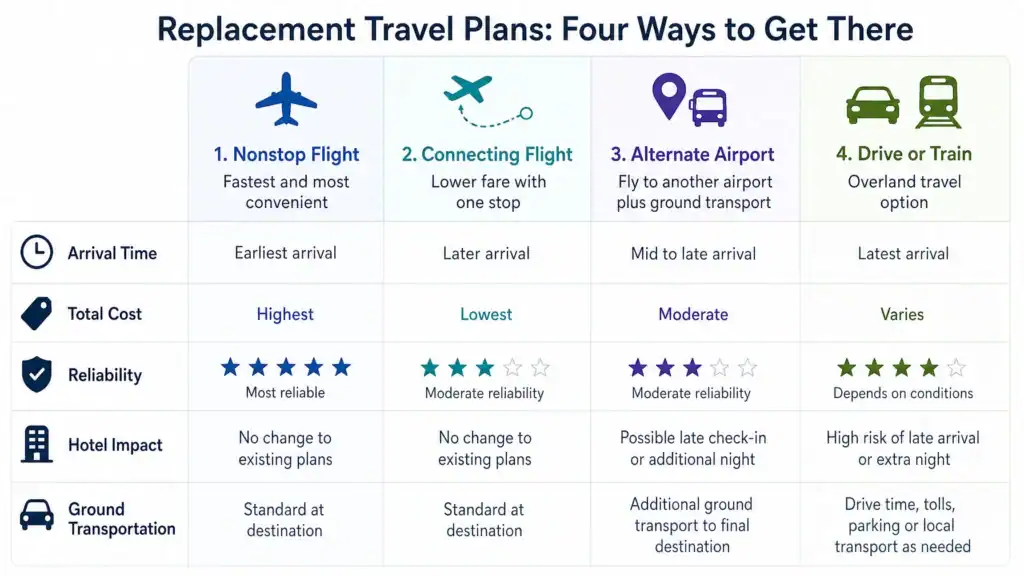
- Nonstop versus connecting options
- Nearby departure and arrival airports
- Early morning versus late evening departures
- One-way tickets, including two one-ways from different carriers
- Different return dates
- Driving to a larger hub airport
- Train or driving alternatives
- Total door-to-door time, not just flight time
- Arrival time relative to your fixed commitment
- Baggage and seat costs
- Change and cancellation terms
- The operating airline (not just the one that sold the ticket)
- How you’ll get from the airport to where you’re sleeping
A useful example: a flight that saves you money but lands at midnight may require a taxi instead of transit, an extra hotel night, or a rental counter that closed hours earlier. That “cheaper” ticket can quietly cost more than the nonstop.
If you want the mechanics behind why fares behave the way they do, it’s worth taking a few minutes to understand how airline prices change and to compare practical cheap-flight strategies. Flexible travelers with no fixed destination can also browse flight destination guidance for ideas that match the airports they can actually reach.
One caution: skip hidden-city or throwaway ticketing. It may violate carrier rules and can create problems you don’t want during a disruption.
Compare Nearby Airports Carefully
An alternate airport may give you more flights, better arrival times, a nonstop route, more rental inventory, or simply a workable itinerary when your home airport has none.
It may also add a long drive, parking, fuel, tolls, train fare, a one-way rental fee, a taxi ride, an extra hotel night, awkward return transportation, and hours of travel time.
Use a simple framework:
Calculate the Real Airport Change
Fare difference + transportation to or from the alternate airport + parking, fuel, tolls, or lodging + added travel time = the real comparison.
That last term matters. Two hours of extra driving after a canceled flight is not free, even if no one charges you for it. To size up the ground piece properly, compare airport and destination transportation costs before you commit. Saving money on a ticket does not necessarily save money on a trip.
Understand the Airline’s Current Booking and Cancellation Terms
Before you pay, read the fare rules for the specific ticket in front of you. Check refundability, travel-credit terms, change fees, fare differences, same-day change options, standby rules, baggage, seat assignments, the operating airline, the missed-flight policy, restrictions that apply to third-party bookings, and the deadline for using any cancellation option that exists.
Two official references worth reading directly: the Department of Transportation guidance on buying an airline ticket and the Department of Transportation 24-hour reservation guidance.
The 24-hour provision gets flattened into “you can always cancel free within a day,” and that’s not accurate. Verify the current rule and its conditions before relying on it, because:
- It has eligibility conditions.
- It may depend on how far in advance of departure the reservation was made—which matters enormously for same-week travel booking.
- It does not necessarily apply when you buy through a third-party seller.
- Holding a reservation without payment and canceling a purchased ticket are different compliance options, and airlines may choose between them.
- Individual airlines may offer more flexibility than the minimum rule requires.
Read the terms on the page where you’re actually paying.
Check Airline Disruption Commitments Separately From Refund Rights
At the gate, travelers tend to blend several unrelated questions into one: Will they rebook me? Will they feed me? Will they cover a hotel? Can I get my money back? Can I decide not to travel at all? Will a different airline accept my ticket? And what happens to the hotel and rental car I already paid for?
Those have different answers. Check the Department of Transportation airline cancellation and delay dashboard for what individual carriers have committed to, and the Department of Transportation airline refund guidance for refund questions.
Keep these distinctions in mind:
- Commitments differ from airline to airline.
- The cause of the disruption may change the outcome, and controllable events are often treated differently from uncontrollable ones.
- A refund is not the same as meals, lodging, or ground transportation.
- The dashboard reflects each airline’s own commitments and should be checked on the day you need it.
- Your hotel, rental car, transfer, and event tickets are governed entirely by their own terms.
Once you know what the airline will and won’t do, you can coordinate replacement airport, hotel, and rental-car arrangements around the itinerary you actually end up with.
Use a Structured Flight-Rebooking Process
When you’re tired, a sequence beats improvisation.
- Confirm the flight’s current status with the operating airline.
- Review the replacement the airline has already offered.
- Write down the latest arrival time that still works.
- Search the same route at different times of day.
- Check nearby airports.
- Compare one-way options.
- Compare driving or rail if it’s realistic.
- Calculate the complete replacement cost.
- Review refund, credit, and cancellation terms before paying.
- Protect the hotel, rental car, and ground transportation.
- Save the new confirmation offline.
- Cancel duplicates you no longer need.
Avoid holding several overlapping nonrefundable reservations unless you fully understand what each one costs and when you can still cancel it.
Search for Last-Minute Lodging by Area, Not Just Property
Short-notice hotel availability varies wildly by neighborhood. A city can look sold out while a transit-connected district two miles away has rooms.
Compare the area around your event, the central business district, airport hotels, transit-connected neighborhoods, nearby towns, suburbs, properties near an alternate airport, and hotels near a train station. Also consider a different room type, a shorter or longer stay, or splitting the stay between two properties if that’s practical.
Then check the details that decide the real price: total stay cost, required property fees, parking, breakfast, cancellation terms, prepayment, check-in time, late-arrival procedure, occupancy limits, bed configuration, distance from the reason you’re traveling, and daily transportation cost.
That last cluster matters more than people expect. A family needing one room that sleeps five doesn’t benefit from a long list of rooms that sleep two. And a hotel twenty minutes out may lose its advantage after two late-night rides and a parking charge.
Worth reading before you book: how to understand the complete hotel price, how to choose a practical hotel location, a set of practical hotel savings tips, and destination-based hotel guidance if you’re still deciding where to stay.
Contact the Hotel When the Arrival Time Changes
A delay or a rebuilt itinerary can affect check-in, late-arrival handling, no-show status, airport shuttle service, luggage storage, parking, room availability, required payment, and whether your reservation is treated as guaranteed.
So call the property itself—not a general reservations line if you can avoid it. Give them your new expected arrival time, ask that the reservation be noted, confirm front-desk or after-hours procedures, ask whether the airport shuttle still runs that late, keep the direct phone number in your phone, and save any written confirmation you receive.
This won’t guarantee the room is held. The property’s own reservation terms control that. But a noted late arrival is far better than silence, and it takes three minutes at the gate.
Compare Last-Minute Rental Cars by Location and Vehicle Class
Availability on short notice can differ sharply between airport counters, consolidated rental centers, off-airport branches, downtown offices, neighborhood locations, nearby airports, and train stations.
Compare total price, taxes and fees, operating hours, pickup location, the cost of reaching that location, vehicle class, luggage capacity, child-restraint needs, deposit or authorization holds, payment requirements, one-way charges, fuel policy, toll program, parking at your destination, cancellation terms, and the return location.
Operating hours deserve special attention during disruptions. Booking a cheaper off-airport branch that closes at 6 p.m. is a problem when your replacement flight lands at 10:40.
For the mechanics, see how to understand rental-car pricing, review practical car rental savings tips, compare airport rental-car strategies, or check destination-based rental-car guidance. The Federal Trade Commission guidance for renting a car is a good plain-language overview of charges and add-ons. Coverage questions depend on your own policies and cards, so ask your insurer or card issuer rather than guessing at the counter.
Consider Whether You Still Need a Rental Car
A shortened or rerouted trip often changes the transportation math entirely.
Alternatives worth pricing: an airport train, a taxi, rideshare, a hotel shuttle, local public transportation, a private transfer, a shorter rental period, a rental for one day only, walking from a central hotel, a train between cities, or driving the whole way from home.
A four-day rental made sense for the original itinerary. After a cancellation trims the trip to two nights in a walkable, transit-connected neighborhood, it may be pure cost. Group travelers sometimes find the reverse: one private transfer for six people can beat several separate rides.
Run the numbers both ways and compare rental cars, transit, shuttles, and rideshare before defaulting to what you originally booked.
Reduce the Trip Before Replacing Every Part
The instinct is to rebuild the original itinerary exactly. That’s usually the most expensive path available.
Consider instead:
- Shortening the trip by one night
- Keeping one major activity and dropping the rest
- Cancelling low-priority reservations
- Staying in a single hotel instead of two
- Eliminating the rental car
- Choosing one neighborhood
- Replacing several day trips with local activities
- Driving instead of flying
- Substituting a nearby destination
- Moving the trip to a later date when that’s genuinely possible
A canceled four-night trip with three excursions can become a workable three-night trip built around the one thing that mattered. A couple whose weekend flight vanishes may find a manageable driving trip to a closer destination more pleasant than a scramble through two connections.
Simplifying reduces replacement costs, cancellation exposure, transportation, parking, baggage, stress, and—importantly—the number of reservations that can fail.
Compare Driving, Train, and Air Travel
Flying isn’t automatically the answer on short notice.
Compare total travel time, true door-to-door time, number of travelers, fuel, tolls, parking, any overnight hotel, train fares, seat reservations, baggage, whether you’ll need a car after arrival, weather, driver fatigue, and schedule reliability.
No universal winners here. Driving is not always cheaper for a group once lodging and fatigue enter the picture. Rail is not always more reliable. But a two-connection itinerary with a four-hour layover can consume nearly as much of your day as driving or taking a train once you count airport arrival time, security, and transfers on both ends. If you’re weighing options, it’s worth reviewing practical flight alternatives and fare strategies alongside the drive time.
Handle Last-Minute International Travel Carefully
International short-notice travel adds a whole category of risk that has nothing to do with price.
Verify passport validity, whether the passport is physically available, visa or travel-authorization requirements, entry and exit rules, transit-country rules, the destination advisory, health information, return-entry requirements, airline document rules, documentation for children, medication restrictions, and whether your phone and payment methods will work.
Start with the State Department international travel planning guidance and the State Department travel advisories.
Requirements change, and they differ by destination, nationality, route, and individual circumstances. Confirm your specific situation with official sources—the airline, the destination’s embassy or consulate, and government advisories—rather than a summary written for someone else.
Use Official Urgent Passport Services
A last-minute international ticket does not solve a missing, expired, or damaged passport. That’s a separate problem with its own timeline.
Use the State Department guidance for getting a passport quickly and the official passport agency appointment information, and verify the current eligibility windows, documentation, fees, and appointment process yourself—those details are updated periodically.
A few things to understand going in:
- Urgent service has eligibility requirements.
- Proof of imminent travel may be required.
- Passport agencies and centers require an appointment.
- Appointment availability is not guaranteed.
- Official appointment scheduling does not carry a separate fee just to hold a slot.
- Don’t pay an unofficial service for an appointment.
- No third party can guarantee that a passport will be issued by a particular date.
If the passport timeline is uncertain, factor that into whether you buy the ticket at all.
Avoid Last-Minute Travel Scams
Rushed travelers are easier targets. That’s not alarmism; it’s just how urgency works.
Watch for copycat airline websites, fake hotel and rental-car “support” numbers, vacation-rental listings that don’t exist, paid passport-appointment services, unofficial visa or travel-authorization sites, event-ticket resale scams, unsolicited transportation offers in arrivals halls, and search advertisements dressed up as official customer service. Pressure to pay by wire transfer, gift card, payment app, or cryptocurrency is a strong warning sign.
Practical habits that help:
- Type the official web address yourself rather than clicking an ad.
- Use the phone number printed on your existing confirmation.
- Check the domain character by character before entering payment details.
- Search the company name along with “scam,” “review,” or “complaint.”
- Confirm vacation-rental addresses and ownership independently.
- Never pay anyone for an official passport appointment.
- Save receipts, confirmation numbers, and screenshots.
The Federal Trade Commission guidance for avoiding travel scams and the FTC guidance for avoiding travel website scams are both worth a quick read. None of this means an unfamiliar provider is automatically fraudulent—plenty of small, legitimate operators exist. It means verify before you pay.
Protect Essential Accessibility and Family Arrangements
Some things are simply scarce on short notice: accessible hotel rooms, wheelchair assistance, accessible transfers, hand controls, accessible rental vehicles, connecting rooms, cribs, child restraints, large vehicles, in-room refrigerators for medication, service-animal arrangements, mobility-equipment handling, and group transportation.
If any of these are essential:
- Contact providers directly rather than relying on a booking field.
- Ask explicitly whether the arrangement is confirmed or only requested.
- Get it in writing and keep the documentation.
- Reconfirm before departure.
- Don’t cancel a confirmed arrangement until the replacement is secured.
- Build a backup where one exists.
For seating, restraints, and schedule questions with kids in tow, the family travel planning tips guide covers the details that get overlooked at 11 p.m. Short notice can’t guarantee availability of an essential request, which is exactly why the confirmed-versus-requested question matters.
Pack for the Replacement Plan, Not the Original Plan
A changed itinerary can change weather, trip length, baggage allowance, airline, airport, transportation, hotel amenities, whether you need formal clothes, whether outdoor activities survived, medication timing, and what belongs in your carry-on.
Recheck the operating airline’s baggage rules, your identification against TSA acceptable-identification guidance, your documents, the new weather forecast, carry-on essentials, medication, chargers, a power bank, offline confirmations, one change of clothing, hotel and rental contact details, and the exact addresses for your transportation. The TSA What Can I Bring tool settles the “can this go in my bag” arguments quickly.
The packing and travel timing tips guide is a useful second pass once the new itinerary is locked.
Create a 72-Hour Last-Minute Travel Plan
Treat this as a framework, not a set of deadlines. Compress it if you’re leaving tomorrow.
Within the first hour
- Identify the fixed commitment.
- Confirm the current status of every affected reservation.
- Review refund and rebooking options before buying.
- Protect the hotel or event reservation.
- Write down the latest acceptable arrival time.
- Resist buying several overlapping replacements.
Within 24 hours
- Compare replacement flights and alternate airports.
- Compare hotel availability and total cost.
- Confirm ground transportation in both directions.
- Check rental-car availability and counter hours.
- Verify documents.
- Confirm accessibility or family arrangements.
- Save all terms and cancellation deadlines.
Within 48 hours
- Recheck schedules.
- Confirm lodging directly with the property.
- Confirm the rental or transfer.
- Review the weather.
- Pack for the revised itinerary.
- Download confirmations and offline maps.
- Cancel duplicate reservations before their deadlines.
Final day
- Check flight status, traffic, transit, and weather.
- Confirm the terminal and operating airline.
- Reconfirm late-arrival arrangements.
- Charge devices and the power bank.
- Put documents and medication in the carry-on.
- Review the airport-to-hotel plan.
- Keep provider phone numbers where you can reach them offline.

Last-Minute Replacement Options Compared
| Replacement option | Total costs to include | When it may work | Risks or limitations |
|---|---|---|---|
| Same-airline replacement | Fare difference, baggage, seats, any hotel-night change | Disruption is the airline’s to fix; you want one point of contact | Offered arrival time may miss the event; first offer isn’t always the best available |
| Different flight, same route | New fare, seat and bag fees, lost prepaid items | A later or earlier departure still meets your deadline | Fare difference may be significant; original ticket terms may limit changes |
| Connecting flight | Fare, meals during a long day, possible overnight | Nonstops are full or priced beyond reach | More failure points; a missed connection can cost you the event |
| Alternate departure airport | Fare difference, drive time, parking, fuel, tolls, transit fare | More departures or a nonstop you can’t get at home | Return transportation is often the hard part; parking accumulates |
| Alternate arrival airport | Fare, transfer to the destination, possible one-way rental | Better schedule or more rental inventory | Late arrival plus long transfer can require an extra hotel night |
| One-way ticket | Both legs priced separately, baggage on each carrier | Outbound and return needs differ after a disruption | Two separate tickets mean no protected connection between them |
| Driving | Fuel, tolls, parking, overnight lodging, fatigue | Moderate distance, several travelers, need for a car on arrival | Weather and traffic risk; not automatically cheaper for a group |
| Train | Fares, seat reservations, station transfers, baggage limits | Well-served corridor, city-center-to-city-center trip | Not always faster or more reliable; limited routes |
| Shorter trip | Fewer hotel nights, shorter rental, dropped activities | Replacement prices are high but the event still matters | Lost prepaid nights or nonrefundable tours |
| Different hotel area | Room rate, property fees, parking, daily transportation | Event-adjacent hotels are full or expensive | Nightly transportation and late-night rides can erase savings |
| Airport hotel | Rate, fees, shuttle availability, transport to the event | Very late arrival or very early departure | May be far from the reason you traveled |
| Short rental car | Daily rate, fees, parking, branch hours | You need a vehicle for one specific day only | Branch may close before arrival; limited inventory on short notice |
| Transit or rideshare plan | Per-ride costs across the whole stay, airport transfers | Central hotel in a transit-connected city | Costs add up with a group; accessibility options may be limited |
| Postponing the trip | Cancellation charges, credit expiration, recoverable amounts | The commitment can genuinely move | Credits expire and carry restrictions; the reason for the trip may not wait |
Common Last-Minute Travel Mistakes
Buying the first replacement before checking refund options
Five minutes reviewing your original reservation can change what you need to buy—or whether you need to buy at all. Once you’ve paid for a replacement, your leverage on the original often shrinks.
Accepting a credit without understanding the terms
Credits expire, may be restricted to certain routes or travelers, and are not money back. A refund and a credit are different products. Understand which one you’re eligible for before you click.
Comparing only the replacement airfare
The airfare is one line. Hotel nights, transfers, parking, baggage, and a changed trip length are the rest of the bill.
Choosing an alternate airport without planning the transfer
An inexpensive fare into a distant airport can cost more after a one-way rental, a long taxi ride, or an unplanned hotel night. Price the ground connection in both directions.
Booking a hotel too far from the fixed commitment
Distance shows up daily. Two rides a day for three days, plus parking, plus a late-night surcharge, often exceeds the nightly difference—and adds a reliability risk on the morning that matters most.
Assuming the rental counter will remain open
Confirm the specific branch’s hours and after-hours procedure directly. Airport locations and neighborhood branches operate on different schedules.
Recreating every part of the original trip
The original itinerary was built for conditions that no longer exist. A simpler replacement usually costs less and fails less often.
Holding several nonrefundable reservations
Parallel bookings feel safe at 1 a.m. and produce duplicate charges by Friday. If you hold options, write down every cancellation deadline immediately.
Waiting to tell the hotel about a late arrival
Call the property directly with your new arrival time and ask that it be noted. It doesn’t guarantee the room, but silence helps no one.
Ignoring child-restraint or accessibility availability
Specialized inventory is limited, and “requested” is not “confirmed.” Handle these before optimizing anything about price.
Booking through an official-looking search advertisement
Copycat sites are built to look right. Type the address yourself, verify the domain, and use contact details from an existing confirmation.
Paying for a passport appointment
Use official scheduling information only. No paid intermediary can guarantee an appointment or an issuance date.
Forgetting to cancel the original rental, transfer, or parking
Changing your flight does not cancel anything else. Airport parking, private transfers, tours, and rentals each need their own cancellation.
Keeping the original packing plan after the itinerary changes
A different airline means different baggage rules. A different destination or season means different clothing. A shorter trip means less of everything.
A Simple Last-Minute Travel Savings Process
- Identify the one commitment that cannot move.
- Separate the fixed details from the flexible ones.
- Review existing reservations and recoverable money.
- Check official disruption, refund, or cancellation information.
- Set the latest acceptable arrival time.
- Compare replacement flights and alternate airports.
- Compare driving, rail, and shorter-trip options.
- Recalculate the complete trip cost.
- Protect the hotel and other anchor reservations.
- Confirm rental-car or ground-transportation availability.
- Simplify the itinerary where practical.
- Verify documents and international requirements.
- Confirm family, accessibility, and medical arrangements.
- Verify the provider and website before paying.
- Save every new confirmation offline.
- Add cancellation deadlines to your calendar.
- Cancel duplicate or unusable reservations.
- Recheck the complete plan before departure.
Once the plan holds together, use it to coordinate airport, hotel, and rental-car preparation for the revised arrival time. And when the trip is behind you, you can browse more practical travel-planning guides to make the next one easier.
Last-Minute Travel Savings Checklist
- ✅ The trip’s fixed commitment is identified
- ✅ Flexible dates, airports, and trip length are listed
- ✅ Existing reservations have been reviewed
- ✅ Refund, credit, and rebooking options are understood
- ✅ The latest acceptable arrival time is clear
- ✅ Replacement flights are compared by total cost
- ✅ Nearby airports are evaluated with ground transportation included
- ✅ Driving and rail alternatives are considered
- ✅ Hotel price includes fees, parking, and transportation
- ✅ Hotel late-arrival procedure is confirmed
- ✅ Rental-car location and operating hours are checked
- ✅ Short-rental and no-rental options are compared
- ✅ Airport transportation is confirmed in both directions
- ✅ Simplifying or shortening the trip has been considered
- ✅ Passport and entry documents are verified
- ✅ Official urgent passport information is used where applicable
- ✅ Provider websites and contact numbers are verified
- ✅ Unusual payment demands are avoided
- ✅ Accessibility and family arrangements are confirmed
- ✅ The revised packing plan matches the new itinerary
- ✅ Confirmations and terms are saved offline
- ✅ Cancellation deadlines are on the calendar
- ✅ Duplicate reservations are canceled
- ✅ Original parking, transfers, and rentals are reviewed
- ✅ Backup transportation is identified
- ✅ Final flight, weather, traffic, and transit checks are planned
Frequently Asked Questions About Last-Minute Travel Savings
Is it cheaper to book travel at the last minute?
Sometimes, and sometimes not. Short-notice pricing depends on demand, remaining inventory, the destination, the season, local events, and how flexible you can be. A quiet route in a slow week may be affordable days out. A city hosting a convention or holiday festival may be expensive in every category at once. You may also find cheap airfare paired with costly lodging, which produces a more expensive trip overall. Compare the full cost each time rather than assuming a direction.
How can I save money on a last-minute flight?
Widen the search before you narrow it. Check different departure times, nearby departure and arrival airports, one-way combinations, and different return dates. Compare total door-to-door time, not just the fare, and include baggage and seat fees. Confirm the arrival time still meets your commitment. If you’re flexible about where you’re going, let availability guide the destination. And read the change and cancellation terms before paying, since short-notice plans often change again.
Should I wait for a last-minute airfare to drop?
Waiting is a gamble, not a strategy. Prices can fall, hold steady, or rise as departure approaches, and suitable inventory—the right arrival time, enough seats together, a nonstop—can disappear while you watch. If you have a fixed commitment, the cost of losing a workable itinerary usually outweighs a possible fare reduction. If you’re genuinely flexible with no deadline, you can afford to watch a while, but decide based on what fits your trip rather than on a hoped-for drop.
Are nearby airports worth checking?
Usually worth checking, not always worth using. An alternate airport may offer more departures, a nonstop, better arrival times, or more rental inventory. But add the drive, parking, fuel, tolls, transit fare, any one-way rental charge, and the return trip. Then add travel time, which is a real cost even when nobody bills you for it. If the total still comes out ahead and the connection is reliable in both directions, it’s a good option.
Is it cheaper to drive than fly at the last minute?
It depends heavily on distance and how many people are traveling. Driving costs roughly the same whether one person or four are in the car, while airfare multiplies per traveler—so groups sometimes come out ahead. But add fuel, tolls, parking at the destination, any overnight hotel along the way, and the value of your time. For a solo traveler covering a long distance, flying often wins. Compare complete door-to-door cost and time, not fuel versus fare.
How can I find a last-minute hotel?
Search by area rather than by property. Check the neighborhood around your commitment, the central business district, airport hotels, transit-connected areas, nearby towns, and districts near an alternate airport. Compare the total stay price with mandatory fees, parking, and daily transportation included. Confirm occupancy limits and bed configuration if you’re traveling with family—one room that sleeps five is a different search than any available room. Also review cancellation terms and prepayment before you book.
Should I call the hotel directly?
Direct contact is useful for confirming things a booking page can’t. You can verify late-arrival procedures, after-hours check-in, shuttle operating times, parking, luggage storage, room configuration, and accessibility details. You can also ask that a delayed arrival be noted on your reservation. What direct contact does not reliably produce is a lower rate—sometimes it does, often it doesn’t. Call for accuracy and reassurance, and treat any price improvement as a bonus.
How do I find a last-minute rental car?
Check several pickup locations, not just the main airport counter: consolidated rental centers, off-airport branches, downtown offices, nearby airports, and train stations. Compare total charges including taxes and fees, and confirm the specific branch’s operating hours against your actual arrival time. Verify vehicle class, luggage capacity, deposit or authorization requirements, fuel and toll policies, and the return location. If inventory is thin, consider whether a shorter rental or no rental at all would work.
What should I do when my flight is canceled?
Start by confirming the flight’s current status with the operating airline and reviewing whatever replacement it has offered. Write down the latest arrival time that still works for your commitment. Then check your refund, credit, and rebooking options before purchasing anything new, and protect your hotel and other anchor reservations. Search alternatives in parallel—same route at other times, nearby airports, driving or rail—and compare complete cost. Finally, cancel whatever you no longer need before its deadline.
Should I accept an airline credit or request a refund?
That decision depends on your circumstances, so compare the terms rather than defaulting to whichever appears first. Look at whether a refund is available under current rules and your fare conditions, then examine the credit’s expiration date, transferability, route or name restrictions, blackout periods, and how it interacts with any rebooking. Consider how likely you are to travel again on that airline within the window. Review the DOT refund guidance and your own reservation terms before choosing.
Does the airline have to pay for my hotel after a cancellation?
It varies. Airline commitments differ from carrier to carrier, and the cause of the disruption often matters—controllable events are frequently treated differently from weather or air-traffic issues. Meals, lodging, and ground transportation are also separate questions from refund rights, and one does not imply the other. Check the DOT airline cancellation and delay dashboard for what your airline has committed to, and confirm with the airline directly at the time of the disruption.
What happens to my hotel when my flight is canceled?
Nothing automatic. Your hotel reservation is governed entirely by the property’s own terms, not by the airline’s actions. Depending on those terms, you may be able to cancel without charge, you may face a penalty, or the night may be nonrefundable. Some properties are accommodating when a flight disruption is documented, but that’s discretionary rather than guaranteed. Contact the hotel as soon as you know your plans changed, and check the cancellation deadline before it passes.
How do I protect a hotel reservation after a delay?
Call the property directly, ideally while you’re still at the airport. Give them your new expected arrival time, ask that the delay be noted on the reservation, and confirm how after-hours check-in works. Ask whether the airport shuttle will still be running when you land, and get the front desk’s direct number. Save any written confirmation, including an email or text. This improves your position considerably, though the property’s reservation terms still control the outcome.
Can I get a passport for urgent travel?
Expedited and urgent-travel options exist, but they come with eligibility requirements, documentation, appointment availability limits, and processing realities that change over time. Start with the State Department fast-passport guidance and the official appointment information and verify the current requirements yourself. Proof of imminent travel may be required, appointments aren’t guaranteed, and no service can promise issuance by a specific date. Never pay a third party to obtain an official appointment.
How do I avoid last-minute travel scams?
Slow down for the sixty seconds it takes to verify. Type official web addresses yourself instead of clicking search ads, and use phone numbers printed on an existing confirmation rather than numbers found through a quick search. Read the domain carefully. Search a company’s name with “scam” or “complaint.” Confirm vacation-rental addresses independently. Treat demands for wire transfers, gift cards, payment apps, or cryptocurrency as a stop signal. The FTC travel-scam guidance covers the common patterns well.
Should I shorten a trip when replacement prices are high?
It’s often the most sensible adjustment available. Price three versions: the full rebuilt trip, a shortened version centered on the one thing that matters most, and cancelling entirely with whatever is recoverable. Include lost prepaid nights and cancellation charges in each. A three-night trip that protects the wedding, the ceremony, or the meeting may deliver almost everything you needed for meaningfully less than a four-night reconstruction with excursions you were lukewarm about anyway.
What should I keep in my carry-on during disrupted travel?
Assume you may be separated from checked bags for a day or more. Keep medication with you, along with identification and travel documents, a phone charger and a power bank, offline copies of every confirmation, one change of clothing, basic toiletries, anything you’d need for the event itself, and phone numbers for your hotel, rental company, and transportation. If a formal event is the reason for the trip, seriously consider carrying that outfit on board.
How do I plan last-minute travel for a family?
Handle the scarce things first: a room with the right occupancy and bed configuration, seats together if that matters, child restraints, cribs, and a vehicle large enough for everyone and their luggage. Confirm these directly with providers and ask whether each arrangement is confirmed or only requested. Then work on price. Build in more buffer time than you would traveling alone, pack snacks and entertainment for delays, and keep the itinerary simpler than the original—fewer moving parts means fewer things to go wrong.
What should I do if accessible transportation is unavailable?
Contact providers directly rather than relying on an online booking field, and ask specifically what is confirmed versus requested. Try multiple providers, including the airport’s own accessibility services, the hotel, local accessible-taxi or paratransit operators, and rental companies that supply adapted vehicles. Ask about lead times and after-hours coverage. Keep any existing confirmed arrangement in place until a replacement is secured, document everything in writing, and build a backup option where one exists. Availability on short notice can’t be assumed.
Bringing It Together
Last-minute travel savings come from a short list of unglamorous habits: protecting the reason for the trip, knowing exactly what can change, reviewing what you already own before buying again, understanding the difference between a refund and a credit, comparing total replacement cost rather than one fare, pricing alternate airports with their ground transportation included, simplifying the itinerary, confirming the arrangements that are genuinely essential, verifying providers before paying, and keeping confirmations and a backup plan where you can reach them.
The goal isn’t to rebuild every detail of the original trip at any cost. A workable replacement trip may leave at a different hour, fly into a different airport, run one night shorter, use a different hotel area, skip the rental car entirely, and keep only the activity you actually cared about. That’s not a failure. That’s a plan that fits the situation you’re in now.
Short-notice travel rewards flexibility, but it also rewards patience. Take enough time to understand what money is recoverable, which parts truly matter, and whether the replacement plan still works from your front door all the way to the final commitment.
Continue Planning Your Trip
How to Choose the Right Travel Destination
If your dates are open and your destination isn’t fixed, this guide helps you compare places by budget, timing, transportation access, weather, and what you actually want to do.
How to Compare Travel Prices
A step-by-step way to calculate the complete cost of an original or replacement itinerary, including the fees that don’t appear in the headline price.
What to Reserve Early When Planning a Trip
Covers which reservations are hardest to replace on short notice—and therefore worth locking down first, whether you’re planning ahead or rebuilding.
Airport, Hotel, and Rental Car Preparation
How to coordinate a changed arrival time with hotel check-in, rental pickup hours, and backup ground transportation so the pieces still connect.
Family Travel Planning Tips
Seating, lodging occupancy, child restraints, realistic schedules, and carry-on essentials for traveling with kids or relatives.
Packing and Travel Timing Tips
Useful when the itinerary changes: revising what goes in the bag, airport timing, hotel checkout, and rental return windows.
Transportation Savings Tips
Compares airport transfers, rental cars, public transit, shuttles, taxis, rideshare, parking, and tolls so you can price the ground portion honestly.
Travel Tips Hub
Browse the full SavingsScoutTravel planning collection, plus our destination guides when you’re deciding where to go next.
Keep Planning Your Trip
Browse the complete SavingsScoutTravel planning collection or compare destination ideas before rebuilding your next trip.