
How to Compare Travel Prices

You find a flight that looks almost too cheap to pass up. Then you add a carry-on bag, pick a seat so your family isn’t scattered across three rows, and watch the total climb past the “expensive” option you dismissed ten minutes earlier. Learning how to compare travel prices starts right there—at the gap between the number on the search page and the number on your credit card statement.

Comparison isn’t about hunting for the smallest figure on a results screen. It’s about understanding what a whole trip actually costs once flights, lodging, rental cars, local transportation, and required fees are added together. Those pieces affect each other, too. A cheaper hotel across town can quietly add rideshare trips. A cheaper airport can add a tank of gas and a parking bill. When you look at them as one connected budget instead of four separate purchases, the better choice usually becomes obvious.

Traveler comparing flight, hotel, and rental car prices while planning a trip

Start With the Total Trip Cost

Advertised prices are a starting point, not a conclusion. A useful way to think about any trip is this:

Flight costs + lodging costs + transportation costs + required fees + optional extras = estimated total trip cost

You don’t need a complicated spreadsheet. A page in a notebook, the notes app on your phone, or a basic calculator handles this fine. What matters is writing the numbers down so you’re not comparing from memory.

The other half of the job is making sure you’re comparing the same thing on both sides. Before you decide one option beats another, check that you’ve matched:

  • Travel dates and length of stay
  • Number of travelers
  • Room type and bed configuration
  • Vehicle class and rental period
  • Baggage you actually plan to bring
  • Cancellation and change terms
  • Deposit or prepayment requirements
  • Taxes and required fees
  • Included services such as breakfast, parking, or Wi-Fi

That’s what “apples-to-apples” means in practice. A room that sleeps two isn’t comparable to a room that sleeps four, and a nonrefundable rate isn’t comparable to a flexible one. It also helps to know what to reserve early when planning a trip, because some components—especially during busy seasons—get more expensive or disappear entirely the longer you wait.

Compare Flight Prices Beyond the Base Fare

Airfare is the category where the displayed price and the final price drift apart most often. When you’re weighing two flights, look at more than the headline number:

  • Base fare plus taxes and required charges
  • Carry-on and checked baggage fees
  • Seat selection, especially if you’re traveling with others
  • Change and cancellation restrictions
  • Which airport you’re flying from and into
  • Getting to and from the airport on both ends
  • Long layovers, red-eye departures, or arrivals after transit shuts down
  • Separate tickets on different airlines, which can leave you unprotected if the first flight is delayed
  • Whether a cancellation produces a travel credit or an actual refund

A flight from an airport two hours away can look like a clear winner until you add fuel, tolls, a week of parking, and possibly a hotel night before an early departure. Sometimes it still wins. Sometimes it doesn’t—and you only know once you write it out.

Convenience carries real value, too. A nonstop that gets you there mid-morning may be worth more to you than a two-stop itinerary that saves money but eats an entire day. That’s a personal call, not a rule. Just make the tradeoff consciously instead of by accident.

Airfare pricing has its own logic, and it deserves a deeper explanation than this overview can provide. Visit FlightSavingsScout to understand how airline prices change, review the best time to book flights, and explore practical cheap flight strategies.

Compare the Full Cost of a Hotel Stay

Nightly rate is the number hotels advertise. Total stay cost is the number you pay. The difference can be significant once you account for:

  • Taxes and occupancy charges
  • Required resort, destination, or property fees
  • Parking, especially self-park versus valet in city centers
  • Breakfast—whether included or à la carte
  • Wi-Fi, if it isn’t complimentary
  • Extra-person charges above a set occupancy
  • Pet fees, if you’re traveling with one
  • Cancellation deadlines and prepayment requirements
  • Distance to the places you actually plan to spend time
  • Transportation costs from the property each day
  • Kitchen or laundry access on longer stays
  • Check-in and checkout times that fit your flights

Here’s the classic comparison. Hotel A has the lower nightly rate but charges for parking, doesn’t include breakfast, and sits fifteen minutes outside the area you came to visit. Hotel B costs more per night, includes breakfast and parking, and is within walking distance of most of your plans. For a family of four staying five nights, Hotel B can end up cheaper—and it saves you two rideshare trips a day. For a solo traveler who’ll be out of the room from dawn to midnight, Hotel A might be exactly right.

The point isn’t that included amenities always win. It’s that you can’t judge until you price the whole stay. For more depth, learn how to understand hotel pricing, review the best time to book hotels, use these practical hotel savings tips, and see how to choose a convenient hotel location.

Compare Rental-Car Prices and Conditions

Daily rate is probably the least reliable indicator in all of travel. A rental quote can include:

  • Base rate and length-of-rental pricing tiers
  • Taxes and required surcharges
  • Airport concession and facility charges
  • Vehicle class—and whether it fits your group plus luggage
  • Mileage limits, which appear more often on certain rates and locations
  • Fuel policy: return full, prepaid fuel, or refueling charges
  • Additional-driver fees
  • Young-driver surcharges where they apply
  • One-way drop-off charges
  • Toll transponder programs and their daily service fees
  • Child seats, ski racks, or other equipment
  • Pickup and return times, since going a bit over can trigger another day
  • Deposit holds and card requirements
  • Cancellation terms on prepaid versus pay-later rates
  • Optional protection products offered at the counter
  • The cost and hassle of reaching an off-airport branch

Airport locations carry facility charges that neighborhood branches usually don’t, which is why an off-airport rate can look dramatically better. Whether it is better depends on what the rideshare ride costs and whether the branch is open when your flight lands. A low base rate with restrictive mileage or a prepaid fuel option you won’t fully use can also erase its own advantage.

A note about optional coverage: This is genuinely personal. Your existing auto policy, your credit card’s benefits, the rental agreement’s terms, and where you’re traveling all matter, and they vary. Review those sources before your trip and decide based on your own situation rather than on a counter conversation at 11 p.m.

For the mechanics behind the quotes, see how to understand rental-car pricing, review the best time to book car rentals, browse these car rental savings tips, and use the dedicated airport car rental strategy guide.

Include Local Transportation in Your Comparison

Not every trip needs a rental car. Before you book one out of habit, sketch out how you’ll actually move around:

  • Rental car, plus fuel and parking at both your hotel and your destinations
  • Public transportation passes, often the cheapest option in dense cities
  • Airport trains, express buses, or shuttles
  • Free hotel shuttles, where offered
  • Rideshare or taxi trips, counted round-trip and multiplied by days
  • Walking, which costs nothing but depends heavily on where you stay
  • Parking your own vehicle at your home airport for the duration
  • A hybrid approach—transit in the city, a rental for two days of countryside driving

That last option is underused. Renting a car only for the days you need it, rather than for the entire trip, often trims both the rental cost and the nightly hotel parking charge.

A well-placed hotel can quietly reduce three line items at once. Our guides on ways to save on transportation while traveling and how to prepare for your airport, hotel, and rental arrangements go further into the logistics.

Use an Apples-to-Apples Travel Comparison

Put your two leading options side by side. This table is a template—fill it in with your own numbers.

Item to compareOption AOption BWhat to check
FlightFare plus taxes, airport used, layovers, arrival time
BaggageCarry-on, checked bags, and seat selection for your party
HotelNightly rate × nights, taxes, room type, occupancy limits
Required hotel feesResort or destination fees, Wi-Fi, extra-person charges
ParkingHotel parking per night, airport parking, valet vs. self-park
Rental carVehicle class, all-in daily rate, airport surcharges, extra driver
Fuel or transitFuel policy and estimated fill-ups, transit passes, rideshare trips
Cancellation termsRefundable, credit only, or nonrefundable; deadlines
Total estimated costCompare final totals, then weigh convenience and risk

How to work through the comparison

  1. Lock in the same dates and the same number of travelers for both options.
  2. Record the complete displayed price, including taxes and mandatory fees.
  3. Add the extras you’ll genuinely use—bags, parking, a second driver, or a child seat.
  4. Subtract the value of inclusions you’d otherwise pay for, such as breakfast for four.
  5. Read the cancellation and refund terms on both sides.
  6. Compare the final estimated totals.
  7. Then weigh convenience and risk before you book.

Remember: Prices and availability shift, so treat your worksheet as a snapshot. If a few days pass before you book, re-check the numbers.
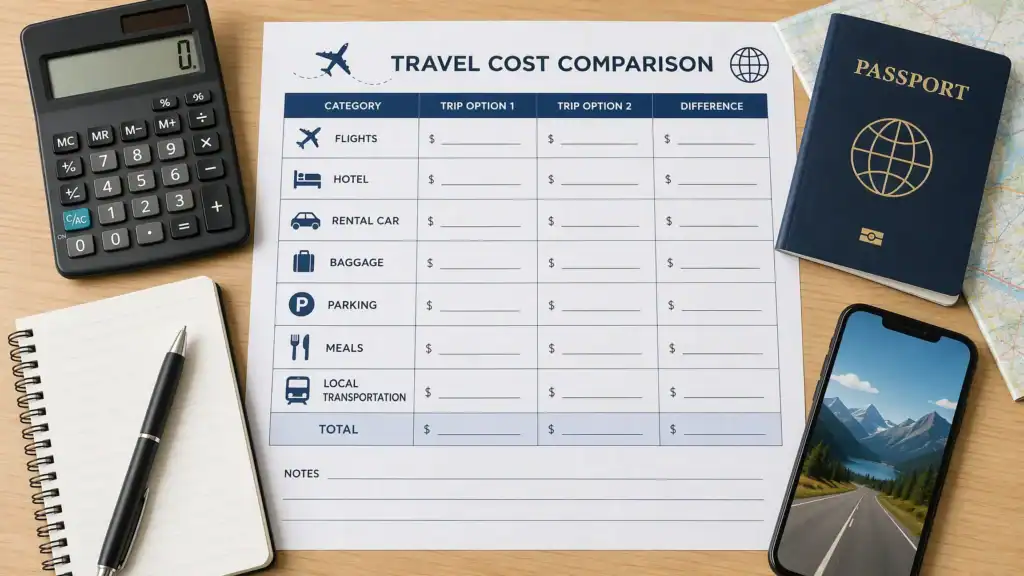
Travel cost checklist for comparing flights, hotels, rental cars, and transportation

Compare Booking Directly With Third-Party Options

You’ll see the same flight, room, or car offered through airlines, hotels, rental companies, online travel agencies, comparison tools, and package providers—sometimes at different prices, sometimes with different terms attached.

Neither channel is universally better. What changes is who stands behind the reservation. Before you pay, check:

  • The final price after all fees, not the teaser rate
  • Who processes the payment and who appears on your statement
  • Who you contact for a change, cancellation, or refund
  • Whether loyalty points and elite benefits still apply
  • Who owns customer service if something goes wrong at 6 a.m.
  • Cancellation deadlines, which may differ from the provider’s own policy
  • Package restrictions that bundle components you can’t modify separately
  • Whether you can select seats, request a specific room type, or choose a vehicle
  • Whether the booking actually shows up in the provider’s system

That last item is worth a phone call. A confirmation email from a booking site doesn’t always mean the hotel or airline has processed the reservation on its end, and a quick verification a few days out costs you nothing.

Bundled packages can genuinely reduce a total, particularly for flight-plus-hotel trips. They can also lock you into terms that are harder to unwind. Read what you’re agreeing to. For airline purchases specifically, the U.S. Department of Transportation guidance on buying an airline ticket explains how ticket sales and disclosures work.

Review Cancellation and Refund Terms Before Booking

A slightly more expensive refundable rate isn’t a waste of money—it’s a hedge. Whether it’s worth it depends on how likely your plans are to change and how much money is exposed if they do.

Points worth confirming before you commit:

  • Is the reservation refundable, changeable, or neither?
  • If you cancel, do you get money back or a travel credit—and when does that credit expire?
  • What’s the deadline to change without a fee?
  • What’s the cancellation window on the hotel, and is it different from the flight’s?
  • What happens if you simply don’t show up?
  • Are partial refunds possible, and on what basis?
  • Who processes the refund—the provider or the booking site?
  • Are add-ons like seats, bags, or prepaid fuel refundable separately?
  • Have you saved the confirmation email and a screenshot of the terms?

Airline refund obligations depend on the circumstances—a cancellation by the airline is treated differently from a change of heart by the passenger. Review the current airline refund information from the U.S. Department of Transportation alongside the specific terms of your own ticket, since official guidance is updated over time. Hotel and rental-car policies operate under their own contracts, not airline rules.

Flexibility matters even more when you’re booking close to departure. Our last-minute travel savings tips cover how to handle short-notice trips without overcommitting.

Watch for Travel Offers That Are Not What They Seem

Most travel businesses are legitimate. A few aren’t, and a handful of signals are worth noticing:

  • Heavy pressure to book in the next few minutes
  • A price that jumps sharply between the search result and the payment page
  • A site whose address is slightly off from the brand it appears to be
  • Required charges that aren’t clearly disclosed anywhere
  • Requests for wire transfers, gift cards, or payment apps
  • Cancellation terms written vaguely or missing entirely
  • A vacation rental you can’t verify through any independent source
  • An offer far outside what similar options cost
  • No phone number, physical address, or clear company identity

Simple protections go a long way. Check the URL character by character. Read the full price breakdown before entering card details. Look at recent reviews on more than one platform. Confirm the reservation directly with the hotel or airline. Pay with a method that offers dispute protection. Keep receipts and confirmations somewhere you can find them. And don’t let a countdown timer make the decision for you—those clocks are usually a design element, not a real deadline.

The Federal Trade Commission maintains plain-language guidance for avoiding travel scams that is worth reviewing before a large booking.

Decide What “Best Value” Means for Your Trip

Value isn’t a fixed number. It depends on what you’re optimizing for, which changes from trip to trip:

  • The lowest final cost, when the budget is firm
  • The shortest total travel time, when you have limited days off
  • Flexibility, when plans might shift
  • A location that keeps you near what you came to see
  • Fewer connections, especially with kids or tight schedules
  • Breakfast or parking included, which simplifies daily spending
  • A vehicle that actually fits your group and luggage
  • Less time in transit between activities
  • Lower financial exposure if something falls through

The cheapest option isn’t automatically the wrong one. Plenty of trips call for exactly that. It just deserves the same scrutiny as everything else—priced fully, terms read, and tradeoffs understood.

Value starts even earlier than booking, at the destination itself. If you’re still deciding, our guide on how to choose the right travel destination can help, and our family travel planning tips address the extra math that comes with a group.

A Simple Travel Price Comparison Process

  1. Establish your dates, destination, and number of travelers.
  2. Search each major component—flight, lodging, and car—separately.
  3. Record the total displayed price for each, taxes included.
  4. Add required fees and the extras you personally need.
  5. Compare cancellation and refund terms side by side.
  6. Estimate local transportation for the whole trip, not one ride.
  7. Check both direct and third-party booking channels.
  8. Calculate the complete trip cost for each combination.
  9. Review every detail on the payment page before confirming.
  10. Save your confirmations, and verify the booking with the provider.

Once your major reservations are in place, use these packing and travel timing tips to organize the practical details before departure.

Travel Price Comparison Checklist

  • ✅ Same travel dates compared
  • ✅ Same number of travelers
  • ✅ Same room type or vehicle class
  • ✅ Taxes and required charges included in both totals
  • ✅ Baggage costs checked for your actual packing plan
  • ✅ Hotel parking and mandatory property fees checked
  • ✅ Rental mileage limits and fuel policy reviewed
  • ✅ Airport and local transportation estimated
  • ✅ Cancellation deadlines reviewed for every component
  • ✅ Refundability versus travel credit understood
  • ✅ Payment, deposit, and card requirements checked
  • ✅ Final total written down for each option
  • ✅ Reservation confirmed in the provider’s own system

For more planning resources across every stage of a trip, browse our travel tips hub or explore ideas by destination.

Frequently Asked Questions About Comparing Travel Prices

What is the best way to compare travel prices?

Compare complete trip totals rather than individual advertised rates. Choose your dates and traveler count, then price each component—flight, lodging, car, or transit—with all taxes and mandatory fees included. Add the extras you’ll actually use, such as bags, parking, or a second driver, and subtract the value of anything genuinely included. Write both options down side by side. The written comparison matters more than the tool you use because it forces you to account for costs that search results tend to display separately or later in the process.

Should I compare flights, hotels, and rental cars separately?

Price them separately, then evaluate them together. Searching each category on its own gives you a clear read on what each component costs. But the decisions interact: a hotel near the transit line may eliminate a rental car, and an airport farther from home may add parking and fuel. After you’ve gathered individual prices, build two or three complete trip scenarios and compare their totals. Packages are worth checking too, though you’ll want to confirm what the bundle restricts before assuming it’s the better deal.

Is the lowest advertised travel price always the cheapest?

Not reliably. Advertised prices often exclude baggage fees, seat selection, resort or destination fees, hotel parking, airport rental surcharges, and equipment charges. Two options that look far apart on a search page can finish within a few dollars of each other once everything is added. Sometimes the low advertised price genuinely does win. The only way to know is to carry both options through to a full estimated total, including the transportation costs each choice creates.

Is it better to book travel directly or through a third party?

Neither is automatically better, and it varies by trip. Direct bookings often make changes simpler, keep loyalty benefits intact, and give you one clear point of contact. Third-party sites sometimes surface lower prices or convenient bundles. What matters is knowing who processes your payment, who handles a change or refund, and whether the provider can actually see your reservation. Compare final prices and the terms attached to each channel, then choose based on how much flexibility your trip is likely to need.

What travel fees should I check before booking?

On flights, check taxes, carry-on and checked baggage, seat selection, and change or cancellation charges. On hotels, check taxes, resort or destination fees, parking, Wi-Fi, extra-person charges, and pet fees. On rental cars, review airport facility surcharges, additional-driver fees, young-driver surcharges, one-way drop charges, toll programs, equipment rentals, and fuel policy. Then add trip-level costs such as airport parking at home, rideshare trips from the hotel, and transit passes.

How often should I check travel prices?

Often enough to spot movement, not so often that it takes over your week. Checking every few days once your dates are set is reasonable for many trips, and price alerts can do the watching for you. Availability and pricing change for reasons outside your control, so no schedule guarantees the best number. Set a decision point in advance and book when an option meets your criteria rather than waiting for a bottom you cannot identify.

Should I book a refundable option?

It depends on how much the flexibility costs and how likely your plans are to change. If the refundable rate is only modestly higher and the trip involves uncertain schedules or connecting travel, the reduced financial exposure can be worthwhile. If your dates are firm and the flexible rate carries a large premium, a nonrefundable rate may make more sense. Also check what “refundable” means on that reservation—some options return money, while others issue credits with expiration dates.

How can I compare the cost of driving, renting a car, and using public transportation?

Estimate each option across the full trip, not per day. For driving your own vehicle, count fuel, tolls, parking, and any vehicle costs you personally factor in. For a rental, use the all-in rate including surcharges, plus fuel and nightly hotel parking. For transit, price a multi-day pass and add the airport connection at each end. Then weigh the non-financial side: how far you’ll walk, how much you’ll carry, and how much time each choice takes.

Bringing It Together

Comparing travel prices well comes down to a single habit: refusing to judge an option until you know what it costs from your front door to your return home. That means fares plus bags, room rates plus parking and fees, rental rates plus surcharges and fuel, and every ride in between.

Match your options fairly. Add what you’ll actually pay. Read the cancellation terms while you still have a choice. Then weigh convenience and flexibility against the number, because those have real value even though they don’t appear as line items.

Prices move, availability shifts, and no method produces the lowest possible number every time. What a careful comparison does give you is confidence that you understood the trip you booked—and that’s usually worth more than shaving a few dollars off a fare.


Continue Planning Your Trip

How to Choose a Travel Destination

Narrow down where to go based on budget, timing, and what you actually want out of the trip.

What to Reserve Early for a Trip

Learn which components tend to get scarce or expensive when you wait too long.

Airport, Hotel, and Rental Car Preparation

Handle the practical details before departure so nothing catches you off guard on arrival.

Transportation Savings Tips

Compare rentals, transit, shuttles, and rideshare to find what fits your destination.

Last-Minute Travel Savings

Use practical approaches for booking on short notice without overpaying for urgency.

Travel Tips Hub

Browse the full library of planning, packing, and booking guides in one place.

Plan the Whole Trip, Not Just One Price

Use SavingsScoutTravel to organize the big picture, then visit each SavingsScout specialist site for deeper flight, hotel, and rental-car guidance.


How to Choose the Right Travel Destination

Aviator dog mascot comparing travel destinations by budget, travel time, season, transportation, group needs, and preferred experiences.

You have twenty-three saved videos of places you might go. Two flight deals sitting in your inbox. A friend who insists you’d love Portugal, a coworker who swears by Costa Rica, and a sibling who keeps sending you photos of a cabin somewhere in the mountains. And still, weeks later, you haven’t booked anything.

That stall-out is normal. Most people get stuck because they’re asking the wrong question. Learning how to choose a travel destination gets a lot easier the moment you stop asking “Where is the best place to visit?” and start asking “Which place fits this trip?”

Those are different questions with different answers. The best place to visit is a matter of opinion, marketing, and whoever posted last. The place that fits this trip depends on things you can actually measure: your total cost, the days you genuinely have available, how much effort it takes to get there, what the season looks like, what you’ll do once you arrive, how you’ll get around, where you’ll sleep, who’s coming with you, and what paperwork or preparation the trip requires.

Work through those nine factors and the long list shrinks fast. This guide will help you get from “somewhere warm, maybe?” down to two or three real options — and then pick one.

Traveler comparing city, beach, and mountain destinations while planning a trip

Start With the Kind of Trip You Actually Want

Skip the destination lists for now. Start with the experience.

If you open a browser and type “best places to travel,” you’ll get a hundred answers shaped by advertising budgets and search trends, none of which know anything about you. A better starting point is describing the trip you want to come home from.

Think about what you’re hoping to spend most of your time doing:

  • Resting, sleeping in, moving slowly
  • Sightseeing, museums, historic sites
  • Hiking, paddling, skiing, or other outdoor recreation
  • Beach time and warm weather
  • Eating well and going out at night
  • Keeping kids entertained and reasonably happy
  • Shopping, shows, and entertainment districts
  • Driving a scenic route with multiple stops
  • A short weekend reset close to home
  • A longer international trip you’ve been saving toward
  • Some deliberate mix of the above

Here’s the part people forget: your answer can change from year to year. The same person who wants a packed city itinerary in March might want a quiet lake house in October. You’re not choosing a permanent travel identity. You’re choosing what this particular trip needs to be.

Write down your top three priorities before you look at a single destination. Not ten. Three. When you’re comparing options later, those three are the tiebreakers.

Before searching destinations, finish this sentence:

For this trip, I want to spend most of my time __________.

If your answer is “walking around a new city and eating,” a remote beach resort is going to disappoint you no matter how good the photos look. If your answer is “not doing anything,” a destination with twelve must-see sites will quietly stress you out. You can browse more trip-planning advice once you’ve got that sentence finished.

Set a Realistic Total-Trip Budget

A lot of destination decisions go sideways because someone anchored on a single number — usually airfare.

A $180 round-trip flight feels like a decision made for you. But airfare is one line in a much longer list. The trip’s real cost includes:

  • Flights, or fuel, tolls, and wear if you’re driving
  • Lodging for every night, including taxes and resort or destination fees
  • Rental car, if you need one
  • Public transportation passes or fares
  • Airport transfers on both ends
  • Parking — at the airport, at the hotel, or at attractions
  • Food, including the meals you’ll eat out because you’re tired
  • Activities, admissions, tours, and timed-entry tickets
  • Passport renewal, visa fees, or other required documents
  • Checked bags and seat selection
  • Travel insurance, if you decide it makes sense for this trip
  • Daily incidentals — coffee, tips, souvenirs, the pharmacy run

Two destinations can land in completely different places once you add all that up. One might have a pricier flight but affordable lodging, walkable neighborhoods, and no rental car needed. Another might have a bargain flight into an airport 90 minutes from anywhere, hotels at peak-season rates during your exact dates, and a car you can’t avoid.

That second scenario catches people constantly. The flight was the cheap part. Everything after it wasn’t.

Set three numbers before you go further:

  • A preferred budget — what you’d like to spend
  • A maximum budget — the number you won’t cross
  • A buffer — roughly 10 to 15 percent set aside for the things you didn’t plan for

Then estimate each finalist destination against the same categories, not against each other’s highlight reels. Our guide on how to compare complete travel prices walks through that process in detail.

It also helps to know why prices move the way they do. Brief primers are available on how to understand how airline prices change, how to understand hotel pricing, and how to understand rental-car pricing. You don’t need to master any of it right now — you just need enough context to build honest estimates.

Match the Destination to the Time You Have

Travel time isn’t flight time. It’s door-to-door time, and it’s almost always longer than the number on the ticket.

Count all of it:

  • Driving to the airport and parking, or the ride there
  • Getting to the airport early enough to be comfortable
  • Layovers and the risk of a delayed connection
  • Customs and immigration on international arrivals
  • Getting from the arrival airport to your lodging
  • Time-zone adjustment
  • Hotel check-in windows, which may not match your arrival
  • The return trip, which repeats most of the above
  • A recovery day before work or school starts again

Take a three-hour flight as an example. Add the drive to the airport, the recommended arrival buffer, boarding, the flight itself, baggage claim, and a transfer into town, and that day is largely gone. The return day usually goes the same way. On a seven-night trip, that’s an acceptable trade. On a three-night trip, you’ve just spent two-thirds of your vacation in transit.

This is why the couple with four vacation days often ends up happier at a city six hours away by car than at an international destination that technically “fits.” The flight was possible. The trip wasn’t.

Shorter trips generally work better with:

  • Nonstop flights
  • Airports close to where you’re actually staying
  • Destinations you can drive to
  • Compact areas where things are near each other
  • Simple, predictable local transportation
  • One hotel, not three

Longer trips earn back the transit cost. A ten-hour flight is a rough day, but spread across two weeks, it stops being the defining feature of the trip.

Once your dates and destination are settled, it’s worth reviewing what to reserve early when planning a trip, since some things sell out long before others. If flight routing is the deciding factor between your finalists, you can also explore flight destination guides to see how connections typically work.

Consider the Season, Weather, and Daylight

Weather is where a lot of otherwise-good destination choices fall apart — usually because someone confused two different things.

Climate is the long-term pattern: what a place is typically like in February versus July. Forecast is what’s happening in the next week or two. Climate helps you choose a destination. Forecast helps you pack. Neither one predicts the other.

When you’re comparing options, look at seasonal patterns rather than day-to-day specifics:

  • Typical temperature ranges for your travel window
  • Rainy and dry seasons
  • Hurricane and storm seasons
  • Snow, ice, and winter road conditions
  • Heat and humidity, especially if you plan to be outside all day
  • Wildfire season in some regions
  • Seasonal closures — trails, roads, ferries, restaurants, entire resort areas
  • Daylight hours, which shape how much you can fit into a day
  • Whether the activity you actually came for is even operating

That last point matters more than most people expect. A mountain town in late spring might have pleasant weather and closed lifts. A coastal town in the off-season might be sunny and mostly shuttered.

For U.S. destinations, NOAA climate information for U.S. destinations offers climate normals — long-term averages for temperature and precipitation — that give you a reasonable sense of what a place is usually like at a given time of year. Use that to shape your shortlist, then check a current forecast in the days before you leave.

And keep the limitation in mind: an average is an average. A destination with typically mild, dry conditions in your travel month can still hand you a week of rain. Choose a destination that gives you decent odds and a backup plan, not one that requires perfect conditions to be worth the trip.

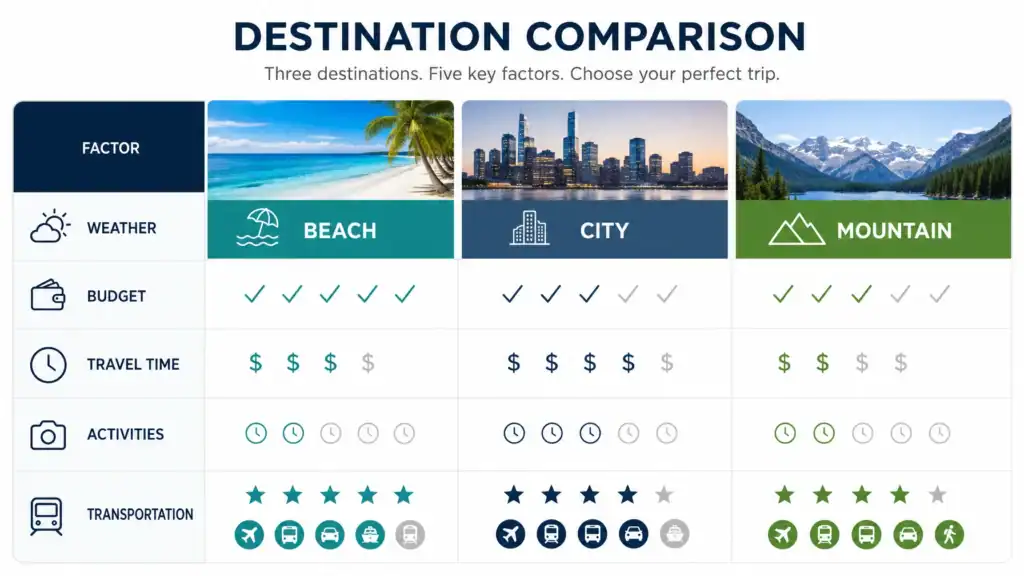
Comparison of travel destinations by budget, weather, travel time, and activities

Think About Crowds and Seasonal Demand

Timing affects more than weather. It affects how the destination functions while you’re in it.

Peak season usually means:

  • Higher lodging rates and less availability
  • Fewer flight options at reasonable prices
  • Crowded attractions and longer lines
  • Restaurant waits, or reservations required weeks ahead
  • Rental car shortages and higher rates
  • Timed-entry tickets and tours selling out

Off-season brings its own tradeoffs:

  • Shortened hours at attractions and museums
  • Seasonal businesses closed entirely
  • Less predictable weather
  • Reduced transit, ferry, or shuttle schedules
  • Fewer tours running, sometimes none
  • Renovation and maintenance work scheduled during slow months

Neither is universally better. A destination that’s uncomfortably crowded in July might be genuinely dull in February — or it might be quiet and pleasant with everything still open. It depends entirely on the place.

Shoulder season — the weeks on either side of peak — often lands somewhere useful in the middle: moderate crowds, moderate prices, most things still operating. But it’s not a guarantee. In some destinations the shoulder weeks are excellent. In others, they’re when half the town closes to repaint. Check what’s actually open during the specific weeks you’re considering.

If your dates are already locked in and you’re working with less lead time than you’d like, our last-minute travel savings tips cover how to work within a tight window. For timing your bookings once the destination is chosen, see guidance on the best time to book flights, the best time to book hotels, and the best time to book car rentals.

Choose a Destination That Fits Your Group

A destination that’s easy for a solo traveler with a backpack can be genuinely difficult for four people with a stroller and a nap schedule. Who’s coming shapes the answer.

Couples

Two people, two sets of interests. Look for a destination where both of you have something to do — including doing nothing, if that’s one person’s priority. Agree on pace ahead of time. One of you may want a full itinerary; the other may want three hours of nothing every afternoon. Talk about budget expectations before booking, not after the first expensive dinner.

Families

Travel time carries more weight here than almost anywhere else. A long travel day with young children costs more than it does with adults, and the recovery takes longer.

Think through:

  • Total door-to-door travel time and how it lines up with sleep schedules
  • Sleeping arrangements — will everyone actually fit, and can anyone sleep separately from a napping child?
  • Meal options, including food you can prepare yourself
  • Whether the main activities suit the ages traveling
  • Stroller usability on local sidewalks, transit, and terrain
  • Car seat requirements, and whether you’re bringing or renting them
  • Laundry access on trips longer than a few days
  • How you’ll move a group around — transit, rental car, walking distances

Our family travel planning tips go deeper on budgets, schedules, and logistics.

Groups of friends

Budgets rarely match. Have that conversation early — it’s uncomfortable once, versus awkward for a week. Decide how rooms will be split, whether the trip skews toward nightlife or daytime activities, how shared transportation costs get handled, and how you’ll manage staggered arrival times. A destination where people can peel off and rejoin easily tends to work better for groups than one where everything requires the whole crew to move together.

Multigenerational groups

The constraint is usually the widest range of needs, not the average. Consider walking distances between lodging and activities, stairs and uneven terrain, whether there are places to sit and rest, medical or mobility considerations, lodging layout — a house with a ground-floor bedroom may matter more than a great view — and transportation that doesn’t require multiple transfers with luggage.

Solo travelers

Comfort level is personal and worth taking seriously. Think about transportation options after dark, whether you’d prefer social lodging or privacy, how easy the destination is to navigate without help, and whether you can manage your own luggage through stairs, transit, and long walks. Choose based on how you actually like to travel, not how you think a solo trip is supposed to look.

Evaluate Transportation Before You Choose

Transportation can change a destination more than the destination itself.

Two places with identical attractions and identical hotel rates can feel completely different depending on how you move around. One might be walkable with reliable transit. The other might require driving twenty-five minutes to every single thing you want to do.

Research before you commit:

  • Distance from the airport to the area where you’d stay
  • Whether public transportation exists, and whether it goes where you’re going
  • Service frequency and operating hours, especially at night
  • Walkability between lodging, food, and activities
  • Rideshare and taxi availability, and typical wait times
  • Whether a rental car is genuinely necessary or just convenient
  • Parking availability and cost at your lodging and destinations
  • Road conditions, mountain passes, and seasonal closures
  • Ferry, shuttle, or gondola schedules if the destination depends on them
  • Distances between the activities on your list
  • Accessibility of the transportation options

Here’s the tradeoff that surprises people most. A hotel twenty minutes outside the center looks like a bargain — maybe $60 less per night. But if you’re taking two rideshares a day for five days, plus parking, plus the time spent in transit, the savings can evaporate. A more central hotel at a higher nightly rate sometimes costs less overall and gives you back several hours.

Run the math both ways before deciding. Our guide to ways to save on transportation while traveling covers how to compare those options directly.

For destination-level detail, you can compare hotel destinations, explore rental-car destinations, learn how to choose a convenient hotel location, or review airport rental-car strategies if you’re weighing picking up a car at the airport versus in town.

Look Beyond the Most Famous Neighborhood

Choosing a destination is really two decisions. The city or region is the first. The specific area you stay in is the second — and it often has more effect on your daily experience.

When comparing neighborhoods or districts, look at:

  • Distance to the activities actually on your list
  • Transit connections and how long the trip takes at different times of day
  • Noise levels, especially at night
  • Restaurants and grocery options within walking distance
  • Parking, if you’ll have a car
  • What the area is like after dark — lively, quiet, or shut down
  • Nightly lodging rates compared to nearby areas
  • Accessibility of sidewalks, entrances, and transit stations
  • Distance from the airport
  • Whether the area’s character matches your trip — families, nightlife, business travel, or rest

The most famous district isn’t automatically the best base. It’s often the most expensive, the most crowded, and the loudest. An area two or three transit stops away can offer better rates, more local restaurants, and a quieter night’s sleep — while still putting you at the main attractions in fifteen minutes.

The tradeoff is convenience. If you’re traveling with small children who need midday naps, or with someone who tires easily, being able to walk back to the room matters more than saving money. If you’re out from morning to night anyway, a short commute costs you very little.

One caution: be careful with generalized claims about which areas are “good” or “bad.” Neighborhoods vary block by block and change over time, and secondhand impressions age badly. Look at current, specific information about the exact area you’re considering, and prioritize practical factors — transit access, walking distance, lighting, and what’s open at the hours you’ll be out. For area-by-area comparisons, you can find destination-based hotel guidance.

Review Practical Requirements Before Getting Attached

There’s a particular kind of disappointment that comes from building a detailed itinerary and then discovering the trip isn’t feasible. Check the requirements early — ideally before you’ve fallen for the place.

For international travel, look into:

  • Passport validity rules, which often require validity well beyond your return date
  • Visa or entry authorization requirements for your nationality
  • Local laws that differ meaningfully from what you’re used to
  • Any additional documents required at entry
  • Health-related requirements or recommendations
  • Current travel advisories
  • Availability and cost of medical care
  • Driving requirements, including whether an international permit is expected
  • Mobile connectivity, roaming, and internet access
  • Accessibility infrastructure

For domestic travel, check:

  • Identification requirements for air travel
  • Seasonal road closures, especially in mountain regions
  • Park entry reservations and timed-entry systems, which can sell out months ahead
  • Limits on local transportation
  • Weather-related conditions that affect access
  • Accessibility information for the specific sites you plan to visit

Three official starting points: U.S. Department of State international travel planning guidance for general preparation, current U.S. Department of State travel advisories for country-level assessments, and CDC destination-specific travel health information for health considerations by destination.

Two things to keep in mind. First, requirements change — sometimes with little notice. Verify current rules before you book, then check again in the weeks before departure. Second, no source can tell you a destination is completely safe. Advisories and health notices are inputs to your decision, not guarantees. Weigh them alongside your own comfort level, and if something is unclear, official embassy or consulate pages for the destination are the appropriate place to confirm.

Consider Accessibility and Personal Travel Needs

The same destination can be straightforward for one traveler and exhausting for another. That’s not a flaw in the destination — it’s a reason to evaluate it against your own needs rather than general reputation.

Worth thinking through before you commit:

  • Mobility needs and how far you can comfortably walk in a day
  • Wheelchair accessibility at lodging, attractions, and transit
  • Sidewalk conditions, curb cuts, cobblestones, and hills
  • Whether public transportation stations have elevators or step-free access
  • Hotel entrances, elevators, and room configurations
  • Accessible bathroom availability
  • Dietary needs and whether they’re commonly accommodated locally
  • Access to pharmacies and prescription medications
  • Sensory considerations — noise, crowds, lighting
  • Tolerance for heat, humidity, or high altitude
  • Language and communication needs
  • Traveling while pregnant
  • Managing a chronic health condition away from home
  • Traveling with a service animal, including entry rules and local recognition

Descriptions on booking sites and tourism pages are often vague or optimistic. “Accessible” can mean very different things. Contact the hotel, the transit authority, the tour operator, or the attraction directly and ask specific questions: How wide is the bathroom door? Is there a step at the entrance? Is the elevator working? Those answers will tell you far more than a website icon.

If you have health concerns that could affect travel, talk with a healthcare professional who knows your situation. Nothing here is medical advice, and general travel guidance can’t account for individual circumstances.

Compare Two or Three Finalists Side by Side

At some point, you have to stop researching and start comparing. Narrow to two or three real options — not seven — and evaluate them against the same criteria.

Comparing more than three at once tends to produce paralysis rather than clarity. Cut anything that failed an earlier filter: wrong season, too far for your available days, over your maximum budget, or missing the activity you actually want.

FactorDestination ADestination BDestination C
Estimated total cost
Door-to-door travel time
Flight or driving convenience
Weather and season fit
Lodging availability for your dates
Local transportation
Desired activities available
Food preferences
Expected crowd level
Suitability for your group
Accessibility
Entry or health requirements
Flexibility if plans change
Overall fit

Fill it in honestly. Use real estimates, not hopeful ones.

A simple 1-to-5 score per row works well, but don’t just add up the columns. Weight the rows that reflect your top three priorities. If a nonstop flight and accessible transit are what make or break this trip, those rows should count for more than restaurant variety.

This is also where the honest tradeoffs surface. A group of six might pick a slightly more expensive destination because everyone can get there on a nonstop flight and one rental house sleeps the whole group — cheaper and simpler in practice than the “affordable” option requiring two connections and three separate hotel rooms. That destination scores worse on cost and better on everything that actually matters for the trip.

Trust the weighted result even when it isn’t the option with the best photographs.

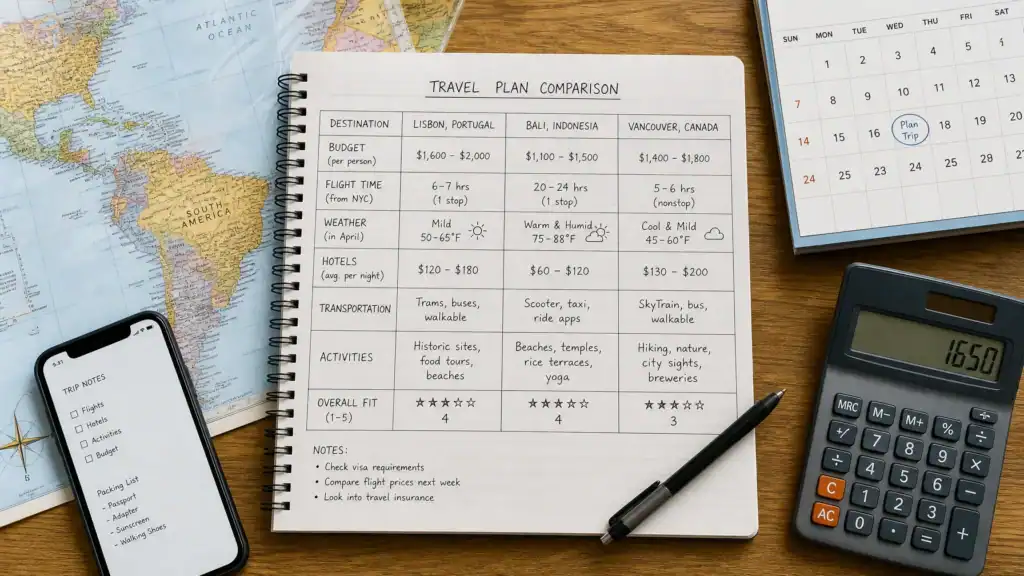
Travel destination comparison worksheet for budget, weather, transportation, and activities

Common Destination-Choosing Mistakes

Choosing based only on cheap airfare

A low fare is a good reason to consider a destination. It’s a poor reason to commit to one. Lodging rates during your dates, whether you need a car, how far the airport sits from anything, and typical food costs can easily overwhelm the flight savings. Price the whole trip before the fare convinces you.

Copying someone else’s ideal vacation

Your friend’s favorite trip reflects their budget, interests, pace, and tolerance for logistics. If they love packed itineraries and you want to read on a porch, the same destination produces very different results. Take recommendations as information about the place, not as a verdict on whether it fits you.

Planning too much for a short trip

Three cities in five days sounds efficient and rarely is. Every hotel change costs a half-day. Every transfer adds friction. On short trips, fewer stops almost always produce a better experience than more.

Ignoring local transportation

Attractions spread across a wide area change the math on everything — time, cost, and energy. Check the distances between the things on your list before you assume the destination is convenient.

Looking only at perfect-weather photos

Destination photography is shot in ideal conditions, in the best month, often at the best hour of the day. That’s not deception, but it isn’t a forecast either. Look at what the place is typically like during your specific travel window.

Trying to satisfy every preference

No destination scores five out of five on every row. The goal isn’t a flawless match — it’s protecting your top priorities and accepting reasonable compromises on the rest. If you refuse to compromise on anything, you’ll keep researching until the good options are gone.

Waiting too long after finding a good fit

Rates and availability shift, and the specific hotel or flight that made a destination work may not be there in three weeks. You don’t need to book the moment you decide. But give yourself a decision deadline — a date by which you’ll commit — so the choice doesn’t drift indefinitely.

A Simple Process for Choosing Your Destination

  1. Decide what kind of trip you want. Finish the sentence: “For this trip, I want to spend most of my time…”
  2. Set a preferred budget and a maximum budget, plus a buffer.
  3. Confirm how many days you actually have, counting travel days honestly.
  4. List five possible destinations. No filtering yet.
  5. Remove anything that doesn’t fit the season or your available time. This usually cuts the list in half.
  6. Estimate the total cost of what’s left — not just flights.
  7. Check transportation and lodging locations for each remaining option.
  8. Review practical, health, and entry requirements.
  9. Compare two or three finalists side by side using the table above.
  10. Choose the one that best matches your top three priorities.
  11. Start comparing flights, hotels, and ground transportation. Our guide to prepare your airport, hotel, and rental arrangements covers coordinating those pieces.
  12. Recheck requirements before booking and again before departure. As your date approaches, it also helps to organize packing and travel timing.

Travel Destination Selection Checklist

  • ✓ The purpose of the trip is clear
  • ✓ Top three priorities are identified and written down
  • ✓ Preferred and maximum budgets are set
  • ✓ Complete trip costs have been estimated, not just airfare
  • ✓ Door-to-door travel time fits the number of days available
  • ✓ Typical seasonal conditions have been reviewed
  • ✓ Desired activities are available and operating during the planned dates
  • ✓ Lodging options fit the size and needs of the group
  • ✓ Local transportation has been researched
  • ✓ Airport transfers on both ends have been considered
  • ✓ Accessibility and personal needs have been reviewed
  • ✓ Current entry requirements have been checked
  • ✓ Travel advisories have been reviewed when relevant
  • ✓ Destination health information has been checked when relevant
  • ✓ Two or three finalists have been compared side by side
  • ✓ The important tradeoffs are understood and accepted
  • ✓ The choice fits the people traveling — not only the lowest advertised price

Frequently Asked Questions About Choosing a Travel Destination

How do I decide where to travel?

Start with the trip rather than the place. Write down what you want to spend most of your time doing, then set a total budget and confirm how many usable days you have. Those three constraints eliminate most options immediately. From what remains, list five candidates and cut anything that doesn’t work for the season, the travel time, or the budget. Compare the final two or three against the same criteria, weighting your top priorities more heavily. The destination that scores best on what matters most to you is your answer.

How can I choose a destination that fits my budget?

Price the entire trip, not the flight. Build a rough estimate for each candidate that includes lodging for all nights with taxes and fees, ground transportation, food, activities, and any documents or bags you’ll pay for. Compare those totals. You’ll frequently find that the destination with the higher airfare ends up cheaper overall because lodging costs less or you can skip the rental car. Set a maximum you won’t exceed and keep a buffer for the costs you didn’t anticipate — there are always a few.

Should I choose a destination before checking flights?

Do both, roughly in parallel. Start with a shortlist based on what you want from the trip, then check flight options for those specific destinations and dates. Flight availability and routing can legitimately eliminate a candidate — a destination requiring two connections each way may not fit a short trip regardless of price. What’s less useful is browsing fares with no shortlist at all, which tends to produce destinations chosen by discount rather than fit. Let flights refine your list, not create it.

How many destinations should I compare?

Start broad — five or so — then narrow quickly to two or three for detailed comparison. Comparing more than three in depth usually creates paralysis rather than clarity, because every option has strengths and you end up cycling through them. Use hard filters first: season, travel time, and maximum budget will typically remove half your list without much agonizing. Save the detailed cost estimates and side-by-side scoring for the finalists. It’s faster and produces a decision you’re more confident in.

How far should I travel for a short vacation?

Measure by door-to-door time rather than distance. On a three-night trip, a destination that consumes most of the first and last days leaves you barely one full day. That’s usually not satisfying. Shorter trips tend to work best with nonstop flights, nearby airports, or drivable destinations where you arrive with the day still ahead of you. Longer trips absorb travel time much better — a long flight matters less across two weeks than across a weekend. There’s no fixed limit, just a ratio worth being honest about.

How do I choose a destination for a family trip?

Weight travel time heavily, since long transit days are harder with children and recovery takes longer. Then look at practical logistics: whether everyone fits comfortably in one lodging option, whether there’s somewhere separate for a child to nap, what meal options exist including food you can prepare yourself, and whether the main activities suit the ages traveling. Check how you’ll get around — stroller-friendly sidewalks, car seat requirements, transit with kids. A slightly less exciting destination that runs smoothly usually beats an ambitious one that doesn’t.

Should weather determine where I travel?

Weather should shape your list but rarely decides it alone. What matters more is whether the season supports the activities you’re going for. Warm temperatures don’t help if the trails are closed; mild weather doesn’t help if the ferry isn’t running. Use climate normals to understand typical conditions in your travel month, then verify that the specific things you want to do are operating then. Remember that averages describe patterns, not your particular week — build in a backup plan for weather that doesn’t cooperate.

Is it better to stay in a city center or outside it?

It depends on how you’ll spend your days. Central lodging usually costs more per night but reduces transportation time and expense, and it lets you return to your room midday — valuable with young children or anyone who tires easily. Staying outside the center can offer better rates, quieter nights, and more local character, provided transit connections are reliable and run at the hours you’ll need them. Estimate your daily transportation costs and time in each scenario. The cheaper nightly rate isn’t always the cheaper trip.

How do I compare a domestic trip with an international trip?

Compare them on total time and total cost, not just the headline numbers. International trips often carry longer door-to-door travel, jet lag, passport or visa requirements, and currency and connectivity considerations. Domestic trips typically involve less preparation and less recovery. On a short window, that difference can be decisive. On a longer trip, the added effort spreads out and matters less. Also factor in preparation time — if a passport needs renewing or a visa takes weeks, that affects whether the trip is feasible at all.

What should I check before choosing an international destination?

Before you build an itinerary, verify the practical requirements: passport validity rules, whether you need a visa or entry authorization for your nationality, any health-related requirements, and current travel advisories. Look at how you’d get from the arrival airport to your lodging, whether you can drive there if you plan to, and how mobile service and payments work. Official government sources are the right place for this — requirements change with little notice. Confirm before booking, then check again in the weeks before you depart.

Bringing It Together

The destination that works isn’t the one with the best photographs or the lowest fare. It’s the one that lines up with what you want from this trip, what you can comfortably spend across the whole thing, how many days you genuinely have, how easy the place is to move around in, whether the season supports what you came to do, and whether it works for everyone traveling with you.

Most people already know their top priorities. They just haven’t written them down and held their options up against them. Once you do, the list tends to shrink on its own, and the decision that felt impossible starts looking obvious.

You don’t need a flawless destination. There isn’t one. You need a place that fits this trip, this budget, these dates, and these people — and there are usually several. Pick the one that fits best, book it, and stop scrolling.

Continue Planning Your Trip

How to Compare Travel Prices

Once you’ve chosen a destination, this guide walks through comparing the complete cost of flights, hotels, rental cars, and ground transportation — so you’re evaluating full trip totals rather than individual line items.

What to Reserve Early for a Trip

Some things sell out months ahead and others can wait. This guide helps you prioritize what to lock in first after your destination is settled.

Airport, Hotel, and Rental Car Preparation

Practical coordination for the weeks before departure, covering how airport timing, hotel check-in, and vehicle pickup fit together.

Family Travel Planning Tips

Budgets, schedules, lodging arrangements, transportation, and activity planning for families traveling with children of different ages.

Transportation Savings Tips

How to compare rental cars, public transit, shuttles, taxis, and rideshare services so you’re not overpaying to get around once you arrive.

Travel Tips Hub

Browse every SavingsScoutTravel planning guide in one place, from destination selection through post-booking preparation.

You can also browse destination overviews if you’re still gathering ideas, or review cheap flight strategies and hotel savings tips once your dates are set.

Explore More Destination Ideas

Browse destination overviews, then use the SavingsScout network to compare flight, hotel, and rental-car options for the places that fit your trip.

What to Reserve Early When Planning a Trip

The destination is settled. The dates are close enough. And now there are twelve browser tabs open—flights, hotels, a rental car, a walking tour, a park pass, a restaurant someone mentioned, airport parking—and no clear sense of which one actually needs attention today. Figuring out what to reserve early for a trip is less about speed and more about sequence. Some arrangements decide whether the trip works at all. Others can comfortably wait until the shape of the trip is clear.

Here’s the principle that makes the rest of this guide easier: reserve the hardest-to-replace parts first, and leave flexible decisions until the trip structure is stable.

That’s it. Not “book everything immediately.” Not “wait for a magic price drop.” Just protect the pieces that would be painful or impossible to replace, then fill in the rest.

Traveler organizing flight, hotel, rental car, and activity reservations for an upcoming trip

Do Not Book Until the Basic Trip Details Are Clear

Research early. Commit once the framework holds together.

Before you make a major nonrefundable reservation, you want reasonable clarity on:

  • The destination—and whether you are firmly settled on it
  • Approximate or fixed dates
  • Number of travelers, including children and their ages
  • Trip length
  • A preferred budget and a maximum budget
  • Your departure airport, or whether you are driving
  • Any event, wedding, cruise, or activity anchoring the trip
  • Passport and entry-document status for everyone traveling
  • Group needs—one room or several, connecting rooms, kitchen access
  • Accessibility needs
  • A general transportation plan at the destination

Your dates do not have to be locked to the hour while you are researching. What matters is knowing which details are flexible and which are not. “We can leave Thursday or Friday” is useful information. “We must be in the room by Friday at 4 p.m. for a rehearsal dinner” is a different kind of constraint, and it changes what you should reserve first.

A concrete example: do not reserve a nonrefundable hotel for an international trip before confirming that every traveler has a usable passport and can meet the destination’s entry requirements. That includes the teenager whose passport expired quietly two years ago and the relative whose passport is technically valid but may not satisfy a destination’s validity rules. Passport processing and mailing times change, so check the current U.S. passport processing information directly rather than trusting a number from an older article.

If the destination itself is still a little soft, work that out first. It is much easier to choose a destination that fits your trip before money is committed, and easier still to compare the complete cost of your options while you can still change your mind without paying for the privilege.

Reserve the Parts That Hold the Trip Together

Most trips have an anchor reservation—the one piece that determines everything else. Identify it early, because the rest of your itinerary hangs off it.

  • A wedding
  • A cruise departure
  • A concert, festival, or sporting event
  • A guided tour with fixed departure dates
  • A national park permit or timed-entry slot
  • A family reunion
  • A limited flight route with only a few weekly departures
  • A small destination with very little lodging
  • Holiday-week accommodation
  • A specific medical, accessibility, or mobility arrangement

The anchor should usually be confirmed before you start filling in optional sightseeing. If the reason you are traveling is a Saturday wedding, the venue and date are already fixed—your job is to secure suitable lodging and transportation around that commitment. The Sunday afternoon tour can wait.

Ask This First

“If this one reservation became unavailable, would I still take the trip?”

If the answer is no, it belongs near the top of your priority list.

That single question sorts most planning confusion. A refundable hotel two blocks farther away is an inconvenience. A cruise that sails without you is a canceled vacation.

Reserve Flights Early When Your Options Are Limited

Flights deserve early attention in specific situations rather than as a blanket rule. Move them up your list when:

  • Your dates are fixed and cannot shift
  • Travel falls during a holiday period or school break
  • The destination has limited air service
  • You need a nonstop flight
  • Several people must travel together on the same itinerary
  • Specific arrival or departure times matter
  • The trip connects to a cruise, wedding, tour, or ticketed event
  • You are using miles and award-seat availability is the constraint
  • You need wheelchair assistance or another special arrangement
  • The international routing is complicated, with multiple carriers or long layovers

Here is the distinction that saves people money and regret: looking early is not the same as buying immediately. Start watching schedules early so you understand what exists on your dates. Then decide when the fare and terms make sense for you.

Before you purchase, compare the things that do not show up in a headline price: total cost with taxes and fees, baggage allowance for your actual luggage, fare restrictions, nearby alternate airports, connection times that leave room for a delay, which airline operates each segment, and the change and cancellation terms. Know whether your ticket is refundable, credit-only, or fully nonrefundable—those describe very different levels of commitment.

For timing and strategy, the specialist guides go deeper: review the best time to book flights, understand how airline prices change, and compare practical cheap-flight strategies that do not depend on luck.

It is also worth reading the U.S. Department of Transportation guidance on buying an airline ticket, which covers ticket restrictions, optional service and baggage-fee disclosures, direct versus agency purchases, and airline booking protections.

One thing this guide will not tell you is that buying early always produces the lowest fare. Airfare does not work that way. Early attention is about availability and suitability—not a guaranteed price.

Reserve Lodging Early When the Right Room Is Scarce

Lodging climbs the priority list fast when the right room—not just any room—is what you need. Consider reserving early when:

  • The destination has limited accommodation overall
  • Your dates overlap a festival, convention, big game, graduation, or holiday
  • You need a family suite or a single room that sleeps five
  • Several rooms must be near one another
  • A vacation rental has to fit a large group
  • An accessible room is required
  • You need a kitchen or in-unit laundry
  • The lodging must be near a wedding venue, cruise port, hospital, event, or transit station
  • The destination has a short operating season
  • You are visiting a national park, island, rural area, or small town
  • You want one specific neighborhood

General availability tells you almost nothing about your availability. A city may still show hundreds of open rooms while the affordable ones near the event are gone, along with every room that sleeps five. A family needing one room for five people has a dramatically smaller inventory than a couple needing a standard king.

When you compare options, look at the total stay price rather than the nightly rate. Add required property fees, parking, and breakfast when relevant. Check the cancellation deadline, prepayment requirement, room occupancy, bed configuration, accessibility details, and distance from the things you plan to do. A cheaper hotel that requires two rideshares a day may not be cheaper.

For timing and total-cost questions, see the best time to book hotels, learn to understand the complete hotel price, and use the guide to choose a convenient hotel location. For city-specific context, browse destination-based hotel guidance.

A flexible reservation can help preserve a suitable room while you compare flights. But “flexible” only means something if you know the exact cancellation deadline and place it on your calendar. A refundable booking you forget about becomes a nonrefundable booking.

Reserve Rental Cars Early When Supply Matters

Rental cars are often treated as an afterthought, which works fine in a large market during a quiet week and badly in a thin market during a busy one. Give them earlier attention when:

  • The destination has limited rental inventory
  • Travel falls during a busy holiday period
  • The airport or town has only a few rental locations
  • Your group needs a minivan, large SUV, or passenger van
  • You need hand controls or another accessibility arrangement
  • You need a one-way rental
  • Pickup or return falls outside normal counter hours
  • The itinerary involves remote areas
  • The entire trip depends on having a vehicle
  • Multiple drivers, car seats, or special equipment are involved

A basic compact car often remains available long after the specific vehicles disappear. A family of six traveling over a holiday week is not competing for “a car”—they are competing for the small number of minivans at that location.

Compare the total rate rather than the daily rate. Check the vehicle class, pickup and return locations, mileage terms, fuel policy, additional-driver charges, one-way fees, airport facility charges, deposit and card requirements, cancellation terms, operating hours, and the cost of reaching an off-airport location.

The specialist guides cover the details: the best time to book car rentals, how to understand rental-car pricing, practical car rental savings tips, and how to plan an airport car rental around your arrival time.

Before assuming you need a car at all, compare transportation options at your destination. In some cities, parking and fees make driving the more expensive and stressful choice.

Check Passports, Entry Requirements, and Health Planning Early

Applications and appointments are not ordinary reservations. You cannot rebook a passport the way you can rebook a hotel. These items belong near the front of your planning because they can quietly invalidate everything else.

For international trips, check:

  • Passport validity for every traveler, including remaining validity required by the destination
  • Current processing status if a renewal or new application is needed
  • Visa or electronic travel-authorization requirements
  • Entry and exit requirements
  • Requirements affecting children
  • Local driving-document requirements
  • Destination-specific health information
  • Lead time needed for a travel-health appointment
  • Prescription and medication planning
  • Current travel advisories

Start with the current passport processing times and the U.S. Department of State international travel planning guidance. Entry rules are set by the destination, can change with little warning, and may differ by nationality—so treat any article as a prompt to check official sources, not a substitute for them.

For health preparation, use the CDC guidance for preparing before travel as a starting point. The CDC advises allowing lead time for destination-specific health preparation; verify the current guidance and use an appropriate healthcare professional for anything specific to you. This article does not tell you which vaccines or medications you need.

The practical takeaway is simple: if an international trip requires document or health action, handle that before a major nonrefundable purchase.

Reserve Major Attractions, Tours, Permits, and Park Access

Some activities can be sorted out the morning you want to do them. Others determine whether the trip delivers the experience you traveled for. The difference matters.

  • National park timed entry or entrance reservations, where they apply
  • Campsites
  • Popular guided tours with small group sizes
  • Museum timed-entry tickets and special exhibits
  • Observation decks
  • Boat tours and ferries
  • Scenic rail trips
  • Theme-park reservations
  • Sporting events, concerts, and theater performances
  • Food or cultural tours
  • Limited hiking permits
  • Seasonal wildlife excursions
  • Holiday events
  • Restaurant experiences tied to a celebration

Reservation systems vary by destination, season, and year. A park that required timed entry one summer may not the next; a tour that accepted walk-ups in April may sell out in July. Release schedules also vary—some open on a fixed date months ahead, some use rolling windows, and some hold a small number for short-notice booking.

For parks, start with the National Park Service trip-planning information, then check the specific park’s official page for entrance reservations, permits, tours, campground availability, fees, and seasonal conditions. Not every national park requires an advance reservation, and the ones that do do not all use the same system.

A traveler may find a lovely cabin near a park and still miss the cave tour, campsite, or timed-entry reservation that motivated the visit. Lodging was the easy part; the experience was the anchor.

If you are still weighing places to go, choose a destination based on the experience you want—because the experience is often what has limited capacity, not the city itself.

Reserve Special Arrangements Before Routine Extras

Anything serving a specific need should be handled early because the supply is smaller than the general inventory. That can include:

  • Accessible hotel rooms
  • Connecting rooms
  • Ground-floor rooms
  • Airport wheelchair assistance
  • Accessible rental vehicles or hand controls
  • Medical equipment rental or delivery
  • Pet-friendly rooms
  • Service-animal documentation where applicable
  • Infant bassinets
  • Rental car seats
  • Large-group transportation
  • Dietary arrangements on an organized tour
  • Mobility-friendly excursions
  • Rooms with kitchens
  • Lodging near a medical facility
  • Equipment rentals for seasonal activities

When an arrangement is essential rather than merely convenient, contact the provider directly. Selecting a checkbox during online booking often creates a request, not a confirmed feature. Call, explain what you need, ask whether it is confirmed or requested, and keep a written record.

No provider can guarantee availability, and a request is not a promise. Asking early, directly, and specifically gives you the best chance and leaves time to find an alternative if the answer is no.

Use the guide on how to coordinate airport, hotel, and rental-car arrangements, and review the family travel planning tips when you are juggling naps, car seats, bed configurations, and mixed-age needs.

What Can Usually Wait Until the Main Reservations Are Set?

Plenty of decisions become easier—and better—once flights, lodging, and transportation are settled. These can often wait:

  • Routine restaurant choices
  • Flexible sightseeing
  • Shopping plans
  • Most casual meals
  • Detailed hour-by-hour schedules
  • Packing lists
  • Airport meals
  • Small local purchases
  • Flexible transit passes
  • Optional low-demand activities
  • Souvenirs
  • Weather-dependent outdoor plans

Waiting is not laziness here. You cannot choose a good dinner spot until you know where you will be at 7 p.m., and you cannot plan a hiking day sensibly until you know the forecast.

Exceptions are real. A famous restaurant may open reservations weeks ahead. A limited ferry may require advance booking. A holiday meal may need a reservation. An ordinarily flexible activity can become scarce during a major event weekend.

Keep the Main Principle in View

Do not fill every hour before the trip’s basic structure is stable. Reserve what is scarce, then leave room for the decisions that improve when you have more information.

Closer to departure, use these packing and travel timing tips once you know what your days actually look like.

Use a Flexible Reservation When It Preserves a Good Option

Holding a flexible reservation can make sense when you need to protect something you may not find again: a suitable hotel, a scarce room type, a specific rental vehicle, a refundable tour, or lodging near a fixed event.

But “flexible” covers a wide range of terms:

  • Fully refundable: refundable before the stay or service under the stated terms
  • Refundable until a deadline: common for hotel bookings
  • Changeable with a price difference: value retained, but a higher new rate may apply
  • Travel credit: value stays with the provider and may expire
  • Partially refundable: a portion is retained
  • Nonrefundable: no refund under the ordinary terms
  • Pay now: payment collected at booking, often with stricter terms
  • Pay later: payment collected at the property or pickup
  • Deposit required: part of the amount charged in advance
  • Free cancellation with conditions: the phrase that needs the most reading

“Free cancellation” tells you very little on its own. Before relying on it, know the exact deadline and time zone, whether taxes and fees are refunded, whether you booked through a third party, who must process the cancellation, and whether no-show penalties apply.

For airline tickets, the U.S. Department of Transportation airline refund information explains the situations in which refunds are owed. Do not extend those rules to hotels, rental cars, tours, cruises, or vacation rentals; those follow their own contract terms.

Reduce avoidable risk by saving confirmation emails, screenshots of cancellation terms, receipts, reservation numbers, provider contact information, and calendar reminders for every deadline.

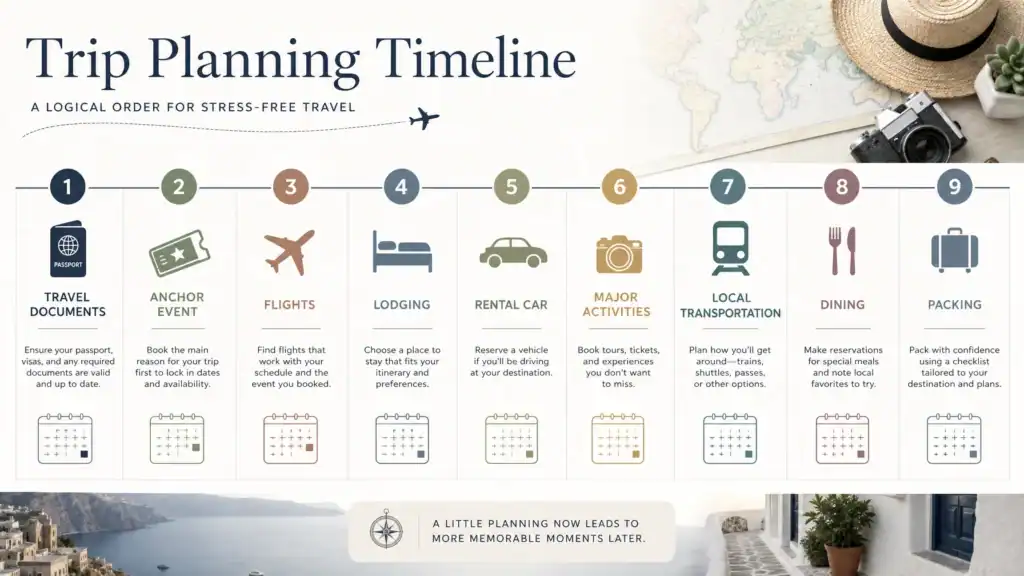
Book in the Right Order

This general sequence works for many trips:

  1. Confirm the destination, dates, travelers, and budget.
  2. Check passports, entry requirements, and major practical barriers.
  3. Identify the anchor event, tour, cruise, permit, or commitment.
  4. Research flight, lodging, and transportation availability together.
  5. Reserve the hardest-to-replace major component.
  6. Reserve lodging that works with the transportation plan.
  7. Reserve a rental car or other essential ground transportation.
  8. Reserve limited activities, permits, and timed-entry attractions.
  9. Confirm special accommodations and accessibility arrangements directly.
  10. Add flexible activities and meals.
  11. Recheck reservation details before cancellation deadlines.
  12. Complete packing, documents, and final preparation.

Now stop treating that sequence as a rigid rule. The order shifts with the trip:

  • A cruise departure usually makes the cruise the first reservation.
  • A fixed wedding date can make lodging the first priority.
  • A rare park permit may need to be secured before flights.
  • An international trip may require passport action before any nonrefundable purchase.
  • A large family may need to secure the one property that sleeps everyone before choosing among several acceptable flights.

Researching flights and lodging together prevents the classic mistake of buying a cheap fare into a weekend where every suitable room is booked or far beyond your budget. Look at the pieces side by side and compare the complete cost of your options.

A Practical Travel Reservation Timeline

Treat this as a planning framework, not a universal deadline. Every row depends on your destination, season, group size, and flexibility.

Planning windowReservations to considerWhy they may need attentionWhat to verify
Six months or morePassport applications or renewals; large-group or holiday lodging; cruises, weddings, and major events; limited permits; highly seasonal destinations; specialized accessible arrangementsDocument processing takes time, and the smallest inventories—large rentals, accessible rooms, and permits—can disappear firstOfficial passport information; permit release dates; occupancy limits; whether accessibility features are confirmed or requested
Three to six monthsFlights for fixed or complicated itineraries; lodging; rental cars in limited markets; popular tours; campsites; event ticketsFixed dates reduce flexibility, and scarce vehicle classes and small-group tours can thin outTotal fare including bags; cancellation terms; vehicle class; tour departure dates and group size
One to three monthsAirport transportation; remaining activities; special-occasion dining; equipment rental; child-related arrangements; transit researchEnough of the itinerary is settled to make good decisions while moderate-demand items may still be availablePickup logistics; deposits; whether requests are confirmed; transit rules
Two to four weeksConfirm reservations; recheck entry requirements; review cancellation deadlines; reserve remaining flexible activitiesDetails can change, and this is a useful window for correcting problemsReservation numbers; name spellings; current entry rules; refund deadlines
Final weekCheck weather; confirm pickup and check-in instructions; download tickets; save offline copies; reconfirm critical reservations; finish packingSmall logistical failures cause much of travel-day stressOperating hours; terminal information; document validity; offline access to passes

One clarification: two to four weeks before departure is not the ideal time to begin destination-specific health preparation. Review the current CDC before-travel guidance much earlier when relevant. If you are already inside the recommended window, contact an appropriate healthcare professional rather than assuming it is too late.

Peak dates may require more lead time than the table suggests. Flexible dates may require less. Small destinations can fill earlier than large cities. Large groups have fewer suitable options. For permits and popular tours, the exact release date often matters more than a broad month range—always check the official provider page.

Common Travel Reservation Mistakes

Booking a Nonrefundable Option Before Confirming the Trip

The discount on a prepaid, nonrefundable rate looks appealing until a date shifts, a passport is expired, or a traveler drops out. Commit to nonrefundable terms only when the underlying details—dates, documents, and travelers—are genuinely settled.

Reserving the Cheapest Flight Before Checking Lodging

A great fare into a convention weekend is not a great deal if every suitable room is gone or priced beyond your budget. Look at flights and lodging side by side and compare the total trip cost.

Waiting on the One Reservation the Trip Depends On

If the trip exists because of a permit, cruise, tour, accessible room, or event ticket, that item goes first—even before the familiar items that feel more urgent.

Booking Every Activity Before Understanding the Destination

An itinerary with something reserved every two hours ignores travel time, weather, jet lag, and the possibility that you will want to stay somewhere longer. Reserve what is scarce. Leave the rest open.

Forgetting Cancellation Deadlines

Flexible bookings quietly become nonrefundable. Put the deadline on your calendar the moment you reserve, with a reminder several days early.

Assuming a Request Is Confirmed

Selecting “accessible room,” “connecting rooms,” or “crib” during checkout often creates a request rather than a confirmation. Contact the provider directly for anything essential and keep written proof.

Using the Same Booking Timeline for Every Trip

The lead time for a quiet weekend in a large city will not fit a holiday week near a national park with eight relatives. Destination, season, group size, and trip purpose change the timeline.

Failing to Verify Reservations Directly

For critical bookings made through a third party, confirm that the actual provider has the correct dates, traveler names, room type, vehicle class, or special arrangement in its own system.

A Simple Process for Prioritizing Reservations

  1. Write down the fixed parts of the trip—dates, events, people, and hard constraints.
  2. Check passports, entry requirements, and practical barriers.
  3. Identify the one reservation the trip cannot work without.
  4. Research flights, lodging, and transportation together.
  5. Compare total costs and cancellation terms.
  6. Reserve the hardest-to-replace component.
  7. Add the remaining major trip components around it.
  8. Confirm special arrangements directly with the provider.
  9. Reserve limited activities, permits, and timed-entry attractions.
  10. Deliberately leave flexible time for lower-priority decisions.
  11. Put every cancellation deadline on a calendar.
  12. Reconfirm critical reservations before departure.

Once the big pieces are booked, shift into logistics mode and prepare your airport, hotel, and rental arrangements. Browse the complete travel-planning library for the next steps, or explore destination guides for location-specific context.

Working with a short lead time instead? Use the last-minute travel savings guidance rather than trying to force a long-range timeline onto a trip that is already close.

What to Reserve Early Checklist

  • ✅ Destination and dates are reasonably clear
  • ✅ Traveler count is confirmed, including children and their ages
  • ✅ Preferred and maximum budgets are set
  • ✅ Passports and entry requirements have been checked on official sources
  • ✅ The trip’s anchor reservation has been identified
  • ✅ Flight availability and schedules have been reviewed
  • ✅ Suitable lodging—the right room type, not just any room—is available
  • ✅ Transportation needs at the destination are understood
  • ✅ Rental-car availability has been checked when a vehicle is needed
  • ✅ Limited permits or timed-entry requirements have been researched on official pages
  • ✅ Major tours and events have been reviewed for release dates
  • ✅ Accessible and special arrangements have been requested and confirmed directly
  • ✅ Cancellation and refund terms have been read and saved
  • ✅ Cancellation deadlines are on the calendar with reminders
  • ✅ Reservation confirmations are stored together
  • ✅ Critical reservations have been verified with the actual provider
  • ✅ Flexible activities have been left flexible where practical

Frequently Asked Questions About Reserving a Trip Early

What should I reserve first when planning a trip?

Start with whatever the trip cannot survive without. For an international trip, that may be document readiness—passports and entry requirements—because those cannot be rebooked. After that, identify the anchor: a cruise, a wedding-weekend room, an event ticket, or a limited permit. The test is simple: if a particular reservation vanished, would you still go? Anything you would cancel the trip over belongs at the front of the line.

Should I book the flight or hotel first?

It depends on which is scarcer for your specific trip. If your dates are fixed and the route has few flights, airfare may be the constraint. If you need one room that sleeps five during a festival weekend, lodging may be tighter. Research both together before committing so you know that both halves exist and what the complete trip costs. Then reserve the harder-to-replace option first.

How early should I book a vacation?

There is no single timeline. Peak dates, small destinations, large groups, permits, and fixed commitments all push you earlier. A flexible weekend in a large city with abundant hotels may require much less lead time. The more constraints you have, the earlier you should begin. Focus on when the scarce items become available rather than on a generic countdown.

Is it always cheaper to book travel early?

No. Early booking reliably improves availability and choice; it does not reliably produce the lowest price. Airfares and hotel rates move in both directions depending on demand, season, and remaining inventory. The dependable reason to reserve early is to protect something difficult to replace—a family suite, an accessible room, a limited permit—not because early always equals cheap.

What travel arrangements usually sell out first?

The narrow-supply items tend to go first: limited permits, timed-entry slots, campsites, small-group tours, accessible rooms, rooms that sleep five or more, connecting rooms, minivans, large vehicles during holiday weeks, and lodging in small towns near major events. A destination can look wide open while the exact item you need is already gone.

Should I reserve a rental car early?

Reserve early when your needs are specific or the market is thin: a minivan for a holiday week, hand controls, a one-way rental, a small airport with few counters, or an itinerary that cannot work without a vehicle. A standard compact car in a large city during a quiet week is generally less urgent. Review cancellation terms so you understand the cost of holding the option.

How early should I book activities and tours?

Separate activities into two groups. Anything with real capacity limits—permits, timed entry, small-group tours, ferries, campsites, or ticketed events—deserves attention as soon as the official release schedule allows. Flexible sightseeing can wait until flights and lodging are settled. Check the official attraction or park page because systems change between seasons and years.

Should I book a refundable hotel while deciding?

It can be a sensible way to hold a good option, particularly when the right room type is scarce. Confirm the exact cancellation deadline and time zone, whether taxes and fees are refunded, whether a deposit is retained, and whether you or a third-party platform must process the cancellation. Set a calendar reminder several days before the deadline.

What should I check before booking an international trip?

Check passport validity for every traveler, destination-specific entry or authorization requirements, and current processing times if a passport application is needed. Review official destination information and current health-planning guidance. Requirements vary by nationality and can change, so verify them before making nonrefundable purchases and again before departure.

What can I wait to reserve until later?

Most routine meals, flexible sightseeing, shopping, souvenirs, packing decisions, and weather-dependent outdoor plans can usually wait. These choices often improve once you know your neighborhood, daily schedule, energy level, and forecast. Exceptions include famous restaurants, holiday meals, limited ferries, timed entry, or activities affected by a major event. Reserve what is scarce and leave the rest flexible.

The Short Version

Reserving early is not about moving fast. It is about knowing which few pieces of your trip are genuinely hard to replace—and handling those before anything else.

Check documents and practical requirements before major nonrefundable purchases. Look at flights, lodging, and ground transportation together because they only make sense as a total. Protect the one reservation that makes the trip possible, whether that is a permit, a cruise, a wedding-weekend room, or a suite that fits everyone. Read the cancellation terms before agreeing to them, and record every deadline.

Then let the flexible parts stay flexible. You do not need to reserve every dinner and afternoon months ahead. Identify the handful of arrangements that could make or break the trip, take care of those, and let the rest fall into place as departure gets closer.

That is a manageable amount of work—and far less than twelve open browser tabs suggest.

Continue Planning Your Trip

How to Choose the Right Travel Destination

Compare destinations by budget, timing, weather, transportation access, and the experiences you want before committing money.

How to Compare Travel Prices

Compare the full cost of flights, lodging, rental cars, and local transportation so a cheap-looking option does not become the expensive one.

Airport, Hotel, and Rental Car Preparation

Coordinate arrival times, check-in windows, vehicle pickup, and the practical details that shape travel day.

Family Travel Planning Tips

Plan sleeping arrangements, realistic schedules, group budgets, transportation, and activities for mixed ages.

Packing and Travel Timing Tips

Organize the final stage once the major reservations are done: what to pack, when to leave, and where to keep documents.

Travel Tips Hub

Browse the full collection of SavingsScoutTravel planning guides, from destination research through post-booking logistics.

Keep Planning in the Right Order

Use the Travel Tips hub to move from destination selection and price comparison into reservations, preparation, packing, and transportation planning.