

Packing and Travel Timing Tips for an Organized Trip
Organize luggage, documents, airport timing, hotel checkout, rental returns, and backup plans as one connected travel system.
The trip is three days away. The suitcase is open on the bed with two shirts and a phone charger in it. Confirmation emails are scattered across an inbox, a text thread, and one app you haven’t opened since booking. The forecast has changed twice. And you still haven’t decided what time to leave for the airport.
Most packing and travel timing tips stop at “roll your clothes” and “bring an extra outfit.” That’s not the part that goes wrong. What goes wrong is the passport left in a desk drawer, the shuttle that runs every twenty minutes instead of every five, the medication zipped into a checked bag, and the noon flight that quietly required a 7:30 a.m. hotel departure once fueling and a rental return were added in.
Packing, documents, transportation, airport timing, hotel checkout, and backup plans are one system, not six separate chores. So here’s the principle this whole guide is built on:
Pack to the Itinerary, Time to the Deadline
Pack according to the itinerary, and build the departure schedule backward from the times you cannot miss.
Everything below is a framework you adjust—for your destination, your baggage, your health needs, your group, and your own comfort level. There is no single correct suitcase and no single correct arrival time.
Start With the Itinerary, Not the Suitcase
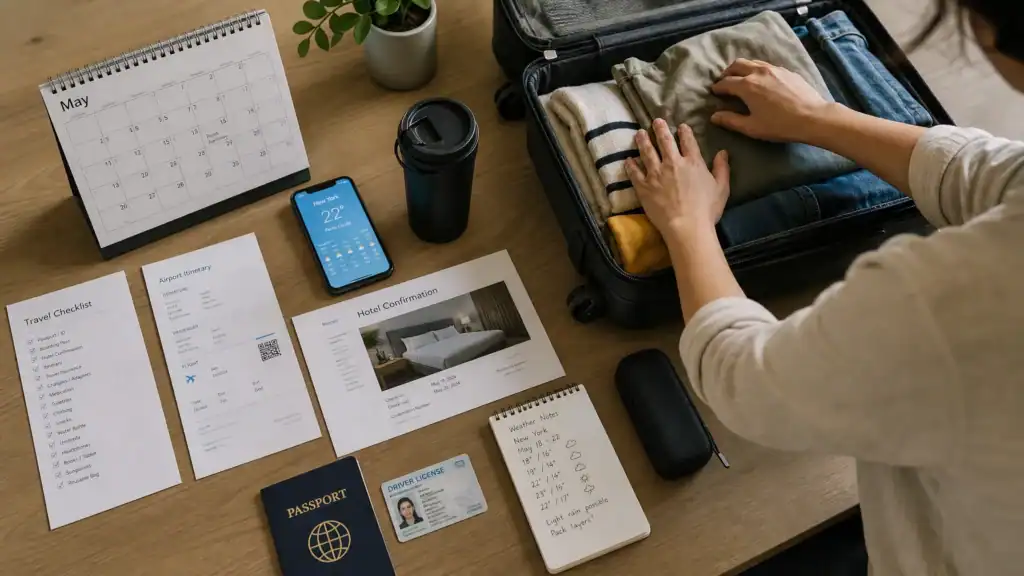
Before you touch a zipper, write down what the trip actually involves. Not what it might involve. What’s on the calendar.
Jot down:
- Destination and travel dates
- Number of nights
- How you’re getting there and getting around
- Expected weather
- Planned activities
- Any formal or special events
- How much walking or outdoor time is realistic
- Hotel amenities you can count on
- Laundry availability
- Medical, medication, and accessibility needs
- Electronics you genuinely need
- Children’s or group supplies
- Baggage allowance for each traveler
- Whether you’re changing hotels mid-trip
- Whether luggage has to go up stairs, onto transit, across a ferry, or down a long cobblestone street
That last one matters more than people expect. A bag that’s easy in a parking garage is not easy on a fourth-floor walk-up.
This step exists to stop you from packing for imaginary situations. A five-night city trip built around walking, one nice dinner, and a hotel gym does not need the same wardrobe as a beach week, a wedding weekend, or a mountain road trip where you’re outside at 6 a.m.
If the destination itself is still flexible, it helps to choose a destination that fits your trip before you plan a wardrobe around it. And if you want the wider planning sequence, you can browse the complete travel-planning library.
Build the Travel Timeline Backward
Pick the first time you absolutely cannot miss. Then walk backward from it.
Fixed times usually include a flight departure, an airline bag-drop cutoff, a boarding cutoff, a train or cruise departure, hotel checkout, a rental-car return, a shuttle departure, a parking reservation, an event start, or a tour check-in.
Then list every stage between your front door and that fixed time:
- Time the flight, train, or event departs
- Time boarding or check-in closes
- Time needed for security or terminal access
- Time needed for airline check-in or bag drop
- Time needed to reach the terminal from where you park or are dropped off
- Shuttle, train, or parking transfer time
- Driving or transit time
- Time needed to load travelers and luggage
- A personal buffer for traffic, weather, and the things you can’t predict
Here’s where people get caught. You think the airport is 35 minutes away, so you leave 35 minutes plus “some cushion.” But the real sequence is: get everyone into the car, drive to off-airport parking, find a space, unload, wait for a shuttle, ride the shuttle, walk to the counter, drop a bag, then clear security. Each piece is small. Together they’re not.
Build the Whole Airport Timeline
Do not ask only: “How long does it take to drive to the airport?” Also ask: “How long does every step take between closing my front door and reaching the gate?”
Families feel this most. Loading luggage, a car seat, a stroller, and three people who each need one more bathroom trip is not a five-minute event.
For the moving parts around the flight itself, it helps to coordinate airport, hotel, and rental-car arrangements as a single plan rather than three separate bookings.
Confirm the Reservations Before Packing Around Them
Schedules change after booking. Sometimes quietly. Open each confirmation and check:
- Flight dates and times
- Departure and arrival airports (not just the city)
- Which airline is actually operating the flight
- Terminal information where it’s available
- Seat assignments
- Baggage allowance for your specific fare
- Hotel dates, address, check-in and checkout times
- Rental-car pickup and return locations
- Rental counter hours, especially for late arrivals
- Any transportation or activity reservations
- Cancellation deadlines
- Special requests and accessibility arrangements
A codeshare flight is a common surprise. You booked with one airline, but another one operates it—and the baggage rules that apply are the operating carrier’s. Worth checking before you weigh anything.
If something looks off, confirm it directly with the provider rather than assuming the app is current.
Two useful references while you’re in there: what to reserve early when planning a trip and how to compare the full cost of your travel arrangements if anything still needs rebooking.
For deeper background on why these confirmations sometimes shift, you can understand how airline schedules and prices change, understand the complete hotel price, and understand rental-car pricing and conditions.
Create One Master Packing List
One long stream of items is hard to check. Categories are easy to check. Build your list in groups, then delete the groups that don’t apply to this trip.
Documents and money
Identification, passport, visa or travel authorization, boarding passes, reservation confirmations, payment cards, emergency contacts, and copies of important documents.
Clothing
Everyday clothing, sleepwear, underwear and socks, outerwear, activity-specific clothing, formal clothing, swimwear, shoes.
Toiletries
Daily hygiene items, skin care, hair care, prescription items, contact-lens supplies, and anything specific to the destination.
Electronics
Phone, charger, power bank, adapters, headphones, laptop or tablet, camera, and the cables each one actually needs.
Health and comfort
Medication, medical devices, a basic travel health kit, glasses, mobility equipment, comfort items, snacks, and a refillable water bottle.
Trip-specific equipment
Beach items, hiking gear, work materials, formal-event items, child supplies, sports equipment, cold-weather gear.
You are not supposed to pack from every category. If you’re going to a conference in a temperate city, the beach and hiking sections vanish. If you’re traveling with a toddler, the child-supply section is longer than everything else combined, and that’s fine.
Packing is a personal system. Some people need more items than others because of health, work, climate, or kids. That’s a logistics question, not a character test.
Decide What Belongs in the Carry-On
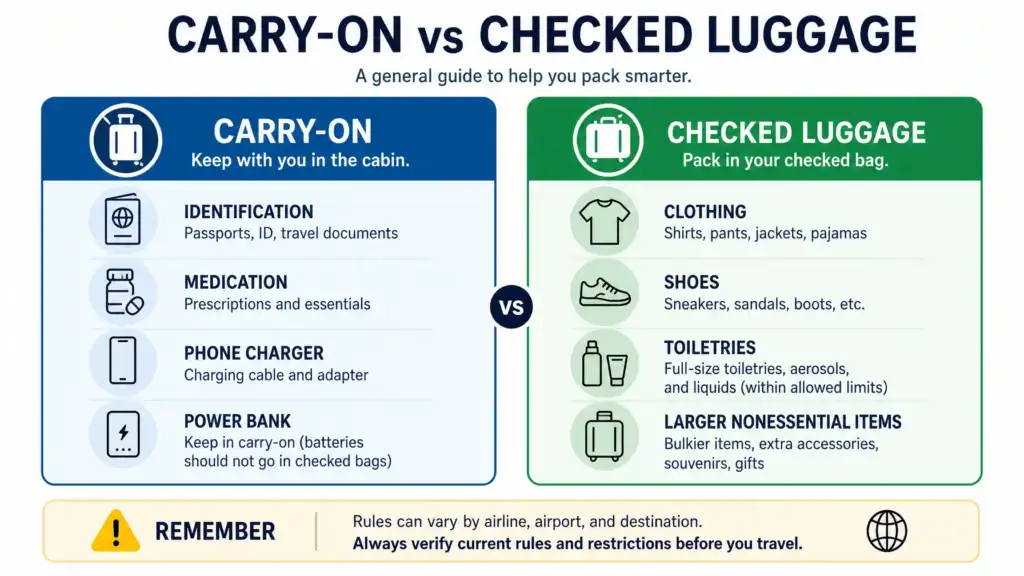
Your carry-on has two jobs: get you through the journey comfortably, and keep you functional if a checked bag shows up later than you do.
Things travelers commonly keep with them:
- Identification and passport
- Required entry documents
- Boarding information
- Medication
- Medical devices
- Valuables
- Electronics and chargers
- A power bank, subject to current FAA and airline rules
- Keys and wallet
- Essential work materials
- One change of clothing
- Basic toiletries allowed through screening
- Necessary child supplies
- Mobility-related supplies
- Copies of confirmations and emergency contacts
- Snacks where permitted
- Anything you’d want during an unexpected two-hour wait
What belongs on your list depends on trip length, whether you’re checking a bag at all, your health needs, who you’re traveling with, your destination, your airline, and what you personally care about having within reach.
For any specific object—a corkscrew, a curling iron, a jar of something—use TSA’s What Can I Bring search tool rather than guessing or relying on what a friend remembers from 2019.
A few things worth being clear about:
- TSA screening rules and airline baggage rules are separate systems. An item can be allowed through security and still be restricted by your airline.
- Destination and international rules may differ from U.S. rules.
- Final screening decisions are made by security personnel at the checkpoint. “Generally permitted” is not the same as “guaranteed through.”
Review Identification and Travel Documents
Do this early in the week, not the night before. A missing document is one of the few travel problems that a good attitude cannot fix at 4 a.m.
Check that:
- The name on each reservation matches the identification that traveler will present
- Your identification is currently acceptable for air travel
- Passports are valid, and valid far enough out for your destination’s requirements
- Any visa or travel authorization is in hand
- You’ve reviewed destination entry requirements
- Documents required for children traveling are sorted
- The rental-car driver has what the rental company requires
- Medical documentation is available where appropriate
- You know whether printed or digital versions are acceptable
- Return-entry requirements are understood
- Emergency contact information is written somewhere accessible
Verify current requirements at the source. Start with TSA’s current acceptable-identification guidance, and for anything crossing a border, the State Department international travel checklist and the broader State Department international travel planning guidance.
Three separate rule sets are in play here, and they don’t overlap neatly:
- TSA rules govern screening.
- Airline policies govern your ticket and baggage.
- Destination governments govern entry.
Requirements change, so check them for this trip rather than remembering the last one. And note that a photo of a passport is a helpful backup—it is not a substitute for the physical document.
Store originals somewhere secure and reachable, keep offline copies on your phone, and save confirmation numbers and provider phone numbers where you can find them without a signal.
Pack Medication and Health Items Deliberately
Medication is not a last-ten-minutes item. Give it its own slot in the week.
Think through:
- Whether you have enough supply for the trip plus a delay
- Refill timing before you leave
- Original labeling where that’s appropriate for you
- Storage requirements, including anything needing refrigeration
- Medical devices and their batteries or charging equipment
- Copies of prescriptions
- Destination restrictions on specific medications
- Time-zone changes and dosing schedules
- A basic travel health kit
- Accessibility needs and any arrangements that must be requested in advance
- Emergency contacts and how you’d access care at the destination
The CDC’s Pack Smart travel health guidance covers the general categories well: prescription and over-the-counter medicines, supplies for existing conditions, insect and sun protection where relevant, and documentation. It’s a good starting framework to adapt.
This article can’t tell you what medications, vaccines, or treatments you need, and it shouldn’t. Talk to a healthcare professional about your specific situation, especially for international travel or trips involving altitude, heat, long flights, or limited medical access.
One thing worth flagging: some countries restrict or prohibit medications that are routine elsewhere, including certain common prescriptions. If you’re traveling internationally, check the destination’s official embassy or consulate guidance rather than assuming.
Pack Electronics and Batteries Using Current Rules
Electronics are more than “did I bring the charger.” Batteries have actual rules attached.
Typical items: phone, laptop, tablet, camera, headphones, e-reader, smartwatch, power bank, charging cables, wall charger, plug adapter, a voltage converter if your device needs one, mobility-device batteries, medical-device batteries, and luggage tracking devices.
Before you pack any of it, check the current official guidance:
- FAA PackSafe guidance for lithium batteries
- FAA guidance for electronic devices containing batteries
- FAA guidance for baggage equipped with lithium batteries
Then check your airline, because carriers can apply their own limits on top of the federal rules.
The questions to answer for each item:
- Does this belong in the cabin or in checked baggage?
- Is the battery installed in a device, or is it a spare?
- What’s its size or rating?
- Do the terminals need protection from short-circuiting?
- Is the battery damaged, swollen, or subject to a recall?
- If it’s smart luggage, does the battery have to be removable?
- Does my specific airline add restrictions?
- Do international rules differ on the return leg?
This is a common, avoidable mistake: a power bank gets tossed into a checked suitcase during a rushed final pack, and it’s discovered at the counter. Check the rules the same week you pack, not from memory.
Beyond pointing you at the official sources, this guide won’t offer technical or hazardous-materials advice. The FAA pages are the place for that.
Pack Clothing Around Activities and Weather
Clothing decisions come from the itinerary, not from the closet. Consider the current forecast, typical seasonal conditions, planned activities, how much time is indoors versus outdoors, any dress requirements, laundry access, what you’re willing to rewear, trip length, transportation, luggage limits, and plain personal comfort.
A method that works:
- List each major activity or day.
- Assign the clothing and footwear each one needs.
- Circle items that cover more than one activity.
- Add weather layers.
- Add sleepwear and basics.
- Remove duplicates that serve the same purpose.
- Keep one backup outfit where it makes sense.
Layering helps in a lot of climates and helps very little in others. In humid heat, three thin layers is just three sweaty layers. Adapt it to where you’re going.
Check the weather about a week out to set expectations, again a few days before departure when the forecast firms up, and once more before you leave if conditions could affect driving, parking, or your flight. Checking once, three weeks in advance, and never again is how people end up in sandals during a cold snap.
If you’re still deciding what a destination’s conditions typically look like, browse destination planning guidance for context.
Pack Shoes Based on the Real Itinerary
Shoes are heavy, bulky, and unusually easy to over-select. Choose them by function:
- How much walking is realistic
- Weather and wet ground
- Formal events
- Beach or pool use
- Outdoor activities
- Driving
- Accessibility or medical needs
- Comfort over long days
- Which pair you can simply wear on travel day
There’s no correct number of pairs. There’s just the question of whether each pair does something the others don’t. A traveler might genuinely need walking shoes, one dressier option, and sandals. That same traveler probably doesn’t need three casual pairs that all do the same job.
One practical note: a trip built around long walking days is a rough place to break in new shoes.
Review Toiletries, Liquids, and Personal-Care Items
Sort toiletries into groups before you pack them:
- Items you need during travel itself
- Items you only need after arrival
- Liquids, gels, and aerosols
- Non-liquid alternatives that simplify screening
- Prescription or medically necessary items
- Things you could easily buy at the destination
- Things that would be difficult or expensive to replace
For any item you’re unsure about, check TSA’s What Can I Bring tool, and skim the general TSA travel tips and screening information before you go so the checkpoint holds no surprises.
Keep in mind:
- Airline baggage rules are separate from screening rules.
- Destination customs and import restrictions can apply to certain products.
- Medically necessary liquids and supplies may follow different screening procedures.
- Declare or present items as current officials instruct at the checkpoint.
Don’t assume the hotel provides toiletries. Many do, some don’t, and vacation rentals often don’t at all.
Use Laundry and Rewearing to Reduce Volume
For longer trips, doing laundry once can cut a suitcase down meaningfully. Options include hotel laundry service, a washing machine in a vacation rental, a nearby laundromat, sink washing, rewearing outer layers, and quick-drying fabrics.
Before you plan around it, verify:
- Whether the facility actually exists at your lodging
- Access and operating hours
- Cost, which can be substantial for hotel service
- Whether detergent is provided
- Realistic drying time
- Whether you’ll have a free block of time to do it
That last point defeats a lot of laundry plans. If every day is booked from breakfast to dinner, the machine downstairs doesn’t help you.
One laundry session makes sense on a two-week trip. On a four-night trip, it’s usually simpler to just pack the extra shirts.
Pack for Children, Groups, and Shared Responsibility
Group packing fails in a predictable way: three people each assume someone else grabbed the shared charger, the medicine bag, or the printed hotel confirmation. Nobody did.
Assign responsibility out loud:
- One packing list per traveler
- One separate list for shared equipment
- One person owns documents
- One person owns chargers and adapters
- One adult verifies child supplies
- Older kids pack their own bag, with a final adult review
- Distribute clothing across checked bags rather than sorting by person
- Label bags clearly
- Make sure more than one adult can access the confirmations
That last item is easy to skip and painful to skip. If all reservations live in one person’s email and that person’s phone dies, the group is stuck at a counter.
For the wider logistics of traveling with kids—seats, car seats, schedules, and pacing—see the family travel planning tips guide.
Prepare for a Checked-Bag Delay
Checking a bag is a completely reasonable choice. Some trips require it. The only thing to plan for is the possibility that the bag and you arrive at different times.
Ask yourself a simple question: if my checked bag showed up a day late, what would I be missing?
For most people the answer includes medication, documents, valuables, chargers, essential work items, one change of clothing, basic toiletries, necessary child supplies, medical or accessibility items, and whatever the first day of the trip requires.
Practical habits that help:
- Keep your baggage receipt or tag number
- Photograph the bag and, for valuable contents, what’s inside
- Put contact information inside the bag as well as outside
- Remove old baggage tags so nothing gets misrouted
- Save the airline’s baggage-service contact information
- Read your airline’s current baggage policy rather than assuming
- Don’t pack irreplaceable items in checked luggage
No one can promise how an airline will respond or what will be reimbursed—policies differ by carrier and circumstance. The point of the carry-on plan is that you don’t need the answer immediately.
For related cost-conscious thinking around bags and fares, see these practical budget travel and baggage tips.
Create a One-Week Travel Preparation Schedule
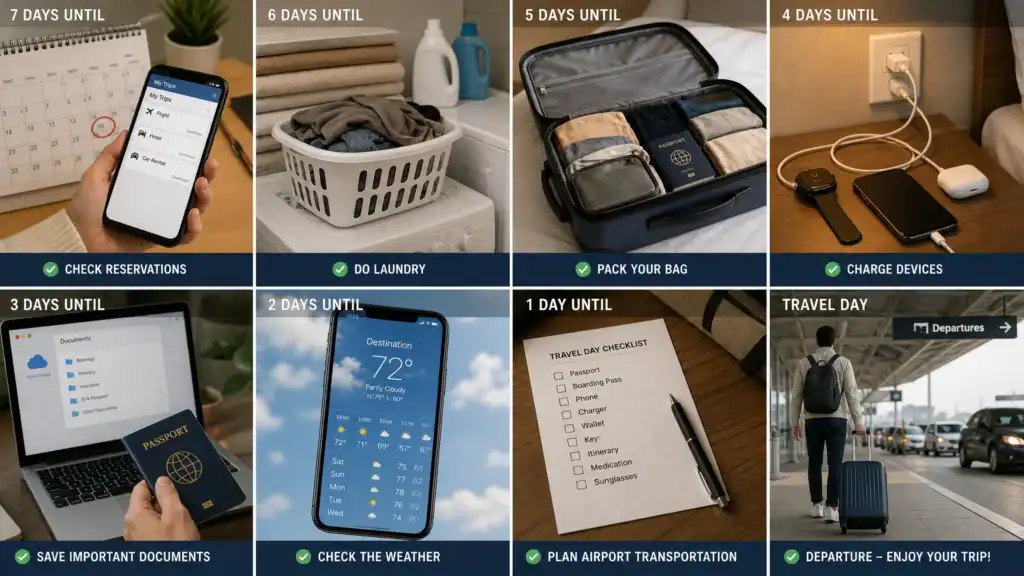
Spread the work out so the final night isn’t a scramble. Adjust the days to fit your trip—a weekend drive needs less runway than a two-week international trip.
Seven days before travel
Review the itinerary. Check identification and passports. Confirm major reservations. Look at the weather. Review baggage rules for the operating airline. Check medication supply and refills. Start laundry. Build your packing categories. Make a list of anything you need to buy.
Three to five days before travel
Lay out trip-specific clothing. Charge devices you rarely use. Download maps, entertainment, and anything you’ll want offline. Confirm airport transportation. Check parking or shuttle arrangements. Reconfirm special requests and accessibility arrangements. Verify rental-car and hotel details. Start organizing documents in one place.
Two days before travel
Pack most clothing. Prepare toiletries. Check the weather again. Save confirmations offline. Check the flight schedule. Note rental-counter and hotel hours. Assemble carry-on essentials. Set aside what you’ll wear on travel day.
Day before travel
Complete airline check-in if it’s available. Recheck terminal and schedule information. Pack chargers you’re no longer using. Charge phones, laptops, and power banks. Prepare medication. Physically place documents with the carry-on—not near it, with it. Set alarms. Confirm your ride. Read through the departure timeline once. Pack snacks if that’s useful.
Travel morning
Add final toiletries. Add anything refrigerated. Walk each room checking outlets, nightstands, and bathroom counters. Check current flight status and traffic. Load bags. Lock up. Leave at the time your timeline says, not the time that feels fine.
This is a framework, not homework. Move things around, skip what doesn’t apply.
Build a Departure-Day Timeline
Fill in the timing column yourself. Your airline, your airport, your parking provider, your group, and your comfort level determine the numbers—not a blog post.
| Departure stage | What to confirm | Time to include | Backup |
|---|---|---|---|
| Waking and final preparation | Alarms set, travel clothes out, who needs the bathroom first | Your realistic morning pace | Second alarm on a different device |
| Packing final-use items | Toiletries, chargers, refrigerated items | Keep this list short and written down | Pre-written “last items” note on the fridge |
| Loading luggage | Number of bags, car seats, strollers, mobility equipment | More than you think for groups | Load the car the night before where safe |
| Leaving home | Doors locked, thermostat, pets, keys | A firm departure time, not a range | Set a phone alarm for the leave time |
| Driving or transit | Route, current traffic, construction, tolls | Check live conditions that morning | Alternate route saved offline |
| Parking | Reservation, lot location, whether it’s on-airport | Time to find a space, not just arrive | Second lot identified in advance |
| Parking shuttle | Frequency, pickup point, luggage capacity | Waiting time plus ride time | Rideshare or drop-off fallback |
| Terminal arrival | Correct terminal for the operating airline | Walking distance from curb or shuttle stop | Terminal map saved offline |
| Airline check-in | Whether you’re already checked in | Counter or kiosk time if needed | Airline app and phone number saved |
| Bag drop | The airline’s current cutoff for your flight | Line length varies by time of day | Know the cutoff before you leave home |
| Security | Which checkpoint, any expedited program you hold | Varies widely by airport and hour | Alternate checkpoint if the airport has one |
| Walking to the gate | Gate number, whether a train or long walk is involved | Larger airports need real walking time | Assistance requested in advance if needed |
| Food or restroom stop | Whether you’ll want it before boarding | Treat as optional, not automatic | Snacks packed in the carry-on |
| Boarding | Boarding time and the airline’s boarding cutoff | Be at the gate before boarding starts | Gate change alerts turned on |
Note the difference between departure time, boarding time, and the boarding cutoff. They are three different clocks, and only one of them is printed in large type on your ticket.
Plan the Return Trip Before Leaving Home
The outbound trip gets planned carefully. The return often gets a shrug and a vague sense that “we’ll leave after breakfast.” That’s where people miss flights.
Before you go, write down:
- Hotel checkout time
- Whether luggage storage is available after checkout (never assume it is)
- Rental-car return address, which is often not the pickup address
- Fuel or charging requirements before return
- Whether a vehicle inspection is part of the return
- Rental shuttle or airport train frequency
- Your departure terminal
- Airline check-in and bag-drop requirements for the return leg
- Traffic patterns at that time of day
- Whether you’re eating before or after the airport
- Time-zone differences
- International departure procedures, which can add steps
- What time your last activity actually ends
Here’s the example that catches people. A noon flight sounds relaxed. Then you add: checkout at 11, loading the car, a fuel stop, a 30-minute drive, the return line, the inspection, the shuttle, the terminal, bag drop, and security. Suddenly that noon flight required leaving the hotel closer to 8:30. Build the return day backward exactly like the outbound day.
For the mechanics of returning a vehicle at an airport, see how to plan an airport rental-car return and pickup, and if you’re weighing whether you need a car at all, compare transportation options at your destination.
Two more that help on the return side: practical car rental savings tips for return-day fuel and fee decisions, and guidance on how to choose a convenient hotel location—because a hotel’s distance from the airport shapes your entire final morning.
Prepare for Delays and Schedule Changes
A timing plan that only works when everything goes right isn’t a plan. Think through what you’d do about a flight delay or cancellation, heavy traffic, a full or closed parking lot, a late shuttle, a long security line, a rental-car problem, a checkout that runs late, bad weather, no internet, a dead phone, a terminal change, or a delayed checked bag.
You don’t need solutions for all of them. You need a small kit that covers most of them:
- Airline contact details
- Hotel phone number
- Rental company number
- A backup way to get to the airport
- Chargers and a charged power bank
- Medication
- Basic toiletries and a change of clothing
- Snacks
- Confirmations saved offline
- More than one payment method
- A rough sense of your cancellation terms
Save your confirmations before you leave. A traveler who downloads everything at home has documents in a rural area with one bar of service. A traveler who relies on the cloud does not.
For understanding what airlines have committed to, review the Department of Transportation airline cancellation and delay dashboard and the Department of Transportation airline refund guidance.
A few distinctions worth holding onto:
- Airline commitments differ from carrier to carrier.
- Disruptions within an airline’s control may be handled differently than weather or air-traffic events.
- A refund right and a courtesy accommodation are not the same thing.
- Hotels, rental-car companies, parking providers, and tour operators follow their own terms. Airline rules don’t apply to them.
- Official guidance changes, so check it near your travel date.
If plans shift and you need to rebuild something quickly, last-minute travel savings and backup strategies covers short-notice options.
Common Packing and Travel Timing Mistakes
Packing before reviewing the itinerary
You end up with clothes for a trip you’re not taking, and missing the one thing this trip actually requires—the rain shell, the dress code item, the adapter. Read the plan first, then pack to it.
Treating drive time as the complete airport timeline
Drive time is one line in a nine-line sequence. Parking, shuttles, walking, bag drop, security, and gate distance are the other eight. A traveler can reach the parking lot exactly on schedule and still miss a flight because the shuttle buffer was never counted.
Waiting until the final night to check documents
An expired passport, a name mismatch, or a missing travel authorization cannot reliably be fixed overnight. Check documents at the start of the week, when there’s still time to do something.
Keeping medication and documents in checked luggage
If the bag is delayed, those items are delayed with it. Keep essentials with you where current rules and your own needs allow. Check TSA guidance for screening specifics and your airline for baggage specifics.
Packing a power bank without checking current rules
Battery rules are real rules, and they distinguish between installed and spare batteries. Confirm placement using FAA PackSafe guidance for lithium batteries and your airline’s current policy before packing.
Packing for every possible situation
There’s a difference between preparing for the activities on your calendar and preparing for a hypothetical gala, hike, and cold front that aren’t happening. Prepare for the realistic version of the trip, then add one flexible layer.
Checking the weather once and never checking again
A forecast checked three weeks out is a rough climate average, not a plan. Check it again a few days before, and once more before you leave if driving or flying conditions could be affected.
Forgetting hotel checkout and rental-return timing
The return day is a full logistics day: checkout, luggage, fuel, drive, return, inspection, shuttle, check-in, security. It needs its own backward timeline, built before you leave home.
Storing every confirmation online
Airport Wi-Fi fails, roaming lapses, apps log you out at the worst moment. Download or screenshot the essentials, and keep at least one contact number reachable without a connection.
Packing every family member’s essentials in one checked bag
If that bag is late, the whole group is affected. Spreading basics across bags means one delay doesn’t leave everyone without a change of clothes.
Leaving chargers connected at home or in the hotel
Chargers, adapters, and cables are the most-forgotten items in travel, in both directions. Do a room-by-room sweep—outlets, nightstands, bathroom counters, behind the desk—before you leave either place.
Ignoring baggage rules for the operating airline
Allowances vary by carrier, by fare type, and by route. A basic fare on the same airline may include different baggage than a standard fare. Check the rules attached to your actual ticket.
A Simple Packing and Travel Timing Process
- Review the itinerary and planned activities.
- Confirm reservations and identify fixed deadlines.
- Build the departure timeline backward from the first time you can’t miss.
- Review identification and document requirements.
- Check the operating airline’s baggage rules for your fare.
- Create packing categories and delete the ones that don’t apply.
- Choose clothing according to activities and weather.
- Separate carry-on essentials from checked items.
- Review medication, health items, electronics, and current battery rules.
- Assign packing responsibilities if you’re traveling as a group.
- Pack most items several days before departure.
- Save confirmations and maps offline.
- Recheck the forecast and flight schedule.
- Pack final-use items the day before or the morning of travel.
- Follow the departure timeline instead of improvising.
- Build a separate backward timeline for hotel checkout and the return trip.
To connect this with the logistics on either end, see how to coordinate airport, hotel, and rental-car preparation, or browse more practical travel-planning guides.
Packing and Travel Timing Checklist
- ✅ Itinerary and planned activities reviewed
- ✅ Weather checked, with another check scheduled before departure
- ✅ Flight, hotel, and rental reservations confirmed
- ✅ Departure and arrival airports verified
- ✅ Identification and passports checked
- ✅ Entry documents reviewed when applicable
- ✅ Traveler names match reservations
- ✅ Airline baggage rules checked for the operating carrier and fare
- ✅ Carry-on and checked-bag items separated
- ✅ Medication and medical items accessible
- ✅ Electronics and batteries packed according to current rules
- ✅ Chargers, cables, and adapters packed
- ✅ Clothing matches activities and weather
- ✅ Shoes match the real itinerary
- ✅ Toiletries reviewed against current screening requirements
- ✅ Laundry plans realistic and verified
- ✅ Family or group responsibilities assigned
- ✅ Essential items not concentrated in a single checked bag
- ✅ Confirmations and maps saved offline
- ✅ Airport transportation arranged
- ✅ Parking and shuttle details saved
- ✅ Departure timeline includes loading and transfer time
- ✅ Hotel checkout time recorded
- ✅ Rental-return address and requirements saved
- ✅ Return-trip airport timing planned backward
- ✅ Delay contacts and backup transportation identified
- ✅ Final weather, traffic, terminal, and flight check planned
- ✅ Room-by-room sweep planned before leaving
Frequently Asked Questions About Packing and Travel Timing
When should I start packing for a trip?
It depends on how complex the trip is. A two-night domestic trip with a carry-on might only need an evening. A two-week international trip with medication refills, visa paperwork, kids, and multiple hotels benefits from starting a week or more out. A useful approach: begin the preparation—documents, refills, laundry, reservation checks—about seven days ahead, and begin physically packing two or three days ahead. That leaves room to discover you’re missing something while stores are still open.
What should I pack first?
Start with the items that are hardest to replace or most disruptive to forget: documents, medication, medical devices, prescription eyewear, chargers, and any specialized equipment your trip requires. Get those into the carry-on early. Next come trip-specific items—formal clothing for an event, hiking gear, work materials. Everyday clothing goes last, because it’s the most flexible and the easiest to adjust once you see how much space remains.
What should always go in a carry-on?
There isn’t one list that fits everyone, but most travelers keep documents, identification, medication, medical devices, valuables, electronics, chargers, and keys with them. Many add a change of clothes and basic toiletries in case a checked bag arrives late. Beyond that, it depends on your trip length, health needs, whether you’re traveling with children, and what you’d genuinely want during a long delay. Build the list around what you couldn’t easily replace or do without for a day.
Should medication go in a carry-on or checked bag?
Many travelers prefer keeping medication accessible in the cabin so it isn’t affected by a delayed bag, but the right answer for you depends on your prescriptions, storage requirements, quantity, and destination. Review current TSA screening guidance for how medications and medically necessary liquids are handled, check your airline’s policies, and confirm any destination restrictions through official embassy or consulate sources. For anything specific to your health, ask your pharmacist or physician rather than relying on general travel advice.
Can power banks go in checked luggage?
Don’t rely on memory or on what someone told you last year. Check the current FAA PackSafe guidance for lithium batteries and then check your airline, since carriers can add their own restrictions. The rules distinguish between batteries installed in devices and spare batteries carried loose, and they may also address terminal protection and battery condition. Verify before you pack rather than sorting it out at the check-in counter.
How do I avoid overpacking?
Pack from your itinerary rather than your closet. List the actual days and activities, assign clothing to each, then remove duplicates that serve the same purpose. Ask of each item: what specific day does this belong to? If there’s no answer, it’s probably a “just in case” item. Keep one or two of those, not ten. And be honest about the trip you’re taking, not the more adventurous version of it you imagined when you booked.
How many outfits should I pack?
There’s no fixed formula. It depends on trip length, whether laundry is realistically available, the weather, how many distinct activities you have, and how comfortable you are rewearing items. A short trip usually means one outfit per day plus a backup. A longer trip usually means planning one laundry session and packing for that interval instead of the full duration. Pieces that mix and match across several days do more work than pieces that only fit one occasion.
How early should I leave for the airport?
No single number works, because the answer is built from your own stages: loading time, drive or transit time, parking and shuttle time, terminal walking, check-in and bag drop, security, and distance to the gate. Add a buffer for traffic and weather. Then check your airline’s guidance for bag-drop and boarding cutoffs, your airport’s information about checkpoint conditions, and your parking provider’s shuttle details. A solo traveler with a carry-on and a family of five checking bags will get very different totals.
What should I do the night before a flight?
Complete airline check-in if it’s available, and recheck the terminal and schedule. Pack the chargers you’re no longer using, and charge every device and power bank. Prepare medication. Physically place documents inside or on top of the carry-on so they can’t be left in a drawer. Set alarms—more than one. Confirm your ride or parking. Read your departure timeline once, out loud if you’re traveling with others, so everyone knows the leave time.
How do I prepare for an early-morning flight?
Front-load everything. For a 5:30 a.m. departure, assume you’ll be functioning poorly and plan accordingly. Pack completely the night before except for toiletries you’ll use at the last minute. Set out travel clothes. Load the car in advance if it’s safe to do so. Leave a short written list of final items where you’ll see it. Set multiple alarms on separate devices. And confirm that your transportation and parking option actually operates at that hour.
How do I pack for changing weather?
Layers help in most temperate climates: a base layer, something insulating, and something wind- or water-resistant. That combination adapts across a wider range than a single heavy item. Check the forecast about a week out, again a few days before, and once more before departure. Pack for the realistic range rather than the extreme, and give yourself one item that handles the outlier—a packable rain shell, a warm layer—rather than a full second wardrobe.
What documents should I keep accessible?
Identification, passport, any required entry documents, boarding information, and payment cards should be with you rather than in a checked bag. Keep confirmation numbers, hotel and rental addresses, and provider phone numbers where you can reach them without internet—screenshots or a printed sheet both work. Emergency contacts belong there too. Digital copies of important documents make useful backups, but they don’t replace originals where an original is required.
How should I prepare for a checked-bag delay?
Assume you might not see the bag on arrival day, and pack your carry-on so that’s survivable: medication, documents, chargers, a change of clothes, basic toiletries, and anything the first day requires. Keep your baggage receipt, put contact information inside the bag, and remove old tags. Photograph the bag and valuable contents. Save the airline’s baggage-service number. Outcomes and compensation vary by carrier and situation, so the goal is simply not needing an immediate answer.
How much time should I allow to return a rental car?
Build it from the steps rather than guessing. You’ll need time to load and drive, stop for fuel or charging if your agreement requires it, find the return facility, wait in the return line, complete any inspection, unload luggage, catch a shuttle or train to the terminal, then check in and clear security. Airport return facilities can be several miles from the terminal. Check the rental company’s return instructions and the airport’s transfer information for your specific location.
What should I check before leaving a hotel?
Do a deliberate sweep: outlets behind nightstands and the desk, the bathroom counter and shower, the closet including the safe, under the bed, and any drawers. Chargers, adapters, and hanging clothes are the most common casualties. Confirm your checkout time in advance and ask whether luggage storage is available if you need it—not every property offers it. Review your bill for anything unexpected, and confirm you have everything before returning the key.
How do I organize packing for a family or group?
Assign ownership. One list per traveler, one list for shared equipment, and one named person responsible for documents, another for chargers, another for child supplies. Have older kids pack themselves with a final adult review. Distribute clothing across bags rather than giving each person their own checked bag, so a single delay doesn’t strip one traveler of everything. Make sure at least two adults can access reservations. Then build in extra loading time—groups are always slower than they estimate.
Conclusion
Packing and timing are the same project. A carefully packed suitcase doesn’t help if you leave twenty minutes late and the shuttle runs on its own schedule. An early departure doesn’t help if the medication is in the bag headed for the cargo hold.
A plan that works connects the itinerary to the weather, the weather to the clothing, the clothing to the baggage, the baggage to the airline’s rules, the documents to the carry-on, the carry-on to a possible delay, the front door to the departure gate, and the hotel checkout to the rental return and the flight home.
Success here isn’t bringing the fewest items or building the most elaborate spreadsheet. It’s simpler than that. You want the things this specific trip requires, the essential things within reach when you need them, documents ready before the week of travel, enough time for each stage of the departure, a return-day plan that got the same attention as the outbound one, and enough slack to absorb a change without panic.
The suitcase doesn’t need to be perfect. The schedule doesn’t need to predict every delay. You just need to know what must be packed, what must stay accessible, and what time you actually have to walk out the front door.
Continue Planning Your Trip
How to Choose the Right Travel Destination
Work through budget, travel time, weather, interests, and transportation to narrow down where your next trip should go.
How to Compare Travel Prices
Compare the complete cost of a trip—airfare, lodging, rental cars, parking, and local transportation—instead of just the headline fare.
What to Reserve Early When Planning a Trip
Identify which reservations need attention well before the packing stage, and which can safely wait.
Airport, Hotel, and Rental Car Preparation
Coordinate airport arrival, hotel check-in, rental pickup, parking, and delay plans as one connected sequence.
Family Travel Planning Tips
Practical guidance on family budgets, seating, lodging, car seats, daily schedules, and carry-on needs.
Transportation Savings Tips
Compare rental cars, public transit, airport transfers, taxis, shuttles, and rideshare at your destination.
Last-Minute Travel Savings
Handle short-notice bookings, changed plans, and rebuilding an itinerary under time pressure.
Travel Tips Hub
Browse the entire SavingsScoutTravel planning collection in one place.
Keep Planning Your Trip
Browse the full SavingsScoutTravel planning collection or explore destination ideas before building your packing list.