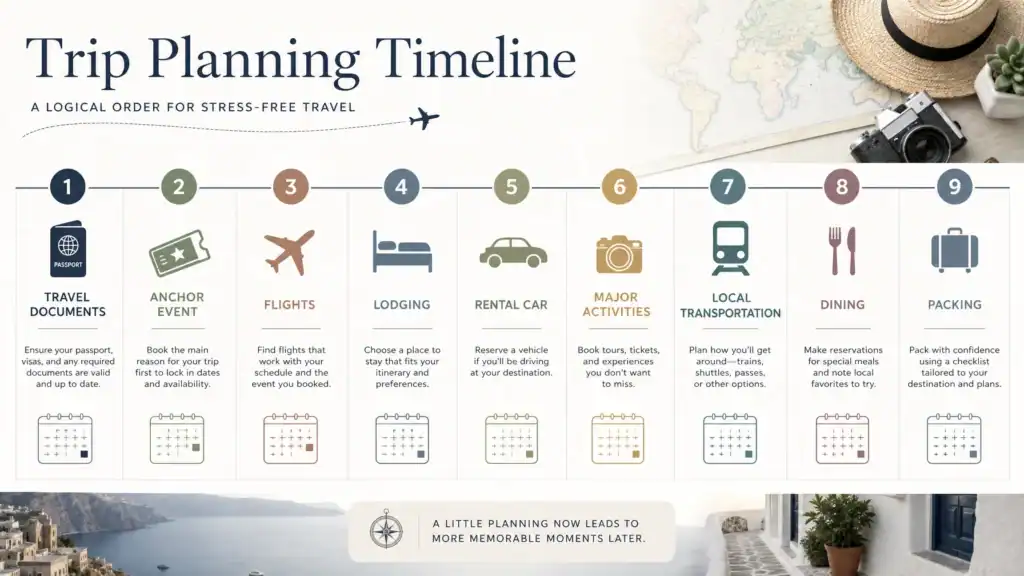

Packing and Travel Timing Tips for an Organized Trip

The trip is three days away. The suitcase is open on the bed with two shirts and a phone charger in it. Confirmation emails are scattered across an inbox, a text thread, and one app you haven’t opened since booking. The forecast has changed twice. And you still haven’t decided what time to leave for the airport.

Most packing and travel timing tips stop at “roll your clothes” and “bring an extra outfit.” That’s not the part that goes wrong. What goes wrong is the passport left in a desk drawer, the shuttle that runs every twenty minutes instead of every five, the medication zipped into a checked bag, and the noon flight that quietly required a 7:30 a.m. hotel departure once fueling and a rental return were added in.

Packing, documents, transportation, airport timing, hotel checkout, and backup plans are one system, not six separate chores. So here’s the principle this whole guide is built on:

Pack to the Itinerary, Time to the Deadline

Pack according to the itinerary, and build the departure schedule backward from the times you cannot miss.

Everything below is a framework you adjust—for your destination, your baggage, your health needs, your group, and your own comfort level. There is no single correct suitcase and no single correct arrival time.

Start With the Itinerary, Not the Suitcase

Before you touch a zipper, write down what the trip actually involves. Not what it might involve. What’s on the calendar.

Jot down:

  • Destination and travel dates
  • Number of nights
  • How you’re getting there and getting around
  • Expected weather
  • Planned activities
  • Any formal or special events
  • How much walking or outdoor time is realistic
  • Hotel amenities you can count on
  • Laundry availability
  • Medical, medication, and accessibility needs
  • Electronics you genuinely need
  • Children’s or group supplies
  • Baggage allowance for each traveler
  • Whether you’re changing hotels mid-trip
  • Whether luggage has to go up stairs, onto transit, across a ferry, or down a long cobblestone street

That last one matters more than people expect. A bag that’s easy in a parking garage is not easy on a fourth-floor walk-up.

This step exists to stop you from packing for imaginary situations. A five-night city trip built around walking, one nice dinner, and a hotel gym does not need the same wardrobe as a beach week, a wedding weekend, or a mountain road trip where you’re outside at 6 a.m.

If the destination itself is still flexible, it helps to choose a destination that fits your trip before you plan a wardrobe around it. And if you want the wider planning sequence, you can browse the complete travel-planning library.

Build the Travel Timeline Backward

Pick the first time you absolutely cannot miss. Then walk backward from it.

Fixed times usually include a flight departure, an airline bag-drop cutoff, a boarding cutoff, a train or cruise departure, hotel checkout, a rental-car return, a shuttle departure, a parking reservation, an event start, or a tour check-in.

Then list every stage between your front door and that fixed time:

  • Time the flight, train, or event departs
  • Time boarding or check-in closes
  • Time needed for security or terminal access
  • Time needed for airline check-in or bag drop
  • Time needed to reach the terminal from where you park or are dropped off
  • Shuttle, train, or parking transfer time
  • Driving or transit time
  • Time needed to load travelers and luggage
  • A personal buffer for traffic, weather, and the things you can’t predict

Here’s where people get caught. You think the airport is 35 minutes away, so you leave 35 minutes plus “some cushion.” But the real sequence is: get everyone into the car, drive to off-airport parking, find a space, unload, wait for a shuttle, ride the shuttle, walk to the counter, drop a bag, then clear security. Each piece is small. Together they’re not.

Build the Whole Airport Timeline

Do not ask only: “How long does it take to drive to the airport?” Also ask: “How long does every step take between closing my front door and reaching the gate?”

Families feel this most. Loading luggage, a car seat, a stroller, and three people who each need one more bathroom trip is not a five-minute event.

For the moving parts around the flight itself, it helps to coordinate airport, hotel, and rental-car arrangements as a single plan rather than three separate bookings.

Confirm the Reservations Before Packing Around Them

Schedules change after booking. Sometimes quietly. Open each confirmation and check:

  • Flight dates and times
  • Departure and arrival airports (not just the city)
  • Which airline is actually operating the flight
  • Terminal information where it’s available
  • Seat assignments
  • Baggage allowance for your specific fare
  • Hotel dates, address, check-in and checkout times
  • Rental-car pickup and return locations
  • Rental counter hours, especially for late arrivals
  • Any transportation or activity reservations
  • Cancellation deadlines
  • Special requests and accessibility arrangements

A codeshare flight is a common surprise. You booked with one airline, but another one operates it—and the baggage rules that apply are the operating carrier’s. Worth checking before you weigh anything.

If something looks off, confirm it directly with the provider rather than assuming the app is current.

Two useful references while you’re in there: what to reserve early when planning a trip and how to compare the full cost of your travel arrangements if anything still needs rebooking.

For deeper background on why these confirmations sometimes shift, you can understand how airline schedules and prices change, understand the complete hotel price, and understand rental-car pricing and conditions.

Create One Master Packing List

One long stream of items is hard to check. Categories are easy to check. Build your list in groups, then delete the groups that don’t apply to this trip.

Documents and money

Identification, passport, visa or travel authorization, boarding passes, reservation confirmations, payment cards, emergency contacts, and copies of important documents.

Clothing

Everyday clothing, sleepwear, underwear and socks, outerwear, activity-specific clothing, formal clothing, swimwear, shoes.

Toiletries

Daily hygiene items, skin care, hair care, prescription items, contact-lens supplies, and anything specific to the destination.

Electronics

Phone, charger, power bank, adapters, headphones, laptop or tablet, camera, and the cables each one actually needs.

Health and comfort

Medication, medical devices, a basic travel health kit, glasses, mobility equipment, comfort items, snacks, and a refillable water bottle.

Trip-specific equipment

Beach items, hiking gear, work materials, formal-event items, child supplies, sports equipment, cold-weather gear.

You are not supposed to pack from every category. If you’re going to a conference in a temperate city, the beach and hiking sections vanish. If you’re traveling with a toddler, the child-supply section is longer than everything else combined, and that’s fine.

Packing is a personal system. Some people need more items than others because of health, work, climate, or kids. That’s a logistics question, not a character test.

Decide What Belongs in the Carry-On

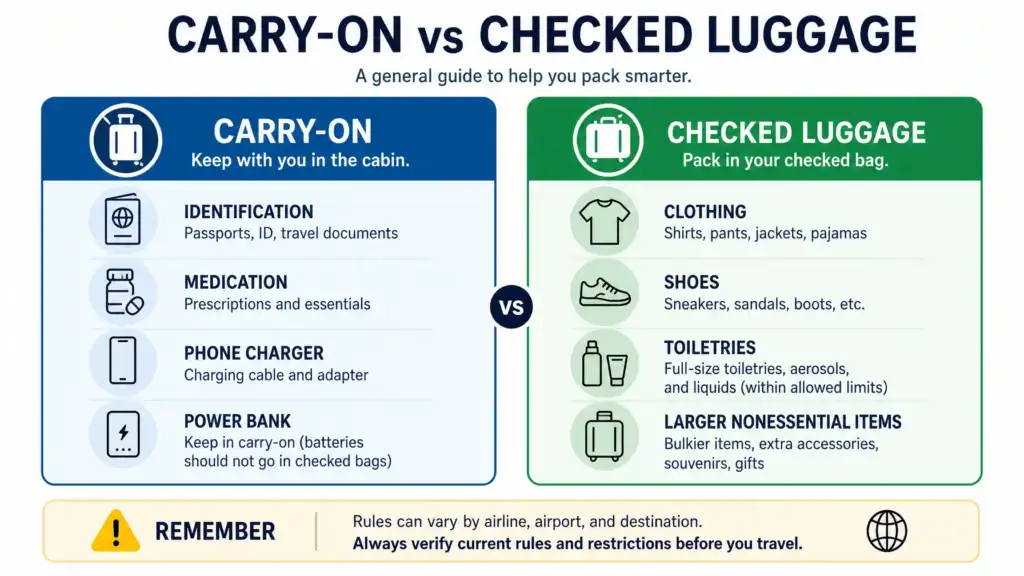
Your carry-on has two jobs: get you through the journey comfortably, and keep you functional if a checked bag shows up later than you do.

Things travelers commonly keep with them:

  • Identification and passport
  • Required entry documents
  • Boarding information
  • Medication
  • Medical devices
  • Valuables
  • Electronics and chargers
  • A power bank, subject to current FAA and airline rules
  • Keys and wallet
  • Essential work materials
  • One change of clothing
  • Basic toiletries allowed through screening
  • Necessary child supplies
  • Mobility-related supplies
  • Copies of confirmations and emergency contacts
  • Snacks where permitted
  • Anything you’d want during an unexpected two-hour wait

What belongs on your list depends on trip length, whether you’re checking a bag at all, your health needs, who you’re traveling with, your destination, your airline, and what you personally care about having within reach.

For any specific object—a corkscrew, a curling iron, a jar of something—use TSA’s What Can I Bring search tool rather than guessing or relying on what a friend remembers from 2019.

A few things worth being clear about:

  • TSA screening rules and airline baggage rules are separate systems. An item can be allowed through security and still be restricted by your airline.
  • Destination and international rules may differ from U.S. rules.
  • Final screening decisions are made by security personnel at the checkpoint. “Generally permitted” is not the same as “guaranteed through.”
Review Identification and Travel Documents

Do this early in the week, not the night before. A missing document is one of the few travel problems that a good attitude cannot fix at 4 a.m.

Check that:

  • The name on each reservation matches the identification that traveler will present
  • Your identification is currently acceptable for air travel
  • Passports are valid, and valid far enough out for your destination’s requirements
  • Any visa or travel authorization is in hand
  • You’ve reviewed destination entry requirements
  • Documents required for children traveling are sorted
  • The rental-car driver has what the rental company requires
  • Medical documentation is available where appropriate
  • You know whether printed or digital versions are acceptable
  • Return-entry requirements are understood
  • Emergency contact information is written somewhere accessible

Verify current requirements at the source. Start with TSA’s current acceptable-identification guidance, and for anything crossing a border, the State Department international travel checklist and the broader State Department international travel planning guidance.

Three separate rule sets are in play here, and they don’t overlap neatly:

  • TSA rules govern screening.
  • Airline policies govern your ticket and baggage.
  • Destination governments govern entry.

Requirements change, so check them for this trip rather than remembering the last one. And note that a photo of a passport is a helpful backup—it is not a substitute for the physical document.

Store originals somewhere secure and reachable, keep offline copies on your phone, and save confirmation numbers and provider phone numbers where you can find them without a signal.

Pack Medication and Health Items Deliberately

Medication is not a last-ten-minutes item. Give it its own slot in the week.

Think through:

  • Whether you have enough supply for the trip plus a delay
  • Refill timing before you leave
  • Original labeling where that’s appropriate for you
  • Storage requirements, including anything needing refrigeration
  • Medical devices and their batteries or charging equipment
  • Copies of prescriptions
  • Destination restrictions on specific medications
  • Time-zone changes and dosing schedules
  • A basic travel health kit
  • Accessibility needs and any arrangements that must be requested in advance
  • Emergency contacts and how you’d access care at the destination

The CDC’s Pack Smart travel health guidance covers the general categories well: prescription and over-the-counter medicines, supplies for existing conditions, insect and sun protection where relevant, and documentation. It’s a good starting framework to adapt.

This article can’t tell you what medications, vaccines, or treatments you need, and it shouldn’t. Talk to a healthcare professional about your specific situation, especially for international travel or trips involving altitude, heat, long flights, or limited medical access.

One thing worth flagging: some countries restrict or prohibit medications that are routine elsewhere, including certain common prescriptions. If you’re traveling internationally, check the destination’s official embassy or consulate guidance rather than assuming.

Pack Electronics and Batteries Using Current Rules

Electronics are more than “did I bring the charger.” Batteries have actual rules attached.

Typical items: phone, laptop, tablet, camera, headphones, e-reader, smartwatch, power bank, charging cables, wall charger, plug adapter, a voltage converter if your device needs one, mobility-device batteries, medical-device batteries, and luggage tracking devices.

Before you pack any of it, check the current official guidance:

Then check your airline, because carriers can apply their own limits on top of the federal rules.

The questions to answer for each item:

  • Does this belong in the cabin or in checked baggage?
  • Is the battery installed in a device, or is it a spare?
  • What’s its size or rating?
  • Do the terminals need protection from short-circuiting?
  • Is the battery damaged, swollen, or subject to a recall?
  • If it’s smart luggage, does the battery have to be removable?
  • Does my specific airline add restrictions?
  • Do international rules differ on the return leg?

This is a common, avoidable mistake: a power bank gets tossed into a checked suitcase during a rushed final pack, and it’s discovered at the counter. Check the rules the same week you pack, not from memory.

Beyond pointing you at the official sources, this guide won’t offer technical or hazardous-materials advice. The FAA pages are the place for that.

Pack Clothing Around Activities and Weather

Clothing decisions come from the itinerary, not from the closet. Consider the current forecast, typical seasonal conditions, planned activities, how much time is indoors versus outdoors, any dress requirements, laundry access, what you’re willing to rewear, trip length, transportation, luggage limits, and plain personal comfort.

A method that works:

  1. List each major activity or day.
  2. Assign the clothing and footwear each one needs.
  3. Circle items that cover more than one activity.
  4. Add weather layers.
  5. Add sleepwear and basics.
  6. Remove duplicates that serve the same purpose.
  7. Keep one backup outfit where it makes sense.

Layering helps in a lot of climates and helps very little in others. In humid heat, three thin layers is just three sweaty layers. Adapt it to where you’re going.

Check the weather about a week out to set expectations, again a few days before departure when the forecast firms up, and once more before you leave if conditions could affect driving, parking, or your flight. Checking once, three weeks in advance, and never again is how people end up in sandals during a cold snap.

If you’re still deciding what a destination’s conditions typically look like, browse destination planning guidance for context.

Pack Shoes Based on the Real Itinerary

Shoes are heavy, bulky, and unusually easy to over-select. Choose them by function:

  • How much walking is realistic
  • Weather and wet ground
  • Formal events
  • Beach or pool use
  • Outdoor activities
  • Driving
  • Accessibility or medical needs
  • Comfort over long days
  • Which pair you can simply wear on travel day

There’s no correct number of pairs. There’s just the question of whether each pair does something the others don’t. A traveler might genuinely need walking shoes, one dressier option, and sandals. That same traveler probably doesn’t need three casual pairs that all do the same job.

One practical note: a trip built around long walking days is a rough place to break in new shoes.

Review Toiletries, Liquids, and Personal-Care Items

Sort toiletries into groups before you pack them:

  • Items you need during travel itself
  • Items you only need after arrival
  • Liquids, gels, and aerosols
  • Non-liquid alternatives that simplify screening
  • Prescription or medically necessary items
  • Things you could easily buy at the destination
  • Things that would be difficult or expensive to replace

For any item you’re unsure about, check TSA’s What Can I Bring tool, and skim the general TSA travel tips and screening information before you go so the checkpoint holds no surprises.

Keep in mind:

  • Airline baggage rules are separate from screening rules.
  • Destination customs and import restrictions can apply to certain products.
  • Medically necessary liquids and supplies may follow different screening procedures.
  • Declare or present items as current officials instruct at the checkpoint.

Don’t assume the hotel provides toiletries. Many do, some don’t, and vacation rentals often don’t at all.

Use Laundry and Rewearing to Reduce Volume

For longer trips, doing laundry once can cut a suitcase down meaningfully. Options include hotel laundry service, a washing machine in a vacation rental, a nearby laundromat, sink washing, rewearing outer layers, and quick-drying fabrics.

Before you plan around it, verify:

  • Whether the facility actually exists at your lodging
  • Access and operating hours
  • Cost, which can be substantial for hotel service
  • Whether detergent is provided
  • Realistic drying time
  • Whether you’ll have a free block of time to do it

That last point defeats a lot of laundry plans. If every day is booked from breakfast to dinner, the machine downstairs doesn’t help you.

One laundry session makes sense on a two-week trip. On a four-night trip, it’s usually simpler to just pack the extra shirts.

Pack for Children, Groups, and Shared Responsibility

Group packing fails in a predictable way: three people each assume someone else grabbed the shared charger, the medicine bag, or the printed hotel confirmation. Nobody did.

Assign responsibility out loud:

  • One packing list per traveler
  • One separate list for shared equipment
  • One person owns documents
  • One person owns chargers and adapters
  • One adult verifies child supplies
  • Older kids pack their own bag, with a final adult review
  • Distribute clothing across checked bags rather than sorting by person
  • Label bags clearly
  • Make sure more than one adult can access the confirmations

That last item is easy to skip and painful to skip. If all reservations live in one person’s email and that person’s phone dies, the group is stuck at a counter.

For the wider logistics of traveling with kids—seats, car seats, schedules, and pacing—see the family travel planning tips guide.

Prepare for a Checked-Bag Delay

Checking a bag is a completely reasonable choice. Some trips require it. The only thing to plan for is the possibility that the bag and you arrive at different times.

Ask yourself a simple question: if my checked bag showed up a day late, what would I be missing?

For most people the answer includes medication, documents, valuables, chargers, essential work items, one change of clothing, basic toiletries, necessary child supplies, medical or accessibility items, and whatever the first day of the trip requires.

Practical habits that help:

  • Keep your baggage receipt or tag number
  • Photograph the bag and, for valuable contents, what’s inside
  • Put contact information inside the bag as well as outside
  • Remove old baggage tags so nothing gets misrouted
  • Save the airline’s baggage-service contact information
  • Read your airline’s current baggage policy rather than assuming
  • Don’t pack irreplaceable items in checked luggage

No one can promise how an airline will respond or what will be reimbursed—policies differ by carrier and circumstance. The point of the carry-on plan is that you don’t need the answer immediately.

For related cost-conscious thinking around bags and fares, see these practical budget travel and baggage tips.

Create a One-Week Travel Preparation Schedule

Spread the work out so the final night isn’t a scramble. Adjust the days to fit your trip—a weekend drive needs less runway than a two-week international trip.

Seven days before travel

Review the itinerary. Check identification and passports. Confirm major reservations. Look at the weather. Review baggage rules for the operating airline. Check medication supply and refills. Start laundry. Build your packing categories. Make a list of anything you need to buy.

Three to five days before travel

Lay out trip-specific clothing. Charge devices you rarely use. Download maps, entertainment, and anything you’ll want offline. Confirm airport transportation. Check parking or shuttle arrangements. Reconfirm special requests and accessibility arrangements. Verify rental-car and hotel details. Start organizing documents in one place.

Two days before travel

Pack most clothing. Prepare toiletries. Check the weather again. Save confirmations offline. Check the flight schedule. Note rental-counter and hotel hours. Assemble carry-on essentials. Set aside what you’ll wear on travel day.

Day before travel

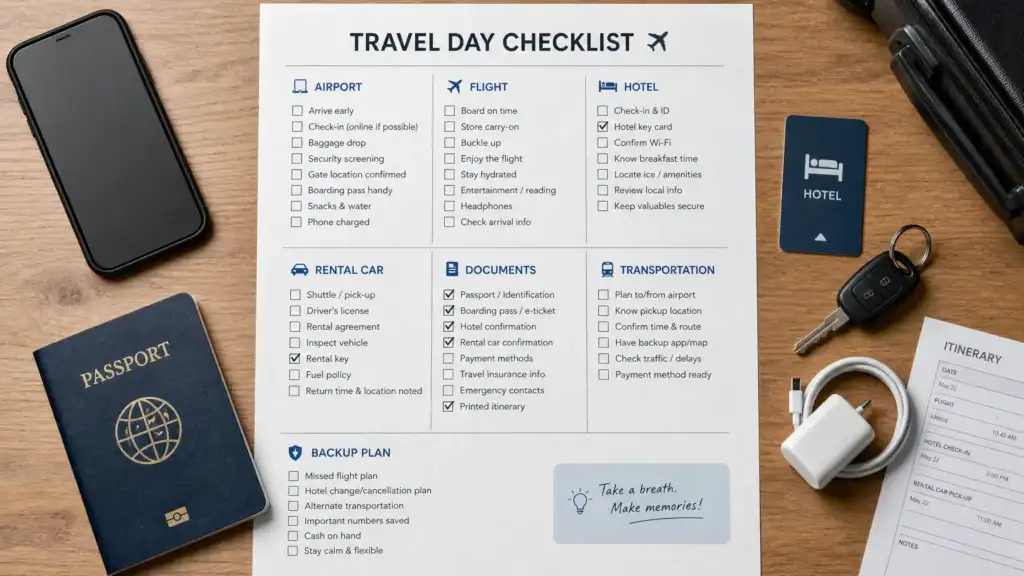
Complete airline check-in if it’s available. Recheck terminal and schedule information. Pack chargers you’re no longer using. Charge phones, laptops, and power banks. Prepare medication. Physically place documents with the carry-on—not near it, with it. Set alarms. Confirm your ride. Read through the departure timeline once. Pack snacks if that’s useful.

Travel morning

Add final toiletries. Add anything refrigerated. Walk each room checking outlets, nightstands, and bathroom counters. Check current flight status and traffic. Load bags. Lock up. Leave at the time your timeline says, not the time that feels fine.

This is a framework, not homework. Move things around, skip what doesn’t apply.

Build a Departure-Day Timeline

Fill in the timing column yourself. Your airline, your airport, your parking provider, your group, and your comfort level determine the numbers—not a blog post.

Departure stageWhat to confirmTime to includeBackup
Waking and final preparationAlarms set, travel clothes out, who needs the bathroom firstYour realistic morning paceSecond alarm on a different device
Packing final-use itemsToiletries, chargers, refrigerated itemsKeep this list short and written downPre-written “last items” note on the fridge
Loading luggageNumber of bags, car seats, strollers, mobility equipmentMore than you think for groupsLoad the car the night before where safe
Leaving homeDoors locked, thermostat, pets, keysA firm departure time, not a rangeSet a phone alarm for the leave time
Driving or transitRoute, current traffic, construction, tollsCheck live conditions that morningAlternate route saved offline
ParkingReservation, lot location, whether it’s on-airportTime to find a space, not just arriveSecond lot identified in advance
Parking shuttleFrequency, pickup point, luggage capacityWaiting time plus ride timeRideshare or drop-off fallback
Terminal arrivalCorrect terminal for the operating airlineWalking distance from curb or shuttle stopTerminal map saved offline
Airline check-inWhether you’re already checked inCounter or kiosk time if neededAirline app and phone number saved
Bag dropThe airline’s current cutoff for your flightLine length varies by time of dayKnow the cutoff before you leave home
SecurityWhich checkpoint, any expedited program you holdVaries widely by airport and hourAlternate checkpoint if the airport has one
Walking to the gateGate number, whether a train or long walk is involvedLarger airports need real walking timeAssistance requested in advance if needed
Food or restroom stopWhether you’ll want it before boardingTreat as optional, not automaticSnacks packed in the carry-on
BoardingBoarding time and the airline’s boarding cutoffBe at the gate before boarding startsGate change alerts turned on

Note the difference between departure time, boarding time, and the boarding cutoff. They are three different clocks, and only one of them is printed in large type on your ticket.

Plan the Return Trip Before Leaving Home

The outbound trip gets planned carefully. The return often gets a shrug and a vague sense that “we’ll leave after breakfast.” That’s where people miss flights.

Before you go, write down:

  • Hotel checkout time
  • Whether luggage storage is available after checkout (never assume it is)
  • Rental-car return address, which is often not the pickup address
  • Fuel or charging requirements before return
  • Whether a vehicle inspection is part of the return
  • Rental shuttle or airport train frequency
  • Your departure terminal
  • Airline check-in and bag-drop requirements for the return leg
  • Traffic patterns at that time of day
  • Whether you’re eating before or after the airport
  • Time-zone differences
  • International departure procedures, which can add steps
  • What time your last activity actually ends

Here’s the example that catches people. A noon flight sounds relaxed. Then you add: checkout at 11, loading the car, a fuel stop, a 30-minute drive, the return line, the inspection, the shuttle, the terminal, bag drop, and security. Suddenly that noon flight required leaving the hotel closer to 8:30. Build the return day backward exactly like the outbound day.

For the mechanics of returning a vehicle at an airport, see how to plan an airport rental-car return and pickup, and if you’re weighing whether you need a car at all, compare transportation options at your destination.

Two more that help on the return side: practical car rental savings tips for return-day fuel and fee decisions, and guidance on how to choose a convenient hotel location—because a hotel’s distance from the airport shapes your entire final morning.

Prepare for Delays and Schedule Changes

A timing plan that only works when everything goes right isn’t a plan. Think through what you’d do about a flight delay or cancellation, heavy traffic, a full or closed parking lot, a late shuttle, a long security line, a rental-car problem, a checkout that runs late, bad weather, no internet, a dead phone, a terminal change, or a delayed checked bag.

You don’t need solutions for all of them. You need a small kit that covers most of them:

  • Airline contact details
  • Hotel phone number
  • Rental company number
  • A backup way to get to the airport
  • Chargers and a charged power bank
  • Medication
  • Basic toiletries and a change of clothing
  • Snacks
  • Confirmations saved offline
  • More than one payment method
  • A rough sense of your cancellation terms

Save your confirmations before you leave. A traveler who downloads everything at home has documents in a rural area with one bar of service. A traveler who relies on the cloud does not.

For understanding what airlines have committed to, review the Department of Transportation airline cancellation and delay dashboard and the Department of Transportation airline refund guidance.

A few distinctions worth holding onto:

  • Airline commitments differ from carrier to carrier.
  • Disruptions within an airline’s control may be handled differently than weather or air-traffic events.
  • A refund right and a courtesy accommodation are not the same thing.
  • Hotels, rental-car companies, parking providers, and tour operators follow their own terms. Airline rules don’t apply to them.
  • Official guidance changes, so check it near your travel date.

If plans shift and you need to rebuild something quickly, last-minute travel savings and backup strategies covers short-notice options.

Common Packing and Travel Timing Mistakes

Packing before reviewing the itinerary

You end up with clothes for a trip you’re not taking, and missing the one thing this trip actually requires—the rain shell, the dress code item, the adapter. Read the plan first, then pack to it.

Treating drive time as the complete airport timeline

Drive time is one line in a nine-line sequence. Parking, shuttles, walking, bag drop, security, and gate distance are the other eight. A traveler can reach the parking lot exactly on schedule and still miss a flight because the shuttle buffer was never counted.

Waiting until the final night to check documents

An expired passport, a name mismatch, or a missing travel authorization cannot reliably be fixed overnight. Check documents at the start of the week, when there’s still time to do something.

Keeping medication and documents in checked luggage

If the bag is delayed, those items are delayed with it. Keep essentials with you where current rules and your own needs allow. Check TSA guidance for screening specifics and your airline for baggage specifics.

Packing a power bank without checking current rules

Battery rules are real rules, and they distinguish between installed and spare batteries. Confirm placement using FAA PackSafe guidance for lithium batteries and your airline’s current policy before packing.

Packing for every possible situation

There’s a difference between preparing for the activities on your calendar and preparing for a hypothetical gala, hike, and cold front that aren’t happening. Prepare for the realistic version of the trip, then add one flexible layer.

Checking the weather once and never checking again

A forecast checked three weeks out is a rough climate average, not a plan. Check it again a few days before, and once more before you leave if driving or flying conditions could be affected.

Forgetting hotel checkout and rental-return timing

The return day is a full logistics day: checkout, luggage, fuel, drive, return, inspection, shuttle, check-in, security. It needs its own backward timeline, built before you leave home.

Storing every confirmation online

Airport Wi-Fi fails, roaming lapses, apps log you out at the worst moment. Download or screenshot the essentials, and keep at least one contact number reachable without a connection.

Packing every family member’s essentials in one checked bag

If that bag is late, the whole group is affected. Spreading basics across bags means one delay doesn’t leave everyone without a change of clothes.

Leaving chargers connected at home or in the hotel

Chargers, adapters, and cables are the most-forgotten items in travel, in both directions. Do a room-by-room sweep—outlets, nightstands, bathroom counters, behind the desk—before you leave either place.

Ignoring baggage rules for the operating airline

Allowances vary by carrier, by fare type, and by route. A basic fare on the same airline may include different baggage than a standard fare. Check the rules attached to your actual ticket.

A Simple Packing and Travel Timing Process

  1. Review the itinerary and planned activities.
  2. Confirm reservations and identify fixed deadlines.
  3. Build the departure timeline backward from the first time you can’t miss.
  4. Review identification and document requirements.
  5. Check the operating airline’s baggage rules for your fare.
  6. Create packing categories and delete the ones that don’t apply.
  7. Choose clothing according to activities and weather.
  8. Separate carry-on essentials from checked items.
  9. Review medication, health items, electronics, and current battery rules.
  10. Assign packing responsibilities if you’re traveling as a group.
  11. Pack most items several days before departure.
  12. Save confirmations and maps offline.
  13. Recheck the forecast and flight schedule.
  14. Pack final-use items the day before or the morning of travel.
  15. Follow the departure timeline instead of improvising.
  16. Build a separate backward timeline for hotel checkout and the return trip.

To connect this with the logistics on either end, see how to coordinate airport, hotel, and rental-car preparation, or browse more practical travel-planning guides.

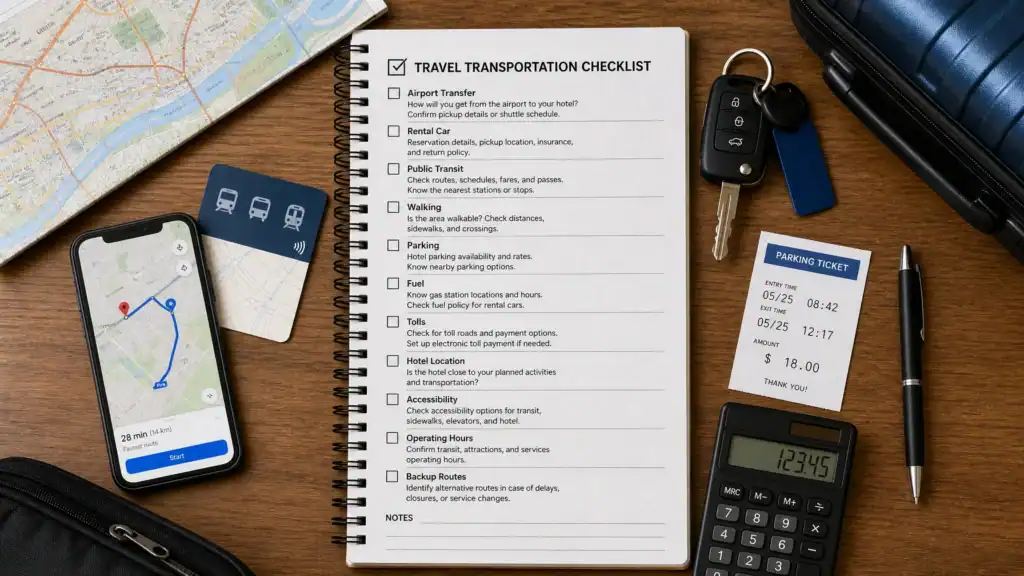
Packing and Travel Timing Checklist

  • ✅ Itinerary and planned activities reviewed
  • ✅ Weather checked, with another check scheduled before departure
  • ✅ Flight, hotel, and rental reservations confirmed
  • ✅ Departure and arrival airports verified
  • ✅ Identification and passports checked
  • ✅ Entry documents reviewed when applicable
  • ✅ Traveler names match reservations
  • ✅ Airline baggage rules checked for the operating carrier and fare
  • ✅ Carry-on and checked-bag items separated
  • ✅ Medication and medical items accessible
  • ✅ Electronics and batteries packed according to current rules
  • ✅ Chargers, cables, and adapters packed
  • ✅ Clothing matches activities and weather
  • ✅ Shoes match the real itinerary
  • ✅ Toiletries reviewed against current screening requirements
  • ✅ Laundry plans realistic and verified
  • ✅ Family or group responsibilities assigned
  • ✅ Essential items not concentrated in a single checked bag
  • ✅ Confirmations and maps saved offline
  • ✅ Airport transportation arranged
  • ✅ Parking and shuttle details saved
  • ✅ Departure timeline includes loading and transfer time
  • ✅ Hotel checkout time recorded
  • ✅ Rental-return address and requirements saved
  • ✅ Return-trip airport timing planned backward
  • ✅ Delay contacts and backup transportation identified
  • ✅ Final weather, traffic, terminal, and flight check planned
  • ✅ Room-by-room sweep planned before leaving

Frequently Asked Questions About Packing and Travel Timing

When should I start packing for a trip?

It depends on how complex the trip is. A two-night domestic trip with a carry-on might only need an evening. A two-week international trip with medication refills, visa paperwork, kids, and multiple hotels benefits from starting a week or more out. A useful approach: begin the preparation—documents, refills, laundry, reservation checks—about seven days ahead, and begin physically packing two or three days ahead. That leaves room to discover you’re missing something while stores are still open.

What should I pack first?

Start with the items that are hardest to replace or most disruptive to forget: documents, medication, medical devices, prescription eyewear, chargers, and any specialized equipment your trip requires. Get those into the carry-on early. Next come trip-specific items—formal clothing for an event, hiking gear, work materials. Everyday clothing goes last, because it’s the most flexible and the easiest to adjust once you see how much space remains.

What should always go in a carry-on?

There isn’t one list that fits everyone, but most travelers keep documents, identification, medication, medical devices, valuables, electronics, chargers, and keys with them. Many add a change of clothes and basic toiletries in case a checked bag arrives late. Beyond that, it depends on your trip length, health needs, whether you’re traveling with children, and what you’d genuinely want during a long delay. Build the list around what you couldn’t easily replace or do without for a day.

Should medication go in a carry-on or checked bag?

Many travelers prefer keeping medication accessible in the cabin so it isn’t affected by a delayed bag, but the right answer for you depends on your prescriptions, storage requirements, quantity, and destination. Review current TSA screening guidance for how medications and medically necessary liquids are handled, check your airline’s policies, and confirm any destination restrictions through official embassy or consulate sources. For anything specific to your health, ask your pharmacist or physician rather than relying on general travel advice.

Can power banks go in checked luggage?

Don’t rely on memory or on what someone told you last year. Check the current FAA PackSafe guidance for lithium batteries and then check your airline, since carriers can add their own restrictions. The rules distinguish between batteries installed in devices and spare batteries carried loose, and they may also address terminal protection and battery condition. Verify before you pack rather than sorting it out at the check-in counter.

How do I avoid overpacking?

Pack from your itinerary rather than your closet. List the actual days and activities, assign clothing to each, then remove duplicates that serve the same purpose. Ask of each item: what specific day does this belong to? If there’s no answer, it’s probably a “just in case” item. Keep one or two of those, not ten. And be honest about the trip you’re taking, not the more adventurous version of it you imagined when you booked.

How many outfits should I pack?

There’s no fixed formula. It depends on trip length, whether laundry is realistically available, the weather, how many distinct activities you have, and how comfortable you are rewearing items. A short trip usually means one outfit per day plus a backup. A longer trip usually means planning one laundry session and packing for that interval instead of the full duration. Pieces that mix and match across several days do more work than pieces that only fit one occasion.

How early should I leave for the airport?

No single number works, because the answer is built from your own stages: loading time, drive or transit time, parking and shuttle time, terminal walking, check-in and bag drop, security, and distance to the gate. Add a buffer for traffic and weather. Then check your airline’s guidance for bag-drop and boarding cutoffs, your airport’s information about checkpoint conditions, and your parking provider’s shuttle details. A solo traveler with a carry-on and a family of five checking bags will get very different totals.

What should I do the night before a flight?

Complete airline check-in if it’s available, and recheck the terminal and schedule. Pack the chargers you’re no longer using, and charge every device and power bank. Prepare medication. Physically place documents inside or on top of the carry-on so they can’t be left in a drawer. Set alarms—more than one. Confirm your ride or parking. Read your departure timeline once, out loud if you’re traveling with others, so everyone knows the leave time.

How do I prepare for an early-morning flight?

Front-load everything. For a 5:30 a.m. departure, assume you’ll be functioning poorly and plan accordingly. Pack completely the night before except for toiletries you’ll use at the last minute. Set out travel clothes. Load the car in advance if it’s safe to do so. Leave a short written list of final items where you’ll see it. Set multiple alarms on separate devices. And confirm that your transportation and parking option actually operates at that hour.

How do I pack for changing weather?

Layers help in most temperate climates: a base layer, something insulating, and something wind- or water-resistant. That combination adapts across a wider range than a single heavy item. Check the forecast about a week out, again a few days before, and once more before departure. Pack for the realistic range rather than the extreme, and give yourself one item that handles the outlier—a packable rain shell, a warm layer—rather than a full second wardrobe.

What documents should I keep accessible?

Identification, passport, any required entry documents, boarding information, and payment cards should be with you rather than in a checked bag. Keep confirmation numbers, hotel and rental addresses, and provider phone numbers where you can reach them without internet—screenshots or a printed sheet both work. Emergency contacts belong there too. Digital copies of important documents make useful backups, but they don’t replace originals where an original is required.

How should I prepare for a checked-bag delay?

Assume you might not see the bag on arrival day, and pack your carry-on so that’s survivable: medication, documents, chargers, a change of clothes, basic toiletries, and anything the first day requires. Keep your baggage receipt, put contact information inside the bag, and remove old tags. Photograph the bag and valuable contents. Save the airline’s baggage-service number. Outcomes and compensation vary by carrier and situation, so the goal is simply not needing an immediate answer.

How much time should I allow to return a rental car?

Build it from the steps rather than guessing. You’ll need time to load and drive, stop for fuel or charging if your agreement requires it, find the return facility, wait in the return line, complete any inspection, unload luggage, catch a shuttle or train to the terminal, then check in and clear security. Airport return facilities can be several miles from the terminal. Check the rental company’s return instructions and the airport’s transfer information for your specific location.

What should I check before leaving a hotel?

Do a deliberate sweep: outlets behind nightstands and the desk, the bathroom counter and shower, the closet including the safe, under the bed, and any drawers. Chargers, adapters, and hanging clothes are the most common casualties. Confirm your checkout time in advance and ask whether luggage storage is available if you need it—not every property offers it. Review your bill for anything unexpected, and confirm you have everything before returning the key.

How do I organize packing for a family or group?

Assign ownership. One list per traveler, one list for shared equipment, and one named person responsible for documents, another for chargers, another for child supplies. Have older kids pack themselves with a final adult review. Distribute clothing across bags rather than giving each person their own checked bag, so a single delay doesn’t strip one traveler of everything. Make sure at least two adults can access reservations. Then build in extra loading time—groups are always slower than they estimate.

Conclusion

Packing and timing are the same project. A carefully packed suitcase doesn’t help if you leave twenty minutes late and the shuttle runs on its own schedule. An early departure doesn’t help if the medication is in the bag headed for the cargo hold.

A plan that works connects the itinerary to the weather, the weather to the clothing, the clothing to the baggage, the baggage to the airline’s rules, the documents to the carry-on, the carry-on to a possible delay, the front door to the departure gate, and the hotel checkout to the rental return and the flight home.

Success here isn’t bringing the fewest items or building the most elaborate spreadsheet. It’s simpler than that. You want the things this specific trip requires, the essential things within reach when you need them, documents ready before the week of travel, enough time for each stage of the departure, a return-day plan that got the same attention as the outbound one, and enough slack to absorb a change without panic.

The suitcase doesn’t need to be perfect. The schedule doesn’t need to predict every delay. You just need to know what must be packed, what must stay accessible, and what time you actually have to walk out the front door.

Continue Planning Your Trip

How to Choose the Right Travel Destination

Work through budget, travel time, weather, interests, and transportation to narrow down where your next trip should go.

How to Compare Travel Prices

Compare the complete cost of a trip—airfare, lodging, rental cars, parking, and local transportation—instead of just the headline fare.

What to Reserve Early When Planning a Trip

Identify which reservations need attention well before the packing stage, and which can safely wait.

Airport, Hotel, and Rental Car Preparation

Coordinate airport arrival, hotel check-in, rental pickup, parking, and delay plans as one connected sequence.

Family Travel Planning Tips

Practical guidance on family budgets, seating, lodging, car seats, daily schedules, and carry-on needs.

Transportation Savings Tips

Compare rental cars, public transit, airport transfers, taxis, shuttles, and rideshare at your destination.

Last-Minute Travel Savings

Handle short-notice bookings, changed plans, and rebuilding an itinerary under time pressure.

Travel Tips Hub

Browse the entire SavingsScoutTravel planning collection in one place.

Keep Planning Your Trip

Browse the full SavingsScoutTravel planning collection or explore destination ideas before building your packing list.


Family Travel Planning Tips for a Smoother Trip

Aviator dog mascot helping a family plan flights, lodging, seating, car seats, meals, documents, travel time, and backup plans for a smoother trip.

The destination looks great. The airfare seems manageable. Someone in the family has already started a list of things to see. Then the practical questions arrive all at once: Where is everyone actually sleeping? Does the rental car hold the stroller and the suitcases? Will the kids be seated next to an adult on the plane? And what happens between a 9:00 a.m. arrival and a 4:00 p.m. hotel check-in?

The most useful family travel planning tips have very little to do with building a perfect schedule. They have to do with building a trip that has enough structure to function and enough slack to recover when something shifts—because something usually does.

Here’s the principle worth carrying through every decision below:

Plan for Your Family’s Real Pace

Plan around your family’s real pace, not the maximum number of activities that fit on a calendar.

A family trip isn’t an adult itinerary with children attached to it. It involves longer transitions, more luggage, different energy levels, meal timing that can’t slide by two hours, bathroom breaks, caregiving responsibilities, strollers or mobility equipment, car seats, sleeping arrangements, and a group of people whose interests don’t line up neatly. Planning for those realities from the start is what makes the rest of the trip easier.

Family planning flights, lodging, transportation, and activities for an upcoming trip

Start With the Family’s Needs and Priorities

Most planning starts with a place. It works better when it starts with the people.

Before you look at flights or hotels, write down what you’re actually working with:

  • Number of travelers and who is responsible for whom
  • Ages of children—and the fact that two kids the same age can need completely different things
  • Sleeping needs, including nap and bedtime routines
  • Mobility and accessibility needs
  • Dietary considerations and medical needs
  • Activity interests, including the adults’ and teenagers’
  • Tolerance for long travel days
  • Who needs quiet time, and how much
  • Budget expectations
  • Fixed dates: a wedding, a school break, a reunion, a work deadline
  • Nonnegotiable activities
  • Things you’re genuinely willing to skip

That last line matters more than people expect. A trip where nothing can be skipped is a trip with no room to breathe.

Once the list exists, narrow it to three shared priorities. Not fifteen. Three. Common ones include easy transportation, a hotel with enough space, one major attraction, pool or beach time, a kitchen, walkable dining, a nonstop flight, outdoor time, time with relatives, or simply a slower schedule than last year.

Choose Three Shared Priorities

For this family trip, the three things that matter most are __________, __________, and __________.

Those three answers will settle almost every tradeoff that comes up later. When the suite costs more than two standard rooms, or the nonstop costs more than the connection, you won’t be debating from scratch—you’ll be checking the decision against what you already agreed mattered.

If you’re still comparing places, it helps to choose a destination that fits your group before locking in dates. You can also browse the complete travel-planning library if you’d rather work through the process in order.

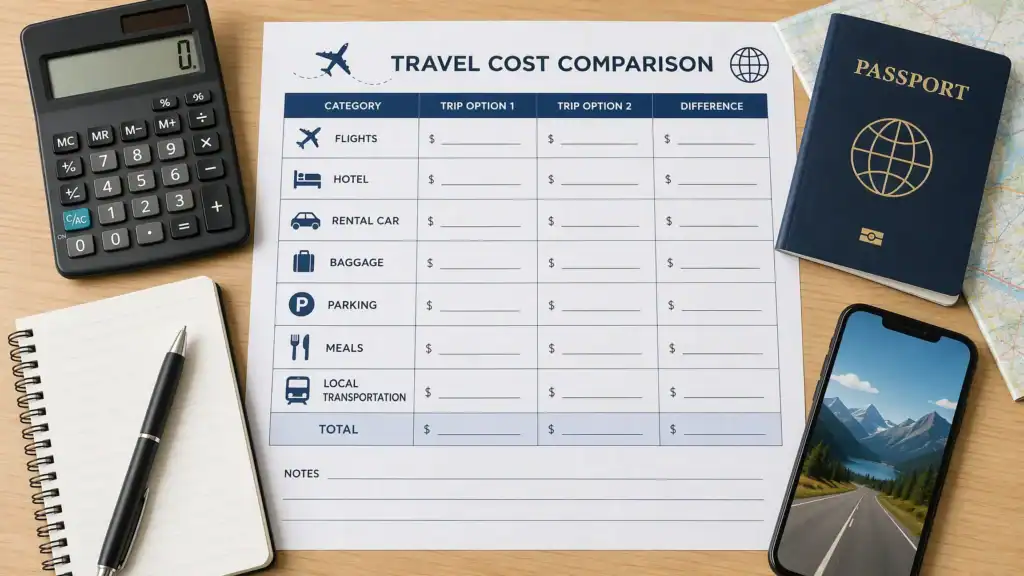
Build a Complete Family Travel Budget

The advertised airfare and the nightly hotel rate are the beginning of a family budget, not the shape of it.

A fuller list looks like this:

  • Getting to the departure airport, plus parking
  • Airfare for every traveler, including seat-selection costs when they apply
  • Baggage
  • Lodging, plus any required property fees and parking
  • Rental car, child seats or other equipment, fuel, and tolls
  • Public transportation and airport transfers
  • Meals, snacks, and groceries
  • Activities and admission
  • Stroller or equipment rentals
  • Travel documents and travel-health preparation
  • Laundry
  • Emergency purchases—the forgotten charger, the replacement rain jacket
  • A buffer for changed plans

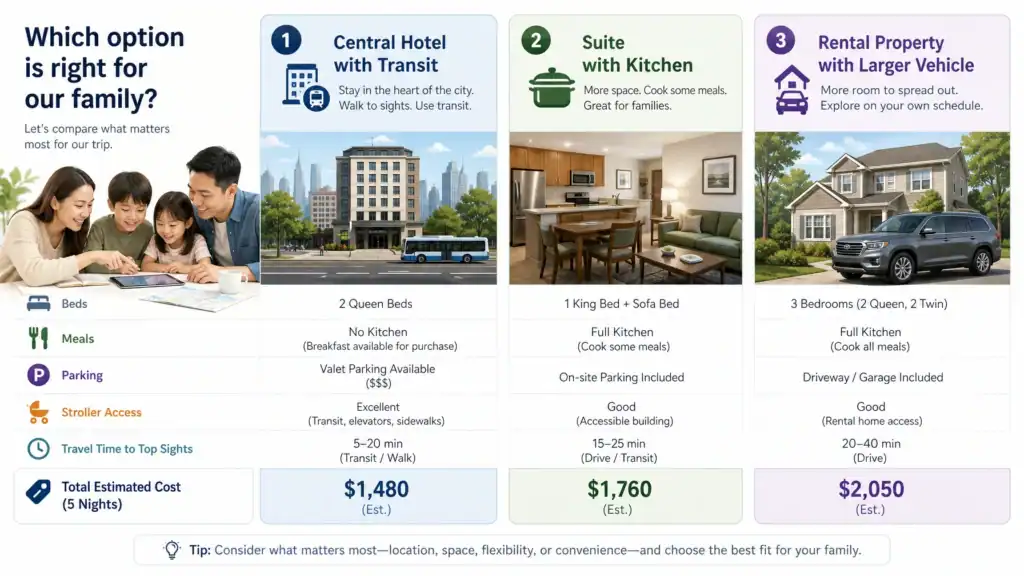
Here’s the part that catches families off guard: costs don’t rise in a straight line. A suite sometimes costs less than two rooms. A kitchen may cost more per night and still lower the total trip cost by absorbing breakfasts and a few dinners. A centrally located hotel can eliminate a rental car entirely. A more expensive nonstop can erase an airport meal, a long transfer, and—in some cases—an overnight hotel near the airport. And a larger rental vehicle may stop being optional the moment you count two car seats, a stroller, and everyone’s luggage.

Set three numbers: a preferred budget, a firm maximum, and a contingency amount you hope not to touch.

Then compare the complete cost of your family trip rather than the individual line items. It’s also worth taking a few minutes to understand how airline prices change, to understand the complete hotel price including fees and parking, and to understand rental-car pricing before you assume the quoted daily rate is the number you’ll pay.

Match the Trip Length to the Travel Effort

Flight duration is a poor measure of how hard a travel day will be. Door-to-door time is the honest one.

Count all of it: getting everyone dressed and out the door, driving to the airport, parking or drop-off, check-in, security, boarding, the flight itself, any connections, baggage claim, rental-car pickup or ground transportation, hotel check-in, time-zone adjustment, and recovery once you arrive.

A four-night trip with two connections in each direction can leave a family with roughly two comfortable days at the destination. That’s not automatically wrong—sometimes the destination is the entire point, or you’re visiting family, or the route is the only one available. But it’s worth seeing clearly. A nearby city reached by one nonstop flight or a manageable drive may deliver far more usable vacation time for the same money.

None of this means families should avoid long flights or international travel. Plenty of children travel long distances well. The right call depends on age and temperament, trip length, schedule flexibility, the reason for the trip, previous travel experience, accessibility needs, which routes exist, and what you can spend.

Once the shape of the trip is settled, review what to reserve early for a family trip—the pieces that are hardest to replace usually deserve attention first.

Choose Lodging Based on How the Family Will Use It

For a family, the room isn’t just where you sleep. It’s where someone naps, where a bag gets repacked, where a kid decompresses after a loud afternoon, and where breakfast might happen.

Before booking, verify:

  • Maximum occupancy and the actual number of sleeping surfaces
  • Bed types—”sleeps four” and “two double beds” are not the same claim
  • Crib or rollaway availability, and whether one fits in the room
  • Whether connecting rooms are guaranteed or only requested
  • Suite layout and whether a door separates the sleeping area
  • Kitchen or refrigerator access
  • Laundry
  • Bathtub versus shower only
  • Accessibility features and elevator access
  • Noise—street side, near elevators, near a nightclub
  • Pool rules and hours
  • Breakfast, parking, and distance to your main activities
  • Public transportation, grocery stores, and restaurants nearby
  • Check-in and checkout timing
  • Cancellation terms

Then think about format. A standard hotel room, a family suite, two rooms, connecting rooms, an aparthotel, a vacation rental, a cabin, a resort, or staying with relatives all solve different problems. None is universally best.

A common example: a standard room technically sleeps four. It works fine until one child naps at midday and three other people have to sit in the dark in silence. A suite or a rental with a separate sleeping area may cost more per night and still be the decision that makes the whole trip function.

For location tradeoffs, this guide on how to choose a convenient hotel location is a good starting point, along with practical hotel savings tips and destination-based hotel guidance. If your dates are flexible, it’s also worth reading about the best time to book hotels.

One caution: confirm essential room features directly with the property. A crib, a connecting room, a specific bed configuration, an accessible bathroom, or an early check-in is a request until the hotel confirms it. Get the confirmation in writing when you can.

Family comparing hotel space, transportation, meals, parking, and total trip costs

Compare Flights Based on the Whole Family’s Travel Day

The lowest fare and the easiest itinerary are sometimes the same flight. Often they aren’t.

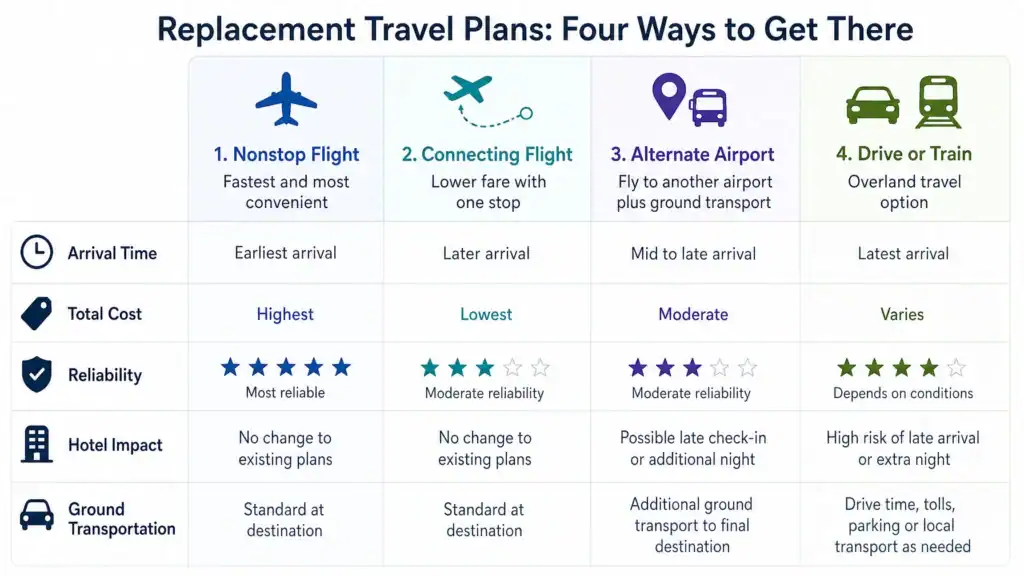
Compare departure and arrival times, nonstop versus connecting routes, total travel time, connection length, airport distance from home and from your lodging, baggage allowance, seat-selection and family-seating policies, aircraft type (and whether it might change), how the timing lines up with meals and sleep, ground transportation after arrival, and the refund and change terms.

A few situations families run into:

  • A 6:00 a.m. departure looks inexpensive until it requires an airport hotel or a very early wake-up that ends the night before it’s finished.
  • A four-hour connection adds two meals and a lot of entertainment.
  • A late arrival can land after the rental counter closes or after the front desk is thinly staffed.
  • A nonstop costs more but removes the missed-connection scenario entirely—which matters more with a group that can’t sprint across a terminal.
  • A cheaper secondary airport can add ninety minutes of driving on both ends.

For timing and fare strategy, see the best time to book flights and these practical cheap-flight strategies. If you’re building the trip around a fare, these budget travel tips for flight planning and the flight destination guides can help you compare routes before committing.

Review Family Seating Before Travel Day

Family seating policies differ by airline, and they change. Treat seat assignments as something to verify, not something to assume.

Practical steps:

  • Book adults and children on the same reservation where possible.
  • Read the airline’s current family-seating policy on its own website.
  • Check your seat assignments right after booking—not the week of travel.
  • Recheck if the aircraft or schedule changes, which can reshuffle seats.
  • Contact the airline if children aren’t seated beside an accompanying adult.
  • If you booked through a third-party platform, confirm the seats directly with the airline.
  • Don’t assume unassigned seats will land your family together automatically.
  • If a seating issue is still unresolved, speak with an airline representative at the airport before boarding rather than hoping to sort it out onboard.

Two official resources are worth reviewing before you book: the Department of Transportation family-seating dashboard and the DOT’s tips for families flying together, which links out to individual airline pages.

Because airline commitments can be added or withdrawn, check the dashboard yourself close to your travel dates rather than relying on what a policy looked like last year. And be aware that no single rule guarantees a particular seat arrangement for every child in every circumstance.

Understand Child Restraint Options for Air Travel

How an infant or young child travels on the aircraft is a decision to research early, not at the gate.

Things families typically weigh:

  • Whether to purchase a separate seat for a child who could otherwise travel on an adult’s lap
  • The airline’s current policy for children under two
  • Whether a child restraint system is approved for use on aircraft—approved restraints carry labeling indicating this, and the FAA describes what to look for
  • Where an approved restraint may be placed in the cabin, including exit-row restrictions and window-seat conventions that vary by airline
  • The physical reality of carrying a restraint through an airport and installing it in a narrow row
  • Whether the restraint fits the seat on your specific aircraft
  • The difference between a restraint approved for aircraft use and a vehicle-only booster seat, which generally is not usable during flight
  • Keeping the manufacturer’s instructions with you

The FAA’s guidance for flying safely with children is the right starting point, and your airline’s own page is the second stop, because airline rules can be more specific than the general federal guidance.

Not every car seat is approved for airplane use, and the only reliable way to know is to check the label, the manufacturer’s instructions, and the airline’s requirements together. This article can’t tell you what’s appropriate for a particular child—that depends on their age, size, and the equipment you own.

Prepare Children for the Airport and Security Screening

An airport is loud, crowded, and full of instructions from strangers. Walking through the sequence beforehand often does more good than anything you pack.

Talk through: checking bags, waiting in line, showing documents, putting belongings in bins, walking through screening, how a stroller gets screened, repacking on the other side, finding the gate, boarding, unfamiliar aircraft sounds, seat-belt expectations, and the fact that waiting is part of it.

Check identification requirements in advance using TSA’s current identification guidance. Keep in mind that an airline’s document requirements are not necessarily identical to TSA screening rules—airlines set their own policies for things like proof of age for infants and lap children, so confirm with the carrier as well.

For anything you’re unsure about—formula, breast milk, baby food, ice packs, medication, strollers, car seats, electronics, or a specific children’s item—use TSA’s What Can I Bring tool rather than a secondhand list. Guidance changes, and the official tool is the current version.

If you want to line up the whole travel day in order, this guide on how to coordinate airport, hotel, and rental-car preparation covers the sequencing.

Decide How the Family Will Get Around

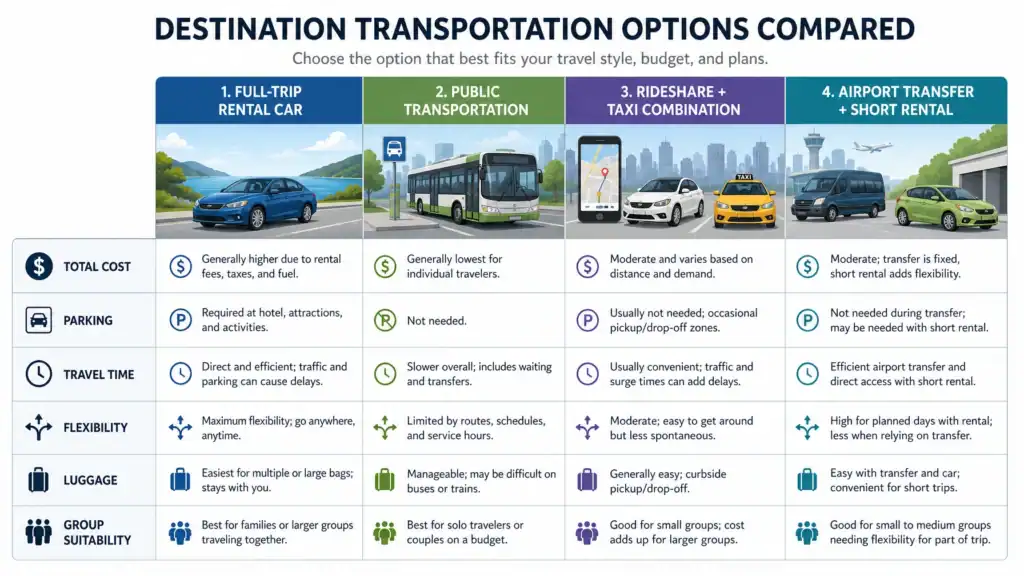
There’s no default answer here. A rental car, public transportation, airport or hotel shuttles, taxis, rideshare, walking, a private transfer, or some combination can each be the right choice depending on where you’re going.

Work through the practical questions:

  • How many people, and how many car seats or booster seats?
  • Stroller, wheelchair, or other mobility equipment?
  • How much luggage?
  • Parking availability and cost at the hotel and at attractions
  • Fuel and tolls
  • Transit accessibility, including elevators and step-free routes
  • Distance between the places you actually plan to go
  • Operating hours—some transit and shuttle services thin out at night
  • Weather
  • Late arrivals and closed counters
  • How well your group tolerates long transfers
  • Whether you’ll want to return to the room midday

The cheapest option on a spreadsheet isn’t always the practical one. A transit day pass costs less than parking downtown, but not if it means three transfers with a stroller and a tired six-year-old. Conversely, a rental car is dead weight in a dense city where parking runs more than the car does.

Start by comparing transportation options and costs side by side. If a car makes sense, it helps to plan an airport car rental deliberately, review practical car rental savings tips, and check destination-based rental-car guidance for local quirks.

Plan Car Seats and Booster Seats Before Pickup

Car-seat decisions made at a rental counter are made under time pressure, with tired travelers, and with whatever happens to be in stock.

The realistic options include bringing your own restraint, renting one from the rental company, arranging one through a transportation provider, using public transportation where it fits, booking a private transfer that confirms suitable equipment in advance, or buying or borrowing a restraint at the destination after doing the research. Each has tradeoffs in cost, hassle, and certainty.

Whichever direction you go, verify:

  • Your child’s age, size, and restraint needs
  • Manufacturer requirements for the specific seat
  • The laws that apply at your destination
  • Vehicle compatibility
  • Whether the rental location actually stocks the seat type you need
  • Who is responsible for installation—many companies leave it to you
  • The condition of any rented equipment when you receive it
  • Whether your request is confirmed or merely noted
  • What the provider will do if the equipment isn’t available on arrival

For general safety information on selection and installation, NHTSA car-seat and booster-seat guidance is the authoritative U.S. resource. For travel outside the U.S., check the destination’s own rules—a seat sold and certified in the United States is not automatically approved everywhere, and local requirements vary.

One more thing worth measuring: a vehicle’s listed passenger capacity says nothing about cargo space. A seven-seat SUV that fits everyone may not fit two car seats plus adults across the second row, or may leave almost no trunk space once a stroller and four suitcases go in. Count seats, restraints, and luggage as three separate problems.

Build a Realistic Daily Schedule

Family itineraries fail on transitions, not attractions.

Build time for getting dressed, breakfast, bathroom stops, travel between locations, parking, folding and unfolding a stroller, ticket lines, bag checks at venues, meals, naps, rest, weather, a trip back to the room, unplanned discoveries, and simple recovery—for the adults too.

A framework many families find workable: one main activity, one optional activity, and one flexible period per day. That’s a starting shape, not a rule. Some families comfortably do more; some days should hold less.

Different travelers need different things from the same day.

Infants and toddlers

Feeding windows, naps, diaper changes, stroller or carrier logistics, a quiet space to reset, and an early bedtime that may end the adults’ evening plans.

School-age children

Shorter explanations, hands-on rather than observational activities, snack and bathroom timing that doesn’t drift, a real say in at least one choice, and breaks from standing and waiting.

Teenagers

Genuine input into the itinerary, time for things they actually care about, personal space, an appropriate amount of independence, charging and connectivity, and a sleep schedule that may not match anyone else’s. A teenager wanting an unscheduled afternoon and a younger sibling needing a predictable one is a normal conflict—often solved by splitting the group for a few hours.

Multigenerational groups

Different walking speeds, planned rest periods, accessible routes checked in advance, optional side activities so nobody has to do everything, clear meeting points and times, and permission for people to spend part of the trip apart. Don’t assume any particular generation is the limiting factor—ask everyone what kind of day they want.

A centrally located hotel is often the quiet hero of a multigenerational trip: less walking, fewer transfers, and an easy return to the room for anyone who wants one.

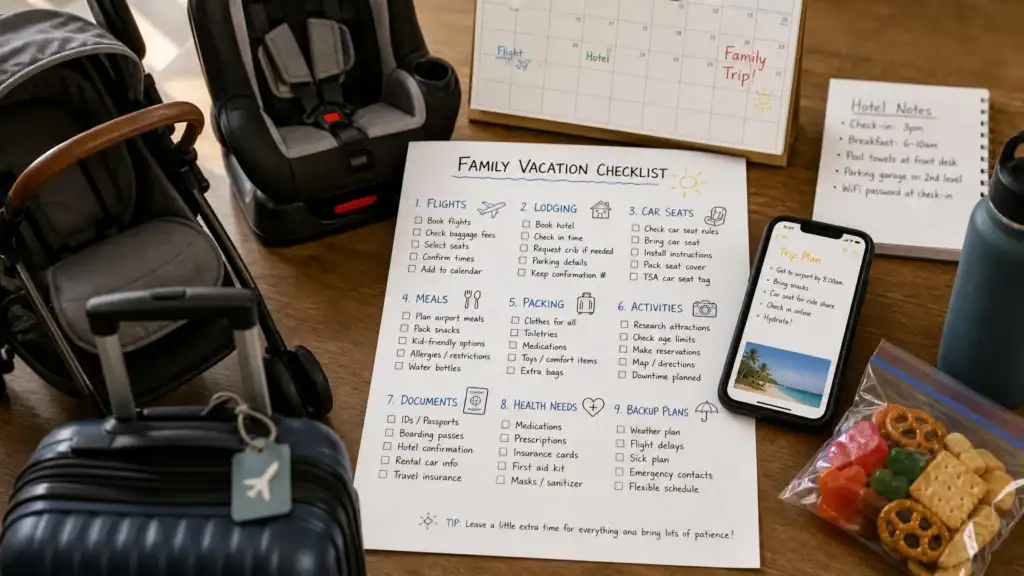
Family travel checklist for flights, lodging, car seats, meals, documents, and activities

Plan Meals and Snacks Without Scheduling Every Bite

Food affects your budget, your energy, and your schedule—usually all three at once.

Research before you go: breakfast availability at your lodging, nearby grocery stores, whether you have a kitchen or just a refrigerator, restaurant hours (which vary a lot by country and season), reservations for any meal that matters, what food exists near your main activities, options at the airport and after a late arrival, dietary needs, how you’ll communicate allergies, familiar backup foods, water access, and anything that needs cold storage.

A practical mix tends to look like: a few planned meals, groceries or simple room meals for the rest, flexible restaurant choices, snacks for transitions, and one backup for the night dinner falls apart.

For serious allergies or medical dietary needs, contact airlines, hotels, and restaurants directly and work with the appropriate healthcare professional—general travel advice isn’t a substitute for that.

The reason this matters: hungry, tired travelers make expensive and inconvenient decisions. The overpriced airport meal, the taxi back to the hotel, the abandoned afternoon—most of those trace back to a food plan that was treated as an afterthought.

Pack by Person, Activity, and Travel Day

Family packing gets easier when it stops being one giant list.

Each traveler

Clothing, shoes, sleep items, toiletries, medication, comfort items, entertainment.

Shared items

Chargers, first-aid supplies, sunscreen, laundry supplies, snacks, documents, child equipment.

By activity

Beach, pool, hiking, a formal event, cold weather, a theme park day, a long drive. Packing by activity catches the things a per-person list misses—the water shoes, the one dress shirt, the rain layer.

Carry-on essentials

Identification and documents, medication, chargers, at least one change of clothing per person who might need it, diapers and childcare supplies, snacks, comfort items, essential electronics, copies of reservations, and anything you’d want during a four-hour delay.

If everything essential lives in one checked bag, a single delayed bag becomes the whole family’s problem. Distribute the important things—a few outfits per person spread across bags, medication and documents always in the cabin.

When you reach the final stage, these packing and travel timing tips cover departure-day sequencing in more detail.

Review Health, Medication, and Accessibility Needs Early

These are the items that go badly when they’re handled in the last week.

Think through prescriptions and refill timing, medication storage (including anything that needs to stay cold), medical devices and their power requirements, how you’d access healthcare at the destination, routine care needs, dietary needs, mobility, sensory needs, communication needs, accessible lodging and transportation, where quiet spaces might be, airport assistance, service animal documentation, and emergency contacts.

For destination-related health preparation, the CDC maintains guidance for traveling with children. Check it close to your departure, and talk with a healthcare professional about what’s appropriate for your family and your destination—vaccination, medication, and preventive care decisions are individual, and no article should make them for you.

For screening support, travelers can submit a TSA Cares assistance request. It’s a helpful resource, though submitting a request doesn’t guarantee every service or remove screening requirements.

Anything essential should be confirmed directly with the airline, the airport, the hotel, the rental provider, any tour operator, the attraction, and your ground transportation. A note in a reservation is not the same as a confirmation from the people who have to deliver it.

Prepare International Travel Documents for Children

International travel with minors can involve more than a ticket and a passport, and the requirements depend heavily on where you’re going and who’s traveling.

Research well ahead of time:

  • Passport requirements for each child and how long processing currently takes
  • Passport validity rules for your destination
  • Visa or electronic travel authorization requirements
  • Entry and exit rules, which are sometimes different
  • Documentation showing your relationship to the child
  • Consent requirements when one parent or guardian, or neither, is traveling with the child
  • Custody documentation where applicable
  • Dual-nationality considerations, which can change entry and exit rules
  • The airline’s own document requirements
  • Return-entry requirements for your home country

Start with the State Department’s guidance for international travel with minors, its child-passport information, and its general international travel planning guidance.

A few honest caveats. Requirements vary by country. They can depend on who is traveling with the child. They change. Airline requirements and government entry rules are not always the same thing, and satisfying one doesn’t guarantee the other. There is no single consent-letter format accepted everywhere.

If one parent is traveling internationally with a child, check the destination’s specific documentation expectations through official destination, embassy, or consulate sources—and consult a qualified professional for anything involving custody or legal status. That’s not a question a travel guide can answer.

Give Older Children and Teenagers a Role

Children often handle travel better when they know what’s happening and have some say in it.

Roles that tend to work: choosing one activity for the trip, picking between two restaurants, carrying a personal checklist, tracking the next gate or stop alongside an adult, packing their own small bag, choosing entertainment for the flight, helping compare destination options early on, taking photos, keeping a journal, managing a reasonable personal spending amount, or helping identify meeting points.

Match the responsibility to the person—their age, maturity, and needs, not just their birthday. Independence isn’t a requirement, and some kids would rather not be in charge of anything. That’s fine.

It’s also worth calmly reviewing a few basics together: what to do if someone gets separated, the name of the hotel, an adult’s phone number written down somewhere, where to meet, who’s holding the documents, and which employees or officials to approach for help. Handled matter-of-factly, this is just information—the same as knowing which gate you’re leaving from.

Create a Family Backup Plan

Backup planning isn’t pessimism. It’s a way of reducing the number of decisions you have to make while tired, delayed, and holding two bags and a sleeping child.

Think through what you’d do about a flight delay, a missed connection, a delayed bag, a closed rental counter, a room that isn’t ready, bad weather, someone getting sick, a canceled activity, an overtired child, a transportation disruption, a dead phone, or no internet access.

Then prepare the things that make those situations easier:

  • Airline contact information saved in your phone
  • The hotel’s direct phone number, not just the booking platform’s
  • The rental location’s phone number and hours
  • A backup way to get from the airport to your lodging
  • Essential items in carry-on luggage
  • Confirmations saved offline as screenshots or PDFs
  • Chargers and a power bank
  • Basic snacks
  • Your cancellation and change terms written down
  • One low-effort backup activity—a park, a pool, a nearby café
  • A plan for splitting the group if that becomes the sensible move

For handling short-notice changes and rebooking, see these last-minute travel savings and backup strategies.

Family Trip Planning by Travel Stage

This is a planning framework, not a universal timeline. Some families book eight months out; others book in three weeks. Adjust the order to fit your circumstances.

Planning stageMain family decisionsDetails to verifyWhat can usually wait
Choosing the destinationWho’s coming, traveler count, age-related needs, three shared priorities, realistic travel timePassport status and validity, seasonal weather, accessibility of the destination, distance between activitiesSpecific restaurants, daily order of activities, souvenir budget
Setting the budgetPreferred budget, firm maximum, contingency amount, who is paying for whatBaggage and seat fees, hotel fees and parking, activity admission rangesExact meal spending, optional excursions, shopping
Booking transportationNonstop versus connecting, departure and arrival times, driving versus flyingBaggage allowance, change and refund terms, aircraft and schedule stability, family-seating policyOnboard entertainment plans, airport meal choices
Choosing lodgingRoom type, number of rooms, suite versus rental, location relative to activitiesOccupancy limits, actual bed count, crib availability, separate sleeping areas, kitchen, elevator, accessibility, cancellation termsRoom number preferences, pool schedule, housekeeping timing
Arranging ground transportationRental car, transit, transfers, or a mixVehicle size for restraints and luggage, car-seat availability and confirmation, counter hours, parking at lodgingDaily route details, transit card purchase
Reserving major activitiesWhich one or two things really matterAge and height requirements, accessibility, stroller policies, timed-entry rules, refund termsOptional secondary activities, backup-day plans
One month before travelConfirming the plan holds togetherPassports and visas, seat assignments, crib and accessibility requests, prescription refills, car-seat planPacking, snack shopping, entertainment downloads
One week before travelFinal confirmations and packing listsFlight times (recheck for changes), seat assignments after any aircraft change, hotel confirmation, rental reservation, weather forecastLast-minute activity additions
Day before departurePacking, charging, printing or saving documentsCarry-on essentials, medication, documents, offline confirmations, airport timingAnything nonessential
Travel dayTiming, transitions, meals, patienceTerminal and gate, bag drop cutoffs, security wait, seat assignments at check-inDestination itinerary details
Arrival dayGetting settled, food, sleepRoom setup on arrival, car-seat installation, nearest grocery or pharmacyAny major attraction—leave room to recover

Common Family Travel Planning Mistakes

Building an adult itinerary and adding children afterward

An itinerary designed for adults and then handed to a family usually breaks on the second morning. Pace, meals, sleep, and transitions aren’t add-ons—they set the maximum number of things a day can hold. Build the day around them from the start and the rest fits more honestly.

Choosing the lowest fare without reviewing the whole travel day

A cheaper fare can carry a 5:00 a.m. departure, two connections, a distant airport, no included bags, and paid seat selection. Add those costs and hours and the “expensive” nonstop sometimes wins outright—and even when it doesn’t, you’ll know what you traded.

Assuming the hotel room setup will work

“Sleeps four” describes an occupancy limit, not a sleeping arrangement. Two double beds, no crib space, and no separating door is a very different room from a suite. Verify bed types, crib availability, and layout before booking, and confirm requests with the property directly.

Planning every hour

A fully booked day has no room for a delayed lunch, a rainstorm, a long line, or a nap that runs late. When one thing slips, everything after it slips too. Leave gaps on purpose—they’re what let the plan survive contact with reality.

Reserving a vehicle based only on passenger count

Seven seats doesn’t mean seven people plus luggage. Two car seats can eat a row. A stroller or wheelchair takes real cargo space. Count passengers, restraints, and bags separately, then choose the vehicle.

Waiting until pickup to think about car seats

Suitability, local law, availability, and installation all take research. Arriving at a counter and asking what they have is how families end up with equipment that doesn’t fit the child, the vehicle, or their comfort level. Decide the approach before you book the car.

Assuming airline seating will resolve itself

Policies differ by airline and change over time. Aircraft swaps reshuffle assignments. Third-party bookings don’t always pass seat requests through. Check your assignments after booking and again before travel, and contact the airline if children aren’t next to an accompanying adult.

Keeping all essential supplies in checked luggage

A delayed bag shouldn’t mean no medication, no diapers, no change of clothes, and no chargers. Your carry-on should be able to carry the family through a long delay and a night without the checked bags.

Ignoring the needs of adults and teenagers

Planning only around the youngest traveler produces a trip nobody else enjoys. Teenagers need input and downtime. Adults need something they actually wanted to do. A day that includes one thing for each person is usually more workable than a day aimed entirely at one age.

Treating a special request as a confirmation

Cribs, connecting rooms, accessible rooms, early check-in, specific child restraints—these are requests until someone confirms them. Call, email, get it in writing, and have a plan B for the ones that matter most.

Forgetting recovery time after arrival

A long travel day plus a major attraction on the same afternoon is a lot to ask of anyone. A child who’s been through an airport and a flight may need quiet time more than a museum. Leave arrival day light and start the real itinerary the next morning.

A Simple Family Travel Planning Process

  1. Confirm who is traveling and identify individual needs.
  2. Choose three family priorities.
  3. Set a preferred budget, a maximum budget, and a buffer.
  4. Choose a destination that fits the time you actually have.
  5. Compare the complete cost of transportation, lodging, and ground travel.
  6. Reserve the hardest-to-replace parts first.
  7. Confirm flight seating and your child-restraint plan.
  8. Choose lodging based on sleeping arrangements and location.
  9. Decide how the family will move around at the destination.
  10. Build a schedule with one main activity and flexible time.
  11. Plan meals, snacks, naps, and rest.
  12. Confirm documents, health needs, and accessibility arrangements.
  13. Pack essential supplies where they stay accessible.
  14. Save confirmations offline.
  15. Create backup plans for delays and changed conditions.
  16. Review the plan with the family before departure—including the kids.

Steps six through nine are where most of the moving parts collide. It helps to coordinate airport, hotel, and rental-car arrangements as one connected sequence, then prepare for the final packing and timing stage in the last week.

Family Travel Planning Checklist

  • ✅ Everyone traveling is included in the budget
  • ✅ Ages and individual needs have been reviewed
  • ✅ The family’s top three priorities are clear
  • ✅ Preferred and maximum budgets are set
  • ✅ Travel time fits the length of the trip
  • ✅ The complete cost has been estimated, not just airfare and room rate
  • ✅ Flight times work with the family’s schedule
  • ✅ Family-seating policies and current seat assignments are reviewed
  • ✅ Child-restraint plans for the flight are confirmed with the airline
  • ✅ Hotel occupancy and bed arrangements are verified
  • ✅ Cribs, connecting rooms, or accessibility requests are confirmed with the property
  • ✅ Lodging location works with the daily itinerary
  • ✅ Transportation at the destination is planned
  • ✅ The rental vehicle fits passengers, restraints, and luggage
  • ✅ Car-seat or booster-seat arrangements are researched, including local rules
  • ✅ Meal and snack options are identified
  • ✅ The itinerary includes rest and flexible time
  • ✅ Major activities suit the ages and interests traveling
  • ✅ Passports and international documents are checked against official sources
  • ✅ Medication and health preparations are addressed
  • ✅ Accessibility and sensory needs are confirmed with each provider
  • ✅ Carry-on luggage contains essential supplies
  • ✅ Confirmations are saved offline
  • ✅ Children understand the basic travel sequence
  • ✅ Backup transportation and delay plans are identified
  • ✅ Important contact information is accessible without internet
  • ✅ The first day allows time to settle in

Frequently Asked Questions About Family Travel Planning

How do I start planning a family vacation?

Start with the travelers rather than the destination. Write down who’s coming, their ages, sleeping and mobility needs, dietary and medical considerations, and how much travel time the group can handle. Then pick three shared priorities—maybe a nonstop flight, a room with a separate sleeping area, and one major attraction. Set your budget range next. Only after that should you compare destinations, because now you’ll be comparing them against something specific instead of picking whatever looks appealing in photos.

How far ahead should I plan family travel?

There’s no single right lead time. It depends on the destination, the season, whether you need passports, how many rooms you need, and how flexible your dates are. Items that are hard to replace—passports, accessible rooms, suites for larger groups, timed-entry tickets, popular holiday dates—generally deserve earlier attention. Things that can be adjusted later, like restaurant choices or optional activities, can wait. Work backward from whatever has the longest processing or shortest supply.

How can I keep a family vacation within budget?

Estimate the full cost before booking anything: transportation to the airport, parking, fares for every traveler, baggage, seat fees, lodging plus fees and parking, ground transportation, meals, activities, and a buffer. Then look for the structural savings rather than small ones. A kitchen, a central location that removes a rental car, or a suite instead of two rooms can each shift the total meaningfully. Set a firm maximum, and decide in advance what gets cut if you approach it.

Is a hotel or vacation rental better for families?

Neither is universally better. Hotels often win on location, daily housekeeping, front-desk support, breakfast, and easier cancellation. Rentals often win on space, separate bedrooms, kitchens, and laundry—which matters a lot with infants, large groups, or longer stays. The right answer depends on your destination, how much time you’ll spend in the unit, whether you need a kitchen, how you’re getting around, and how many separate sleeping areas the group needs. Compare total cost, not nightly rate.

How do I make sure my family sits together on a flight?

Book everyone on one reservation when you can, then check the airline’s current family-seating policy on its own website. Review your assignments right after booking and again before travel, since aircraft changes can reshuffle seats. If you booked through a third party, confirm the seats directly with the airline. The DOT’s family-seating dashboard and its tips page for families flying together are useful starting points, but policies vary and change, so verify with your carrier.

Should I bring a car seat on the airplane?

That’s a decision to make with current, official information rather than general advice. Review the FAA’s guidance on flying with children and approved child restraint systems, check your restraint’s label and manufacturer instructions to see whether it’s approved for aircraft use, and confirm your airline’s specific rules about placement and seat requirements. Also weigh the practical side: carrying the restraint through the airport, whether it fits your aircraft’s seat, and whether you’ll need it at the destination anyway.

Should I bring or rent a car seat at my destination?

Both approaches have real tradeoffs. Bringing your own means known equipment and a familiar installation, but it’s one more thing to carry and it can be damaged in transit. Renting reduces what you haul, but availability, model, and condition aren’t always predictable, and installation is often your responsibility. Some families use private transfers that confirm equipment, or rely on transit where that works. Check destination laws, confirm any reservation directly, and consult NHTSA guidance on selection and installation.

How many activities should a family plan each day?

There’s no correct number for every family. A useful starting structure is one main activity, one optional activity, and one genuinely flexible block—then adjust based on how your first day actually goes. Some families comfortably do more; some days need less. What matters more than the count is the transition time between things: travel, parking, lines, bathrooms, and meals often take longer than the activities themselves.

How do I plan a trip for children of different ages?

Look for activities with multiple entry points—a beach, a park, a market, a zoo—where a toddler and a fifteen-year-old can each find something. Then accept that some things won’t work for everyone, and plan to split up occasionally. One adult takes the teenager to something they chose while another handles nap time. Give older children input into the itinerary, keep meal and rest timing predictable for younger ones, and let each person have at least one thing they picked.

What should go in a family carry-on bag?

Anything you’d need if the checked bags didn’t arrive or the flight was delayed for hours: medication, identification and documents, chargers and a power bank, a change of clothing for anyone likely to need one, diapers and childcare supplies with extra beyond your estimate, snacks, water bottles to fill after screening, comfort items, entertainment, and offline copies of your confirmations. Spread essentials across bags rather than concentrating them, so one lost bag doesn’t affect the whole family.

How do I plan family travel with grandparents?

Ask, don’t assume. Some grandparents want long hiking days; others want a slower pace; the preferences vary as much as they do in any other age group. Have a direct conversation about walking distances, preferred activities, sleep schedules, dietary needs, and how much time they want with everyone versus on their own. Then build in optional activities so no one has to opt out of the whole day, agree on meeting points, and consider lodging that reduces transfers for everyone.

What documents do children need for domestic flights?

Requirements come from more than one place, and they aren’t identical. TSA publishes its own identification guidance for screening, and adults should check it for current requirements. Airlines set separate policies—many ask for proof of age for infants and lap children, for example, and those rules are the airline’s, not TSA’s. Check both your airline’s website and TSA’s identification page before travel rather than relying on what was true on a previous trip.

What documents do children need for international travel?

It depends on the destination and on who is traveling with the child. Common considerations include a valid passport for each child, passport validity rules for the destination, visas or travel authorizations, documentation of your relationship to the child, and consent documentation when one or both parents or guardians aren’t traveling. Requirements vary and change, and airline rules may differ from government entry rules. Verify through the State Department’s resources plus the destination’s embassy or consulate and your airline.

How do I prepare children for their first flight?

Walk through the sequence out loud a few days ahead: bag drop, waiting in line, showing documents, putting things in bins, screening, finding the gate, boarding, engine noise, the seat-belt sign, takeoff pressure, and the fact that a lot of flying is waiting. Let them pack a small bag with their own entertainment and a comfort item. Bring snacks and something to chew or drink for pressure changes. And keep expectations modest—a first flight doesn’t have to go perfectly.

What should I do when a child becomes overtired during the trip?

Reduce input before adding anything. Find a quieter space—a park bench, the hotel room, a corner of a café—and let the schedule slip. Food and water often help. Go back to the room if you can; a canceled afternoon usually costs less than pushing through and losing the evening too. Simplify the next day rather than trying to make up lost ground. If you’re concerned about a child’s health rather than tiredness, contact a healthcare professional.

Bringing It Together

Family travel planning works when the pieces connect: the budget matches the trip, the travel time matches the length of the stay, the room actually holds everyone comfortably, the transportation fits the passengers and the gear, meals and rest are on the schedule instead of squeezed around it, the activities suit more than one person, the documents are verified through official sources, health and accessibility needs are confirmed with the people responsible for them, and there’s a backup for the parts most likely to change.

That’s not the same as a flawless itinerary. No amount of planning guarantees a smooth trip, and no schedule satisfies every person at every moment. What a good plan actually delivers is narrower and more useful: a comfortable place to sleep, a realistic way to get around, enough food and rest, a few things worth doing, and room to change course.

A family trip doesn’t have to run exactly as planned to be worth taking. It just needs enough preparation that when something shifts—and something will—you can adjust the afternoon instead of rebuilding the vacation.

Continue Planning Your Trip

How to Choose the Right Travel Destination

Compare destinations by budget, travel time, weather, available activities, and how easy it is to get around once you arrive—useful when the group can’t agree on where to go.

How to Compare Travel Prices

Look at the complete cost of a trip, including flights, lodging, rental cars, parking, and local transportation, instead of comparing headline rates that leave things out.

What to Reserve Early When Planning a Trip

Sort out which reservations are hardest to replace and deserve attention first, and which ones can safely wait until closer to departure.

Airport, Hotel, and Rental Car Preparation

Coordinate travel-day timing, hotel check-in, rental pickup, parking, and backup plans so the pieces line up instead of competing.

Packing and Travel Timing Tips

Organize luggage, documents, departure timing, and the final round of preparation in the week before you leave.

Transportation Savings Tips

Compare rental cars, public transportation, airport transfers, shuttles, taxis, and rideshare services based on cost and practicality for your group.

Last-Minute Travel Savings

Handle short-notice bookings, rebooking after a disruption, and plans that change after everything is already reserved.

Travel Tips Hub

Browse the full SavingsScoutTravel planning collection, or start with our destination guides if you’re still deciding where to go.

Continue Planning Your Family Trip

Browse the full SavingsScoutTravel planning collection, or explore destination ideas before choosing the trip that fits your family.

Airport, Hotel and Rental Car Preparation Guide

Aviator dog mascot organizing airport timing, flight documents, hotel check-in, rental-car pickup, parking, and backup travel plans before a trip.

The flight is booked. The hotel confirmation is sitting in your inbox. A rental car shows up on the itinerary with a nice, tidy confirmation number. Everything feels finished—until you look a little closer and notice the flight lands at 10:40 p.m., the rental counter closes at 11:00 p.m., and the hotel is another hour up the highway.

That gap is exactly what airport hotel and rental car preparation is meant to close. Good travel preparation isn’t really about having three reservations. It’s about making sure those three reservations agree with each other.

Each booking can be perfectly correct on its own and still produce a rough arrival day. A flight can be a great fare. A hotel can be well reviewed and well priced. A rental car can be the cheapest in the market. Put them together without checking the seams, and you end up standing in a quiet baggage claim at midnight with no car, no shuttle, and a front desk that stopped answering the phone.

So here’s the principle this guide is built around: build one connected arrival plan, not three separate reservations.

By the time you leave home, you should be able to answer these without opening nine emails:

Your Connected Arrival Plan

  • How will I reach the departure airport?
  • Which airport and terminal am I actually using?
  • What documents do I need to carry?
  • What happens after I land?
  • Where will I collect my luggage?
  • How will I get to the hotel?
  • Is the rental location open when I arrive?
  • What does the hotel need from me if I show up late?
  • What’s my backup plan if the flight changes?

If you can answer those nine questions, most of the work is done.

Traveler reviewing airport, hotel, and rental car arrangements before a trip

Put Every Reservation Into One Travel Plan

Most travel-day confusion comes from scattered information, not missing information. The details usually exist—they’re just spread across an airline email, a hotel confirmation, a rental-car receipt, two apps, a text message from a friend, a calendar entry, and a screenshot you took three weeks ago.

Pull it all into one place. One document, one note, one page. Whatever you’ll actually open.

Your master itinerary should include:

  • Travel dates
  • Flight numbers
  • Departure and arrival airports
  • Terminals, when that information is available
  • Confirmation numbers for every booking
  • Traveler names exactly as they appear on the reservations
  • Hotel name, full address, phone number, and check-in time
  • Rental company name and the exact pickup location
  • Rental counter operating hours
  • Ground-transportation details
  • Cancellation deadlines
  • Any special requests you’ve made
  • Emergency and provider contact numbers

Then do a sanity check on the details that are easy to get wrong. Airport codes look alike. Hotel brands run several properties in the same metro area with nearly identical names. Rental companies operate multiple branches within a few miles of each other.

Confirm the correct city, the correct airport, the correct terminal when known, the exact rental branch, whether the hotel is in the neighborhood you pictured, and whether the rental pickup is on-airport or off-airport. Five minutes here prevents the kind of mistake that costs an entire afternoon.

Finally, store the plan where you can reach it when things go sideways. On your phone, yes—but also offline, as screenshots or a downloaded file. Keep the emails in one labeled folder. If you’re traveling with other people, put it in a shared document so nobody has to text you from a different terminal. Print it if that’s your comfort level; there’s nothing old-fashioned about a piece of paper that works without a battery.

If you’re still in the booking phase, it helps to know what to reserve early when planning a trip so the pieces line up before you start coordinating them. You can also browse the complete travel-planning library for the earlier stages of trip planning.

Recheck the Flight Before Building the Arrival Plan

Your flight schedule drives nearly every decision that follows it. Recheck it before you build anything else.

Verify the departure airport, arrival airport, flight number, operating airline, and both times. Check time-zone differences—an arrival time that looks reasonable can shift dramatically once you account for the clock change. If you’re connecting, look at the connection airport and how much time you actually have on the ground. Confirm baggage allowance, seat assignments, and check-in requirements. And check whether the itinerary has changed since you booked, because schedule adjustments happen quietly.

One detail catches people off guard: the airline that sold you the ticket isn’t always the airline operating the flight. Codeshare and regional-partner arrangements are common. That matters because check-in desks, baggage rules, and terminals often follow the operating carrier. If your confirmation lists a different airline in small print, find out which counter you’re actually using.

Download the operating airline’s app or at least know how you’ll check current flight status from your phone. Airlines differ in what they offer, so use whatever tool your carrier provides rather than assuming a general flight tracker will notify you of gate changes.

Here’s the part travelers most often skip: the scheduled arrival time is not the time you reach the hotel or the rental counter. Between wheels down and your room key, the day may include taxiing, deplaning, a long walk through an unfamiliar terminal, baggage claim, international arrival procedures, a shuttle ride to a rental center, paperwork at the counter, and a drive to the hotel.

Every one of those steps takes real minutes. Add them up honestly, and then add a little more.

For background on how flight schedules and fares are structured, it helps to understand how airline schedules and prices work and to review practical flight-booking strategies before you lock in an arrival time. If you’re still choosing routes, you can also browse flight destination guides.

Plan How You Will Reach the Departure Airport

The travel day starts long before security. Decide early how you’re getting to the airport, because “we’ll figure it out” tends to figure itself out badly at 5 a.m.

Your options usually include a personal vehicle plus airport parking, a ride from family or a friend, a taxi, rideshare, public transportation, a hotel shuttle, an off-airport parking shuttle, returning a rental car, or some combination of these.

Whichever you choose, confirm the practical details:

  • Travel time at the time of day you’ll actually be traveling, not the midday estimate
  • Which parking lot or garage you’re using and how to get to it
  • Shuttle frequency and hours
  • Whether parking requires a reservation
  • Transit operating hours for very early or very late flights
  • Road construction and expected weather
  • The correct terminal for drop-off
  • How long it takes to unload children, luggage, or mobility equipment
  • A backup if your ride falls through

You’ll notice this guide doesn’t give you a single “arrive X hours early” rule. That’s deliberate, because the right buffer genuinely depends on your situation: airport size and layout, domestic versus international travel, your airline’s own guidance, whether you’re checking bags, how you’re parking, security conditions that day, group size, accessibility needs, time of day, and how well you know the airport.

A solo traveler with a carry-on at a small regional airport and a family of five checking bags at a major international hub are not solving the same problem. Check your airline’s and airport’s current guidance for your specific trip, then add margin for your own comfort.

While you’re organizing the departure end, it’s worth reviewing how to organize packing and travel timing so bags and schedule come together at the same moment.

Confirm Identification, Documents, and Baggage Rules

Don’t rely on memory for this. Requirements change, and the version you remember from a trip three years ago may no longer be current.

Work through this list well before travel day:

  • Acceptable identification for airport screening
  • Passport and any destination-specific documents for international travel
  • Traveler names matching reservations and ID
  • Boarding passes and how you’ll access them
  • Visas or travel authorizations where required
  • Documents for children, when applicable
  • Documents the rental driver will need
  • Hotel and rental confirmations
  • Medication and medical-device preparation
  • Airline baggage dimensions and weight limits
  • Security restrictions on carry-on items
  • Items that belong in your carry-on rather than checked bags
  • Items you should verify before packing them at all

For identification questions, check TSA’s current list of acceptable identification rather than a summary on a blog. For specific items, use TSA’s What Can I Bring tool, which is searchable and kept current. TSA also publishes a short travel checklist worth skimming before you pack.

These requirements are updated periodically. Treat anything you read here—or anywhere else—as a prompt to check the official source rather than a permanent rule.

One distinction that trips people up: TSA security rules and airline baggage rules are separate things. TSA governs what can go through screening. Your operating airline sets bag size, weight, and fee policies, and those vary by carrier and fare type. Check both.

If you’re building a trip where every dollar counts, practical budget travel preparation covers the money side of packing and bag decisions.

Coordinate Flight Arrival With Hotel Check-In

A hotel reservation does not, by itself, solve the gap between landing and getting into a room. That gap is where a lot of arrival-day frustration lives.

Before you travel, confirm with the property:

  • Official check-in time
  • Front-desk hours
  • Late-arrival procedure
  • Whether early check-in is available, and on what terms
  • Luggage-storage availability
  • Exact address (including which of several nearby properties it is)
  • Transportation options from the airport
  • Parking arrangements and cost
  • Any required deposit
  • Accepted payment methods
  • The name on the reservation
  • Occupancy limits and bed configuration
  • Accessibility requests
  • What’s included—breakfast, parking, Wi-Fi, resort or facility charges
  • Checkout time

Two scenarios come up constantly.

Early arrival

Your flight lands at 9:00 a.m. The hotel doesn’t guarantee check-in until mid-afternoon. You have luggage, and possibly children who have been awake since 4 a.m.

Reasonable plans include asking about luggage storage, choosing a nearby meal or a low-effort activity that doesn’t require energy, and keeping medication, valuables, chargers, and a change of clothing accessible rather than buried in a checked bag. Ask about early check-in—but treat it as a request, not a plan. Rooms depend on the previous night’s occupancy and housekeeping progress.

For a very early morning arrival, some travelers book the prior night so the room is theirs on landing. That can be worth it, particularly on an overnight flight with a group. It isn’t universally necessary, and it’s a cost decision only you can weigh.

Late arrival

A delay pushes your arrival well past the usual check-in window.

Call the property. Ask them to note your reservation for a late arrival. Confirm whether the front desk is staffed overnight, and if it isn’t, ask for after-hours instructions. Keep the hotel’s direct phone number—the property line, not just a central reservations number—somewhere you can reach it offline.

And don’t assume that a note typed into an online booking field guarantees the room will be held. Policies differ by property and by how the reservation was made. A short phone call is the more reliable version of that request.

To understand what you’re actually paying for, review how to understand the complete hotel price including parking and fees. When location matters more than rate, this guide on how to choose a convenient hotel location is useful, along with practical hotel savings tips and destination-based hotel guidance.

Airport arrival timeline showing baggage claim, rental car pickup, transportation, and hotel check-in

Confirm Exactly Where the Rental Car Is Located

“Airport car rental” can mean a lot of different things:

  • A counter inside the terminal
  • A consolidated rental-car center serving all companies
  • A facility reached by an airport train
  • A shuttle ride to an on-airport lot
  • An independently operated off-airport branch
  • A neighborhood location a few miles away
  • A vehicle delivered through a provider-specific system

These are not interchangeable, and following airport signs to the rental center when your reservation is at a branch two miles down the road is a genuinely common mistake.

Confirm the company name, the exact street address, terminal or shuttle instructions, whether transportation is required to reach it, the counter’s operating hours, after-hours procedures, whether that branch tracks delayed flights, and the direct phone number for the actual location—not a national call center. Ask whether pickup is possible after the scheduled closing time. And find out where the car must be returned, which isn’t always where you picked it up.

An off-airport branch can still be the better choice. Rates are often lower and lines shorter. Just include the shuttle time, the shuttle cost if any, and the narrower operating hours in your comparison, because those are part of the real price.

For a deeper look at this decision, see how to plan an airport car rental and how to understand rental-car pricing. You can also compare car rental savings strategies and browse destination-based rental-car guidance.

Prepare for the Rental-Car Counter

A confirmation number gets you into the queue. It doesn’t always get you into a car.

Review the specific company’s current requirements—and note that these vary by brand, by country, and sometimes by individual branch—for:

  • Driver’s license (and whether a temporary or digital license is accepted)
  • Minimum driver age and any young-driver surcharge
  • The name on the reservation matching the driver
  • Payment card type, and whether a physical card in the renter’s name is required
  • Deposit or authorization hold
  • Debit-card restrictions, which are often stricter than credit-card rules
  • Additional drivers and how they’re added
  • International driving documents where applicable
  • Proof of return travel, required at some locations
  • The rental agreement itself
  • Optional protection products
  • Vehicle class
  • Child seats or other equipment
  • Accessibility arrangements
  • One-way return terms
  • Mileage terms
  • Fuel policy
  • Toll program and how charges are billed
  • Roadside-assistance contact information

On insurance and optional protection: this guide can’t tell you what to buy. Coverage depends on your personal auto policy, any benefits attached to the card you’re paying with, the terms in the rental agreement, the rules at your destination, and your own tolerance for risk. Those vary enormously. Read your policy and card benefits before you’re standing at a counter being asked to decide in ninety seconds. The FTC’s guidance for renting a car is a solid plain-language starting point on what to look at in a rental agreement and what questions to ask.

One example worth flagging because it happens constantly: the person who booked the car isn’t the person planning to drive. Maybe one spouse manages the bookings and the other handles the highway. If the driver isn’t named on the reservation and doesn’t hold the payment card, the counter may not release the vehicle. Sort that out in advance, not in line.

Make Sure the Vehicle Fits the Trip

Rental categories describe general classes, not a specific make and model. “Midsize SUV” is a bucket, and what’s in that bucket on any given morning depends on the fleet.

Think through what you’re actually loading:

  • Number of travelers
  • Number and size of suitcases
  • Strollers
  • Wheelchairs or mobility equipment
  • Car seats
  • Sports equipment
  • Road and weather conditions at your destination
  • Parking space size, especially in older cities
  • Fuel or charging needs
  • Length of the drive
  • Whether every passenger needs a full seat and usable luggage space

A vehicle that technically seats five will not comfortably hold five adults, two car seats, and five large suitcases. Passenger capacity and luggage capacity are separate numbers, and the listed seat count tells you almost nothing about the trunk.

If you’re traveling with a group, picture the actual load-in before you book. It’s much cheaper to upgrade a reservation than to discover the problem in a parking garage with everyone standing around.

Families will find more on this in these family travel planning tips. If you’re not certain a car is the right call at all, it’s worth taking time to compare transportation options at your destination.

Inspect and Document the Rental Vehicle

Before you drive off the lot, spend a few minutes on the car:

  • Walk all the way around it, including the roof and bumpers
  • Photograph or video any existing damage, with the lot visible in frame
  • Check that visible damage is noted on the agreement
  • Confirm the fuel or charge level matches what’s written
  • Locate the basic controls—lights, wipers, hazards, fuel door
  • Adjust mirrors and seating before you move
  • Confirm the luggage actually fits
  • Check the dashboard for warning lights
  • Find and save the return instructions
  • Save the roadside-assistance number to your phone
  • Ask your questions while a staff member is still standing there

Documentation won’t automatically resolve every dispute—that depends on the agreement and the company’s process. But a clear, timestamped record of the vehicle’s condition at pickup gives you something concrete to point to, which is far better than a recollection.

One modern item people forget: rental cars let you pair your phone. Before returning the vehicle, remove saved contacts, call logs, navigation destinations, garage-door codes, and paired-device entries from the infotainment system. Your home address shouldn’t stay in the car after you leave it.

This isn’t mechanical or legal advice—if something seems wrong with the vehicle, ask the rental location rather than diagnosing it yourself.

Connect the Rental-Car Plan to the Hotel Plan

The car and the hotel need to be evaluated as one unit, because the car has to go somewhere every night.

Confirm:

  • Whether the hotel offers parking at all
  • What parking costs
  • Valet versus self-parking
  • Garage height restrictions, which matter for SUVs and vans
  • In-and-out privileges
  • Electric-vehicle charging, if you need it
  • Overnight street-parking restrictions in the neighborhood
  • Distance between the parking area and your room
  • How luggage unloading works
  • Whether the hotel entrance is easy to find after dark
  • Toll roads between the airport and the hotel
  • Realistic driving time at your arrival hour
  • Whether food will be available when you get in

Picture a late-night arrival: the rental counter has just closed behind you, it’s a fifty-minute drive, nothing near the hotel is open, and the parking garage entrance is on a side street you can’t see from the main road. Every one of those is manageable if you know about it in advance. Together, unplanned, they make for a long night.

Know the sequence before you leave the airport:

  1. Collect bags.
  2. Find rental transportation.
  3. Complete pickup.
  4. Load luggage.
  5. Enter the hotel address in your navigation.
  6. Set toll and route preferences.
  7. Call the hotel if you’re running behind.
  8. Know where to park and which entrance to use.

Plan for International Arrivals and Connections

International arrivals add steps, and those steps add time that domestic travelers don’t budget for.

Research in advance:

  • Passport validity and entry requirements for your destination
  • The arrival airport’s procedures and layout
  • Immigration or border inspection
  • Where baggage is collected
  • Customs and agricultural declarations
  • Whether you must reclaim and recheck bags during a connection
  • Terminal changes between arrival and onward flights
  • Whether you’ll pass through security again on a connection
  • Ground transportation from the airport
  • Rental-counter hours in local time
  • Time-zone changes
  • Mobile-phone service and data after arrival
  • The hotel’s late-arrival procedure in local time

The U.S. Department of State’s international travel planning guidance is a good starting point for documents and country information. Beyond that, check official destination and airport sources directly, because arrival procedures genuinely differ by country and by airport. Two airports in the same country can handle connections differently.

If you’re connecting through the United States after an overseas flight, verify current U.S. Customs and Border Protection procedures and your airline’s specific instructions for baggage and connections rather than assuming your bags will move automatically. Arrangements vary—preclearance at certain foreign airports changes the process, and airline agreements differ. Ask before you land, not while you’re watching the carousel.

Prepare for Flight Delays and Changed Arrival Times

Delays ripple outward. A two-hour delay doesn’t just move your landing time; it touches hotel arrival, rental-counter hours, airport shuttle schedules, public transit service windows, restaurant availability, connecting flights, childcare or pickup arrangements, and any event you booked for that evening.

Have this ready before you need it:

  • Airline contact information
  • The hotel’s direct phone number
  • The rental location’s direct phone number
  • At least one ground-transportation alternative
  • All reservation numbers
  • Cancellation terms for each booking
  • A charger and, ideally, a power bank
  • Essential medication in your carry-on
  • Basic toiletries and a change of clothing in your carry-on
  • A simple food plan for a long wait
  • A backup route to the hotel

When a delay becomes significant enough to threaten a reservation, call. Call the hotel. Call the rental branch. Do it from the gate while you still have signal and they’re still open, rather than after you land.

For understanding what airlines have committed to, the Department of Transportation maintains an airline cancellation and delay dashboard and publishes airline refund guidance.

A few honest caveats. Airline commitments differ from carrier to carrier. The cause of a disruption can affect what’s offered. Refund rights and discretionary services—meals, hotels, rebooking—are not the same thing and don’t follow identical rules. And critically: airline rules do not govern your hotel, rental car, or tour reservations. Those follow their own terms, which you agreed to when you booked. Read current official guidance and your own reservation conditions.

If plans change enough that you need to rebook on short notice, last-minute travel savings and backup strategies can help you regroup without overpaying.

Confirm Accessibility and Special Arrangements

If something is essential to your trip, confirm it in a conversation—not by trusting a checkbox on a booking form.

Arrangements that deserve direct confirmation include airport wheelchair assistance, help getting through security, accessible ground transportation, an accessible hotel room, a roll-in shower, a ground-floor room, an accessible rental vehicle, hand controls, service-animal arrangements, mobility-equipment handling, medical-device screening, a refrigerator for medication, connecting rooms, cribs, car seats, large-group transfers, dietary arrangements, and late-night staffing.

For each one that matters:

  • Contact the provider directly—airline, airport, hotel, or rental company
  • Ask specifically whether the request is confirmed or only noted
  • Get written documentation, even a short email reply
  • Reconfirm closer to departure
  • Allow extra time on travel day
  • Have a backup for anything you truly can’t do without

TSA offers a request form for travelers who need screening assistance for a disability or medical condition—TSA assistance for travelers with disabilities or medical conditions—which is worth submitting in advance of your travel date.

Contacting a provider early improves your chances considerably. It doesn’t guarantee any particular service, and it’s fair to plan with that in mind.

Create an Arrival-Day Timeline

Fill this out for your specific trip. The point isn’t the template—it’s forcing yourself to name a backup for each stage.

Travel stageInformation to confirmTime or buffer to considerBackup plan
Leaving homeDeparture time, who’s driving, what’s loadedTraffic at your actual departure hourSecond ride option or taxi/rideshare
Airport parking or drop-offLot location, reservation, shuttle hoursShuttle wait plus walk to terminalAlternate lot or curbside drop-off
Airline check-inCounter vs. app, bag drop cutoffAirline’s stated cutoff for your routeAgent assistance; kiosk if app fails
Security screeningID accepted, expedited program statusConditions at that airport and timeAllow extra time; standard lane
BoardingGate, boarding group, gate changesAirline’s boarding cutoffMonitor app for gate reassignment
Flight connectionTerminal, rechecking bags, re-screeningMinimum connection time for that airportRebooking options and airline contact
Arrival at the gateActual arrival gate, terminal exit routeTaxi and deplaning timeAsk crew or gate staff for directions
Baggage claimCarousel number, oversize item locationVaries by aircraft size and airportBaggage service office number saved
International arrivalImmigration, customs, bag recheckHighly airport-specificLater ground transport option
Rental-car shuttlePickup curb, frequency, last runShuttle interval plus ride timeTaxi or rideshare to rental branch
Rental counterHours, documents, payment cardQueue length varies by time of dayAlternate transport to hotel
Drive or transfer to hotelRoute, tolls, night visibilityRealistic drive time at your hourOffline map downloaded
Hotel parkingGarage entrance, height limit, costTime to park and unloadNearby lot identified in advance
Hotel check-inFront-desk hours, late-arrival noteTime to reach the desk with bagsProperty phone number accessible
Late meal or suppliesNearby hours, room service, 24-hour storeWhether anything is open on arrivalSnacks packed in carry-on

Notice there are no universal minute counts in the buffer column. Fill those in yourself using your airline’s guidance, your airport’s information, your hotel’s stated policies, your rental location’s hours, your group’s needs, and how much cushion you personally need to feel calm.

A realistic travel-day checklist divided into airport, flight, hotel, rental car, documents, transportation, and backup-plan sections. Include a phone, passport or identification, luggage, hotel key card, rental key, charger, and printed itinerary without real brand names.

What to Confirm One Week Before Travel

  • ✅ Flight schedule reviewed for changes since booking
  • ✅ Traveler names checked against identification
  • ✅ Identification and passport checked for validity
  • ✅ Airline baggage rules checked with the operating carrier
  • ✅ Transportation to the departure airport arranged
  • ✅ Hotel reservation confirmed with the property
  • ✅ Hotel address and direct phone number saved
  • ✅ Check-in time and late-arrival policy reviewed
  • ✅ Rental pickup location verified as on-airport or off-airport
  • ✅ Rental-counter operating hours checked
  • ✅ Driver name and payment-card requirements reviewed
  • ✅ Vehicle size reconsidered against actual passengers and luggage
  • ✅ Parking arrangements at the hotel checked
  • ✅ Special requests reconfirmed directly with each provider
  • ✅ Cancellation deadlines reviewed and noted
  • ✅ Offline copies of all confirmations saved

One week is a convenient organizing checkpoint, not a rule. If you’re leaving in four days, do it today. If you’re leaving in three weeks, doing it early costs you nothing.

What to Confirm the Day Before Travel

  • ✅ Current flight status checked
  • ✅ Airline check-in completed if it’s open
  • ✅ Seat assignments and bag counts reviewed
  • ✅ Terminal information checked
  • ✅ Airport transportation reconfirmed
  • ✅ Weather and road conditions checked for both ends of the trip
  • ✅ Phones, tablets, and power banks charged
  • ✅ Essential documents placed in the carry-on
  • ✅ Medication and valuables packed in the carry-on, not checked
  • ✅ Hotel and rental contact information saved offline
  • ✅ Arrival route from airport to hotel reviewed
  • ✅ Rental-counter closing time checked one more time against your arrival
  • ✅ Late-arrival notice sent to the hotel if the schedule already looks tight
  • ✅ Offline maps downloaded for the destination
  • ✅ Alarms set and departure time confirmed with everyone traveling

Gate and terminal information can still change after you check in—sometimes after you’ve arrived at the airport. Keep an eye on the app rather than trusting yesterday’s printout.

Common Airport, Hotel, and Rental-Car Preparation Mistakes

Treating the scheduled landing time as the hotel arrival time

Wheels down is not the finish line. Taxiing, deplaning, walking the terminal, waiting at baggage claim, riding a shuttle, completing rental paperwork, and driving to the property all sit between the landing time and the front desk. Build the plan around when you’ll realistically arrive, not when the aircraft touches the runway.

Booking a rental car at the wrong location

Airport facilities and nearby off-airport branches often share a company name and look identical on a booking screen. They have different addresses, different hours, and different access methods. Read the full address on your confirmation, then look it up on a map.

Ignoring rental-counter operating hours

Counters close. Some branches monitor delayed flights and hold reservations; others don’t. Some airport locations have after-hours procedures; many neighborhood branches don’t. This is entirely location-specific, so call the actual branch and ask.

Assuming an early hotel check-in is guaranteed

Requesting early check-in and having early check-in are different states. Availability depends on the prior night’s occupancy and housekeeping. Ask, hope for the best, and have a plan for the hours in between.

Failing to report a late hotel arrival

If a property doesn’t hear from you and you don’t appear, your reservation may be treated as a no-show under its own terms. Calling ahead gives the property a chance to note your arrival and gives you a chance to learn about after-hours access. It doesn’t guarantee the room will be held, but it’s far better than silence.

Bringing the wrong payment method to the rental counter

Some locations require a physical credit card in the primary driver’s name. Debit-card rules are often more restrictive and may involve additional verification. Deposit and authorization-hold practices vary by company and branch. Check the specific location’s current policy before travel day.

Reserving a vehicle that is too small

Seat count and luggage capacity are separate measurements. A sedan that seats five will not swallow five large suitcases. Count bags, strollers, and car seats honestly, and size up if you’re on the line.

Keeping confirmations only in an online inbox

Phones die. Airport Wi-Fi refuses to load. International data doesn’t activate the moment you land. Screenshots, a downloaded PDF, or a printed page cost nothing and work when nothing else does.

Forgetting to plan the rental-car return

The return is a multi-step process: refueling or charging, driving to the return facility, vehicle inspection, unloading luggage, riding a shuttle or train to the terminal, and then checking in for a flight. Plan it as its own segment of the trip, not as an afterthought.

Assuming every requested hotel feature is confirmed

A crib, a roll-in shower, connecting rooms, a specific bed configuration, a refrigerator for medication—if it’s essential, confirm it in a phone call or an email reply. An online request field is a message, not a confirmation.

A Simple Airport-to-Hotel Preparation Process

  1. Put all reservation information into one itinerary.
  2. Confirm the correct airports, hotel, and rental location.
  3. Review the current flight schedule for changes.
  4. Plan transportation to the departure airport.
  5. Check identification, documents, and baggage rules against official sources.
  6. Estimate the realistic time from landing to ground transportation.
  7. Confirm hotel check-in and late-arrival procedures with the property.
  8. Confirm rental-counter location, hours, driver, and payment requirements.
  9. Make sure the vehicle fits the group and the luggage.
  10. Review hotel parking and the route from the airport.
  11. Confirm accessibility and special arrangements directly with each provider.
  12. Create a delay plan and identify backup transportation.
  13. Save every confirmation offline.
  14. Recheck the critical details the day before departure.

Before you finalize the pieces, it’s worth taking a moment to compare the full cost of your travel arrangements—parking, tolls, and shuttle fees have a way of changing which option was actually cheapest. Once the logistics are settled, move on and prepare for the final packing and timing stage.

Airport, Hotel, and Rental Car Preparation Checklist

  • ✅ ✓ Correct departure and arrival airports confirmed
  • ✅ ✓ Flight numbers and operating airlines checked
  • ✅ ✓ Traveler names match identification
  • ✅ ✓ Required identification and documents are ready
  • ✅ ✓ Airline baggage rules have been reviewed
  • ✅ ✓ Transportation to the departure airport is arranged
  • ✅ ✓ Airport parking or drop-off instructions are saved
  • ✅ ✓ Hotel address and direct phone number are accessible
  • ✅ ✓ Hotel check-in and late-arrival policies are known
  • ✅ ✓ Luggage storage has been researched for an early arrival
  • ✅ ✓ Rental pickup location is confirmed
  • ✅ ✓ Rental-counter hours are checked
  • ✅ ✓ After-hours rental procedures are understood
  • ✅ ✓ Driver and payment-card requirements are reviewed
  • ✅ ✓ Deposit or authorization-hold terms are reviewed
  • ✅ ✓ Vehicle class fits passengers and luggage
  • ✅ ✓ Child seats or special equipment are confirmed
  • ✅ ✓ Rental fuel, mileage, and toll terms are understood
  • ✅ ✓ Hotel parking arrangements are known
  • ✅ ✓ Arrival route is saved, including offline maps
  • ✅ ✓ Special requests are confirmed directly with providers
  • ✅ ✓ Delay contacts and backup transportation are identified
  • ✅ ✓ Cancellation and refund terms are saved for each booking
  • ✅ ✓ All confirmations are available offline
  • ✅ ✓ Rental-return timing is included in the departure plan

Frequently Asked Questions About Airport, Hotel, and Rental Car Preparation

How do I coordinate a flight, hotel, and rental car?

Start by putting all three into a single itinerary so you can see them side by side. Then work forward through the day: departure transportation, flight, landing, bags, rental pickup, drive, parking, check-in. At each handoff, ask whether the next provider is open and ready when you’ll actually arrive. Most coordination failures happen at those handoffs—a counter that closes, a front desk that isn’t staffed, a shuttle that stops running. Confirm hours and procedures directly with each provider rather than assuming they align.

How much time should I allow between landing and rental-car pickup?

There’s no single number, because the variables are too different from airport to airport. What matters is your aircraft size and how long deplaning takes, whether you checked bags, whether the rental facility is in the terminal or reached by shuttle or train, how frequently that shuttle runs, whether you’re arriving internationally, how busy the counter is at your arrival hour, and how large your group is. Look up your specific arrival airport’s rental-center setup, then add a cushion for the parts you can’t predict.

What happens if my flight lands after the rental counter closes?

It depends entirely on the location. Some airport branches monitor incoming flight delays and hold reservations; some have after-hours pickup arrangements; others simply lock up at closing time and release the vehicle the next morning. Neighborhood branches typically have shorter hours than airport facilities. The only reliable answer comes from calling that specific branch’s direct number and asking before you travel. If the margin is thin, consider an alternate pickup time, a different location, or ground transportation for the first night.

Should I tell the hotel if I will arrive late?

Yes—call the property directly. Ask them to note your reservation for a late arrival, and confirm whether the front desk is staffed overnight. If it isn’t, ask what the after-hours access procedure is. Also check whether the reservation requires a guarantee to be held past a certain hour, since terms vary by property and by how you booked. A phone call is more dependable than a note typed into a booking form, though neither guarantees the room will be held under every property’s policy.

What should I do if I arrive before hotel check-in?

Ask the property whether early check-in is available that day, understanding it’s a request and depends on the previous night’s occupancy. Ask about luggage storage, which many hotels offer even before your room is ready. Then plan something low-effort nearby—a long meal, a park, a museum—rather than an ambitious activity when everyone is tired. Keep medication, chargers, valuables, and a change of clothing accessible so you’re not dependent on a bag you’ve just handed to the bell desk.

What documents do I need to pick up a rental car?

Requirements vary by company, by location, by driver age, and by payment method, so check your specific reservation’s terms. Generally you’ll need a valid driver’s license for the person driving, a payment card that meets the location’s requirements, and the reservation details. Some locations require a physical credit card in the renter’s name, apply extra conditions to debit cards, or ask for proof of return travel. International rentals may require additional documents. Confirm before travel day rather than at the counter.

How do I know whether my rental car is at the airport?

Read the full street address on your confirmation, not just the company name and airport code. Then look that address up on a map. If it’s a consolidated rental center or terminal counter, the airport’s official website will describe how to reach it. If the address is off the airport property, plan for a shuttle or a paid ride, and check whether that shuttle is operated by the rental company, the airport, or not at all. When in doubt, call the branch directly.

Should I use an airport rental location or an off-airport branch?

Both can work. Airport locations are usually more convenient, often have longer hours, and may accommodate late arrivals better. Off-airport branches frequently cost less and can have shorter lines, but may require a shuttle or paid ride, and often keep narrower hours. Compare the total picture: rate plus any airport fees at one location, versus rate plus transportation time and cost at the other. Your arrival time matters too—a cheaper branch that closes at 6 p.m. isn’t cheaper if you land at 9.

What should I keep in my carry-on in case of a delay?

Essential medication, a phone charger and power bank, all identification and travel documents, printed or downloaded copies of your confirmations, valuables and electronics, a change of clothing, basic toiletries, and something to eat. If you’re traveling with children, add whatever gets them through an unexpected extra three hours. The general principle: anything you would be genuinely stuck without should never go into a checked bag, because checked bags and their owners occasionally take different routes.

How should I prepare for an international airport arrival?

Verify passport validity and any entry requirements or travel authorizations well in advance through official government sources. Learn the arrival airport’s layout and whether you’ll clear immigration before or after collecting bags. Find out whether a connection requires reclaiming and rechecking luggage or passing through security again. Confirm how you’ll get mobile service on arrival, note the time-zone change, and check rental hours and hotel late-arrival procedures in local time. Procedures differ by country and airport, so use official destination sources.

How do I protect my hotel reservation during a flight delay?

Call the property as soon as you know the delay is significant—ideally from the gate, while you still have signal and the desk is staffed. Ask them to note the late arrival and confirm whether the reservation requires a guarantee to be held. Also review your booking’s terms, since no-show and cancellation policies are set by the property or booking channel, not by your airline. Airline delay obligations don’t transfer to hotels, so treat the hotel as a separate conversation.

How early should I return a rental car before a flight?

Rather than a single number, build the return as its own sequence and time each step for your specific airport. You’ll need to refuel or recharge, drive to the return facility, allow for inspection and paperwork, unload luggage, ride a shuttle or train to the terminal, and then complete airline check-in and security. Return-facility traffic peaks at certain hours, and shuttle intervals vary. Look up your airport’s return process, add each piece, and give yourself margin for the fuel stop.

Conclusion

Three confirmation numbers don’t add up to a plan. They add up to three plans that may or may not talk to each other.

Real preparation is about the connections: the flight schedule feeding into airport transportation, identification and baggage rules cleared before you leave the house, arrival procedures accounted for honestly, rental pickup that’s actually open when you land, hotel check-in that knows you’re coming, parking you can find in the dark, special arrangements confirmed by a person rather than a checkbox, and a backup for the moments when one link gives way.

None of that requires a spreadsheet or an unusual amount of effort. It mostly requires reading your own confirmations closely and making two or three phone calls.

The goal is not to predict every possible delay. It’s to know what should happen next, who to contact when it doesn’t, and how to reach the hotel safely even when the original plan changes.

Continue Planning Your Trip

How to Choose the Right Travel Destination

Still deciding where to go? This guide walks through choosing a destination based on budget, total travel time, weather, your interests, and how easy it is to get around once you arrive.

How to Compare Travel Prices

Compare the complete cost of a trip—flights, lodging, rental cars, parking, and local transportation—instead of judging each piece in isolation.

What to Reserve Early When Planning a Trip

Not every booking needs to happen at once. This guide sorts out which reservations deserve your attention first and which can wait.

Family Travel Planning Tips

Practical help with schedules, sleeping arrangements, car seats, transportation, and activity planning when you’re traveling with kids or a multi-generation group.

Packing and Travel Timing Tips

Organize luggage, documents, departure timing, and the final round of preparation before you leave the house.

Transportation Savings Tips

Compare rental cars, public transportation, airport transfers, taxis, shuttles, and rideshare services to find what actually fits your destination.

Continue Through the Travel Planning Process

Browse the full SavingsScoutTravel planning collection, from destination selection through arrival day, or use the destination hub for location-specific planning.

Last-Minute Travel Savings for Short-Notice Trips

It’s Thursday afternoon. Your flight to your cousin’s Saturday wedding just got canceled, the airline app is offering a replacement that lands two hours after the ceremony starts, and the hotel you booked three months ago now shows a rate you wouldn’t have agreed to. You have nine browser tabs open and every one of them creates another decision. Real last-minute travel savings don’t come from finding the single lowest new price in that mess. They come from rebuilding a trip that still works—and refusing to pay for the parts that no longer fit.

Short-notice travel can be cheaper than planning ahead. It can also be considerably more expensive, or roughly the same, or cheap in one category and painful in another. Airfare might drop while hotels near a convention triple. There is no rule that rewards you for waiting.

Protect the Reason for the Trip First

So start with one principle: protect the reason for the trip first, then rebuild everything else around that fixed commitment.

Before you search anything, answer five questions:

  • What genuinely cannot change?
  • What can change?
  • What money may already be recoverable?
  • Which replacement piece will be hardest to find?
  • Is the trip still worth taking at the new total cost?
Traveler comparing last-minute flights, hotels, rental cars, and backup travel plans

Decide Whether This Is a Flexible Trip or a Fixed Trip

These two situations look similar in a search box and behave nothing alike.

Flexible last-minute trip

You have a free weekend, unexpected time off, or a vague urge to go somewhere. You may be able to change the destination, dates, departure airport, trip length, hotel type, neighborhood, transportation, and activities. Search broadly. Let price and availability suggest the answer.

Fixed last-minute trip

You need to reach a specific city by a specific hour—a funeral, a wedding, a cruise departure, a medical appointment, a work obligation, a tour with a permit that can’t be moved. Here, broad searching wastes time. Your job is to protect the nonnegotiable commitment and reduce spending everywhere else.

Ask This Before Searching

What is the one part of this trip that cannot move?

Every later decision gets measured against that answer.

If you’re the flexible type, it helps to choose a destination that fits your available time and budget before you start comparing fares. And if you have a few minutes to spare, you can browse the complete travel-planning library for the pieces you’ll need next.

Write Down the Fixed and Flexible Parts

Do this on paper or in a notes app. It takes four minutes and prevents an hour of circular searching.

Fixed

Fixed may include: the event date, required arrival time, destination, number of travelers, passport status, required return date, accessibility needs, existing nonrefundable reservations, school or work schedules, medication or medical-equipment needs.

Flexible

Flexible may include: departure time, a nearby airport, trip length, hotel neighborhood, room type, rental-car duration, public transportation, optional activities, one night before or after the event, or driving part of the route.

If you can move even one significant detail, your options widen. A Saturday afternoon ceremony is fixed—but flying Friday morning instead of Friday evening, or returning Monday instead of Sunday, may open itineraries that weren’t there before. That doesn’t mean shifting dates always lowers the price. Sometimes it costs more and simply works better. Both outcomes are worth knowing.

Check What You Already Own Before Buying Again

This is the step rushed travelers skip, and it’s usually where the money is.

Before you pay for anything new, review:

  • Your original airline ticket and any airline-provided replacement
  • Refund eligibility versus credit or voucher
  • Rebooking options offered by the carrier
  • Hotel cancellation terms
  • Rental-car cancellation terms
  • Airport transfer, parking, tour, and event ticket terms
  • Credit-card benefits and any travel-insurance policy you hold
  • Loyalty points, certificates, or existing flexible reservations

Do not tap “accept” on the first credit the app displays. A credit and a refund are not the same thing, and once you take one, your options may narrow. Before accepting, find out whether a refund may be available, when the credit expires, whether it’s transferable, whether it’s restricted by route or name, whether blackout dates apply, who actually issued it, and whether your ticket was purchased directly or through a third-party seller.

For federal rules on when refunds are owed, read the Department of Transportation airline refund guidance directly and check it against your specific reservation. Refund rights and voluntary airline accommodations are separate issues, and guidance changes—verify the current version rather than relying on what someone told you last year.

One more thing: airline rules do not automatically extend to hotels, rental cars, parking reservations, tours, vacation rentals, private transfers, or event tickets. Each of those follows its own contract. And nothing here is individualized legal or insurance advice; your policy documents and provider terms control.

Recalculate the Complete Trip Cost

A cheap replacement flight can produce an expensive replacement trip.

Add up everything: new airfare, baggage, seat fees, hotel rate, mandatory property fees, parking, rental car, fuel, tolls, airport transfers, meals during a longer travel day, an overnight connection, prepaid reservations you’ll lose, new activity costs, cancellation charges, a changed trip length, and transportation from an alternate airport.

Then compare five numbers:

  • What the original trip cost you
  • What is recoverable
  • What the replacement costs
  • Your new total out-of-pocket amount
  • What it costs to simply cancel the trip

It helps to compare the complete cost of the replacement trip side by side rather than judging one line item at a time. The cheapest component rarely produces the cheapest trip.

Look at Last-Minute Flights Without Chasing a Magic Fare

Short-notice airfare moves in both directions. Some routes soften; others climb as seats thin out. Treat every fare as information, not as a verdict.

Compare:

  • Nonstop versus connecting options
  • Nearby departure and arrival airports
  • Early morning versus late evening departures
  • One-way tickets, including two one-ways from different carriers
  • Different return dates
  • Driving to a larger hub airport
  • Train or driving alternatives
  • Total door-to-door time, not just flight time
  • Arrival time relative to your fixed commitment
  • Baggage and seat costs
  • Change and cancellation terms
  • The operating airline (not just the one that sold the ticket)
  • How you’ll get from the airport to where you’re sleeping

A useful example: a flight that saves you money but lands at midnight may require a taxi instead of transit, an extra hotel night, or a rental counter that closed hours earlier. That “cheaper” ticket can quietly cost more than the nonstop.

If you want the mechanics behind why fares behave the way they do, it’s worth taking a few minutes to understand how airline prices change and to compare practical cheap-flight strategies. Flexible travelers with no fixed destination can also browse flight destination guidance for ideas that match the airports they can actually reach.

One caution: skip hidden-city or throwaway ticketing. It may violate carrier rules and can create problems you don’t want during a disruption.

Compare Nearby Airports Carefully

An alternate airport may give you more flights, better arrival times, a nonstop route, more rental inventory, or simply a workable itinerary when your home airport has none.

It may also add a long drive, parking, fuel, tolls, train fare, a one-way rental fee, a taxi ride, an extra hotel night, awkward return transportation, and hours of travel time.

Use a simple framework:

Calculate the Real Airport Change

Fare difference + transportation to or from the alternate airport + parking, fuel, tolls, or lodging + added travel time = the real comparison.

That last term matters. Two hours of extra driving after a canceled flight is not free, even if no one charges you for it. To size up the ground piece properly, compare airport and destination transportation costs before you commit. Saving money on a ticket does not necessarily save money on a trip.

Understand the Airline’s Current Booking and Cancellation Terms

Before you pay, read the fare rules for the specific ticket in front of you. Check refundability, travel-credit terms, change fees, fare differences, same-day change options, standby rules, baggage, seat assignments, the operating airline, the missed-flight policy, restrictions that apply to third-party bookings, and the deadline for using any cancellation option that exists.

Two official references worth reading directly: the Department of Transportation guidance on buying an airline ticket and the Department of Transportation 24-hour reservation guidance.

The 24-hour provision gets flattened into “you can always cancel free within a day,” and that’s not accurate. Verify the current rule and its conditions before relying on it, because:

  • It has eligibility conditions.
  • It may depend on how far in advance of departure the reservation was made—which matters enormously for same-week travel booking.
  • It does not necessarily apply when you buy through a third-party seller.
  • Holding a reservation without payment and canceling a purchased ticket are different compliance options, and airlines may choose between them.
  • Individual airlines may offer more flexibility than the minimum rule requires.

Read the terms on the page where you’re actually paying.

Comparison of last-minute flight, alternate airport, driving, and train replacement options

Check Airline Disruption Commitments Separately From Refund Rights

At the gate, travelers tend to blend several unrelated questions into one: Will they rebook me? Will they feed me? Will they cover a hotel? Can I get my money back? Can I decide not to travel at all? Will a different airline accept my ticket? And what happens to the hotel and rental car I already paid for?

Those have different answers. Check the Department of Transportation airline cancellation and delay dashboard for what individual carriers have committed to, and the Department of Transportation airline refund guidance for refund questions.

Keep these distinctions in mind:

  • Commitments differ from airline to airline.
  • The cause of the disruption may change the outcome, and controllable events are often treated differently from uncontrollable ones.
  • A refund is not the same as meals, lodging, or ground transportation.
  • The dashboard reflects each airline’s own commitments and should be checked on the day you need it.
  • Your hotel, rental car, transfer, and event tickets are governed entirely by their own terms.

Once you know what the airline will and won’t do, you can coordinate replacement airport, hotel, and rental-car arrangements around the itinerary you actually end up with.

Use a Structured Flight-Rebooking Process

When you’re tired, a sequence beats improvisation.

  1. Confirm the flight’s current status with the operating airline.
  2. Review the replacement the airline has already offered.
  3. Write down the latest arrival time that still works.
  4. Search the same route at different times of day.
  5. Check nearby airports.
  6. Compare one-way options.
  7. Compare driving or rail if it’s realistic.
  8. Calculate the complete replacement cost.
  9. Review refund, credit, and cancellation terms before paying.
  10. Protect the hotel, rental car, and ground transportation.
  11. Save the new confirmation offline.
  12. Cancel duplicates you no longer need.

Avoid holding several overlapping nonrefundable reservations unless you fully understand what each one costs and when you can still cancel it.

Search for Last-Minute Lodging by Area, Not Just Property

Short-notice hotel availability varies wildly by neighborhood. A city can look sold out while a transit-connected district two miles away has rooms.

Compare the area around your event, the central business district, airport hotels, transit-connected neighborhoods, nearby towns, suburbs, properties near an alternate airport, and hotels near a train station. Also consider a different room type, a shorter or longer stay, or splitting the stay between two properties if that’s practical.

Then check the details that decide the real price: total stay cost, required property fees, parking, breakfast, cancellation terms, prepayment, check-in time, late-arrival procedure, occupancy limits, bed configuration, distance from the reason you’re traveling, and daily transportation cost.

That last cluster matters more than people expect. A family needing one room that sleeps five doesn’t benefit from a long list of rooms that sleep two. And a hotel twenty minutes out may lose its advantage after two late-night rides and a parking charge.

Worth reading before you book: how to understand the complete hotel price, how to choose a practical hotel location, a set of practical hotel savings tips, and destination-based hotel guidance if you’re still deciding where to stay.

Contact the Hotel When the Arrival Time Changes

A delay or a rebuilt itinerary can affect check-in, late-arrival handling, no-show status, airport shuttle service, luggage storage, parking, room availability, required payment, and whether your reservation is treated as guaranteed.

So call the property itself—not a general reservations line if you can avoid it. Give them your new expected arrival time, ask that the reservation be noted, confirm front-desk or after-hours procedures, ask whether the airport shuttle still runs that late, keep the direct phone number in your phone, and save any written confirmation you receive.

This won’t guarantee the room is held. The property’s own reservation terms control that. But a noted late arrival is far better than silence, and it takes three minutes at the gate.

Compare Last-Minute Rental Cars by Location and Vehicle Class

Availability on short notice can differ sharply between airport counters, consolidated rental centers, off-airport branches, downtown offices, neighborhood locations, nearby airports, and train stations.

Compare total price, taxes and fees, operating hours, pickup location, the cost of reaching that location, vehicle class, luggage capacity, child-restraint needs, deposit or authorization holds, payment requirements, one-way charges, fuel policy, toll program, parking at your destination, cancellation terms, and the return location.

Operating hours deserve special attention during disruptions. Booking a cheaper off-airport branch that closes at 6 p.m. is a problem when your replacement flight lands at 10:40.

For the mechanics, see how to understand rental-car pricing, review practical car rental savings tips, compare airport rental-car strategies, or check destination-based rental-car guidance. The Federal Trade Commission guidance for renting a car is a good plain-language overview of charges and add-ons. Coverage questions depend on your own policies and cards, so ask your insurer or card issuer rather than guessing at the counter.

Consider Whether You Still Need a Rental Car

A shortened or rerouted trip often changes the transportation math entirely.

Alternatives worth pricing: an airport train, a taxi, rideshare, a hotel shuttle, local public transportation, a private transfer, a shorter rental period, a rental for one day only, walking from a central hotel, a train between cities, or driving the whole way from home.

A four-day rental made sense for the original itinerary. After a cancellation trims the trip to two nights in a walkable, transit-connected neighborhood, it may be pure cost. Group travelers sometimes find the reverse: one private transfer for six people can beat several separate rides.

Run the numbers both ways and compare rental cars, transit, shuttles, and rideshare before defaulting to what you originally booked.

Reduce the Trip Before Replacing Every Part

The instinct is to rebuild the original itinerary exactly. That’s usually the most expensive path available.

Consider instead:

  • Shortening the trip by one night
  • Keeping one major activity and dropping the rest
  • Cancelling low-priority reservations
  • Staying in a single hotel instead of two
  • Eliminating the rental car
  • Choosing one neighborhood
  • Replacing several day trips with local activities
  • Driving instead of flying
  • Substituting a nearby destination
  • Moving the trip to a later date when that’s genuinely possible

A canceled four-night trip with three excursions can become a workable three-night trip built around the one thing that mattered. A couple whose weekend flight vanishes may find a manageable driving trip to a closer destination more pleasant than a scramble through two connections.

Simplifying reduces replacement costs, cancellation exposure, transportation, parking, baggage, stress, and—importantly—the number of reservations that can fail.

Compare Driving, Train, and Air Travel

Flying isn’t automatically the answer on short notice.

Compare total travel time, true door-to-door time, number of travelers, fuel, tolls, parking, any overnight hotel, train fares, seat reservations, baggage, whether you’ll need a car after arrival, weather, driver fatigue, and schedule reliability.

No universal winners here. Driving is not always cheaper for a group once lodging and fatigue enter the picture. Rail is not always more reliable. But a two-connection itinerary with a four-hour layover can consume nearly as much of your day as driving or taking a train once you count airport arrival time, security, and transfers on both ends. If you’re weighing options, it’s worth reviewing practical flight alternatives and fare strategies alongside the drive time.

Handle Last-Minute International Travel Carefully

International short-notice travel adds a whole category of risk that has nothing to do with price.

Verify passport validity, whether the passport is physically available, visa or travel-authorization requirements, entry and exit rules, transit-country rules, the destination advisory, health information, return-entry requirements, airline document rules, documentation for children, medication restrictions, and whether your phone and payment methods will work.

Start with the State Department international travel planning guidance and the State Department travel advisories.

Requirements change, and they differ by destination, nationality, route, and individual circumstances. Confirm your specific situation with official sources—the airline, the destination’s embassy or consulate, and government advisories—rather than a summary written for someone else.

Use Official Urgent Passport Services

A last-minute international ticket does not solve a missing, expired, or damaged passport. That’s a separate problem with its own timeline.

Use the State Department guidance for getting a passport quickly and the official passport agency appointment information, and verify the current eligibility windows, documentation, fees, and appointment process yourself—those details are updated periodically.

A few things to understand going in:

  • Urgent service has eligibility requirements.
  • Proof of imminent travel may be required.
  • Passport agencies and centers require an appointment.
  • Appointment availability is not guaranteed.
  • Official appointment scheduling does not carry a separate fee just to hold a slot.
  • Don’t pay an unofficial service for an appointment.
  • No third party can guarantee that a passport will be issued by a particular date.

If the passport timeline is uncertain, factor that into whether you buy the ticket at all.

Avoid Last-Minute Travel Scams

Rushed travelers are easier targets. That’s not alarmism; it’s just how urgency works.

Watch for copycat airline websites, fake hotel and rental-car “support” numbers, vacation-rental listings that don’t exist, paid passport-appointment services, unofficial visa or travel-authorization sites, event-ticket resale scams, unsolicited transportation offers in arrivals halls, and search advertisements dressed up as official customer service. Pressure to pay by wire transfer, gift card, payment app, or cryptocurrency is a strong warning sign.

Practical habits that help:

  • Type the official web address yourself rather than clicking an ad.
  • Use the phone number printed on your existing confirmation.
  • Check the domain character by character before entering payment details.
  • Search the company name along with “scam,” “review,” or “complaint.”
  • Confirm vacation-rental addresses and ownership independently.
  • Never pay anyone for an official passport appointment.
  • Save receipts, confirmation numbers, and screenshots.

The Federal Trade Commission guidance for avoiding travel scams and the FTC guidance for avoiding travel website scams are both worth a quick read. None of this means an unfamiliar provider is automatically fraudulent—plenty of small, legitimate operators exist. It means verify before you pay.

Protect Essential Accessibility and Family Arrangements

Some things are simply scarce on short notice: accessible hotel rooms, wheelchair assistance, accessible transfers, hand controls, accessible rental vehicles, connecting rooms, cribs, child restraints, large vehicles, in-room refrigerators for medication, service-animal arrangements, mobility-equipment handling, and group transportation.

If any of these are essential:

  • Contact providers directly rather than relying on a booking field.
  • Ask explicitly whether the arrangement is confirmed or only requested.
  • Get it in writing and keep the documentation.
  • Reconfirm before departure.
  • Don’t cancel a confirmed arrangement until the replacement is secured.
  • Build a backup where one exists.

For seating, restraints, and schedule questions with kids in tow, the family travel planning tips guide covers the details that get overlooked at 11 p.m. Short notice can’t guarantee availability of an essential request, which is exactly why the confirmed-versus-requested question matters.

Pack for the Replacement Plan, Not the Original Plan

A changed itinerary can change weather, trip length, baggage allowance, airline, airport, transportation, hotel amenities, whether you need formal clothes, whether outdoor activities survived, medication timing, and what belongs in your carry-on.

Recheck the operating airline’s baggage rules, your identification against TSA acceptable-identification guidance, your documents, the new weather forecast, carry-on essentials, medication, chargers, a power bank, offline confirmations, one change of clothing, hotel and rental contact details, and the exact addresses for your transportation. The TSA What Can I Bring tool settles the “can this go in my bag” arguments quickly.

The packing and travel timing tips guide is a useful second pass once the new itinerary is locked.

Create a 72-Hour Last-Minute Travel Plan

Treat this as a framework, not a set of deadlines. Compress it if you’re leaving tomorrow.

Within the first hour

  • Identify the fixed commitment.
  • Confirm the current status of every affected reservation.
  • Review refund and rebooking options before buying.
  • Protect the hotel or event reservation.
  • Write down the latest acceptable arrival time.
  • Resist buying several overlapping replacements.

Within 24 hours

  • Compare replacement flights and alternate airports.
  • Compare hotel availability and total cost.
  • Confirm ground transportation in both directions.
  • Check rental-car availability and counter hours.
  • Verify documents.
  • Confirm accessibility or family arrangements.
  • Save all terms and cancellation deadlines.

Within 48 hours

  • Recheck schedules.
  • Confirm lodging directly with the property.
  • Confirm the rental or transfer.
  • Review the weather.
  • Pack for the revised itinerary.
  • Download confirmations and offline maps.
  • Cancel duplicate reservations before their deadlines.

Final day

  • Check flight status, traffic, transit, and weather.
  • Confirm the terminal and operating airline.
  • Reconfirm late-arrival arrangements.
  • Charge devices and the power bank.
  • Put documents and medication in the carry-on.
  • Review the airport-to-hotel plan.
  • Keep provider phone numbers where you can reach them offline.
Last-minute travel checklist for flights, hotels, rental cars, documents, refunds, and backup plans

Last-Minute Replacement Options Compared

Replacement optionTotal costs to includeWhen it may workRisks or limitations
Same-airline replacementFare difference, baggage, seats, any hotel-night changeDisruption is the airline’s to fix; you want one point of contactOffered arrival time may miss the event; first offer isn’t always the best available
Different flight, same routeNew fare, seat and bag fees, lost prepaid itemsA later or earlier departure still meets your deadlineFare difference may be significant; original ticket terms may limit changes
Connecting flightFare, meals during a long day, possible overnightNonstops are full or priced beyond reachMore failure points; a missed connection can cost you the event
Alternate departure airportFare difference, drive time, parking, fuel, tolls, transit fareMore departures or a nonstop you can’t get at homeReturn transportation is often the hard part; parking accumulates
Alternate arrival airportFare, transfer to the destination, possible one-way rentalBetter schedule or more rental inventoryLate arrival plus long transfer can require an extra hotel night
One-way ticketBoth legs priced separately, baggage on each carrierOutbound and return needs differ after a disruptionTwo separate tickets mean no protected connection between them
DrivingFuel, tolls, parking, overnight lodging, fatigueModerate distance, several travelers, need for a car on arrivalWeather and traffic risk; not automatically cheaper for a group
TrainFares, seat reservations, station transfers, baggage limitsWell-served corridor, city-center-to-city-center tripNot always faster or more reliable; limited routes
Shorter tripFewer hotel nights, shorter rental, dropped activitiesReplacement prices are high but the event still mattersLost prepaid nights or nonrefundable tours
Different hotel areaRoom rate, property fees, parking, daily transportationEvent-adjacent hotels are full or expensiveNightly transportation and late-night rides can erase savings
Airport hotelRate, fees, shuttle availability, transport to the eventVery late arrival or very early departureMay be far from the reason you traveled
Short rental carDaily rate, fees, parking, branch hoursYou need a vehicle for one specific day onlyBranch may close before arrival; limited inventory on short notice
Transit or rideshare planPer-ride costs across the whole stay, airport transfersCentral hotel in a transit-connected cityCosts add up with a group; accessibility options may be limited
Postponing the tripCancellation charges, credit expiration, recoverable amountsThe commitment can genuinely moveCredits expire and carry restrictions; the reason for the trip may not wait

Common Last-Minute Travel Mistakes

Buying the first replacement before checking refund options

Five minutes reviewing your original reservation can change what you need to buy—or whether you need to buy at all. Once you’ve paid for a replacement, your leverage on the original often shrinks.

Accepting a credit without understanding the terms

Credits expire, may be restricted to certain routes or travelers, and are not money back. A refund and a credit are different products. Understand which one you’re eligible for before you click.

Comparing only the replacement airfare

The airfare is one line. Hotel nights, transfers, parking, baggage, and a changed trip length are the rest of the bill.

Choosing an alternate airport without planning the transfer

An inexpensive fare into a distant airport can cost more after a one-way rental, a long taxi ride, or an unplanned hotel night. Price the ground connection in both directions.

Booking a hotel too far from the fixed commitment

Distance shows up daily. Two rides a day for three days, plus parking, plus a late-night surcharge, often exceeds the nightly difference—and adds a reliability risk on the morning that matters most.

Assuming the rental counter will remain open

Confirm the specific branch’s hours and after-hours procedure directly. Airport locations and neighborhood branches operate on different schedules.

Recreating every part of the original trip

The original itinerary was built for conditions that no longer exist. A simpler replacement usually costs less and fails less often.

Holding several nonrefundable reservations

Parallel bookings feel safe at 1 a.m. and produce duplicate charges by Friday. If you hold options, write down every cancellation deadline immediately.

Waiting to tell the hotel about a late arrival

Call the property directly with your new arrival time and ask that it be noted. It doesn’t guarantee the room, but silence helps no one.

Ignoring child-restraint or accessibility availability

Specialized inventory is limited, and “requested” is not “confirmed.” Handle these before optimizing anything about price.

Booking through an official-looking search advertisement

Copycat sites are built to look right. Type the address yourself, verify the domain, and use contact details from an existing confirmation.

Paying for a passport appointment

Use official scheduling information only. No paid intermediary can guarantee an appointment or an issuance date.

Forgetting to cancel the original rental, transfer, or parking

Changing your flight does not cancel anything else. Airport parking, private transfers, tours, and rentals each need their own cancellation.

Keeping the original packing plan after the itinerary changes

A different airline means different baggage rules. A different destination or season means different clothing. A shorter trip means less of everything.

A Simple Last-Minute Travel Savings Process

  1. Identify the one commitment that cannot move.
  2. Separate the fixed details from the flexible ones.
  3. Review existing reservations and recoverable money.
  4. Check official disruption, refund, or cancellation information.
  5. Set the latest acceptable arrival time.
  6. Compare replacement flights and alternate airports.
  7. Compare driving, rail, and shorter-trip options.
  8. Recalculate the complete trip cost.
  9. Protect the hotel and other anchor reservations.
  10. Confirm rental-car or ground-transportation availability.
  11. Simplify the itinerary where practical.
  12. Verify documents and international requirements.
  13. Confirm family, accessibility, and medical arrangements.
  14. Verify the provider and website before paying.
  15. Save every new confirmation offline.
  16. Add cancellation deadlines to your calendar.
  17. Cancel duplicate or unusable reservations.
  18. Recheck the complete plan before departure.

Once the plan holds together, use it to coordinate airport, hotel, and rental-car preparation for the revised arrival time. And when the trip is behind you, you can browse more practical travel-planning guides to make the next one easier.

Last-Minute Travel Savings Checklist

  • ✅ The trip’s fixed commitment is identified
  • ✅ Flexible dates, airports, and trip length are listed
  • ✅ Existing reservations have been reviewed
  • ✅ Refund, credit, and rebooking options are understood
  • ✅ The latest acceptable arrival time is clear
  • ✅ Replacement flights are compared by total cost
  • ✅ Nearby airports are evaluated with ground transportation included
  • ✅ Driving and rail alternatives are considered
  • ✅ Hotel price includes fees, parking, and transportation
  • ✅ Hotel late-arrival procedure is confirmed
  • ✅ Rental-car location and operating hours are checked
  • ✅ Short-rental and no-rental options are compared
  • ✅ Airport transportation is confirmed in both directions
  • ✅ Simplifying or shortening the trip has been considered
  • ✅ Passport and entry documents are verified
  • ✅ Official urgent passport information is used where applicable
  • ✅ Provider websites and contact numbers are verified
  • ✅ Unusual payment demands are avoided
  • ✅ Accessibility and family arrangements are confirmed
  • ✅ The revised packing plan matches the new itinerary
  • ✅ Confirmations and terms are saved offline
  • ✅ Cancellation deadlines are on the calendar
  • ✅ Duplicate reservations are canceled
  • ✅ Original parking, transfers, and rentals are reviewed
  • ✅ Backup transportation is identified
  • ✅ Final flight, weather, traffic, and transit checks are planned

Frequently Asked Questions About Last-Minute Travel Savings

Is it cheaper to book travel at the last minute?

Sometimes, and sometimes not. Short-notice pricing depends on demand, remaining inventory, the destination, the season, local events, and how flexible you can be. A quiet route in a slow week may be affordable days out. A city hosting a convention or holiday festival may be expensive in every category at once. You may also find cheap airfare paired with costly lodging, which produces a more expensive trip overall. Compare the full cost each time rather than assuming a direction.

How can I save money on a last-minute flight?

Widen the search before you narrow it. Check different departure times, nearby departure and arrival airports, one-way combinations, and different return dates. Compare total door-to-door time, not just the fare, and include baggage and seat fees. Confirm the arrival time still meets your commitment. If you’re flexible about where you’re going, let availability guide the destination. And read the change and cancellation terms before paying, since short-notice plans often change again.

Should I wait for a last-minute airfare to drop?

Waiting is a gamble, not a strategy. Prices can fall, hold steady, or rise as departure approaches, and suitable inventory—the right arrival time, enough seats together, a nonstop—can disappear while you watch. If you have a fixed commitment, the cost of losing a workable itinerary usually outweighs a possible fare reduction. If you’re genuinely flexible with no deadline, you can afford to watch a while, but decide based on what fits your trip rather than on a hoped-for drop.

Are nearby airports worth checking?

Usually worth checking, not always worth using. An alternate airport may offer more departures, a nonstop, better arrival times, or more rental inventory. But add the drive, parking, fuel, tolls, transit fare, any one-way rental charge, and the return trip. Then add travel time, which is a real cost even when nobody bills you for it. If the total still comes out ahead and the connection is reliable in both directions, it’s a good option.

Is it cheaper to drive than fly at the last minute?

It depends heavily on distance and how many people are traveling. Driving costs roughly the same whether one person or four are in the car, while airfare multiplies per traveler—so groups sometimes come out ahead. But add fuel, tolls, parking at the destination, any overnight hotel along the way, and the value of your time. For a solo traveler covering a long distance, flying often wins. Compare complete door-to-door cost and time, not fuel versus fare.

How can I find a last-minute hotel?

Search by area rather than by property. Check the neighborhood around your commitment, the central business district, airport hotels, transit-connected areas, nearby towns, and districts near an alternate airport. Compare the total stay price with mandatory fees, parking, and daily transportation included. Confirm occupancy limits and bed configuration if you’re traveling with family—one room that sleeps five is a different search than any available room. Also review cancellation terms and prepayment before you book.

Should I call the hotel directly?

Direct contact is useful for confirming things a booking page can’t. You can verify late-arrival procedures, after-hours check-in, shuttle operating times, parking, luggage storage, room configuration, and accessibility details. You can also ask that a delayed arrival be noted on your reservation. What direct contact does not reliably produce is a lower rate—sometimes it does, often it doesn’t. Call for accuracy and reassurance, and treat any price improvement as a bonus.

How do I find a last-minute rental car?

Check several pickup locations, not just the main airport counter: consolidated rental centers, off-airport branches, downtown offices, nearby airports, and train stations. Compare total charges including taxes and fees, and confirm the specific branch’s operating hours against your actual arrival time. Verify vehicle class, luggage capacity, deposit or authorization requirements, fuel and toll policies, and the return location. If inventory is thin, consider whether a shorter rental or no rental at all would work.

What should I do when my flight is canceled?

Start by confirming the flight’s current status with the operating airline and reviewing whatever replacement it has offered. Write down the latest arrival time that still works for your commitment. Then check your refund, credit, and rebooking options before purchasing anything new, and protect your hotel and other anchor reservations. Search alternatives in parallel—same route at other times, nearby airports, driving or rail—and compare complete cost. Finally, cancel whatever you no longer need before its deadline.

Should I accept an airline credit or request a refund?

That decision depends on your circumstances, so compare the terms rather than defaulting to whichever appears first. Look at whether a refund is available under current rules and your fare conditions, then examine the credit’s expiration date, transferability, route or name restrictions, blackout periods, and how it interacts with any rebooking. Consider how likely you are to travel again on that airline within the window. Review the DOT refund guidance and your own reservation terms before choosing.

Does the airline have to pay for my hotel after a cancellation?

It varies. Airline commitments differ from carrier to carrier, and the cause of the disruption often matters—controllable events are frequently treated differently from weather or air-traffic issues. Meals, lodging, and ground transportation are also separate questions from refund rights, and one does not imply the other. Check the DOT airline cancellation and delay dashboard for what your airline has committed to, and confirm with the airline directly at the time of the disruption.

What happens to my hotel when my flight is canceled?

Nothing automatic. Your hotel reservation is governed entirely by the property’s own terms, not by the airline’s actions. Depending on those terms, you may be able to cancel without charge, you may face a penalty, or the night may be nonrefundable. Some properties are accommodating when a flight disruption is documented, but that’s discretionary rather than guaranteed. Contact the hotel as soon as you know your plans changed, and check the cancellation deadline before it passes.

How do I protect a hotel reservation after a delay?

Call the property directly, ideally while you’re still at the airport. Give them your new expected arrival time, ask that the delay be noted on the reservation, and confirm how after-hours check-in works. Ask whether the airport shuttle will still be running when you land, and get the front desk’s direct number. Save any written confirmation, including an email or text. This improves your position considerably, though the property’s reservation terms still control the outcome.

Can I get a passport for urgent travel?

Expedited and urgent-travel options exist, but they come with eligibility requirements, documentation, appointment availability limits, and processing realities that change over time. Start with the State Department fast-passport guidance and the official appointment information and verify the current requirements yourself. Proof of imminent travel may be required, appointments aren’t guaranteed, and no service can promise issuance by a specific date. Never pay a third party to obtain an official appointment.

How do I avoid last-minute travel scams?

Slow down for the sixty seconds it takes to verify. Type official web addresses yourself instead of clicking search ads, and use phone numbers printed on an existing confirmation rather than numbers found through a quick search. Read the domain carefully. Search a company’s name with “scam” or “complaint.” Confirm vacation-rental addresses independently. Treat demands for wire transfers, gift cards, payment apps, or cryptocurrency as a stop signal. The FTC travel-scam guidance covers the common patterns well.

Should I shorten a trip when replacement prices are high?

It’s often the most sensible adjustment available. Price three versions: the full rebuilt trip, a shortened version centered on the one thing that matters most, and cancelling entirely with whatever is recoverable. Include lost prepaid nights and cancellation charges in each. A three-night trip that protects the wedding, the ceremony, or the meeting may deliver almost everything you needed for meaningfully less than a four-night reconstruction with excursions you were lukewarm about anyway.

What should I keep in my carry-on during disrupted travel?

Assume you may be separated from checked bags for a day or more. Keep medication with you, along with identification and travel documents, a phone charger and a power bank, offline copies of every confirmation, one change of clothing, basic toiletries, anything you’d need for the event itself, and phone numbers for your hotel, rental company, and transportation. If a formal event is the reason for the trip, seriously consider carrying that outfit on board.

How do I plan last-minute travel for a family?

Handle the scarce things first: a room with the right occupancy and bed configuration, seats together if that matters, child restraints, cribs, and a vehicle large enough for everyone and their luggage. Confirm these directly with providers and ask whether each arrangement is confirmed or only requested. Then work on price. Build in more buffer time than you would traveling alone, pack snacks and entertainment for delays, and keep the itinerary simpler than the original—fewer moving parts means fewer things to go wrong.

What should I do if accessible transportation is unavailable?

Contact providers directly rather than relying on an online booking field, and ask specifically what is confirmed versus requested. Try multiple providers, including the airport’s own accessibility services, the hotel, local accessible-taxi or paratransit operators, and rental companies that supply adapted vehicles. Ask about lead times and after-hours coverage. Keep any existing confirmed arrangement in place until a replacement is secured, document everything in writing, and build a backup option where one exists. Availability on short notice can’t be assumed.

Bringing It Together

Last-minute travel savings come from a short list of unglamorous habits: protecting the reason for the trip, knowing exactly what can change, reviewing what you already own before buying again, understanding the difference between a refund and a credit, comparing total replacement cost rather than one fare, pricing alternate airports with their ground transportation included, simplifying the itinerary, confirming the arrangements that are genuinely essential, verifying providers before paying, and keeping confirmations and a backup plan where you can reach them.

The goal isn’t to rebuild every detail of the original trip at any cost. A workable replacement trip may leave at a different hour, fly into a different airport, run one night shorter, use a different hotel area, skip the rental car entirely, and keep only the activity you actually cared about. That’s not a failure. That’s a plan that fits the situation you’re in now.

Short-notice travel rewards flexibility, but it also rewards patience. Take enough time to understand what money is recoverable, which parts truly matter, and whether the replacement plan still works from your front door all the way to the final commitment.

Continue Planning Your Trip

How to Choose the Right Travel Destination

If your dates are open and your destination isn’t fixed, this guide helps you compare places by budget, timing, transportation access, weather, and what you actually want to do.

How to Compare Travel Prices

A step-by-step way to calculate the complete cost of an original or replacement itinerary, including the fees that don’t appear in the headline price.

What to Reserve Early When Planning a Trip

Covers which reservations are hardest to replace on short notice—and therefore worth locking down first, whether you’re planning ahead or rebuilding.

Airport, Hotel, and Rental Car Preparation

How to coordinate a changed arrival time with hotel check-in, rental pickup hours, and backup ground transportation so the pieces still connect.

Family Travel Planning Tips

Seating, lodging occupancy, child restraints, realistic schedules, and carry-on essentials for traveling with kids or relatives.

Packing and Travel Timing Tips

Useful when the itinerary changes: revising what goes in the bag, airport timing, hotel checkout, and rental return windows.

Transportation Savings Tips

Compares airport transfers, rental cars, public transit, shuttles, taxis, rideshare, parking, and tolls so you can price the ground portion honestly.

Travel Tips Hub

Browse the full SavingsScoutTravel planning collection, plus our destination guides when you’re deciding where to go next.

Keep Planning Your Trip

Browse the complete SavingsScoutTravel planning collection or compare destination ideas before rebuilding your next trip.

Transportation Savings Tips for Your Next Trip

Aviator dog mascot comparing rental cars, public transportation, airport transfers, shuttles, taxis, rideshare, walking, parking, and toll costs on a trip-planning board.

The hotel looks like a bargain. The rental car has a daily rate that seems almost too reasonable. The airport shuttle is listed at a price that barely registers. Then you start adding things up—hotel parking, a tank of fuel, tolls on the way to the beach, the airport concession fee buried in the rental total, and the four rides you’ll need between your hotel and the parts of town you actually want to see.

Suddenly the “cheap” plan isn’t cheap at all.

That’s the part most people miss. Useful transportation savings tips don’t start with finding the lowest advertised fare. They start with comparing the entire transportation plan, from the moment you land to the moment you head back to the airport.

Compare the Whole Transportation Plan

Here’s the central idea worth holding onto: compare the total cost of getting from the airport to your lodging, around the destination all week, and back to the airport again. One number. Not a daily rate. Not a single ride.

And cost isn’t the only measure. A transportation plan also has to work in practical terms, which means weighing:

  • Total price for the whole trip
  • Travel time
  • Reliability
  • Operating hours
  • Luggage
  • Group size
  • Accessibility
  • Convenience
  • Flexibility
  • Parking
  • Weather
  • Arrival and departure timing

Some of those things save money. Some of them just save your sanity. Both matter.

Traveler comparing rental cars, public transportation, airport shuttles, and rideshare options

Start With the Places You Actually Need to Reach

Most people begin transportation planning by looking at what’s available. Rental cars, transit passes, shuttles, rideshare. That’s backwards.

Start with your itinerary instead. Write down every place you’ll physically need to be:

  • Arrival airport, train station, or cruise port
  • Lodging address (the actual address, not the neighborhood)
  • Main attractions
  • Restaurants or shopping areas you’ve bookmarked
  • Event or concert venues
  • A grocery store, if you’re planning to buy breakfast items
  • Day-trip destinations
  • Rental-car pickup and return locations
  • Departure airport or station
  • Any hotel changes mid-trip
  • Any rural or remote stops

Now put all of it on a map. A free mapping tool with saved pins works fine. This one step tells you more than an hour of reading generic advice.

Then ask yourself:

  • Are most of these places clustered together, or scattered?
  • Are the attractions strung along one transit line?
  • Is your hotel far from the places you actually want to visit?
  • Do your day trips fall outside the transit network entirely?
  • Does the airport connect directly to your lodging area, or does it require two transfers?
  • Will you want to return to the hotel midday for a nap or a change of clothes?
  • Are activities spread across several neighborhoods or towns?
  • Will your chosen transportation still be running when your flight lands?

A destination can be described as walkable and still leave you stranded, because “walkable” usually describes a specific core. If your hotel sits four miles from that core and your dinner reservations are in a third area, walkability doesn’t help you.

This is also why it pays to choose a destination that fits your transportation needs before you’re locked in. If you’d rather not drive on unfamiliar roads, a destination with strong rail service will feel entirely different from a sprawling resort region. You can also browse destination planning guidance to get a sense of how a place is laid out before you commit.

Calculate the Complete Transportation Cost

Once you know where you’re going, price the whole thing—not one leg of it.

Here’s a working list of what can show up in a transportation budget:

  • Airport transfer on arrival
  • Airport transfer on departure
  • Base rental rate
  • Taxes and mandatory charges
  • Airport concession or facility charges on rentals
  • Hotel and attraction parking
  • Valet parking
  • Fuel
  • EV charging
  • Tolls
  • Rental toll-program charges
  • Additional-driver fees
  • Child-restraint rental
  • One-way drop charges
  • Individual public transportation fares
  • Transit passes
  • Seat reservations on some trains
  • Shuttle fares
  • Taxi fares
  • Rideshare fares
  • Demand-based pricing during busy periods
  • Bicycle or bike-share rental
  • Ferry fares
  • Luggage charges on certain shuttle and bus services
  • Tips where customary
  • Transportation to an off-airport rental branch
  • The cost of changing plans after a delay

You won’t have every one of these. But you’ll have more of them than you expect.

Time counts too. A route that saves a modest amount but requires three transfers with two suitcases and a tired child isn’t automatically the better deal. If you’re on a five-day trip, ninety minutes lost each way is a meaningful chunk of your vacation. Convenience has real value, and pretending otherwise leads to plans people abandon on day two.

A simple way to keep yourself honest is to write down four numbers before you book anything:

  • Your preferred transportation budget
  • Your realistic expected total
  • Your maximum, above which you’d change the plan
  • A backup amount set aside for disruptions

Then compare the complete cost of your trip as one package rather than as separate purchases. It also helps to understand the complete hotel price and understand rental-car pricing, because both categories include charges that don’t appear in the headline number.

Hotel location and transportation cost are the same decision wearing two hats. Evaluate them together or you’ll get it wrong.

Compare a Rental Car With Other Transportation

There’s no universal answer here, which is exactly why the question keeps coming up. The itinerary decides it.

A rental car often makes sense when:

  • Attractions are far apart
  • The destination has limited or infrequent transit
  • Your trip includes rural areas, small towns, or national park regions
  • You’ve planned several day trips
  • You’re traveling with a larger group
  • You need to carry gear, coolers, or sports equipment
  • Your schedule needs flexibility
  • Public transportation stops running early
  • Your lodging includes practical, reasonably priced parking
  • You’re staying at several hotels along a route

A rental car is often less useful when:

  • You’re staying in a dense city center
  • Parking is expensive, scarce, or both
  • Your attractions sit along a single transit line
  • The car will sit in a garage most of the week
  • You’re not comfortable driving in unfamiliar conditions
  • The destination has narrow roads, complicated signage, or restricted zones
  • Your hotel charges a substantial nightly parking rate
  • Only one or two days of your trip actually require a vehicle

That last point is where a lot of money quietly leaks out. Plenty of travelers reserve a car for seven days because it seemed simpler, then use it twice.

You don’t have to pick one method for the whole trip. Some alternatives worth pricing:

  • Rent only for the day-trip days
  • Spend the city portion without a car, then pick one up
  • Return the car before your city stay begins
  • Combine transit with a short two-day rental
  • Take an airport transfer on arrival and rent later from a downtown branch
  • Take an intercity train between cities and rent only at the final stop

Someone spending four days in a walkable city and two days exploring wine country nearby will almost always do better with a two-day rental than a six-day one—even accounting for a downtown pickup fee.

If you do rent, a few practical car rental savings tips go a long way, and it’s worth knowing the best time to book car rentals since rental pricing moves differently from flight pricing. For location-specific quirks, you can browse destination-based rental-car guidance.

Compare the Total Rental-Car Price

Never compare daily rates. Compare totals.

Two quotes with identical daily rates can differ substantially once everything lands on the final screen. Before you book, look at:

  • The all-in total for your exact dates and times
  • Taxes
  • Required fees
  • Airport concession charges
  • Facility or customer-facility charges
  • Vehicle class and what actually fits inside it
  • Mileage terms
  • Fuel policy
  • Charging requirements for EVs
  • Toll program terms
  • Additional-driver charges
  • Young-driver charges where they apply
  • One-way drop charges
  • Child-restraint or equipment rental charges
  • Deposit or credit-card authorization hold
  • Pickup and return hours for that specific branch
  • Cancellation terms
  • Payment requirements, including debit-card rules
  • Transportation to an off-airport branch, if applicable
  • Hotel parking for every night
  • Parking at the attractions you’re visiting

The Federal Trade Commission guidance for renting a car is a genuinely useful read before your first rental. In plain terms, it encourages travelers to confirm the full price including add-on charges, read the rental agreement before signing, understand fuel and mileage terms, know what happens if you return the vehicle late or to a different location, and inspect and document the car’s condition at pickup and return. None of that is exotic advice—it’s just easy to skip when there’s a line behind you.

On optional protection products: this is a personal review, not something anyone can decide for you in an article. Look at your own personal auto policy, any benefits attached to the credit card you’ll use, the rental agreement’s terms, the destination’s requirements, and your own tolerance for risk. Coverage varies by policy, card, country, and vehicle type. Don’t assume your existing coverage transfers—confirm it with the issuer or insurer before you travel, and get the answer in writing if it matters to you.

Decide Whether an Airport Rental Location Is Worth It

Airport counters and neighborhood branches are different products at different prices.

Airport locations may offer:

  • Longer operating hours
  • Easy access right after you land
  • More vehicle inventory and more class options
  • Simpler luggage handling
  • Better handling of delayed flights

The tradeoffs may include:

  • Airport concession recovery charges
  • Customer facility charges
  • Longer counter lines during peak arrivals
  • A shuttle or train ride to a consolidated rental center
  • Return procedures that require extra time on departure day

Off-airport locations may offer:

  • Lower base rates
  • Fewer airport-specific charges
  • Shorter lines
  • Pickup close to your hotel instead of across town

The tradeoffs may include:

  • Shorter hours, sometimes closing early evening
  • A paid ride to reach the branch
  • Limited inventory, especially for larger vehicles
  • No flight tracking if you’re delayed
  • Weekend or holiday closures
  • Awkward luggage handling on the way there

The comparison that matters: airport rental total versus off-airport rental total plus the cost and time of getting to that branch, in both directions if needed. A traveler who saves on the rate and then pays for two taxi rides across town may come out even—or behind.

For a deeper look, you can compare airport and off-airport rental strategies. It also helps to coordinate airport, hotel, and rental-car preparation so pickup times, check-in times, and flight schedules don’t collide.

Comparison of rental cars, public transit, rideshare, taxis, and airport transfers

Use Public Transportation When It Fits the Itinerary

“Public transportation” covers a lot of ground: airport trains, metro and subway systems, local buses, streetcars, commuter rail, regional trains, ferries, and public airport shuttle routes.

Where it tends to shine:

  • No parking to find or pay for
  • No fuel or toll costs
  • Predictable, published fares
  • Direct access to city centers where driving is difficult
  • No driving required in unfamiliar conditions
  • Airport connections that drop you near your lodging

Where it can fall short:

  • Limited operating hours, especially late at night
  • Reduced weekend and holiday service
  • Transfers that add time and hassle
  • Stairs at older stations
  • Crowding at peak hours
  • Luggage restrictions on some services
  • Accessibility that varies station by station
  • Weather exposure while waiting
  • Planned or unplanned service disruptions
  • Long waits in lower-frequency suburban areas
  • Routes that simply don’t reach where you’re going

Before you rely on it, verify the details through the destination’s official transportation authority—the transit agency’s own website, the airport’s ground transportation page, or the rail or ferry operator. Look up route maps, operating hours, airport connections, the fare system, pass options, accepted payment methods, transfer rules, accessibility details, elevator outage notices, current service alerts, luggage policies, holiday schedules, and the time of the last departure.

Mapping apps are good for a rough plan. They’re not the operator’s live schedule. Check both.

Compare Individual Fares With Transit Passes

A multi-day pass feels like the frugal choice. Sometimes it isn’t.

Before buying, compare:

  • How many trips you realistically expect per day
  • The single-ride fare
  • Transfer rules (does a transfer count as a new fare?)
  • Whether a daily fare cap exists
  • Multi-day pass price
  • Airport supplements, which some systems charge separately
  • Which zones are included
  • Which transportation types the pass covers
  • Activation rules—does the clock start at purchase or first use?
  • Expiration terms
  • Reduced fares for children, seniors, or riders with disabilities
  • Whether each traveler needs a separate pass
  • Whether the pass covers the specific routes you’ll use

A three-day pass looks tidy. But if you’re taking one round trip a day and walking the rest, individual fares may cost less. On the other hand, a family bouncing across the city six times a day may clear the pass price by lunch on day one.

Run the numbers with your actual itinerary and the operator’s current published fares. Don’t guess.

Compare Airport Transportation Before Arrival

Your airport transfer is often the single most expensive transportation decision of the trip, and it’s the one people plan last.

Options usually include an airport train, a public bus, a hotel shuttle, a shared van shuttle, a taxi, a rideshare, a private transfer, a rental car, a pickup from friends or family, or—in rare airport-adjacent cases—walking.

Compare them on:

  • Total cost
  • Cost per traveler
  • Operating hours at your actual arrival time
  • Advance-reservation requirements
  • Luggage capacity
  • Child-restraint requirements
  • Accessibility
  • Where pickup happens
  • Travel time
  • Number of transfers
  • Late-night availability
  • Cancellation terms
  • Expected waiting time
  • Walking distance from the final stop to your hotel door

That last item catches people. An airport train that saves money is a poor deal if the station leaves you dragging luggage six blocks uphill in the rain.

A solo traveler landing midafternoon at an airport with direct rail service will often do best on the train. A family of five landing at 11:40 p.m. with a car seat and four suitcases usually won’t.

About hotel shuttles: don’t assume anything. Some are complimentary, some are paid, some are shared with neighboring properties, and some require a phone call or an advance reservation. Confirm directly with the hotel:

  • Whether it’s free or paid
  • Which airport and which terminals it serves
  • Operating hours
  • Exact pickup instructions and curb location
  • Whether reservations are required
  • Luggage limitations
  • Accessibility
  • Whether it makes stops at other hotels first

Then plan how you’d get to the hotel if the shuttle isn’t running when you land. To smooth out the rest of the arrival, prepare for airport arrival and hotel check-in before you go.

Use Taxis and Rideshare Strategically

Taxis and rideshare services are tools, not a default. They tend to work well for:

  • Airport transfers when transit doesn’t line up
  • Late-night trips after transit has stopped
  • Short hops that transit doesn’t serve directly
  • Groups splitting a single fare
  • Trips with luggage
  • Getting back after an evening event
  • Avoiding parking at a venue where parking is a headache

Costs and limitations to keep in mind:

  • Demand-based pricing during busy periods, bad weather, and event lets-out
  • Airport pickup surcharges at many airports
  • Tolls added to the fare
  • Waiting time before your ride arrives
  • Larger-vehicle upgrades for groups
  • Needing two vehicles instead of one
  • Child-restraint requirements
  • Thin or nonexistent service in rural areas
  • App and mobile-data requirements
  • Restricted pickup zones at airports and stadiums
  • Accessible vehicle availability that varies by market and time of day

The math is entirely about trip volume. Two rideshare trips over a weekend will almost certainly cost less than renting and parking a car for a week. Four rides a day for six days can easily flip that result. Estimate your realistic number of rides—including the ones you’ll take because you’re tired—before deciding.

Check current fare estimates in the app for your actual route and time, and use the airport’s official ground transportation page for pickup instructions, since designated zones change.

A few basic precautions, without drama: confirm the vehicle description and driver information shown in the app before getting in, use designated pickup areas, share your trip details with someone when it makes sense, don’t enter a vehicle that doesn’t match your reservation, and use official taxi queues where they exist.

Consider a Private or Shared Airport Transfer

Private transfers get dismissed as a luxury. For some travelers they’re the practical choice, and occasionally the cheaper one.

They tend to work for:

  • Large families
  • Groups traveling together
  • Anyone with a lot of luggage
  • Late-night arrivals
  • Rural resorts far from any transit
  • Cruise port transfers with tight timing
  • Travelers who need accessible transportation
  • Destinations where the transit connection involves several confusing steps
  • Anyone who wants a confirmed, named pickup waiting

Compare on:

  • Price per person
  • Total group price
  • Waiting policy after landing
  • Flight-delay policy
  • Cancellation terms
  • Vehicle size and seat count
  • Actual luggage capacity
  • Child-restraint arrangements and whether they must be requested
  • Accessibility details
  • Number of stops for shared shuttles
  • Meeting location
  • How you’ll contact the driver
  • Gratuity expectations

A private van that costs more than one train ticket may cost less per person than five train tickets plus a taxi for the luggage. Run it both ways—total and per person.

Book through the airport’s official ground transportation listings, your hotel’s recommended providers, or a company you’ve researched properly. Don’t accept unsolicited offers inside the terminal.

Let Hotel Location Reduce Transportation Costs

This is where the biggest savings usually hide, and it’s the section most people skip.

A lower nightly rate can quietly generate:

  • Daily rideshare trips in both directions
  • A rental car you wouldn’t otherwise need
  • Nightly parking charges
  • Fuel
  • Tolls
  • Long transit rides that eat your day
  • More expensive airport transfers
  • An impossible midday return to the room

A central hotel may cost more per night but allow:

  • Walking to a meaningful share of your activities
  • Shorter, cheaper transit trips
  • Skipping the rental entirely
  • Easy access to food that isn’t hotel food
  • Going back to the room midday
  • Simpler airport transportation in both directions
  • Fewer paid rides overall

Compare hotel price plus transportation, not hotel price alone.

Picture a couple weighing a downtown hotel against a suburban one that’s noticeably cheaper per night. The suburban choice requires a rental car, five nights of hotel parking, and fuel. Once all of that goes on the sheet, the downtown room—where they’d walk to dinner and take one airport train each way—can easily come out ahead, and they’d spend less time in traffic.

It doesn’t always work out that way. Sometimes the suburban hotel wins by a mile, especially when your activities are outside the city anyway. The point is to actually run it.

To make that comparison easier, choose a hotel location that reduces transportation needs, review some practical hotel savings tips, and browse destination-based hotel guidance for the specific place you’re visiting.

Include Parking in the Decision

If you’re renting a car, parking is not a footnote. It’s a line item that can rival the rental itself.

Parking may include hotel self-parking, valet, attraction lots, event parking, metered street parking, public garages, airport parking if you’re driving to your departure airport, resort parking, and overnight restrictions in residential areas.

Verify before you book:

  • Daily or nightly price
  • Whether taxes are included in the quoted figure
  • Valet gratuity expectations where applicable
  • In-and-out privileges, and whether each reentry costs extra
  • Garage height clearance if you’re renting an SUV or van
  • Operating hours of the garage
  • Reentry rules after hours
  • EV charging availability and fees
  • Security procedures
  • Whether reservations are required or recommended
  • Walking distance from the garage to the hotel or attraction
  • Overnight street parking restrictions
  • Whether the vehicle must be moved for street cleaning

Get these numbers from the hotel’s own website or front desk, the attraction’s official page, the airport’s parking page, the garage operator, or the municipal parking authority. Not from a forum post from three years ago.

Estimate Fuel, Charging, and Tolls

A rough estimate beats no estimate. Work out:

  • Expected total driving distance across the trip
  • The fuel efficiency of the class you’re renting
  • Current local fuel cost at the destination
  • Charging network access if you’re renting an EV
  • How long charging will take and where it fits in your day
  • Whether the hotel charges for charging
  • Toll roads on your planned routes
  • Bridges and tunnels with separate tolls
  • Congestion or low-emission zone charges in some cities
  • The rental company’s toll program terms
  • Administrative charges attached to that program
  • Cashless toll systems that have no cash lane at all

Toll programs are convenient—you drive through and it’s handled—but they often carry a per-day or per-use administrative charge on top of the toll. On a long trip with light toll use, that convenience fee can exceed the tolls themselves. Read the rental agreement’s toll section and check the official toll agency’s website for the roads you’ll actually use, since some agencies offer visitor payment options.

Avoiding tolls entirely is sometimes worth it and sometimes not. A five-minute detour to skip a toll is fine. A forty-minute detour through stop-and-go traffic to save a modest toll usually isn’t, once you count fuel and your own time.

Combine Transportation Methods

You are not required to pick one method and marry it. Mixed plans are often the practical answer.

Some combinations that work:

  • Airport train plus walking for a compact city stay
  • Transit on city days plus a one-day rental for a rural excursion
  • Taxi after a late arrival, transit for everything after that
  • Private van transfer for a group, then walking near the hotel
  • Rental car for the first half of a trip, intercity train for the second
  • Public transit during the day, rideshare after service ends at night
  • Hotel shuttle on arrival, downtown rental pickup two days later

The easiest way to build this is to plan transportation by day, not by trip:

  • Arrival day—how do you get from the airport to your bed?
  • City sightseeing days—what covers the day-to-day movement?
  • Day-trip days—what reaches places transit doesn’t?
  • Event days—parking, late returns, crowd dispersal
  • Departure day—early morning options, rental return timing

Then look at the seams. The transitions between methods are where plans break—the rental pickup you assumed was walkable, the transit ride to the car branch that closes at 5 p.m., the shuttle that runs hourly. Price and time each handoff, not just each method.

For intercity legs, comparing a flight against a train sometimes changes the whole structure of a trip. If you’re weighing that, understanding how airline pricing works helps you see when a short flight is genuinely competitive with ground transportation once transfers and airport time are counted.

Account for Families, Groups, and Luggage

The cheapest option for one traveler is frequently the most expensive option for five.

Think through:

  • How many fares you’re actually buying
  • How many vehicles a group requires
  • Child restraints—how many, what type, who supplies them
  • A stroller
  • A wheelchair or other mobility equipment
  • Number and size of suitcases
  • Sports or hobby equipment
  • Whether you’ll return to the hotel midday
  • Group members arriving on different flights
  • Group members with different activity plans
  • The likelihood that the group splits up during the day

Concrete comparisons that come up constantly:

  • Five train fares each way versus one van transfer
  • One rental vehicle versus two rideshare vehicles for every trip
  • A transit route with three flights of stairs and four suitcases
  • A midsize car that seats five but cannot hold five people’s luggage plus a stroller plus two car seats

That last one deserves emphasis. Seat count is not luggage capacity. A family that books a midsize sedan because it seats five may find themselves at the counter paying for an upgrade they didn’t budget for. Check the vehicle’s stated luggage capacity, and when in doubt, size up before you travel rather than at the counter.

For broader logistics, our family travel planning tips cover how transportation interacts with nap schedules, meal timing, and everything else that shapes a family trip.

On child restraints: review the NHTSA car-seat and booster-seat guidance for general information about seat types and proper installation. Requirements differ by jurisdiction, and rules for taxis, rideshare vehicles, and shuttles vary as well. Confirm the applicable law at your destination and ask each provider directly what they require and what they can supply. If a rental company offers seats, availability isn’t guaranteed—reserve early and have a plan if the seat isn’t there.

Confirm Accessibility Before Relying on a Transportation Option

If any part of your group has mobility, vision, hearing, or stamina considerations, verify the specifics rather than trusting a symbol on a map.

Research:

  • Step-free routes from entrance to platform to exit
  • Elevator locations
  • Current elevator outages
  • Which stations are designated accessible
  • Wheelchair spaces on vehicles
  • Boarding assistance procedures and whether advance notice is needed
  • Accessible taxi or rideshare availability in that market
  • Accessible rental vehicles
  • Hand-control availability
  • Shuttle accessibility, including lift-equipped vans
  • Mobility-equipment storage on transfers
  • Walking distance at each end
  • Sidewalk and curb conditions
  • Service-animal policies
  • Advance-notice requirements and deadlines

Contact the transit authority, the airport, the hotel, the rental provider, the shuttle company, the transfer operator, and the attraction. Yes, that’s a lot of phone calls. It’s less trouble than discovering the problem at 11 p.m. with your luggage on the curb.

Here’s the trap worth naming: an accessibility symbol describes a station, not a journey. A station can be fully step-free while the eight-minute walk from that station to your hotel involves broken sidewalks and a steep grade. The route has to work end to end.

No article can promise availability. Confirm essential arrangements directly with each provider, get confirmation numbers, and build a backup—a phone number for an accessible taxi service, or a transfer company that can be booked on short notice.

Plan Around Arrival and Departure Times

Every dollar you save disappears if the service isn’t running when you need it.

Verify:

  • The last airport train of the night
  • The first train of the morning
  • Hotel shuttle operating hours
  • Rental counter hours at your specific branch
  • Weekend transit schedules, which often differ substantially
  • Holiday schedules
  • Ferry departure times
  • Private transfer waiting limits after a delayed flight
  • Taxi availability at your arrival hour
  • Rideshare availability in that area at that hour
  • Time needed to return a rental and reach the terminal
  • Airport parking shuttle frequency early in the morning

Say your flight lands at 11:50 p.m. If the airport train’s last departure is well before that—and many systems stop earlier than travelers expect—your entire hotel comparison changes. That “cheaper” hotel twenty minutes out of town now requires a late-night taxi, and the total shifts.

Same thing on the way out. A 6:15 a.m. departure may fall before the first train, before the shuttle starts, and before the rental counter opens. Confirm both directions.

Our guide to packing and travel timing tips helps you build realistic buffers into these transitions.

Prepare for Transportation Disruptions

Things go sideways. Flight delays, cancellations, missed connections, transit service disruptions, road closures, weather, rental vehicles unavailable at pickup, counters already closed, shuttle delays, heavy traffic, canceled ferries, patchy mobile service, and dead phone batteries all happen to ordinary travelers on ordinary trips.

Keep these accessible without an internet connection:

  • Hotel phone number
  • Rental location phone number
  • Transit authority contact and service alert page
  • At least one alternative airport transportation option
  • Offline maps of your destination
  • Confirmation numbers for every reservation
  • Chargers and a power bank
  • More than one payment method
  • Cancellation terms
  • A backup route to your lodging

On the airline side, two official resources are worth bookmarking. The Department of Transportation airline cancellation and delay dashboard shows commitments that participating U.S. airlines have made for certain controllable delays and cancellations. Separately, Department of Transportation airline refund guidance explains refund rights, which are a different question from optional amenities an airline may offer.

Some important clarifications:

  • Airline commitments vary from carrier to carrier.
  • The cause of the disruption often determines what applies.
  • Your hotel, rental car, shuttle, parking, and activity reservations follow their own separate cancellation terms.
  • Airline rules do not automatically reimburse missed ground transportation, prepaid transfers, or a rental you couldn’t pick up.
  • You’ll need to contact each affected provider individually, and the sooner the better.

That last point is the practical one. If your flight slips four hours, call the transfer company and the rental branch while you’re still sitting at the gate. Our guide to last-minute travel savings and backup strategies covers how to regroup when plans change on short notice.

Transportation Comparison Table

Transportation optionTotal costs to includeBest suited forLimitations to check
Full-trip rental carBase rate, taxes, airport and facility charges, parking every night, attraction parking, fuel or charging, tolls, toll-program fees, additional driver, child seatsRural regions, national park areas, multi-stop road trips, larger groups, gear-heavy travelHotel parking costs, driving comfort, garage height, counter hours, days the car sits unused
Short-term rental carSame as above, but only for the days rented, plus transportation to the pickup branchTrips with one or two excursion days from a walkable baseBranch hours, weekend closures, inventory limits, downtown pickup logistics
Public transportationIndividual fares or pass, airport supplements, occasional taxi to fill gapsDense cities with connected attractions, solo travelers and couples, budget-focused tripsOperating hours, transfers, stairs, luggage policies, accessibility by station, service alerts
Airport train or busFare, any airport supplement, transfers, walk from the final stopSolo travelers and couples with manageable luggage arriving during service hoursLast departure of the night, first departure of the morning, distance to your hotel door
Hotel shuttleFare if it isn’t complimentary, gratuity where customaryAirport-area hotels, travelers with flexible arrival timingWhether it’s actually free, operating hours, reservation requirements, shared stops, luggage and accessibility limits
Shared airport shuttlePer-person fare both directions, luggage charges on some services, tipsSolo travelers and small groups without transit accessMultiple stops, wait for the van to fill, longer total travel time, advance booking
TaxiMetered fare, airport surcharge, tolls, tipLate arrivals, short trips, luggage-heavy trips, travelers not using appsFares vary by traffic and route, availability in rural areas, accessible vehicle availability
RideshareFare, demand-based pricing, airport pickup fee, tolls, tip, larger-vehicle upgradesFilling gaps in transit, evening returns, splitting among a few peopleApp and data requirements, restricted pickup zones, multiple vehicles for groups, child seats
Private transferTotal vehicle price, gratuity, waiting chargesGroups, families, late arrivals, rural resorts, cruise ports, accessible transportation needsFlight-delay and waiting policy, cancellation terms, luggage capacity, meeting point
WalkingFree, plus appropriate footwear and weather gearCompact city centers, central lodging, short distancesWeather, hills, sidewalk conditions, distance limits, luggage, nighttime lighting
Bicycle or bike-shareRental or membership, per-minute charges, helmet, docking rulesFlat cities with bike infrastructure, short hops, good weatherWeather, traffic, helmet laws, dock availability, not practical with luggage or small children
Mixed transportation planEvery method used, plus each transition between themMost multi-part trips combining a city stay with excursionsHandoff timing, branch hours, luggage storage between segments, added complexity
Travel transportation checklist for rental cars, transit, airport transfers, parking, and tolls

Common Transportation Planning Mistakes

Comparing only the rental-car daily rate

The daily rate is the smallest part of the story. Taxes, airport concession charges, facility fees, parking, fuel, tolls, toll-program administrative charges, and optional add-ons all attach to that number. Two rentals with the same headline rate can finish far apart. Always compare the all-in total for your exact dates, and then add the parking you’ll pay at your hotel every night.

Choosing a cheaper hotel without adding transportation

A hotel that saves you money per night can cost more per day once you’re paying for rides, parking, or a rental you’d otherwise skip. Location changes your daily transportation spending more than almost any other decision. Add the transportation column before you compare room rates.

Assuming public transportation operates all night

Most systems reduce or stop service overnight, and weekend and holiday schedules often differ from weekdays. A late arrival or a predawn departure can put you outside the service window entirely. Check the last departure and the first departure on the operator’s own site, for your actual travel dates.

Renting a car for the entire trip when it’s needed for two days

If four of your six days are spent in a walkable area, you may be paying for four days of rental plus four nights of parking to have a vehicle sit still. A two-day rental—or a downtown pickup after the city portion—can cost meaningfully less. Price both structures.

Assuming a hotel shuttle is free

Some are complimentary. Some are paid. Some require an advance reservation, run only on a fixed schedule, serve only certain terminals, or are shared with several nearby properties. Confirm price, hours, reservation requirements, and pickup instructions with the hotel directly before you build your arrival around it.

Using rideshare for every trip without estimating the total

Individual fares feel small. Twenty of them don’t. Count your realistic daily rides across the full trip, factor in higher pricing during peak periods and bad weather, and compare that total against a rental with parking or a transit pass. Sometimes rideshare wins easily. Sometimes it’s the most expensive plan on the table.

Ignoring luggage and vehicle capacity

A vehicle that seats your group may not hold your group’s luggage. Add strollers, car seats, and any equipment, then check the vehicle’s stated luggage capacity. It’s cheaper to book the right size in advance than to upgrade at the counter with a tired family behind you.

Forgetting parking at the hotel

Nightly parking can rival the daily rental rate in some city centers, and valet may be the only option at certain properties. Confirm the price on the hotel’s own site or by phone, ask about in-and-out privileges, and add the full stay’s parking to your rental total before deciding.

Ignoring toll-program charges

Rental toll transponder programs are convenient, but they frequently carry a per-day or per-use administrative charge separate from the tolls. On some itineraries that fee exceeds the tolls. Read the toll section of your rental agreement and check the official toll agency’s site for visitor payment options on the roads you’ll use.

Choosing transit without reviewing transfers and accessibility

A route that looks efficient on a map may involve two transfers, a long platform change, and stairs. With luggage, a stroller, or limited mobility, that changes everything. Review the actual station layouts, elevator status, and transfer points before you commit to a transit-based plan.

Using an off-airport rental without planning how to reach it

A lower rate at a neighborhood branch is only a savings if you account for the ride there. Include the cost both directions where relevant, the branch’s operating hours, and what happens if your flight arrives after it closes.

Planning only the arrival transfer

People research the airport-to-hotel trip carefully and then improvise the return. Departure day usually has tighter timing, earlier hours, and less service available. Confirm your return transportation with the same care, and check whether it runs at the hour you’ll actually need it.

A Simple Transportation Planning Process

  1. Mark the airport, your hotel, and every planned activity on a map.
  2. Identify which days actually require transportation and which don’t.
  3. Compare hotel location and transportation costs together, as one decision.
  4. List every realistic transportation option for your destination.
  5. Calculate the complete trip cost of each option, not the advertised rate.
  6. Include parking, fuel or charging, tolls, transfers, and airport charges.
  7. Check operating hours against your real arrival and departure times.
  8. Factor in group size, luggage, child restraints, and accessibility needs.
  9. Compare a full-trip rental against a short rental for only the days you need it.
  10. Consider combining several transportation methods across different days.
  11. Review cancellation and payment terms for everything you reserve.
  12. Confirm essential services directly with the provider, especially shuttles and accessible arrangements.
  13. Save route maps, addresses, and contact numbers offline on your phone.
  14. Create a backup plan for both arrival and departure.
  15. Recheck schedules and service alerts a day or two before you travel.

To tie the pieces together, coordinate your airport, hotel, and rental-car arrangements as a single timeline, and browse more practical travel-planning guides when you’re ready to work on the rest of the trip. If you haven’t locked in the big pieces yet, our guide to what to reserve early when planning a trip explains which transportation decisions benefit from booking ahead.

Transportation Savings Checklist

  • ✅ Airport, hotel, and activities are marked on a map
  • ✅ Hotel location has been compared with transportation costs
  • ✅ Airport transfer is planned in both directions
  • ✅ Arrival and departure operating hours are checked
  • ✅ Public transportation routes and schedules are verified with the official operator
  • ✅ Transit pass has been compared with individual fares
  • ✅ Full-trip rental has been compared with a short rental
  • ✅ Rental total includes taxes and required charges
  • ✅ Airport and off-airport rental options are compared
  • ✅ Cost of reaching an off-airport branch is included
  • ✅ Rental vehicle fits travelers, luggage, and equipment
  • ✅ Parking costs are included for every night and every attraction
  • ✅ Fuel or charging costs are estimated
  • ✅ Tolls and toll-program charges are reviewed
  • ✅ Additional-driver and one-way terms are reviewed
  • ✅ Taxi and rideshare estimates reflect the expected number of trips
  • ✅ Shuttle cost and reservation requirements are confirmed
  • ✅ Group price is compared with per-person fares
  • ✅ Child-restraint arrangements are researched and confirmed
  • ✅ Accessibility is confirmed for each part of the route
  • ✅ Late-night and early-morning alternatives are identified
  • ✅ Return transportation to the airport is confirmed
  • ✅ Cancellation terms are saved
  • ✅ Addresses and contact information are available offline
  • ✅ Backup transportation is identified
  • ✅ Schedules and service alerts will be rechecked before travel

Frequently Asked Questions About Transportation Savings

What is the cheapest way to get around while traveling?

There isn’t one answer that holds everywhere. It depends on how spread out your destination is, where you’re staying, how many people are traveling, how much luggage you have, and when you arrive. Walking and public transportation are often least expensive in dense cities with good networks. A rental car frequently wins in rural regions where attractions sit far apart. The reliable method is to price two or three complete plans—airport to hotel, around town all week, and back to the airport—and compare the totals.

Is it cheaper to rent a car or use public transportation?

Compare the full rental total, including taxes, airport charges, nightly parking, fuel, and tolls, against your expected transit fares or pass price for the same days. In a city center with connected attractions and expensive parking, transit usually costs less. In a region where sights are twenty miles apart with limited bus service, the rental often costs less and saves hours. Many trips land in between, which is why renting for only part of the trip works well.

Is it cheaper to rent a car or use rideshare?

It comes down to how many trips you’ll take and how long each one is. Two or three rides over a weekend generally cost less than a week’s rental plus parking. Four or five rides every day for a week usually costs more, especially with peak-period pricing and airport surcharges. Estimate a realistic daily ride count, check current fare estimates for your actual routes, and compare that against the all-in rental total including parking at your hotel.

Should I rent a car at the airport?

Airport locations offer longer hours, larger inventory, easier luggage handling, and better accommodation for delayed flights. They also carry concession and facility charges that off-airport branches often avoid. If you’re landing late, traveling with a family, or need a specific vehicle class, airport convenience frequently justifies the extra cost. If your schedule is flexible and a neighborhood branch is genuinely easy to reach, compare both totals before assuming the airport is the default.

Are off-airport rental cars cheaper?

The base rate often is. Whether the trip is cheaper depends on what it costs and takes to get there. Add the ride to the branch—and back, if you’re returning there—plus any time lost. Check the branch’s operating hours carefully, since many close earlier than airport counters and some close entirely on weekends or holidays. Off-airport locations also typically don’t track delayed flights, so a late arrival can leave you without a car.

How can I save money on airport transportation?

Look at every option before you land: airport train, public bus, hotel shuttle, shared van, taxi, rideshare, private transfer, and rental car. Compare total cost and cost per traveler, since the ranking often flips between one person and five. Check operating hours for your actual arrival time. Verify the walk from your final stop to the hotel door. And plan the return trip at the same time—departure day usually has fewer options at earlier hours.

Is a hotel shuttle always free?

No. Some hotel shuttles are complimentary, some charge a per-person fare, and terms vary widely by property. Many also require an advance reservation or a phone call after you land, run only during set hours, serve specific terminals, or share the route with neighboring hotels. Confirm the price, hours, pickup location, reservation requirements, luggage limits, and accessibility directly with the hotel before you rely on it, and know what you’d do if it isn’t running.

Is a transit pass worth buying?

Sometimes. Compare the pass price against the single fares for the trips you realistically expect. Check whether the system has a daily fare cap that gives you pass-like pricing automatically, whether transfers count as new fares, whether the airport connection carries a supplement, and which zones and modes the pass covers. A traveler making one round trip per day may spend less on individual fares. A family riding six times a day will usually clear the pass price quickly.

How do I know whether I need a rental car?

Map your activities first. If most of them cluster in one area connected by transit or short walks, you probably don’t need a car for the whole trip. If you’ve planned day trips into rural areas, national park regions, or small towns with limited service, a car becomes hard to replace. Also weigh your own comfort driving in unfamiliar conditions, your hotel’s parking situation, and whether the car would sit unused for several days.

Can I rent a car for only part of my trip?

Yes, and it’s often the smarter structure. Many travelers spend their city days without a car, then pick one up from a downtown or neighborhood branch for two days of excursions. Check the branch’s operating hours, confirm it has the vehicle class you need, factor in how you’ll reach it, and compare the total against a full-trip airport rental. Sometimes the shorter rental plus a transfer costs less than the longer one plus parking.

How do I estimate parking costs before a trip?

Go to the source. Check the hotel’s own website or call the front desk for the nightly self-parking and valet rates, and ask whether taxes are included and whether in-and-out privileges apply. For attractions and events, check their official pages. For street parking and overnight restrictions, check the municipal or parking-authority website. Multiply the nightly figure by your number of nights and add it to the rental total before comparing options.

How do rental-car toll programs work?

Arrangements differ by company, location, and vehicle, so the details you need are in your specific rental agreement rather than in general advice. Broadly, these programs let you use electronic toll lanes and bill you afterward, often with an administrative charge in addition to the tolls. Read the toll section of your agreement before you drive off, and check the official toll agency’s website for the roads on your route—many offer visitor payment options that may cost less depending on how much you’ll drive.

What transportation is best for a family?

It depends on luggage, restraints, schedule, and how fares scale. Five individual transit fares each way add up differently than one vehicle. Car seats create real constraints for taxis and rideshare, and requirements vary by location and provider. Families also tend to return to the hotel midday, which increases trip counts. Compare a rental with parking, a private or shared transfer plus transit, and a rideshare-heavy plan using your actual daily movement.

How should I plan transportation for a late-night arrival?

Check whether the airport train, public bus, or hotel shuttle is still operating at your scheduled landing time—then check again for an hour or two later, since delays happen. If service ends before you’d arrive, price a taxi, rideshare, or prebooked transfer as your primary plan rather than your emergency plan. Have the hotel’s phone number saved, know the official pickup area for your chosen service, and keep a second payment method available.

How do I compare a central hotel with a cheaper suburban hotel?

Build two columns. Under each hotel, list the nightly rate times the number of nights, then add airport transportation both directions, daily transportation to your activities, parking if a car is involved, fuel, and tolls. Include travel time as a separate line, even if you don’t assign it a dollar value. Then compare the bottom of each column. The central hotel sometimes wins outright; other times the suburban option is clearly better, especially if your activities are outside the city.

What should I do if my flight delay affects my ground transportation?

Contact each provider separately and as early as you can—ideally from the gate. Airline commitments and refund rules apply to the flight, not to your rental car, transfer, shuttle, hotel, or parking reservation, and each of those follows its own cancellation and no-show terms. Some rental branches close before late arrivals and some transfer companies have limited waiting policies. Keep confirmation numbers and phone numbers accessible offline, and know your backup route to the hotel.

Conclusion

Transportation savings almost never come from finding one cheap fare. They come from seeing the whole picture at once—the airport transfer in both directions, where your hotel actually sits, the full rental total rather than the daily rate, parking, fuel, tolls, transit fares, the rides you’ll take when transit stops running, how many people are splitting the cost, how long each option takes, whether it’s even operating at your arrival hour, whether it works for every traveler in your group, and what you’ll do if something goes wrong.

The goal isn’t to pick the option with the lowest advertised price. Plenty of travelers have done that and paid more.

The better choice is the one that gets you to the places you’re actually going, runs at the times you need it, fits your travelers and your luggage, works with where you’re staying, fits your budget, and doesn’t make the trip harder than it needs to be.

For some trips that’s a rental car. For others it’s a transit pass and comfortable shoes. Often it’s a mix—a train from the airport, walking for three days, and a rented car for the one excursion that transit can’t reach.

What matters is knowing the full cost before you leave, rather than discovering it one parking charge and one airport transfer at a time.

Continue Planning Your Trip

How to Choose the Right Travel Destination

Work through budget, timing, weather, interests, and how easy a place is to get around before you commit to it.

How to Compare Travel Prices

A practical method for comparing the complete cost of flights, lodging, rental cars, parking, and local transportation instead of individual line items.

What to Reserve Early When Planning a Trip

Which transportation arrangements and other reservations genuinely benefit from booking ahead, and which can wait.

Airport, Hotel, and Rental Car Preparation

How to line up arrival timing, rental pickup, hotel check-in, parking, and backup plans so the pieces don’t collide.

Family Travel Planning Tips

Transportation with children, including car seats, luggage, realistic schedules, and family budgets.

Packing and Travel Timing Tips

Organizing luggage, airport timing, hotel checkout, and rental-car returns without last-minute scrambling.

Last-Minute Travel Savings

Handling short-notice transportation, changed plans, and disruptions without overspending.

Travel Tips Hub

Browse the full SavingsScoutTravel planning collection in one place.

You can also compare related savings guidance across the network: cheap flight strategies for the air portion of your trip, the best time to book hotels for lodging timing, and destination-based flight guidance when you’re still deciding where to go.

Keep Planning Your Trip

Browse the complete SavingsScoutTravel planning collection or explore destination ideas before choosing how you will get around.

How to Compare Travel Prices

You find a flight that looks almost too cheap to pass up. Then you add a carry-on bag, pick a seat so your family isn’t scattered across three rows, and watch the total climb past the “expensive” option you dismissed ten minutes earlier. Learning how to compare travel prices starts right there—at the gap between the number on the search page and the number on your credit card statement.

Comparison isn’t about hunting for the smallest figure on a results screen. It’s about understanding what a whole trip actually costs once flights, lodging, rental cars, local transportation, and required fees are added together. Those pieces affect each other, too. A cheaper hotel across town can quietly add rideshare trips. A cheaper airport can add a tank of gas and a parking bill. When you look at them as one connected budget instead of four separate purchases, the better choice usually becomes obvious.

Traveler comparing flight, hotel, and rental car prices while planning a trip

Start With the Total Trip Cost

Advertised prices are a starting point, not a conclusion. A useful way to think about any trip is this:

Flight costs + lodging costs + transportation costs + required fees + optional extras = estimated total trip cost

You don’t need a complicated spreadsheet. A page in a notebook, the notes app on your phone, or a basic calculator handles this fine. What matters is writing the numbers down so you’re not comparing from memory.

The other half of the job is making sure you’re comparing the same thing on both sides. Before you decide one option beats another, check that you’ve matched:

  • Travel dates and length of stay
  • Number of travelers
  • Room type and bed configuration
  • Vehicle class and rental period
  • Baggage you actually plan to bring
  • Cancellation and change terms
  • Deposit or prepayment requirements
  • Taxes and required fees
  • Included services such as breakfast, parking, or Wi-Fi

That’s what “apples-to-apples” means in practice. A room that sleeps two isn’t comparable to a room that sleeps four, and a nonrefundable rate isn’t comparable to a flexible one. It also helps to know what to reserve early when planning a trip, because some components—especially during busy seasons—get more expensive or disappear entirely the longer you wait.

Compare Flight Prices Beyond the Base Fare

Airfare is the category where the displayed price and the final price drift apart most often. When you’re weighing two flights, look at more than the headline number:

  • Base fare plus taxes and required charges
  • Carry-on and checked baggage fees
  • Seat selection, especially if you’re traveling with others
  • Change and cancellation restrictions
  • Which airport you’re flying from and into
  • Getting to and from the airport on both ends
  • Long layovers, red-eye departures, or arrivals after transit shuts down
  • Separate tickets on different airlines, which can leave you unprotected if the first flight is delayed
  • Whether a cancellation produces a travel credit or an actual refund

A flight from an airport two hours away can look like a clear winner until you add fuel, tolls, a week of parking, and possibly a hotel night before an early departure. Sometimes it still wins. Sometimes it doesn’t—and you only know once you write it out.

Convenience carries real value, too. A nonstop that gets you there mid-morning may be worth more to you than a two-stop itinerary that saves money but eats an entire day. That’s a personal call, not a rule. Just make the tradeoff consciously instead of by accident.

Airfare pricing has its own logic, and it deserves a deeper explanation than this overview can provide. Visit FlightSavingsScout to understand how airline prices change, review the best time to book flights, and explore practical cheap flight strategies.

Compare the Full Cost of a Hotel Stay

Nightly rate is the number hotels advertise. Total stay cost is the number you pay. The difference can be significant once you account for:

  • Taxes and occupancy charges
  • Required resort, destination, or property fees
  • Parking, especially self-park versus valet in city centers
  • Breakfast—whether included or à la carte
  • Wi-Fi, if it isn’t complimentary
  • Extra-person charges above a set occupancy
  • Pet fees, if you’re traveling with one
  • Cancellation deadlines and prepayment requirements
  • Distance to the places you actually plan to spend time
  • Transportation costs from the property each day
  • Kitchen or laundry access on longer stays
  • Check-in and checkout times that fit your flights

Here’s the classic comparison. Hotel A has the lower nightly rate but charges for parking, doesn’t include breakfast, and sits fifteen minutes outside the area you came to visit. Hotel B costs more per night, includes breakfast and parking, and is within walking distance of most of your plans. For a family of four staying five nights, Hotel B can end up cheaper—and it saves you two rideshare trips a day. For a solo traveler who’ll be out of the room from dawn to midnight, Hotel A might be exactly right.

The point isn’t that included amenities always win. It’s that you can’t judge until you price the whole stay. For more depth, learn how to understand hotel pricing, review the best time to book hotels, use these practical hotel savings tips, and see how to choose a convenient hotel location.

Compare Rental-Car Prices and Conditions

Daily rate is probably the least reliable indicator in all of travel. A rental quote can include:

  • Base rate and length-of-rental pricing tiers
  • Taxes and required surcharges
  • Airport concession and facility charges
  • Vehicle class—and whether it fits your group plus luggage
  • Mileage limits, which appear more often on certain rates and locations
  • Fuel policy: return full, prepaid fuel, or refueling charges
  • Additional-driver fees
  • Young-driver surcharges where they apply
  • One-way drop-off charges
  • Toll transponder programs and their daily service fees
  • Child seats, ski racks, or other equipment
  • Pickup and return times, since going a bit over can trigger another day
  • Deposit holds and card requirements
  • Cancellation terms on prepaid versus pay-later rates
  • Optional protection products offered at the counter
  • The cost and hassle of reaching an off-airport branch

Airport locations carry facility charges that neighborhood branches usually don’t, which is why an off-airport rate can look dramatically better. Whether it is better depends on what the rideshare ride costs and whether the branch is open when your flight lands. A low base rate with restrictive mileage or a prepaid fuel option you won’t fully use can also erase its own advantage.

A note about optional coverage: This is genuinely personal. Your existing auto policy, your credit card’s benefits, the rental agreement’s terms, and where you’re traveling all matter, and they vary. Review those sources before your trip and decide based on your own situation rather than on a counter conversation at 11 p.m.

For the mechanics behind the quotes, see how to understand rental-car pricing, review the best time to book car rentals, browse these car rental savings tips, and use the dedicated airport car rental strategy guide.

Include Local Transportation in Your Comparison

Not every trip needs a rental car. Before you book one out of habit, sketch out how you’ll actually move around:

  • Rental car, plus fuel and parking at both your hotel and your destinations
  • Public transportation passes, often the cheapest option in dense cities
  • Airport trains, express buses, or shuttles
  • Free hotel shuttles, where offered
  • Rideshare or taxi trips, counted round-trip and multiplied by days
  • Walking, which costs nothing but depends heavily on where you stay
  • Parking your own vehicle at your home airport for the duration
  • A hybrid approach—transit in the city, a rental for two days of countryside driving

That last option is underused. Renting a car only for the days you need it, rather than for the entire trip, often trims both the rental cost and the nightly hotel parking charge.

A well-placed hotel can quietly reduce three line items at once. Our guides on ways to save on transportation while traveling and how to prepare for your airport, hotel, and rental arrangements go further into the logistics.

Use an Apples-to-Apples Travel Comparison

Put your two leading options side by side. This table is a template—fill it in with your own numbers.

Item to compareOption AOption BWhat to check
FlightFare plus taxes, airport used, layovers, arrival time
BaggageCarry-on, checked bags, and seat selection for your party
HotelNightly rate × nights, taxes, room type, occupancy limits
Required hotel feesResort or destination fees, Wi-Fi, extra-person charges
ParkingHotel parking per night, airport parking, valet vs. self-park
Rental carVehicle class, all-in daily rate, airport surcharges, extra driver
Fuel or transitFuel policy and estimated fill-ups, transit passes, rideshare trips
Cancellation termsRefundable, credit only, or nonrefundable; deadlines
Total estimated costCompare final totals, then weigh convenience and risk

How to work through the comparison

  1. Lock in the same dates and the same number of travelers for both options.
  2. Record the complete displayed price, including taxes and mandatory fees.
  3. Add the extras you’ll genuinely use—bags, parking, a second driver, or a child seat.
  4. Subtract the value of inclusions you’d otherwise pay for, such as breakfast for four.
  5. Read the cancellation and refund terms on both sides.
  6. Compare the final estimated totals.
  7. Then weigh convenience and risk before you book.

Remember: Prices and availability shift, so treat your worksheet as a snapshot. If a few days pass before you book, re-check the numbers.

Travel cost checklist for comparing flights, hotels, rental cars, and transportation

Compare Booking Directly With Third-Party Options

You’ll see the same flight, room, or car offered through airlines, hotels, rental companies, online travel agencies, comparison tools, and package providers—sometimes at different prices, sometimes with different terms attached.

Neither channel is universally better. What changes is who stands behind the reservation. Before you pay, check:

  • The final price after all fees, not the teaser rate
  • Who processes the payment and who appears on your statement
  • Who you contact for a change, cancellation, or refund
  • Whether loyalty points and elite benefits still apply
  • Who owns customer service if something goes wrong at 6 a.m.
  • Cancellation deadlines, which may differ from the provider’s own policy
  • Package restrictions that bundle components you can’t modify separately
  • Whether you can select seats, request a specific room type, or choose a vehicle
  • Whether the booking actually shows up in the provider’s system

That last item is worth a phone call. A confirmation email from a booking site doesn’t always mean the hotel or airline has processed the reservation on its end, and a quick verification a few days out costs you nothing.

Bundled packages can genuinely reduce a total, particularly for flight-plus-hotel trips. They can also lock you into terms that are harder to unwind. Read what you’re agreeing to. For airline purchases specifically, the U.S. Department of Transportation guidance on buying an airline ticket explains how ticket sales and disclosures work.

Review Cancellation and Refund Terms Before Booking

A slightly more expensive refundable rate isn’t a waste of money—it’s a hedge. Whether it’s worth it depends on how likely your plans are to change and how much money is exposed if they do.

Points worth confirming before you commit:

  • Is the reservation refundable, changeable, or neither?
  • If you cancel, do you get money back or a travel credit—and when does that credit expire?
  • What’s the deadline to change without a fee?
  • What’s the cancellation window on the hotel, and is it different from the flight’s?
  • What happens if you simply don’t show up?
  • Are partial refunds possible, and on what basis?
  • Who processes the refund—the provider or the booking site?
  • Are add-ons like seats, bags, or prepaid fuel refundable separately?
  • Have you saved the confirmation email and a screenshot of the terms?

Airline refund obligations depend on the circumstances—a cancellation by the airline is treated differently from a change of heart by the passenger. Review the current airline refund information from the U.S. Department of Transportation alongside the specific terms of your own ticket, since official guidance is updated over time. Hotel and rental-car policies operate under their own contracts, not airline rules.

Flexibility matters even more when you’re booking close to departure. Our last-minute travel savings tips cover how to handle short-notice trips without overcommitting.

Watch for Travel Offers That Are Not What They Seem

Most travel businesses are legitimate. A few aren’t, and a handful of signals are worth noticing:

  • Heavy pressure to book in the next few minutes
  • A price that jumps sharply between the search result and the payment page
  • A site whose address is slightly off from the brand it appears to be
  • Required charges that aren’t clearly disclosed anywhere
  • Requests for wire transfers, gift cards, or payment apps
  • Cancellation terms written vaguely or missing entirely
  • A vacation rental you can’t verify through any independent source
  • An offer far outside what similar options cost
  • No phone number, physical address, or clear company identity

Simple protections go a long way. Check the URL character by character. Read the full price breakdown before entering card details. Look at recent reviews on more than one platform. Confirm the reservation directly with the hotel or airline. Pay with a method that offers dispute protection. Keep receipts and confirmations somewhere you can find them. And don’t let a countdown timer make the decision for you—those clocks are usually a design element, not a real deadline.

The Federal Trade Commission maintains plain-language guidance for avoiding travel scams that is worth reviewing before a large booking.

Decide What “Best Value” Means for Your Trip

Value isn’t a fixed number. It depends on what you’re optimizing for, which changes from trip to trip:

  • The lowest final cost, when the budget is firm
  • The shortest total travel time, when you have limited days off
  • Flexibility, when plans might shift
  • A location that keeps you near what you came to see
  • Fewer connections, especially with kids or tight schedules
  • Breakfast or parking included, which simplifies daily spending
  • A vehicle that actually fits your group and luggage
  • Less time in transit between activities
  • Lower financial exposure if something falls through

The cheapest option isn’t automatically the wrong one. Plenty of trips call for exactly that. It just deserves the same scrutiny as everything else—priced fully, terms read, and tradeoffs understood.

Value starts even earlier than booking, at the destination itself. If you’re still deciding, our guide on how to choose the right travel destination can help, and our family travel planning tips address the extra math that comes with a group.

A Simple Travel Price Comparison Process

  1. Establish your dates, destination, and number of travelers.
  2. Search each major component—flight, lodging, and car—separately.
  3. Record the total displayed price for each, taxes included.
  4. Add required fees and the extras you personally need.
  5. Compare cancellation and refund terms side by side.
  6. Estimate local transportation for the whole trip, not one ride.
  7. Check both direct and third-party booking channels.
  8. Calculate the complete trip cost for each combination.
  9. Review every detail on the payment page before confirming.
  10. Save your confirmations, and verify the booking with the provider.

Once your major reservations are in place, use these packing and travel timing tips to organize the practical details before departure.

Travel Price Comparison Checklist

  • ✅ Same travel dates compared
  • ✅ Same number of travelers
  • ✅ Same room type or vehicle class
  • ✅ Taxes and required charges included in both totals
  • ✅ Baggage costs checked for your actual packing plan
  • ✅ Hotel parking and mandatory property fees checked
  • ✅ Rental mileage limits and fuel policy reviewed
  • ✅ Airport and local transportation estimated
  • ✅ Cancellation deadlines reviewed for every component
  • ✅ Refundability versus travel credit understood
  • ✅ Payment, deposit, and card requirements checked
  • ✅ Final total written down for each option
  • ✅ Reservation confirmed in the provider’s own system

For more planning resources across every stage of a trip, browse our travel tips hub or explore ideas by destination.

Frequently Asked Questions About Comparing Travel Prices

What is the best way to compare travel prices?

Compare complete trip totals rather than individual advertised rates. Choose your dates and traveler count, then price each component—flight, lodging, car, or transit—with all taxes and mandatory fees included. Add the extras you’ll actually use, such as bags, parking, or a second driver, and subtract the value of anything genuinely included. Write both options down side by side. The written comparison matters more than the tool you use because it forces you to account for costs that search results tend to display separately or later in the process.

Should I compare flights, hotels, and rental cars separately?

Price them separately, then evaluate them together. Searching each category on its own gives you a clear read on what each component costs. But the decisions interact: a hotel near the transit line may eliminate a rental car, and an airport farther from home may add parking and fuel. After you’ve gathered individual prices, build two or three complete trip scenarios and compare their totals. Packages are worth checking too, though you’ll want to confirm what the bundle restricts before assuming it’s the better deal.

Is the lowest advertised travel price always the cheapest?

Not reliably. Advertised prices often exclude baggage fees, seat selection, resort or destination fees, hotel parking, airport rental surcharges, and equipment charges. Two options that look far apart on a search page can finish within a few dollars of each other once everything is added. Sometimes the low advertised price genuinely does win. The only way to know is to carry both options through to a full estimated total, including the transportation costs each choice creates.

Is it better to book travel directly or through a third party?

Neither is automatically better, and it varies by trip. Direct bookings often make changes simpler, keep loyalty benefits intact, and give you one clear point of contact. Third-party sites sometimes surface lower prices or convenient bundles. What matters is knowing who processes your payment, who handles a change or refund, and whether the provider can actually see your reservation. Compare final prices and the terms attached to each channel, then choose based on how much flexibility your trip is likely to need.

What travel fees should I check before booking?

On flights, check taxes, carry-on and checked baggage, seat selection, and change or cancellation charges. On hotels, check taxes, resort or destination fees, parking, Wi-Fi, extra-person charges, and pet fees. On rental cars, review airport facility surcharges, additional-driver fees, young-driver surcharges, one-way drop charges, toll programs, equipment rentals, and fuel policy. Then add trip-level costs such as airport parking at home, rideshare trips from the hotel, and transit passes.

How often should I check travel prices?

Often enough to spot movement, not so often that it takes over your week. Checking every few days once your dates are set is reasonable for many trips, and price alerts can do the watching for you. Availability and pricing change for reasons outside your control, so no schedule guarantees the best number. Set a decision point in advance and book when an option meets your criteria rather than waiting for a bottom you cannot identify.

Should I book a refundable option?

It depends on how much the flexibility costs and how likely your plans are to change. If the refundable rate is only modestly higher and the trip involves uncertain schedules or connecting travel, the reduced financial exposure can be worthwhile. If your dates are firm and the flexible rate carries a large premium, a nonrefundable rate may make more sense. Also check what “refundable” means on that reservation—some options return money, while others issue credits with expiration dates.

How can I compare the cost of driving, renting a car, and using public transportation?

Estimate each option across the full trip, not per day. For driving your own vehicle, count fuel, tolls, parking, and any vehicle costs you personally factor in. For a rental, use the all-in rate including surcharges, plus fuel and nightly hotel parking. For transit, price a multi-day pass and add the airport connection at each end. Then weigh the non-financial side: how far you’ll walk, how much you’ll carry, and how much time each choice takes.

Bringing It Together

Comparing travel prices well comes down to a single habit: refusing to judge an option until you know what it costs from your front door to your return home. That means fares plus bags, room rates plus parking and fees, rental rates plus surcharges and fuel, and every ride in between.

Match your options fairly. Add what you’ll actually pay. Read the cancellation terms while you still have a choice. Then weigh convenience and flexibility against the number, because those have real value even though they don’t appear as line items.

Prices move, availability shifts, and no method produces the lowest possible number every time. What a careful comparison does give you is confidence that you understood the trip you booked—and that’s usually worth more than shaving a few dollars off a fare.


Continue Planning Your Trip

How to Choose a Travel Destination

Narrow down where to go based on budget, timing, and what you actually want out of the trip.

What to Reserve Early for a Trip

Learn which components tend to get scarce or expensive when you wait too long.

Airport, Hotel, and Rental Car Preparation

Handle the practical details before departure so nothing catches you off guard on arrival.

Transportation Savings Tips

Compare rentals, transit, shuttles, and rideshare to find what fits your destination.

Last-Minute Travel Savings

Use practical approaches for booking on short notice without overpaying for urgency.

Travel Tips Hub

Browse the full library of planning, packing, and booking guides in one place.

Plan the Whole Trip, Not Just One Price

Use SavingsScoutTravel to organize the big picture, then visit each SavingsScout specialist site for deeper flight, hotel, and rental-car guidance.

How to Choose the Right Travel Destination

Aviator dog mascot comparing travel destinations by budget, travel time, season, transportation, group needs, and preferred experiences.

You have twenty-three saved videos of places you might go. Two flight deals sitting in your inbox. A friend who insists you’d love Portugal, a coworker who swears by Costa Rica, and a sibling who keeps sending you photos of a cabin somewhere in the mountains. And still, weeks later, you haven’t booked anything.

That stall-out is normal. Most people get stuck because they’re asking the wrong question. Learning how to choose a travel destination gets a lot easier the moment you stop asking “Where is the best place to visit?” and start asking “Which place fits this trip?”

Those are different questions with different answers. The best place to visit is a matter of opinion, marketing, and whoever posted last. The place that fits this trip depends on things you can actually measure: your total cost, the days you genuinely have available, how much effort it takes to get there, what the season looks like, what you’ll do once you arrive, how you’ll get around, where you’ll sleep, who’s coming with you, and what paperwork or preparation the trip requires.

Work through those nine factors and the long list shrinks fast. This guide will help you get from “somewhere warm, maybe?” down to two or three real options — and then pick one.

Traveler comparing city, beach, and mountain destinations while planning a trip

Start With the Kind of Trip You Actually Want

Skip the destination lists for now. Start with the experience.

If you open a browser and type “best places to travel,” you’ll get a hundred answers shaped by advertising budgets and search trends, none of which know anything about you. A better starting point is describing the trip you want to come home from.

Think about what you’re hoping to spend most of your time doing:

  • Resting, sleeping in, moving slowly
  • Sightseeing, museums, historic sites
  • Hiking, paddling, skiing, or other outdoor recreation
  • Beach time and warm weather
  • Eating well and going out at night
  • Keeping kids entertained and reasonably happy
  • Shopping, shows, and entertainment districts
  • Driving a scenic route with multiple stops
  • A short weekend reset close to home
  • A longer international trip you’ve been saving toward
  • Some deliberate mix of the above

Here’s the part people forget: your answer can change from year to year. The same person who wants a packed city itinerary in March might want a quiet lake house in October. You’re not choosing a permanent travel identity. You’re choosing what this particular trip needs to be.

Write down your top three priorities before you look at a single destination. Not ten. Three. When you’re comparing options later, those three are the tiebreakers.

Before searching destinations, finish this sentence:

For this trip, I want to spend most of my time __________.

If your answer is “walking around a new city and eating,” a remote beach resort is going to disappoint you no matter how good the photos look. If your answer is “not doing anything,” a destination with twelve must-see sites will quietly stress you out. You can browse more trip-planning advice once you’ve got that sentence finished.

Set a Realistic Total-Trip Budget

A lot of destination decisions go sideways because someone anchored on a single number — usually airfare.

A $180 round-trip flight feels like a decision made for you. But airfare is one line in a much longer list. The trip’s real cost includes:

  • Flights, or fuel, tolls, and wear if you’re driving
  • Lodging for every night, including taxes and resort or destination fees
  • Rental car, if you need one
  • Public transportation passes or fares
  • Airport transfers on both ends
  • Parking — at the airport, at the hotel, or at attractions
  • Food, including the meals you’ll eat out because you’re tired
  • Activities, admissions, tours, and timed-entry tickets
  • Passport renewal, visa fees, or other required documents
  • Checked bags and seat selection
  • Travel insurance, if you decide it makes sense for this trip
  • Daily incidentals — coffee, tips, souvenirs, the pharmacy run

Two destinations can land in completely different places once you add all that up. One might have a pricier flight but affordable lodging, walkable neighborhoods, and no rental car needed. Another might have a bargain flight into an airport 90 minutes from anywhere, hotels at peak-season rates during your exact dates, and a car you can’t avoid.

That second scenario catches people constantly. The flight was the cheap part. Everything after it wasn’t.

Set three numbers before you go further:

  • A preferred budget — what you’d like to spend
  • A maximum budget — the number you won’t cross
  • A buffer — roughly 10 to 15 percent set aside for the things you didn’t plan for

Then estimate each finalist destination against the same categories, not against each other’s highlight reels. Our guide on how to compare complete travel prices walks through that process in detail.

It also helps to know why prices move the way they do. Brief primers are available on how to understand how airline prices change, how to understand hotel pricing, and how to understand rental-car pricing. You don’t need to master any of it right now — you just need enough context to build honest estimates.

Match the Destination to the Time You Have

Travel time isn’t flight time. It’s door-to-door time, and it’s almost always longer than the number on the ticket.

Count all of it:

  • Driving to the airport and parking, or the ride there
  • Getting to the airport early enough to be comfortable
  • Layovers and the risk of a delayed connection
  • Customs and immigration on international arrivals
  • Getting from the arrival airport to your lodging
  • Time-zone adjustment
  • Hotel check-in windows, which may not match your arrival
  • The return trip, which repeats most of the above
  • A recovery day before work or school starts again

Take a three-hour flight as an example. Add the drive to the airport, the recommended arrival buffer, boarding, the flight itself, baggage claim, and a transfer into town, and that day is largely gone. The return day usually goes the same way. On a seven-night trip, that’s an acceptable trade. On a three-night trip, you’ve just spent two-thirds of your vacation in transit.

This is why the couple with four vacation days often ends up happier at a city six hours away by car than at an international destination that technically “fits.” The flight was possible. The trip wasn’t.

Shorter trips generally work better with:

  • Nonstop flights
  • Airports close to where you’re actually staying
  • Destinations you can drive to
  • Compact areas where things are near each other
  • Simple, predictable local transportation
  • One hotel, not three

Longer trips earn back the transit cost. A ten-hour flight is a rough day, but spread across two weeks, it stops being the defining feature of the trip.

Once your dates and destination are settled, it’s worth reviewing what to reserve early when planning a trip, since some things sell out long before others. If flight routing is the deciding factor between your finalists, you can also explore flight destination guides to see how connections typically work.

Consider the Season, Weather, and Daylight

Weather is where a lot of otherwise-good destination choices fall apart — usually because someone confused two different things.

Climate is the long-term pattern: what a place is typically like in February versus July. Forecast is what’s happening in the next week or two. Climate helps you choose a destination. Forecast helps you pack. Neither one predicts the other.

When you’re comparing options, look at seasonal patterns rather than day-to-day specifics:

  • Typical temperature ranges for your travel window
  • Rainy and dry seasons
  • Hurricane and storm seasons
  • Snow, ice, and winter road conditions
  • Heat and humidity, especially if you plan to be outside all day
  • Wildfire season in some regions
  • Seasonal closures — trails, roads, ferries, restaurants, entire resort areas
  • Daylight hours, which shape how much you can fit into a day
  • Whether the activity you actually came for is even operating

That last point matters more than most people expect. A mountain town in late spring might have pleasant weather and closed lifts. A coastal town in the off-season might be sunny and mostly shuttered.

For U.S. destinations, NOAA climate information for U.S. destinations offers climate normals — long-term averages for temperature and precipitation — that give you a reasonable sense of what a place is usually like at a given time of year. Use that to shape your shortlist, then check a current forecast in the days before you leave.

And keep the limitation in mind: an average is an average. A destination with typically mild, dry conditions in your travel month can still hand you a week of rain. Choose a destination that gives you decent odds and a backup plan, not one that requires perfect conditions to be worth the trip.

Comparison of travel destinations by budget, weather, travel time, and activities

Think About Crowds and Seasonal Demand

Timing affects more than weather. It affects how the destination functions while you’re in it.

Peak season usually means:

  • Higher lodging rates and less availability
  • Fewer flight options at reasonable prices
  • Crowded attractions and longer lines
  • Restaurant waits, or reservations required weeks ahead
  • Rental car shortages and higher rates
  • Timed-entry tickets and tours selling out

Off-season brings its own tradeoffs:

  • Shortened hours at attractions and museums
  • Seasonal businesses closed entirely
  • Less predictable weather
  • Reduced transit, ferry, or shuttle schedules
  • Fewer tours running, sometimes none
  • Renovation and maintenance work scheduled during slow months

Neither is universally better. A destination that’s uncomfortably crowded in July might be genuinely dull in February — or it might be quiet and pleasant with everything still open. It depends entirely on the place.

Shoulder season — the weeks on either side of peak — often lands somewhere useful in the middle: moderate crowds, moderate prices, most things still operating. But it’s not a guarantee. In some destinations the shoulder weeks are excellent. In others, they’re when half the town closes to repaint. Check what’s actually open during the specific weeks you’re considering.

If your dates are already locked in and you’re working with less lead time than you’d like, our last-minute travel savings tips cover how to work within a tight window. For timing your bookings once the destination is chosen, see guidance on the best time to book flights, the best time to book hotels, and the best time to book car rentals.

Choose a Destination That Fits Your Group

A destination that’s easy for a solo traveler with a backpack can be genuinely difficult for four people with a stroller and a nap schedule. Who’s coming shapes the answer.

Couples

Two people, two sets of interests. Look for a destination where both of you have something to do — including doing nothing, if that’s one person’s priority. Agree on pace ahead of time. One of you may want a full itinerary; the other may want three hours of nothing every afternoon. Talk about budget expectations before booking, not after the first expensive dinner.

Families

Travel time carries more weight here than almost anywhere else. A long travel day with young children costs more than it does with adults, and the recovery takes longer.

Think through:

  • Total door-to-door travel time and how it lines up with sleep schedules
  • Sleeping arrangements — will everyone actually fit, and can anyone sleep separately from a napping child?
  • Meal options, including food you can prepare yourself
  • Whether the main activities suit the ages traveling
  • Stroller usability on local sidewalks, transit, and terrain
  • Car seat requirements, and whether you’re bringing or renting them
  • Laundry access on trips longer than a few days
  • How you’ll move a group around — transit, rental car, walking distances

Our family travel planning tips go deeper on budgets, schedules, and logistics.

Groups of friends

Budgets rarely match. Have that conversation early — it’s uncomfortable once, versus awkward for a week. Decide how rooms will be split, whether the trip skews toward nightlife or daytime activities, how shared transportation costs get handled, and how you’ll manage staggered arrival times. A destination where people can peel off and rejoin easily tends to work better for groups than one where everything requires the whole crew to move together.

Multigenerational groups

The constraint is usually the widest range of needs, not the average. Consider walking distances between lodging and activities, stairs and uneven terrain, whether there are places to sit and rest, medical or mobility considerations, lodging layout — a house with a ground-floor bedroom may matter more than a great view — and transportation that doesn’t require multiple transfers with luggage.

Solo travelers

Comfort level is personal and worth taking seriously. Think about transportation options after dark, whether you’d prefer social lodging or privacy, how easy the destination is to navigate without help, and whether you can manage your own luggage through stairs, transit, and long walks. Choose based on how you actually like to travel, not how you think a solo trip is supposed to look.

Evaluate Transportation Before You Choose

Transportation can change a destination more than the destination itself.

Two places with identical attractions and identical hotel rates can feel completely different depending on how you move around. One might be walkable with reliable transit. The other might require driving twenty-five minutes to every single thing you want to do.

Research before you commit:

  • Distance from the airport to the area where you’d stay
  • Whether public transportation exists, and whether it goes where you’re going
  • Service frequency and operating hours, especially at night
  • Walkability between lodging, food, and activities
  • Rideshare and taxi availability, and typical wait times
  • Whether a rental car is genuinely necessary or just convenient
  • Parking availability and cost at your lodging and destinations
  • Road conditions, mountain passes, and seasonal closures
  • Ferry, shuttle, or gondola schedules if the destination depends on them
  • Distances between the activities on your list
  • Accessibility of the transportation options

Here’s the tradeoff that surprises people most. A hotel twenty minutes outside the center looks like a bargain — maybe $60 less per night. But if you’re taking two rideshares a day for five days, plus parking, plus the time spent in transit, the savings can evaporate. A more central hotel at a higher nightly rate sometimes costs less overall and gives you back several hours.

Run the math both ways before deciding. Our guide to ways to save on transportation while traveling covers how to compare those options directly.

For destination-level detail, you can compare hotel destinations, explore rental-car destinations, learn how to choose a convenient hotel location, or review airport rental-car strategies if you’re weighing picking up a car at the airport versus in town.

Look Beyond the Most Famous Neighborhood

Choosing a destination is really two decisions. The city or region is the first. The specific area you stay in is the second — and it often has more effect on your daily experience.

When comparing neighborhoods or districts, look at:

  • Distance to the activities actually on your list
  • Transit connections and how long the trip takes at different times of day
  • Noise levels, especially at night
  • Restaurants and grocery options within walking distance
  • Parking, if you’ll have a car
  • What the area is like after dark — lively, quiet, or shut down
  • Nightly lodging rates compared to nearby areas
  • Accessibility of sidewalks, entrances, and transit stations
  • Distance from the airport
  • Whether the area’s character matches your trip — families, nightlife, business travel, or rest

The most famous district isn’t automatically the best base. It’s often the most expensive, the most crowded, and the loudest. An area two or three transit stops away can offer better rates, more local restaurants, and a quieter night’s sleep — while still putting you at the main attractions in fifteen minutes.

The tradeoff is convenience. If you’re traveling with small children who need midday naps, or with someone who tires easily, being able to walk back to the room matters more than saving money. If you’re out from morning to night anyway, a short commute costs you very little.

One caution: be careful with generalized claims about which areas are “good” or “bad.” Neighborhoods vary block by block and change over time, and secondhand impressions age badly. Look at current, specific information about the exact area you’re considering, and prioritize practical factors — transit access, walking distance, lighting, and what’s open at the hours you’ll be out. For area-by-area comparisons, you can find destination-based hotel guidance.

Review Practical Requirements Before Getting Attached

There’s a particular kind of disappointment that comes from building a detailed itinerary and then discovering the trip isn’t feasible. Check the requirements early — ideally before you’ve fallen for the place.

For international travel, look into:

  • Passport validity rules, which often require validity well beyond your return date
  • Visa or entry authorization requirements for your nationality
  • Local laws that differ meaningfully from what you’re used to
  • Any additional documents required at entry
  • Health-related requirements or recommendations
  • Current travel advisories
  • Availability and cost of medical care
  • Driving requirements, including whether an international permit is expected
  • Mobile connectivity, roaming, and internet access
  • Accessibility infrastructure

For domestic travel, check:

  • Identification requirements for air travel
  • Seasonal road closures, especially in mountain regions
  • Park entry reservations and timed-entry systems, which can sell out months ahead
  • Limits on local transportation
  • Weather-related conditions that affect access
  • Accessibility information for the specific sites you plan to visit

Three official starting points: U.S. Department of State international travel planning guidance for general preparation, current U.S. Department of State travel advisories for country-level assessments, and CDC destination-specific travel health information for health considerations by destination.

Two things to keep in mind. First, requirements change — sometimes with little notice. Verify current rules before you book, then check again in the weeks before departure. Second, no source can tell you a destination is completely safe. Advisories and health notices are inputs to your decision, not guarantees. Weigh them alongside your own comfort level, and if something is unclear, official embassy or consulate pages for the destination are the appropriate place to confirm.

Consider Accessibility and Personal Travel Needs

The same destination can be straightforward for one traveler and exhausting for another. That’s not a flaw in the destination — it’s a reason to evaluate it against your own needs rather than general reputation.

Worth thinking through before you commit:

  • Mobility needs and how far you can comfortably walk in a day
  • Wheelchair accessibility at lodging, attractions, and transit
  • Sidewalk conditions, curb cuts, cobblestones, and hills
  • Whether public transportation stations have elevators or step-free access
  • Hotel entrances, elevators, and room configurations
  • Accessible bathroom availability
  • Dietary needs and whether they’re commonly accommodated locally
  • Access to pharmacies and prescription medications
  • Sensory considerations — noise, crowds, lighting
  • Tolerance for heat, humidity, or high altitude
  • Language and communication needs
  • Traveling while pregnant
  • Managing a chronic health condition away from home
  • Traveling with a service animal, including entry rules and local recognition

Descriptions on booking sites and tourism pages are often vague or optimistic. “Accessible” can mean very different things. Contact the hotel, the transit authority, the tour operator, or the attraction directly and ask specific questions: How wide is the bathroom door? Is there a step at the entrance? Is the elevator working? Those answers will tell you far more than a website icon.

If you have health concerns that could affect travel, talk with a healthcare professional who knows your situation. Nothing here is medical advice, and general travel guidance can’t account for individual circumstances.

Compare Two or Three Finalists Side by Side

At some point, you have to stop researching and start comparing. Narrow to two or three real options — not seven — and evaluate them against the same criteria.

Comparing more than three at once tends to produce paralysis rather than clarity. Cut anything that failed an earlier filter: wrong season, too far for your available days, over your maximum budget, or missing the activity you actually want.

FactorDestination ADestination BDestination C
Estimated total cost
Door-to-door travel time
Flight or driving convenience
Weather and season fit
Lodging availability for your dates
Local transportation
Desired activities available
Food preferences
Expected crowd level
Suitability for your group
Accessibility
Entry or health requirements
Flexibility if plans change
Overall fit

Fill it in honestly. Use real estimates, not hopeful ones.

A simple 1-to-5 score per row works well, but don’t just add up the columns. Weight the rows that reflect your top three priorities. If a nonstop flight and accessible transit are what make or break this trip, those rows should count for more than restaurant variety.

This is also where the honest tradeoffs surface. A group of six might pick a slightly more expensive destination because everyone can get there on a nonstop flight and one rental house sleeps the whole group — cheaper and simpler in practice than the “affordable” option requiring two connections and three separate hotel rooms. That destination scores worse on cost and better on everything that actually matters for the trip.

Trust the weighted result even when it isn’t the option with the best photographs.

Travel destination comparison worksheet for budget, weather, transportation, and activities

Common Destination-Choosing Mistakes

Choosing based only on cheap airfare

A low fare is a good reason to consider a destination. It’s a poor reason to commit to one. Lodging rates during your dates, whether you need a car, how far the airport sits from anything, and typical food costs can easily overwhelm the flight savings. Price the whole trip before the fare convinces you.

Copying someone else’s ideal vacation

Your friend’s favorite trip reflects their budget, interests, pace, and tolerance for logistics. If they love packed itineraries and you want to read on a porch, the same destination produces very different results. Take recommendations as information about the place, not as a verdict on whether it fits you.

Planning too much for a short trip

Three cities in five days sounds efficient and rarely is. Every hotel change costs a half-day. Every transfer adds friction. On short trips, fewer stops almost always produce a better experience than more.

Ignoring local transportation

Attractions spread across a wide area change the math on everything — time, cost, and energy. Check the distances between the things on your list before you assume the destination is convenient.

Looking only at perfect-weather photos

Destination photography is shot in ideal conditions, in the best month, often at the best hour of the day. That’s not deception, but it isn’t a forecast either. Look at what the place is typically like during your specific travel window.

Trying to satisfy every preference

No destination scores five out of five on every row. The goal isn’t a flawless match — it’s protecting your top priorities and accepting reasonable compromises on the rest. If you refuse to compromise on anything, you’ll keep researching until the good options are gone.

Waiting too long after finding a good fit

Rates and availability shift, and the specific hotel or flight that made a destination work may not be there in three weeks. You don’t need to book the moment you decide. But give yourself a decision deadline — a date by which you’ll commit — so the choice doesn’t drift indefinitely.

A Simple Process for Choosing Your Destination

  1. Decide what kind of trip you want. Finish the sentence: “For this trip, I want to spend most of my time…”
  2. Set a preferred budget and a maximum budget, plus a buffer.
  3. Confirm how many days you actually have, counting travel days honestly.
  4. List five possible destinations. No filtering yet.
  5. Remove anything that doesn’t fit the season or your available time. This usually cuts the list in half.
  6. Estimate the total cost of what’s left — not just flights.
  7. Check transportation and lodging locations for each remaining option.
  8. Review practical, health, and entry requirements.
  9. Compare two or three finalists side by side using the table above.
  10. Choose the one that best matches your top three priorities.
  11. Start comparing flights, hotels, and ground transportation. Our guide to prepare your airport, hotel, and rental arrangements covers coordinating those pieces.
  12. Recheck requirements before booking and again before departure. As your date approaches, it also helps to organize packing and travel timing.

Travel Destination Selection Checklist

  • ✓ The purpose of the trip is clear
  • ✓ Top three priorities are identified and written down
  • ✓ Preferred and maximum budgets are set
  • ✓ Complete trip costs have been estimated, not just airfare
  • ✓ Door-to-door travel time fits the number of days available
  • ✓ Typical seasonal conditions have been reviewed
  • ✓ Desired activities are available and operating during the planned dates
  • ✓ Lodging options fit the size and needs of the group
  • ✓ Local transportation has been researched
  • ✓ Airport transfers on both ends have been considered
  • ✓ Accessibility and personal needs have been reviewed
  • ✓ Current entry requirements have been checked
  • ✓ Travel advisories have been reviewed when relevant
  • ✓ Destination health information has been checked when relevant
  • ✓ Two or three finalists have been compared side by side
  • ✓ The important tradeoffs are understood and accepted
  • ✓ The choice fits the people traveling — not only the lowest advertised price

Frequently Asked Questions About Choosing a Travel Destination

How do I decide where to travel?

Start with the trip rather than the place. Write down what you want to spend most of your time doing, then set a total budget and confirm how many usable days you have. Those three constraints eliminate most options immediately. From what remains, list five candidates and cut anything that doesn’t work for the season, the travel time, or the budget. Compare the final two or three against the same criteria, weighting your top priorities more heavily. The destination that scores best on what matters most to you is your answer.

How can I choose a destination that fits my budget?

Price the entire trip, not the flight. Build a rough estimate for each candidate that includes lodging for all nights with taxes and fees, ground transportation, food, activities, and any documents or bags you’ll pay for. Compare those totals. You’ll frequently find that the destination with the higher airfare ends up cheaper overall because lodging costs less or you can skip the rental car. Set a maximum you won’t exceed and keep a buffer for the costs you didn’t anticipate — there are always a few.

Should I choose a destination before checking flights?

Do both, roughly in parallel. Start with a shortlist based on what you want from the trip, then check flight options for those specific destinations and dates. Flight availability and routing can legitimately eliminate a candidate — a destination requiring two connections each way may not fit a short trip regardless of price. What’s less useful is browsing fares with no shortlist at all, which tends to produce destinations chosen by discount rather than fit. Let flights refine your list, not create it.

How many destinations should I compare?

Start broad — five or so — then narrow quickly to two or three for detailed comparison. Comparing more than three in depth usually creates paralysis rather than clarity, because every option has strengths and you end up cycling through them. Use hard filters first: season, travel time, and maximum budget will typically remove half your list without much agonizing. Save the detailed cost estimates and side-by-side scoring for the finalists. It’s faster and produces a decision you’re more confident in.

How far should I travel for a short vacation?

Measure by door-to-door time rather than distance. On a three-night trip, a destination that consumes most of the first and last days leaves you barely one full day. That’s usually not satisfying. Shorter trips tend to work best with nonstop flights, nearby airports, or drivable destinations where you arrive with the day still ahead of you. Longer trips absorb travel time much better — a long flight matters less across two weeks than across a weekend. There’s no fixed limit, just a ratio worth being honest about.

How do I choose a destination for a family trip?

Weight travel time heavily, since long transit days are harder with children and recovery takes longer. Then look at practical logistics: whether everyone fits comfortably in one lodging option, whether there’s somewhere separate for a child to nap, what meal options exist including food you can prepare yourself, and whether the main activities suit the ages traveling. Check how you’ll get around — stroller-friendly sidewalks, car seat requirements, transit with kids. A slightly less exciting destination that runs smoothly usually beats an ambitious one that doesn’t.

Should weather determine where I travel?

Weather should shape your list but rarely decides it alone. What matters more is whether the season supports the activities you’re going for. Warm temperatures don’t help if the trails are closed; mild weather doesn’t help if the ferry isn’t running. Use climate normals to understand typical conditions in your travel month, then verify that the specific things you want to do are operating then. Remember that averages describe patterns, not your particular week — build in a backup plan for weather that doesn’t cooperate.

Is it better to stay in a city center or outside it?

It depends on how you’ll spend your days. Central lodging usually costs more per night but reduces transportation time and expense, and it lets you return to your room midday — valuable with young children or anyone who tires easily. Staying outside the center can offer better rates, quieter nights, and more local character, provided transit connections are reliable and run at the hours you’ll need them. Estimate your daily transportation costs and time in each scenario. The cheaper nightly rate isn’t always the cheaper trip.

How do I compare a domestic trip with an international trip?

Compare them on total time and total cost, not just the headline numbers. International trips often carry longer door-to-door travel, jet lag, passport or visa requirements, and currency and connectivity considerations. Domestic trips typically involve less preparation and less recovery. On a short window, that difference can be decisive. On a longer trip, the added effort spreads out and matters less. Also factor in preparation time — if a passport needs renewing or a visa takes weeks, that affects whether the trip is feasible at all.

What should I check before choosing an international destination?

Before you build an itinerary, verify the practical requirements: passport validity rules, whether you need a visa or entry authorization for your nationality, any health-related requirements, and current travel advisories. Look at how you’d get from the arrival airport to your lodging, whether you can drive there if you plan to, and how mobile service and payments work. Official government sources are the right place for this — requirements change with little notice. Confirm before booking, then check again in the weeks before you depart.

Bringing It Together

The destination that works isn’t the one with the best photographs or the lowest fare. It’s the one that lines up with what you want from this trip, what you can comfortably spend across the whole thing, how many days you genuinely have, how easy the place is to move around in, whether the season supports what you came to do, and whether it works for everyone traveling with you.

Most people already know their top priorities. They just haven’t written them down and held their options up against them. Once you do, the list tends to shrink on its own, and the decision that felt impossible starts looking obvious.

You don’t need a flawless destination. There isn’t one. You need a place that fits this trip, this budget, these dates, and these people — and there are usually several. Pick the one that fits best, book it, and stop scrolling.

Continue Planning Your Trip

How to Compare Travel Prices

Once you’ve chosen a destination, this guide walks through comparing the complete cost of flights, hotels, rental cars, and ground transportation — so you’re evaluating full trip totals rather than individual line items.

What to Reserve Early for a Trip

Some things sell out months ahead and others can wait. This guide helps you prioritize what to lock in first after your destination is settled.

Airport, Hotel, and Rental Car Preparation

Practical coordination for the weeks before departure, covering how airport timing, hotel check-in, and vehicle pickup fit together.

Family Travel Planning Tips

Budgets, schedules, lodging arrangements, transportation, and activity planning for families traveling with children of different ages.

Transportation Savings Tips

How to compare rental cars, public transit, shuttles, taxis, and rideshare services so you’re not overpaying to get around once you arrive.

Travel Tips Hub

Browse every SavingsScoutTravel planning guide in one place, from destination selection through post-booking preparation.

You can also browse destination overviews if you’re still gathering ideas, or review cheap flight strategies and hotel savings tips once your dates are set.

Explore More Destination Ideas

Browse destination overviews, then use the SavingsScout network to compare flight, hotel, and rental-car options for the places that fit your trip.

What to Reserve Early When Planning a Trip

The destination is settled. The dates are close enough. And now there are twelve browser tabs open—flights, hotels, a rental car, a walking tour, a park pass, a restaurant someone mentioned, airport parking—and no clear sense of which one actually needs attention today. Figuring out what to reserve early for a trip is less about speed and more about sequence. Some arrangements decide whether the trip works at all. Others can comfortably wait until the shape of the trip is clear.

Here’s the principle that makes the rest of this guide easier: reserve the hardest-to-replace parts first, and leave flexible decisions until the trip structure is stable.

That’s it. Not “book everything immediately.” Not “wait for a magic price drop.” Just protect the pieces that would be painful or impossible to replace, then fill in the rest.

Traveler organizing flight, hotel, rental car, and activity reservations for an upcoming trip

Do Not Book Until the Basic Trip Details Are Clear

Research early. Commit once the framework holds together.

Before you make a major nonrefundable reservation, you want reasonable clarity on:

  • The destination—and whether you are firmly settled on it
  • Approximate or fixed dates
  • Number of travelers, including children and their ages
  • Trip length
  • A preferred budget and a maximum budget
  • Your departure airport, or whether you are driving
  • Any event, wedding, cruise, or activity anchoring the trip
  • Passport and entry-document status for everyone traveling
  • Group needs—one room or several, connecting rooms, kitchen access
  • Accessibility needs
  • A general transportation plan at the destination

Your dates do not have to be locked to the hour while you are researching. What matters is knowing which details are flexible and which are not. “We can leave Thursday or Friday” is useful information. “We must be in the room by Friday at 4 p.m. for a rehearsal dinner” is a different kind of constraint, and it changes what you should reserve first.

A concrete example: do not reserve a nonrefundable hotel for an international trip before confirming that every traveler has a usable passport and can meet the destination’s entry requirements. That includes the teenager whose passport expired quietly two years ago and the relative whose passport is technically valid but may not satisfy a destination’s validity rules. Passport processing and mailing times change, so check the current U.S. passport processing information directly rather than trusting a number from an older article.

If the destination itself is still a little soft, work that out first. It is much easier to choose a destination that fits your trip before money is committed, and easier still to compare the complete cost of your options while you can still change your mind without paying for the privilege.

Reserve the Parts That Hold the Trip Together

Most trips have an anchor reservation—the one piece that determines everything else. Identify it early, because the rest of your itinerary hangs off it.

  • A wedding
  • A cruise departure
  • A concert, festival, or sporting event
  • A guided tour with fixed departure dates
  • A national park permit or timed-entry slot
  • A family reunion
  • A limited flight route with only a few weekly departures
  • A small destination with very little lodging
  • Holiday-week accommodation
  • A specific medical, accessibility, or mobility arrangement

The anchor should usually be confirmed before you start filling in optional sightseeing. If the reason you are traveling is a Saturday wedding, the venue and date are already fixed—your job is to secure suitable lodging and transportation around that commitment. The Sunday afternoon tour can wait.

Ask This First

“If this one reservation became unavailable, would I still take the trip?”

If the answer is no, it belongs near the top of your priority list.

That single question sorts most planning confusion. A refundable hotel two blocks farther away is an inconvenience. A cruise that sails without you is a canceled vacation.

Reserve Flights Early When Your Options Are Limited

Flights deserve early attention in specific situations rather than as a blanket rule. Move them up your list when:

  • Your dates are fixed and cannot shift
  • Travel falls during a holiday period or school break
  • The destination has limited air service
  • You need a nonstop flight
  • Several people must travel together on the same itinerary
  • Specific arrival or departure times matter
  • The trip connects to a cruise, wedding, tour, or ticketed event
  • You are using miles and award-seat availability is the constraint
  • You need wheelchair assistance or another special arrangement
  • The international routing is complicated, with multiple carriers or long layovers

Here is the distinction that saves people money and regret: looking early is not the same as buying immediately. Start watching schedules early so you understand what exists on your dates. Then decide when the fare and terms make sense for you.

Before you purchase, compare the things that do not show up in a headline price: total cost with taxes and fees, baggage allowance for your actual luggage, fare restrictions, nearby alternate airports, connection times that leave room for a delay, which airline operates each segment, and the change and cancellation terms. Know whether your ticket is refundable, credit-only, or fully nonrefundable—those describe very different levels of commitment.

For timing and strategy, the specialist guides go deeper: review the best time to book flights, understand how airline prices change, and compare practical cheap-flight strategies that do not depend on luck.

It is also worth reading the U.S. Department of Transportation guidance on buying an airline ticket, which covers ticket restrictions, optional service and baggage-fee disclosures, direct versus agency purchases, and airline booking protections.

One thing this guide will not tell you is that buying early always produces the lowest fare. Airfare does not work that way. Early attention is about availability and suitability—not a guaranteed price.

Reserve Lodging Early When the Right Room Is Scarce

Lodging climbs the priority list fast when the right room—not just any room—is what you need. Consider reserving early when:

  • The destination has limited accommodation overall
  • Your dates overlap a festival, convention, big game, graduation, or holiday
  • You need a family suite or a single room that sleeps five
  • Several rooms must be near one another
  • A vacation rental has to fit a large group
  • An accessible room is required
  • You need a kitchen or in-unit laundry
  • The lodging must be near a wedding venue, cruise port, hospital, event, or transit station
  • The destination has a short operating season
  • You are visiting a national park, island, rural area, or small town
  • You want one specific neighborhood

General availability tells you almost nothing about your availability. A city may still show hundreds of open rooms while the affordable ones near the event are gone, along with every room that sleeps five. A family needing one room for five people has a dramatically smaller inventory than a couple needing a standard king.

When you compare options, look at the total stay price rather than the nightly rate. Add required property fees, parking, and breakfast when relevant. Check the cancellation deadline, prepayment requirement, room occupancy, bed configuration, accessibility details, and distance from the things you plan to do. A cheaper hotel that requires two rideshares a day may not be cheaper.

For timing and total-cost questions, see the best time to book hotels, learn to understand the complete hotel price, and use the guide to choose a convenient hotel location. For city-specific context, browse destination-based hotel guidance.

A flexible reservation can help preserve a suitable room while you compare flights. But “flexible” only means something if you know the exact cancellation deadline and place it on your calendar. A refundable booking you forget about becomes a nonrefundable booking.

Reserve Rental Cars Early When Supply Matters

Rental cars are often treated as an afterthought, which works fine in a large market during a quiet week and badly in a thin market during a busy one. Give them earlier attention when:

  • The destination has limited rental inventory
  • Travel falls during a busy holiday period
  • The airport or town has only a few rental locations
  • Your group needs a minivan, large SUV, or passenger van
  • You need hand controls or another accessibility arrangement
  • You need a one-way rental
  • Pickup or return falls outside normal counter hours
  • The itinerary involves remote areas
  • The entire trip depends on having a vehicle
  • Multiple drivers, car seats, or special equipment are involved

A basic compact car often remains available long after the specific vehicles disappear. A family of six traveling over a holiday week is not competing for “a car”—they are competing for the small number of minivans at that location.

Compare the total rate rather than the daily rate. Check the vehicle class, pickup and return locations, mileage terms, fuel policy, additional-driver charges, one-way fees, airport facility charges, deposit and card requirements, cancellation terms, operating hours, and the cost of reaching an off-airport location.

The specialist guides cover the details: the best time to book car rentals, how to understand rental-car pricing, practical car rental savings tips, and how to plan an airport car rental around your arrival time.

Before assuming you need a car at all, compare transportation options at your destination. In some cities, parking and fees make driving the more expensive and stressful choice.

Check Passports, Entry Requirements, and Health Planning Early

Applications and appointments are not ordinary reservations. You cannot rebook a passport the way you can rebook a hotel. These items belong near the front of your planning because they can quietly invalidate everything else.

For international trips, check:

  • Passport validity for every traveler, including remaining validity required by the destination
  • Current processing status if a renewal or new application is needed
  • Visa or electronic travel-authorization requirements
  • Entry and exit requirements
  • Requirements affecting children
  • Local driving-document requirements
  • Destination-specific health information
  • Lead time needed for a travel-health appointment
  • Prescription and medication planning
  • Current travel advisories

Start with the current passport processing times and the U.S. Department of State international travel planning guidance. Entry rules are set by the destination, can change with little warning, and may differ by nationality—so treat any article as a prompt to check official sources, not a substitute for them.

For health preparation, use the CDC guidance for preparing before travel as a starting point. The CDC advises allowing lead time for destination-specific health preparation; verify the current guidance and use an appropriate healthcare professional for anything specific to you. This article does not tell you which vaccines or medications you need.

The practical takeaway is simple: if an international trip requires document or health action, handle that before a major nonrefundable purchase.

Reserve Major Attractions, Tours, Permits, and Park Access

Some activities can be sorted out the morning you want to do them. Others determine whether the trip delivers the experience you traveled for. The difference matters.

  • National park timed entry or entrance reservations, where they apply
  • Campsites
  • Popular guided tours with small group sizes
  • Museum timed-entry tickets and special exhibits
  • Observation decks
  • Boat tours and ferries
  • Scenic rail trips
  • Theme-park reservations
  • Sporting events, concerts, and theater performances
  • Food or cultural tours
  • Limited hiking permits
  • Seasonal wildlife excursions
  • Holiday events
  • Restaurant experiences tied to a celebration

Reservation systems vary by destination, season, and year. A park that required timed entry one summer may not the next; a tour that accepted walk-ups in April may sell out in July. Release schedules also vary—some open on a fixed date months ahead, some use rolling windows, and some hold a small number for short-notice booking.

For parks, start with the National Park Service trip-planning information, then check the specific park’s official page for entrance reservations, permits, tours, campground availability, fees, and seasonal conditions. Not every national park requires an advance reservation, and the ones that do do not all use the same system.

A traveler may find a lovely cabin near a park and still miss the cave tour, campsite, or timed-entry reservation that motivated the visit. Lodging was the easy part; the experience was the anchor.

If you are still weighing places to go, choose a destination based on the experience you want—because the experience is often what has limited capacity, not the city itself.

Reserve Special Arrangements Before Routine Extras

Anything serving a specific need should be handled early because the supply is smaller than the general inventory. That can include:

  • Accessible hotel rooms
  • Connecting rooms
  • Ground-floor rooms
  • Airport wheelchair assistance
  • Accessible rental vehicles or hand controls
  • Medical equipment rental or delivery
  • Pet-friendly rooms
  • Service-animal documentation where applicable
  • Infant bassinets
  • Rental car seats
  • Large-group transportation
  • Dietary arrangements on an organized tour
  • Mobility-friendly excursions
  • Rooms with kitchens
  • Lodging near a medical facility
  • Equipment rentals for seasonal activities

When an arrangement is essential rather than merely convenient, contact the provider directly. Selecting a checkbox during online booking often creates a request, not a confirmed feature. Call, explain what you need, ask whether it is confirmed or requested, and keep a written record.

No provider can guarantee availability, and a request is not a promise. Asking early, directly, and specifically gives you the best chance and leaves time to find an alternative if the answer is no.

Use the guide on how to coordinate airport, hotel, and rental-car arrangements, and review the family travel planning tips when you are juggling naps, car seats, bed configurations, and mixed-age needs.

What Can Usually Wait Until the Main Reservations Are Set?

Plenty of decisions become easier—and better—once flights, lodging, and transportation are settled. These can often wait:

  • Routine restaurant choices
  • Flexible sightseeing
  • Shopping plans
  • Most casual meals
  • Detailed hour-by-hour schedules
  • Packing lists
  • Airport meals
  • Small local purchases
  • Flexible transit passes
  • Optional low-demand activities
  • Souvenirs
  • Weather-dependent outdoor plans

Waiting is not laziness here. You cannot choose a good dinner spot until you know where you will be at 7 p.m., and you cannot plan a hiking day sensibly until you know the forecast.

Exceptions are real. A famous restaurant may open reservations weeks ahead. A limited ferry may require advance booking. A holiday meal may need a reservation. An ordinarily flexible activity can become scarce during a major event weekend.

Keep the Main Principle in View

Do not fill every hour before the trip’s basic structure is stable. Reserve what is scarce, then leave room for the decisions that improve when you have more information.

Closer to departure, use these packing and travel timing tips once you know what your days actually look like.

Use a Flexible Reservation When It Preserves a Good Option

Holding a flexible reservation can make sense when you need to protect something you may not find again: a suitable hotel, a scarce room type, a specific rental vehicle, a refundable tour, or lodging near a fixed event.

But “flexible” covers a wide range of terms:

  • Fully refundable: refundable before the stay or service under the stated terms
  • Refundable until a deadline: common for hotel bookings
  • Changeable with a price difference: value retained, but a higher new rate may apply
  • Travel credit: value stays with the provider and may expire
  • Partially refundable: a portion is retained
  • Nonrefundable: no refund under the ordinary terms
  • Pay now: payment collected at booking, often with stricter terms
  • Pay later: payment collected at the property or pickup
  • Deposit required: part of the amount charged in advance
  • Free cancellation with conditions: the phrase that needs the most reading

“Free cancellation” tells you very little on its own. Before relying on it, know the exact deadline and time zone, whether taxes and fees are refunded, whether you booked through a third party, who must process the cancellation, and whether no-show penalties apply.

For airline tickets, the U.S. Department of Transportation airline refund information explains the situations in which refunds are owed. Do not extend those rules to hotels, rental cars, tours, cruises, or vacation rentals; those follow their own contract terms.

Reduce avoidable risk by saving confirmation emails, screenshots of cancellation terms, receipts, reservation numbers, provider contact information, and calendar reminders for every deadline.

Book in the Right Order

This general sequence works for many trips:

  1. Confirm the destination, dates, travelers, and budget.
  2. Check passports, entry requirements, and major practical barriers.
  3. Identify the anchor event, tour, cruise, permit, or commitment.
  4. Research flight, lodging, and transportation availability together.
  5. Reserve the hardest-to-replace major component.
  6. Reserve lodging that works with the transportation plan.
  7. Reserve a rental car or other essential ground transportation.
  8. Reserve limited activities, permits, and timed-entry attractions.
  9. Confirm special accommodations and accessibility arrangements directly.
  10. Add flexible activities and meals.
  11. Recheck reservation details before cancellation deadlines.
  12. Complete packing, documents, and final preparation.

Now stop treating that sequence as a rigid rule. The order shifts with the trip:

  • A cruise departure usually makes the cruise the first reservation.
  • A fixed wedding date can make lodging the first priority.
  • A rare park permit may need to be secured before flights.
  • An international trip may require passport action before any nonrefundable purchase.
  • A large family may need to secure the one property that sleeps everyone before choosing among several acceptable flights.

Researching flights and lodging together prevents the classic mistake of buying a cheap fare into a weekend where every suitable room is booked or far beyond your budget. Look at the pieces side by side and compare the complete cost of your options.

A Practical Travel Reservation Timeline

Treat this as a planning framework, not a universal deadline. Every row depends on your destination, season, group size, and flexibility.

Planning windowReservations to considerWhy they may need attentionWhat to verify
Six months or morePassport applications or renewals; large-group or holiday lodging; cruises, weddings, and major events; limited permits; highly seasonal destinations; specialized accessible arrangementsDocument processing takes time, and the smallest inventories—large rentals, accessible rooms, and permits—can disappear firstOfficial passport information; permit release dates; occupancy limits; whether accessibility features are confirmed or requested
Three to six monthsFlights for fixed or complicated itineraries; lodging; rental cars in limited markets; popular tours; campsites; event ticketsFixed dates reduce flexibility, and scarce vehicle classes and small-group tours can thin outTotal fare including bags; cancellation terms; vehicle class; tour departure dates and group size
One to three monthsAirport transportation; remaining activities; special-occasion dining; equipment rental; child-related arrangements; transit researchEnough of the itinerary is settled to make good decisions while moderate-demand items may still be availablePickup logistics; deposits; whether requests are confirmed; transit rules
Two to four weeksConfirm reservations; recheck entry requirements; review cancellation deadlines; reserve remaining flexible activitiesDetails can change, and this is a useful window for correcting problemsReservation numbers; name spellings; current entry rules; refund deadlines
Final weekCheck weather; confirm pickup and check-in instructions; download tickets; save offline copies; reconfirm critical reservations; finish packingSmall logistical failures cause much of travel-day stressOperating hours; terminal information; document validity; offline access to passes

One clarification: two to four weeks before departure is not the ideal time to begin destination-specific health preparation. Review the current CDC before-travel guidance much earlier when relevant. If you are already inside the recommended window, contact an appropriate healthcare professional rather than assuming it is too late.

Peak dates may require more lead time than the table suggests. Flexible dates may require less. Small destinations can fill earlier than large cities. Large groups have fewer suitable options. For permits and popular tours, the exact release date often matters more than a broad month range—always check the official provider page.

Common Travel Reservation Mistakes

Booking a Nonrefundable Option Before Confirming the Trip

The discount on a prepaid, nonrefundable rate looks appealing until a date shifts, a passport is expired, or a traveler drops out. Commit to nonrefundable terms only when the underlying details—dates, documents, and travelers—are genuinely settled.

Reserving the Cheapest Flight Before Checking Lodging

A great fare into a convention weekend is not a great deal if every suitable room is gone or priced beyond your budget. Look at flights and lodging side by side and compare the total trip cost.

Waiting on the One Reservation the Trip Depends On

If the trip exists because of a permit, cruise, tour, accessible room, or event ticket, that item goes first—even before the familiar items that feel more urgent.

Booking Every Activity Before Understanding the Destination

An itinerary with something reserved every two hours ignores travel time, weather, jet lag, and the possibility that you will want to stay somewhere longer. Reserve what is scarce. Leave the rest open.

Forgetting Cancellation Deadlines

Flexible bookings quietly become nonrefundable. Put the deadline on your calendar the moment you reserve, with a reminder several days early.

Assuming a Request Is Confirmed

Selecting “accessible room,” “connecting rooms,” or “crib” during checkout often creates a request rather than a confirmation. Contact the provider directly for anything essential and keep written proof.

Using the Same Booking Timeline for Every Trip

The lead time for a quiet weekend in a large city will not fit a holiday week near a national park with eight relatives. Destination, season, group size, and trip purpose change the timeline.

Failing to Verify Reservations Directly

For critical bookings made through a third party, confirm that the actual provider has the correct dates, traveler names, room type, vehicle class, or special arrangement in its own system.

A Simple Process for Prioritizing Reservations

  1. Write down the fixed parts of the trip—dates, events, people, and hard constraints.
  2. Check passports, entry requirements, and practical barriers.
  3. Identify the one reservation the trip cannot work without.
  4. Research flights, lodging, and transportation together.
  5. Compare total costs and cancellation terms.
  6. Reserve the hardest-to-replace component.
  7. Add the remaining major trip components around it.
  8. Confirm special arrangements directly with the provider.
  9. Reserve limited activities, permits, and timed-entry attractions.
  10. Deliberately leave flexible time for lower-priority decisions.
  11. Put every cancellation deadline on a calendar.
  12. Reconfirm critical reservations before departure.

Once the big pieces are booked, shift into logistics mode and prepare your airport, hotel, and rental arrangements. Browse the complete travel-planning library for the next steps, or explore destination guides for location-specific context.

Working with a short lead time instead? Use the last-minute travel savings guidance rather than trying to force a long-range timeline onto a trip that is already close.

What to Reserve Early Checklist

  • ✅ Destination and dates are reasonably clear
  • ✅ Traveler count is confirmed, including children and their ages
  • ✅ Preferred and maximum budgets are set
  • ✅ Passports and entry requirements have been checked on official sources
  • ✅ The trip’s anchor reservation has been identified
  • ✅ Flight availability and schedules have been reviewed
  • ✅ Suitable lodging—the right room type, not just any room—is available
  • ✅ Transportation needs at the destination are understood
  • ✅ Rental-car availability has been checked when a vehicle is needed
  • ✅ Limited permits or timed-entry requirements have been researched on official pages
  • ✅ Major tours and events have been reviewed for release dates
  • ✅ Accessible and special arrangements have been requested and confirmed directly
  • ✅ Cancellation and refund terms have been read and saved
  • ✅ Cancellation deadlines are on the calendar with reminders
  • ✅ Reservation confirmations are stored together
  • ✅ Critical reservations have been verified with the actual provider
  • ✅ Flexible activities have been left flexible where practical

Frequently Asked Questions About Reserving a Trip Early

What should I reserve first when planning a trip?

Start with whatever the trip cannot survive without. For an international trip, that may be document readiness—passports and entry requirements—because those cannot be rebooked. After that, identify the anchor: a cruise, a wedding-weekend room, an event ticket, or a limited permit. The test is simple: if a particular reservation vanished, would you still go? Anything you would cancel the trip over belongs at the front of the line.

Should I book the flight or hotel first?

It depends on which is scarcer for your specific trip. If your dates are fixed and the route has few flights, airfare may be the constraint. If you need one room that sleeps five during a festival weekend, lodging may be tighter. Research both together before committing so you know that both halves exist and what the complete trip costs. Then reserve the harder-to-replace option first.

How early should I book a vacation?

There is no single timeline. Peak dates, small destinations, large groups, permits, and fixed commitments all push you earlier. A flexible weekend in a large city with abundant hotels may require much less lead time. The more constraints you have, the earlier you should begin. Focus on when the scarce items become available rather than on a generic countdown.

Is it always cheaper to book travel early?

No. Early booking reliably improves availability and choice; it does not reliably produce the lowest price. Airfares and hotel rates move in both directions depending on demand, season, and remaining inventory. The dependable reason to reserve early is to protect something difficult to replace—a family suite, an accessible room, a limited permit—not because early always equals cheap.

What travel arrangements usually sell out first?

The narrow-supply items tend to go first: limited permits, timed-entry slots, campsites, small-group tours, accessible rooms, rooms that sleep five or more, connecting rooms, minivans, large vehicles during holiday weeks, and lodging in small towns near major events. A destination can look wide open while the exact item you need is already gone.

Should I reserve a rental car early?

Reserve early when your needs are specific or the market is thin: a minivan for a holiday week, hand controls, a one-way rental, a small airport with few counters, or an itinerary that cannot work without a vehicle. A standard compact car in a large city during a quiet week is generally less urgent. Review cancellation terms so you understand the cost of holding the option.

How early should I book activities and tours?

Separate activities into two groups. Anything with real capacity limits—permits, timed entry, small-group tours, ferries, campsites, or ticketed events—deserves attention as soon as the official release schedule allows. Flexible sightseeing can wait until flights and lodging are settled. Check the official attraction or park page because systems change between seasons and years.

Should I book a refundable hotel while deciding?

It can be a sensible way to hold a good option, particularly when the right room type is scarce. Confirm the exact cancellation deadline and time zone, whether taxes and fees are refunded, whether a deposit is retained, and whether you or a third-party platform must process the cancellation. Set a calendar reminder several days before the deadline.

What should I check before booking an international trip?

Check passport validity for every traveler, destination-specific entry or authorization requirements, and current processing times if a passport application is needed. Review official destination information and current health-planning guidance. Requirements vary by nationality and can change, so verify them before making nonrefundable purchases and again before departure.

What can I wait to reserve until later?

Most routine meals, flexible sightseeing, shopping, souvenirs, packing decisions, and weather-dependent outdoor plans can usually wait. These choices often improve once you know your neighborhood, daily schedule, energy level, and forecast. Exceptions include famous restaurants, holiday meals, limited ferries, timed entry, or activities affected by a major event. Reserve what is scarce and leave the rest flexible.

The Short Version

Reserving early is not about moving fast. It is about knowing which few pieces of your trip are genuinely hard to replace—and handling those before anything else.

Check documents and practical requirements before major nonrefundable purchases. Look at flights, lodging, and ground transportation together because they only make sense as a total. Protect the one reservation that makes the trip possible, whether that is a permit, a cruise, a wedding-weekend room, or a suite that fits everyone. Read the cancellation terms before agreeing to them, and record every deadline.

Then let the flexible parts stay flexible. You do not need to reserve every dinner and afternoon months ahead. Identify the handful of arrangements that could make or break the trip, take care of those, and let the rest fall into place as departure gets closer.

That is a manageable amount of work—and far less than twelve open browser tabs suggest.

Continue Planning Your Trip

How to Choose the Right Travel Destination

Compare destinations by budget, timing, weather, transportation access, and the experiences you want before committing money.

How to Compare Travel Prices

Compare the full cost of flights, lodging, rental cars, and local transportation so a cheap-looking option does not become the expensive one.

Airport, Hotel, and Rental Car Preparation

Coordinate arrival times, check-in windows, vehicle pickup, and the practical details that shape travel day.

Family Travel Planning Tips

Plan sleeping arrangements, realistic schedules, group budgets, transportation, and activities for mixed ages.

Packing and Travel Timing Tips

Organize the final stage once the major reservations are done: what to pack, when to leave, and where to keep documents.

Travel Tips Hub

Browse the full collection of SavingsScoutTravel planning guides, from destination research through post-booking logistics.

Keep Planning in the Right Order

Use the Travel Tips hub to move from destination selection and price comparison into reservations, preparation, packing, and transportation planning.