

Airport, Hotel, and Rental Car Preparation Guide
Connect your airport timing, flight details, hotel check-in, rental-car pickup, documents, parking, and backup plans before travel day.
The flight is booked. The hotel confirmation is sitting in your inbox. A rental car shows up on the itinerary with a nice, tidy confirmation number. Everything feels finished—until you look a little closer and notice the flight lands at 10:40 p.m., the rental counter closes at 11:00 p.m., and the hotel is another hour up the highway.
That gap is exactly what airport hotel and rental car preparation is meant to close. Good travel preparation isn’t really about having three reservations. It’s about making sure those three reservations agree with each other.
Each booking can be perfectly correct on its own and still produce a rough arrival day. A flight can be a great fare. A hotel can be well reviewed and well priced. A rental car can be the cheapest in the market. Put them together without checking the seams, and you end up standing in a quiet baggage claim at midnight with no car, no shuttle, and a front desk that stopped answering the phone.
So here’s the principle this guide is built around: build one connected arrival plan, not three separate reservations.
By the time you leave home, you should be able to answer these without opening nine emails:
Your Connected Arrival Plan
- How will I reach the departure airport?
- Which airport and terminal am I actually using?
- What documents do I need to carry?
- What happens after I land?
- Where will I collect my luggage?
- How will I get to the hotel?
- Is the rental location open when I arrive?
- What does the hotel need from me if I show up late?
- What’s my backup plan if the flight changes?
If you can answer those nine questions, most of the work is done.

Put Every Reservation Into One Travel Plan
Most travel-day confusion comes from scattered information, not missing information. The details usually exist—they’re just spread across an airline email, a hotel confirmation, a rental-car receipt, two apps, a text message from a friend, a calendar entry, and a screenshot you took three weeks ago.
Pull it all into one place. One document, one note, one page. Whatever you’ll actually open.
Your master itinerary should include:
- Travel dates
- Flight numbers
- Departure and arrival airports
- Terminals, when that information is available
- Confirmation numbers for every booking
- Traveler names exactly as they appear on the reservations
- Hotel name, full address, phone number, and check-in time
- Rental company name and the exact pickup location
- Rental counter operating hours
- Ground-transportation details
- Cancellation deadlines
- Any special requests you’ve made
- Emergency and provider contact numbers
Then do a sanity check on the details that are easy to get wrong. Airport codes look alike. Hotel brands run several properties in the same metro area with nearly identical names. Rental companies operate multiple branches within a few miles of each other.
Confirm the correct city, the correct airport, the correct terminal when known, the exact rental branch, whether the hotel is in the neighborhood you pictured, and whether the rental pickup is on-airport or off-airport. Five minutes here prevents the kind of mistake that costs an entire afternoon.
Finally, store the plan where you can reach it when things go sideways. On your phone, yes—but also offline, as screenshots or a downloaded file. Keep the emails in one labeled folder. If you’re traveling with other people, put it in a shared document so nobody has to text you from a different terminal. Print it if that’s your comfort level; there’s nothing old-fashioned about a piece of paper that works without a battery.
If you’re still in the booking phase, it helps to know what to reserve early when planning a trip so the pieces line up before you start coordinating them. You can also browse the complete travel-planning library for the earlier stages of trip planning.
Recheck the Flight Before Building the Arrival Plan
Your flight schedule drives nearly every decision that follows it. Recheck it before you build anything else.
Verify the departure airport, arrival airport, flight number, operating airline, and both times. Check time-zone differences—an arrival time that looks reasonable can shift dramatically once you account for the clock change. If you’re connecting, look at the connection airport and how much time you actually have on the ground. Confirm baggage allowance, seat assignments, and check-in requirements. And check whether the itinerary has changed since you booked, because schedule adjustments happen quietly.
One detail catches people off guard: the airline that sold you the ticket isn’t always the airline operating the flight. Codeshare and regional-partner arrangements are common. That matters because check-in desks, baggage rules, and terminals often follow the operating carrier. If your confirmation lists a different airline in small print, find out which counter you’re actually using.
Download the operating airline’s app or at least know how you’ll check current flight status from your phone. Airlines differ in what they offer, so use whatever tool your carrier provides rather than assuming a general flight tracker will notify you of gate changes.
Here’s the part travelers most often skip: the scheduled arrival time is not the time you reach the hotel or the rental counter. Between wheels down and your room key, the day may include taxiing, deplaning, a long walk through an unfamiliar terminal, baggage claim, international arrival procedures, a shuttle ride to a rental center, paperwork at the counter, and a drive to the hotel.
Every one of those steps takes real minutes. Add them up honestly, and then add a little more.
For background on how flight schedules and fares are structured, it helps to understand how airline schedules and prices work and to review practical flight-booking strategies before you lock in an arrival time. If you’re still choosing routes, you can also browse flight destination guides.
Plan How You Will Reach the Departure Airport
The travel day starts long before security. Decide early how you’re getting to the airport, because “we’ll figure it out” tends to figure itself out badly at 5 a.m.
Your options usually include a personal vehicle plus airport parking, a ride from family or a friend, a taxi, rideshare, public transportation, a hotel shuttle, an off-airport parking shuttle, returning a rental car, or some combination of these.
Whichever you choose, confirm the practical details:
- Travel time at the time of day you’ll actually be traveling, not the midday estimate
- Which parking lot or garage you’re using and how to get to it
- Shuttle frequency and hours
- Whether parking requires a reservation
- Transit operating hours for very early or very late flights
- Road construction and expected weather
- The correct terminal for drop-off
- How long it takes to unload children, luggage, or mobility equipment
- A backup if your ride falls through
You’ll notice this guide doesn’t give you a single “arrive X hours early” rule. That’s deliberate, because the right buffer genuinely depends on your situation: airport size and layout, domestic versus international travel, your airline’s own guidance, whether you’re checking bags, how you’re parking, security conditions that day, group size, accessibility needs, time of day, and how well you know the airport.
A solo traveler with a carry-on at a small regional airport and a family of five checking bags at a major international hub are not solving the same problem. Check your airline’s and airport’s current guidance for your specific trip, then add margin for your own comfort.
While you’re organizing the departure end, it’s worth reviewing how to organize packing and travel timing so bags and schedule come together at the same moment.
Confirm Identification, Documents, and Baggage Rules
Don’t rely on memory for this. Requirements change, and the version you remember from a trip three years ago may no longer be current.
Work through this list well before travel day:
- Acceptable identification for airport screening
- Passport and any destination-specific documents for international travel
- Traveler names matching reservations and ID
- Boarding passes and how you’ll access them
- Visas or travel authorizations where required
- Documents for children, when applicable
- Documents the rental driver will need
- Hotel and rental confirmations
- Medication and medical-device preparation
- Airline baggage dimensions and weight limits
- Security restrictions on carry-on items
- Items that belong in your carry-on rather than checked bags
- Items you should verify before packing them at all
For identification questions, check TSA’s current list of acceptable identification rather than a summary on a blog. For specific items, use TSA’s What Can I Bring tool, which is searchable and kept current. TSA also publishes a short travel checklist worth skimming before you pack.
These requirements are updated periodically. Treat anything you read here—or anywhere else—as a prompt to check the official source rather than a permanent rule.
One distinction that trips people up: TSA security rules and airline baggage rules are separate things. TSA governs what can go through screening. Your operating airline sets bag size, weight, and fee policies, and those vary by carrier and fare type. Check both.
If you’re building a trip where every dollar counts, practical budget travel preparation covers the money side of packing and bag decisions.
Coordinate Flight Arrival With Hotel Check-In
A hotel reservation does not, by itself, solve the gap between landing and getting into a room. That gap is where a lot of arrival-day frustration lives.
Before you travel, confirm with the property:
- Official check-in time
- Front-desk hours
- Late-arrival procedure
- Whether early check-in is available, and on what terms
- Luggage-storage availability
- Exact address (including which of several nearby properties it is)
- Transportation options from the airport
- Parking arrangements and cost
- Any required deposit
- Accepted payment methods
- The name on the reservation
- Occupancy limits and bed configuration
- Accessibility requests
- What’s included—breakfast, parking, Wi-Fi, resort or facility charges
- Checkout time
Two scenarios come up constantly.
Early arrival
Your flight lands at 9:00 a.m. The hotel doesn’t guarantee check-in until mid-afternoon. You have luggage, and possibly children who have been awake since 4 a.m.
Reasonable plans include asking about luggage storage, choosing a nearby meal or a low-effort activity that doesn’t require energy, and keeping medication, valuables, chargers, and a change of clothing accessible rather than buried in a checked bag. Ask about early check-in—but treat it as a request, not a plan. Rooms depend on the previous night’s occupancy and housekeeping progress.
For a very early morning arrival, some travelers book the prior night so the room is theirs on landing. That can be worth it, particularly on an overnight flight with a group. It isn’t universally necessary, and it’s a cost decision only you can weigh.
Late arrival
A delay pushes your arrival well past the usual check-in window.
Call the property. Ask them to note your reservation for a late arrival. Confirm whether the front desk is staffed overnight, and if it isn’t, ask for after-hours instructions. Keep the hotel’s direct phone number—the property line, not just a central reservations number—somewhere you can reach it offline.
And don’t assume that a note typed into an online booking field guarantees the room will be held. Policies differ by property and by how the reservation was made. A short phone call is the more reliable version of that request.
To understand what you’re actually paying for, review how to understand the complete hotel price including parking and fees. When location matters more than rate, this guide on how to choose a convenient hotel location is useful, along with practical hotel savings tips and destination-based hotel guidance.
Confirm Exactly Where the Rental Car Is Located
“Airport car rental” can mean a lot of different things:
- A counter inside the terminal
- A consolidated rental-car center serving all companies
- A facility reached by an airport train
- A shuttle ride to an on-airport lot
- An independently operated off-airport branch
- A neighborhood location a few miles away
- A vehicle delivered through a provider-specific system
These are not interchangeable, and following airport signs to the rental center when your reservation is at a branch two miles down the road is a genuinely common mistake.
Confirm the company name, the exact street address, terminal or shuttle instructions, whether transportation is required to reach it, the counter’s operating hours, after-hours procedures, whether that branch tracks delayed flights, and the direct phone number for the actual location—not a national call center. Ask whether pickup is possible after the scheduled closing time. And find out where the car must be returned, which isn’t always where you picked it up.
An off-airport branch can still be the better choice. Rates are often lower and lines shorter. Just include the shuttle time, the shuttle cost if any, and the narrower operating hours in your comparison, because those are part of the real price.
For a deeper look at this decision, see how to plan an airport car rental and how to understand rental-car pricing. You can also compare car rental savings strategies and browse destination-based rental-car guidance.
Prepare for the Rental-Car Counter
A confirmation number gets you into the queue. It doesn’t always get you into a car.
Review the specific company’s current requirements—and note that these vary by brand, by country, and sometimes by individual branch—for:
- Driver’s license (and whether a temporary or digital license is accepted)
- Minimum driver age and any young-driver surcharge
- The name on the reservation matching the driver
- Payment card type, and whether a physical card in the renter’s name is required
- Deposit or authorization hold
- Debit-card restrictions, which are often stricter than credit-card rules
- Additional drivers and how they’re added
- International driving documents where applicable
- Proof of return travel, required at some locations
- The rental agreement itself
- Optional protection products
- Vehicle class
- Child seats or other equipment
- Accessibility arrangements
- One-way return terms
- Mileage terms
- Fuel policy
- Toll program and how charges are billed
- Roadside-assistance contact information
On insurance and optional protection: this guide can’t tell you what to buy. Coverage depends on your personal auto policy, any benefits attached to the card you’re paying with, the terms in the rental agreement, the rules at your destination, and your own tolerance for risk. Those vary enormously. Read your policy and card benefits before you’re standing at a counter being asked to decide in ninety seconds. The FTC’s guidance for renting a car is a solid plain-language starting point on what to look at in a rental agreement and what questions to ask.
One example worth flagging because it happens constantly: the person who booked the car isn’t the person planning to drive. Maybe one spouse manages the bookings and the other handles the highway. If the driver isn’t named on the reservation and doesn’t hold the payment card, the counter may not release the vehicle. Sort that out in advance, not in line.
Make Sure the Vehicle Fits the Trip
Rental categories describe general classes, not a specific make and model. “Midsize SUV” is a bucket, and what’s in that bucket on any given morning depends on the fleet.
Think through what you’re actually loading:
- Number of travelers
- Number and size of suitcases
- Strollers
- Wheelchairs or mobility equipment
- Car seats
- Sports equipment
- Road and weather conditions at your destination
- Parking space size, especially in older cities
- Fuel or charging needs
- Length of the drive
- Whether every passenger needs a full seat and usable luggage space
A vehicle that technically seats five will not comfortably hold five adults, two car seats, and five large suitcases. Passenger capacity and luggage capacity are separate numbers, and the listed seat count tells you almost nothing about the trunk.
If you’re traveling with a group, picture the actual load-in before you book. It’s much cheaper to upgrade a reservation than to discover the problem in a parking garage with everyone standing around.
Families will find more on this in these family travel planning tips. If you’re not certain a car is the right call at all, it’s worth taking time to compare transportation options at your destination.
Inspect and Document the Rental Vehicle
Before you drive off the lot, spend a few minutes on the car:
- Walk all the way around it, including the roof and bumpers
- Photograph or video any existing damage, with the lot visible in frame
- Check that visible damage is noted on the agreement
- Confirm the fuel or charge level matches what’s written
- Locate the basic controls—lights, wipers, hazards, fuel door
- Adjust mirrors and seating before you move
- Confirm the luggage actually fits
- Check the dashboard for warning lights
- Find and save the return instructions
- Save the roadside-assistance number to your phone
- Ask your questions while a staff member is still standing there
Documentation won’t automatically resolve every dispute—that depends on the agreement and the company’s process. But a clear, timestamped record of the vehicle’s condition at pickup gives you something concrete to point to, which is far better than a recollection.
One modern item people forget: rental cars let you pair your phone. Before returning the vehicle, remove saved contacts, call logs, navigation destinations, garage-door codes, and paired-device entries from the infotainment system. Your home address shouldn’t stay in the car after you leave it.
This isn’t mechanical or legal advice—if something seems wrong with the vehicle, ask the rental location rather than diagnosing it yourself.
Connect the Rental-Car Plan to the Hotel Plan
The car and the hotel need to be evaluated as one unit, because the car has to go somewhere every night.
Confirm:
- Whether the hotel offers parking at all
- What parking costs
- Valet versus self-parking
- Garage height restrictions, which matter for SUVs and vans
- In-and-out privileges
- Electric-vehicle charging, if you need it
- Overnight street-parking restrictions in the neighborhood
- Distance between the parking area and your room
- How luggage unloading works
- Whether the hotel entrance is easy to find after dark
- Toll roads between the airport and the hotel
- Realistic driving time at your arrival hour
- Whether food will be available when you get in
Picture a late-night arrival: the rental counter has just closed behind you, it’s a fifty-minute drive, nothing near the hotel is open, and the parking garage entrance is on a side street you can’t see from the main road. Every one of those is manageable if you know about it in advance. Together, unplanned, they make for a long night.
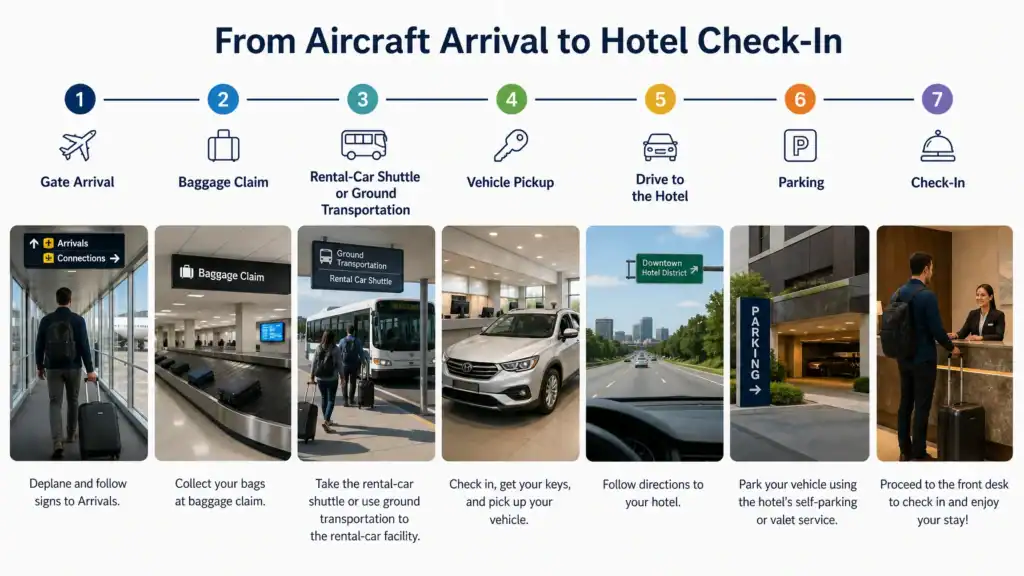
Know the sequence before you leave the airport:
- Collect bags.
- Find rental transportation.
- Complete pickup.
- Load luggage.
- Enter the hotel address in your navigation.
- Set toll and route preferences.
- Call the hotel if you’re running behind.
- Know where to park and which entrance to use.
Plan for International Arrivals and Connections
International arrivals add steps, and those steps add time that domestic travelers don’t budget for.
Research in advance:
- Passport validity and entry requirements for your destination
- The arrival airport’s procedures and layout
- Immigration or border inspection
- Where baggage is collected
- Customs and agricultural declarations
- Whether you must reclaim and recheck bags during a connection
- Terminal changes between arrival and onward flights
- Whether you’ll pass through security again on a connection
- Ground transportation from the airport
- Rental-counter hours in local time
- Time-zone changes
- Mobile-phone service and data after arrival
- The hotel’s late-arrival procedure in local time
The U.S. Department of State’s international travel planning guidance is a good starting point for documents and country information. Beyond that, check official destination and airport sources directly, because arrival procedures genuinely differ by country and by airport. Two airports in the same country can handle connections differently.
If you’re connecting through the United States after an overseas flight, verify current U.S. Customs and Border Protection procedures and your airline’s specific instructions for baggage and connections rather than assuming your bags will move automatically. Arrangements vary—preclearance at certain foreign airports changes the process, and airline agreements differ. Ask before you land, not while you’re watching the carousel.
Prepare for Flight Delays and Changed Arrival Times
Delays ripple outward. A two-hour delay doesn’t just move your landing time; it touches hotel arrival, rental-counter hours, airport shuttle schedules, public transit service windows, restaurant availability, connecting flights, childcare or pickup arrangements, and any event you booked for that evening.
Have this ready before you need it:
- Airline contact information
- The hotel’s direct phone number
- The rental location’s direct phone number
- At least one ground-transportation alternative
- All reservation numbers
- Cancellation terms for each booking
- A charger and, ideally, a power bank
- Essential medication in your carry-on
- Basic toiletries and a change of clothing in your carry-on
- A simple food plan for a long wait
- A backup route to the hotel
When a delay becomes significant enough to threaten a reservation, call. Call the hotel. Call the rental branch. Do it from the gate while you still have signal and they’re still open, rather than after you land.
For understanding what airlines have committed to, the Department of Transportation maintains an airline cancellation and delay dashboard and publishes airline refund guidance.
A few honest caveats. Airline commitments differ from carrier to carrier. The cause of a disruption can affect what’s offered. Refund rights and discretionary services—meals, hotels, rebooking—are not the same thing and don’t follow identical rules. And critically: airline rules do not govern your hotel, rental car, or tour reservations. Those follow their own terms, which you agreed to when you booked. Read current official guidance and your own reservation conditions.
If plans change enough that you need to rebook on short notice, last-minute travel savings and backup strategies can help you regroup without overpaying.
Confirm Accessibility and Special Arrangements
If something is essential to your trip, confirm it in a conversation—not by trusting a checkbox on a booking form.
Arrangements that deserve direct confirmation include airport wheelchair assistance, help getting through security, accessible ground transportation, an accessible hotel room, a roll-in shower, a ground-floor room, an accessible rental vehicle, hand controls, service-animal arrangements, mobility-equipment handling, medical-device screening, a refrigerator for medication, connecting rooms, cribs, car seats, large-group transfers, dietary arrangements, and late-night staffing.
For each one that matters:
- Contact the provider directly—airline, airport, hotel, or rental company
- Ask specifically whether the request is confirmed or only noted
- Get written documentation, even a short email reply
- Reconfirm closer to departure
- Allow extra time on travel day
- Have a backup for anything you truly can’t do without
TSA offers a request form for travelers who need screening assistance for a disability or medical condition—TSA assistance for travelers with disabilities or medical conditions—which is worth submitting in advance of your travel date.
Contacting a provider early improves your chances considerably. It doesn’t guarantee any particular service, and it’s fair to plan with that in mind.
Create an Arrival-Day Timeline
Fill this out for your specific trip. The point isn’t the template—it’s forcing yourself to name a backup for each stage.
| Travel stage | Information to confirm | Time or buffer to consider | Backup plan |
|---|---|---|---|
| Leaving home | Departure time, who’s driving, what’s loaded | Traffic at your actual departure hour | Second ride option or taxi/rideshare |
| Airport parking or drop-off | Lot location, reservation, shuttle hours | Shuttle wait plus walk to terminal | Alternate lot or curbside drop-off |
| Airline check-in | Counter vs. app, bag drop cutoff | Airline’s stated cutoff for your route | Agent assistance; kiosk if app fails |
| Security screening | ID accepted, expedited program status | Conditions at that airport and time | Allow extra time; standard lane |
| Boarding | Gate, boarding group, gate changes | Airline’s boarding cutoff | Monitor app for gate reassignment |
| Flight connection | Terminal, rechecking bags, re-screening | Minimum connection time for that airport | Rebooking options and airline contact |
| Arrival at the gate | Actual arrival gate, terminal exit route | Taxi and deplaning time | Ask crew or gate staff for directions |
| Baggage claim | Carousel number, oversize item location | Varies by aircraft size and airport | Baggage service office number saved |
| International arrival | Immigration, customs, bag recheck | Highly airport-specific | Later ground transport option |
| Rental-car shuttle | Pickup curb, frequency, last run | Shuttle interval plus ride time | Taxi or rideshare to rental branch |
| Rental counter | Hours, documents, payment card | Queue length varies by time of day | Alternate transport to hotel |
| Drive or transfer to hotel | Route, tolls, night visibility | Realistic drive time at your hour | Offline map downloaded |
| Hotel parking | Garage entrance, height limit, cost | Time to park and unload | Nearby lot identified in advance |
| Hotel check-in | Front-desk hours, late-arrival note | Time to reach the desk with bags | Property phone number accessible |
| Late meal or supplies | Nearby hours, room service, 24-hour store | Whether anything is open on arrival | Snacks packed in carry-on |
Notice there are no universal minute counts in the buffer column. Fill those in yourself using your airline’s guidance, your airport’s information, your hotel’s stated policies, your rental location’s hours, your group’s needs, and how much cushion you personally need to feel calm.
What to Confirm One Week Before Travel
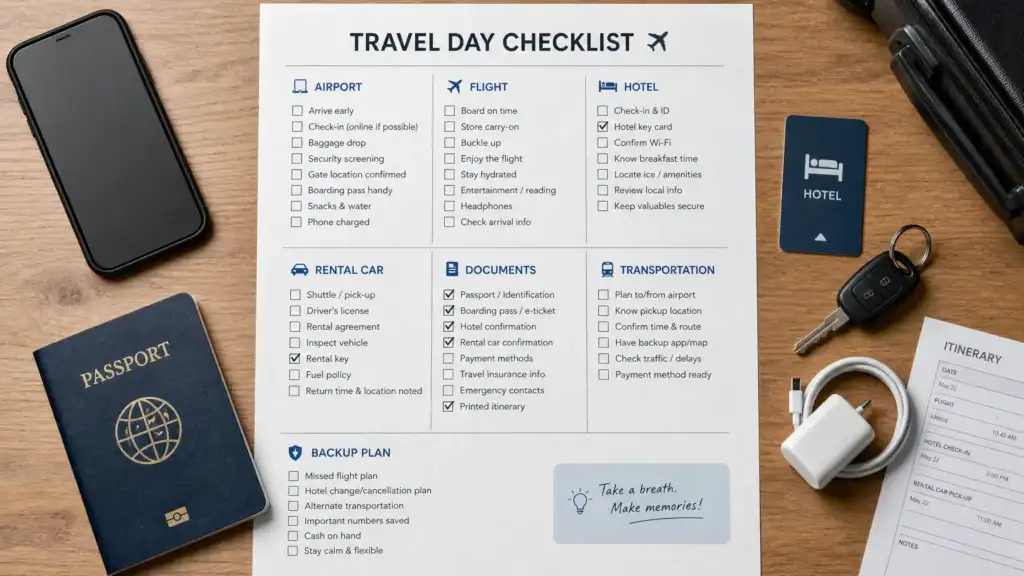
- ✅ Flight schedule reviewed for changes since booking
- ✅ Traveler names checked against identification
- ✅ Identification and passport checked for validity
- ✅ Airline baggage rules checked with the operating carrier
- ✅ Transportation to the departure airport arranged
- ✅ Hotel reservation confirmed with the property
- ✅ Hotel address and direct phone number saved
- ✅ Check-in time and late-arrival policy reviewed
- ✅ Rental pickup location verified as on-airport or off-airport
- ✅ Rental-counter operating hours checked
- ✅ Driver name and payment-card requirements reviewed
- ✅ Vehicle size reconsidered against actual passengers and luggage
- ✅ Parking arrangements at the hotel checked
- ✅ Special requests reconfirmed directly with each provider
- ✅ Cancellation deadlines reviewed and noted
- ✅ Offline copies of all confirmations saved
One week is a convenient organizing checkpoint, not a rule. If you’re leaving in four days, do it today. If you’re leaving in three weeks, doing it early costs you nothing.
What to Confirm the Day Before Travel
- ✅ Current flight status checked
- ✅ Airline check-in completed if it’s open
- ✅ Seat assignments and bag counts reviewed
- ✅ Terminal information checked
- ✅ Airport transportation reconfirmed
- ✅ Weather and road conditions checked for both ends of the trip
- ✅ Phones, tablets, and power banks charged
- ✅ Essential documents placed in the carry-on
- ✅ Medication and valuables packed in the carry-on, not checked
- ✅ Hotel and rental contact information saved offline
- ✅ Arrival route from airport to hotel reviewed
- ✅ Rental-counter closing time checked one more time against your arrival
- ✅ Late-arrival notice sent to the hotel if the schedule already looks tight
- ✅ Offline maps downloaded for the destination
- ✅ Alarms set and departure time confirmed with everyone traveling
Gate and terminal information can still change after you check in—sometimes after you’ve arrived at the airport. Keep an eye on the app rather than trusting yesterday’s printout.
Common Airport, Hotel, and Rental-Car Preparation Mistakes
Treating the scheduled landing time as the hotel arrival time
Wheels down is not the finish line. Taxiing, deplaning, walking the terminal, waiting at baggage claim, riding a shuttle, completing rental paperwork, and driving to the property all sit between the landing time and the front desk. Build the plan around when you’ll realistically arrive, not when the aircraft touches the runway.
Booking a rental car at the wrong location
Airport facilities and nearby off-airport branches often share a company name and look identical on a booking screen. They have different addresses, different hours, and different access methods. Read the full address on your confirmation, then look it up on a map.
Ignoring rental-counter operating hours
Counters close. Some branches monitor delayed flights and hold reservations; others don’t. Some airport locations have after-hours procedures; many neighborhood branches don’t. This is entirely location-specific, so call the actual branch and ask.
Assuming an early hotel check-in is guaranteed
Requesting early check-in and having early check-in are different states. Availability depends on the prior night’s occupancy and housekeeping. Ask, hope for the best, and have a plan for the hours in between.
Failing to report a late hotel arrival
If a property doesn’t hear from you and you don’t appear, your reservation may be treated as a no-show under its own terms. Calling ahead gives the property a chance to note your arrival and gives you a chance to learn about after-hours access. It doesn’t guarantee the room will be held, but it’s far better than silence.
Bringing the wrong payment method to the rental counter
Some locations require a physical credit card in the primary driver’s name. Debit-card rules are often more restrictive and may involve additional verification. Deposit and authorization-hold practices vary by company and branch. Check the specific location’s current policy before travel day.
Reserving a vehicle that is too small
Seat count and luggage capacity are separate measurements. A sedan that seats five will not swallow five large suitcases. Count bags, strollers, and car seats honestly, and size up if you’re on the line.
Keeping confirmations only in an online inbox
Phones die. Airport Wi-Fi refuses to load. International data doesn’t activate the moment you land. Screenshots, a downloaded PDF, or a printed page cost nothing and work when nothing else does.
Forgetting to plan the rental-car return
The return is a multi-step process: refueling or charging, driving to the return facility, vehicle inspection, unloading luggage, riding a shuttle or train to the terminal, and then checking in for a flight. Plan it as its own segment of the trip, not as an afterthought.
Assuming every requested hotel feature is confirmed
A crib, a roll-in shower, connecting rooms, a specific bed configuration, a refrigerator for medication—if it’s essential, confirm it in a phone call or an email reply. An online request field is a message, not a confirmation.
A Simple Airport-to-Hotel Preparation Process
- Put all reservation information into one itinerary.
- Confirm the correct airports, hotel, and rental location.
- Review the current flight schedule for changes.
- Plan transportation to the departure airport.
- Check identification, documents, and baggage rules against official sources.
- Estimate the realistic time from landing to ground transportation.
- Confirm hotel check-in and late-arrival procedures with the property.
- Confirm rental-counter location, hours, driver, and payment requirements.
- Make sure the vehicle fits the group and the luggage.
- Review hotel parking and the route from the airport.
- Confirm accessibility and special arrangements directly with each provider.
- Create a delay plan and identify backup transportation.
- Save every confirmation offline.
- Recheck the critical details the day before departure.
Before you finalize the pieces, it’s worth taking a moment to compare the full cost of your travel arrangements—parking, tolls, and shuttle fees have a way of changing which option was actually cheapest. Once the logistics are settled, move on and prepare for the final packing and timing stage.
Airport, Hotel, and Rental Car Preparation Checklist
- ✅ ✓ Correct departure and arrival airports confirmed
- ✅ ✓ Flight numbers and operating airlines checked
- ✅ ✓ Traveler names match identification
- ✅ ✓ Required identification and documents are ready
- ✅ ✓ Airline baggage rules have been reviewed
- ✅ ✓ Transportation to the departure airport is arranged
- ✅ ✓ Airport parking or drop-off instructions are saved
- ✅ ✓ Hotel address and direct phone number are accessible
- ✅ ✓ Hotel check-in and late-arrival policies are known
- ✅ ✓ Luggage storage has been researched for an early arrival
- ✅ ✓ Rental pickup location is confirmed
- ✅ ✓ Rental-counter hours are checked
- ✅ ✓ After-hours rental procedures are understood
- ✅ ✓ Driver and payment-card requirements are reviewed
- ✅ ✓ Deposit or authorization-hold terms are reviewed
- ✅ ✓ Vehicle class fits passengers and luggage
- ✅ ✓ Child seats or special equipment are confirmed
- ✅ ✓ Rental fuel, mileage, and toll terms are understood
- ✅ ✓ Hotel parking arrangements are known
- ✅ ✓ Arrival route is saved, including offline maps
- ✅ ✓ Special requests are confirmed directly with providers
- ✅ ✓ Delay contacts and backup transportation are identified
- ✅ ✓ Cancellation and refund terms are saved for each booking
- ✅ ✓ All confirmations are available offline
- ✅ ✓ Rental-return timing is included in the departure plan
Frequently Asked Questions About Airport, Hotel, and Rental Car Preparation
How do I coordinate a flight, hotel, and rental car?
Start by putting all three into a single itinerary so you can see them side by side. Then work forward through the day: departure transportation, flight, landing, bags, rental pickup, drive, parking, check-in. At each handoff, ask whether the next provider is open and ready when you’ll actually arrive. Most coordination failures happen at those handoffs—a counter that closes, a front desk that isn’t staffed, a shuttle that stops running. Confirm hours and procedures directly with each provider rather than assuming they align.
How much time should I allow between landing and rental-car pickup?
There’s no single number, because the variables are too different from airport to airport. What matters is your aircraft size and how long deplaning takes, whether you checked bags, whether the rental facility is in the terminal or reached by shuttle or train, how frequently that shuttle runs, whether you’re arriving internationally, how busy the counter is at your arrival hour, and how large your group is. Look up your specific arrival airport’s rental-center setup, then add a cushion for the parts you can’t predict.
What happens if my flight lands after the rental counter closes?
It depends entirely on the location. Some airport branches monitor incoming flight delays and hold reservations; some have after-hours pickup arrangements; others simply lock up at closing time and release the vehicle the next morning. Neighborhood branches typically have shorter hours than airport facilities. The only reliable answer comes from calling that specific branch’s direct number and asking before you travel. If the margin is thin, consider an alternate pickup time, a different location, or ground transportation for the first night.
Should I tell the hotel if I will arrive late?
Yes—call the property directly. Ask them to note your reservation for a late arrival, and confirm whether the front desk is staffed overnight. If it isn’t, ask what the after-hours access procedure is. Also check whether the reservation requires a guarantee to be held past a certain hour, since terms vary by property and by how you booked. A phone call is more dependable than a note typed into a booking form, though neither guarantees the room will be held under every property’s policy.
What should I do if I arrive before hotel check-in?
Ask the property whether early check-in is available that day, understanding it’s a request and depends on the previous night’s occupancy. Ask about luggage storage, which many hotels offer even before your room is ready. Then plan something low-effort nearby—a long meal, a park, a museum—rather than an ambitious activity when everyone is tired. Keep medication, chargers, valuables, and a change of clothing accessible so you’re not dependent on a bag you’ve just handed to the bell desk.
What documents do I need to pick up a rental car?
Requirements vary by company, by location, by driver age, and by payment method, so check your specific reservation’s terms. Generally you’ll need a valid driver’s license for the person driving, a payment card that meets the location’s requirements, and the reservation details. Some locations require a physical credit card in the renter’s name, apply extra conditions to debit cards, or ask for proof of return travel. International rentals may require additional documents. Confirm before travel day rather than at the counter.
How do I know whether my rental car is at the airport?
Read the full street address on your confirmation, not just the company name and airport code. Then look that address up on a map. If it’s a consolidated rental center or terminal counter, the airport’s official website will describe how to reach it. If the address is off the airport property, plan for a shuttle or a paid ride, and check whether that shuttle is operated by the rental company, the airport, or not at all. When in doubt, call the branch directly.
Should I use an airport rental location or an off-airport branch?
Both can work. Airport locations are usually more convenient, often have longer hours, and may accommodate late arrivals better. Off-airport branches frequently cost less and can have shorter lines, but may require a shuttle or paid ride, and often keep narrower hours. Compare the total picture: rate plus any airport fees at one location, versus rate plus transportation time and cost at the other. Your arrival time matters too—a cheaper branch that closes at 6 p.m. isn’t cheaper if you land at 9.
What should I keep in my carry-on in case of a delay?
Essential medication, a phone charger and power bank, all identification and travel documents, printed or downloaded copies of your confirmations, valuables and electronics, a change of clothing, basic toiletries, and something to eat. If you’re traveling with children, add whatever gets them through an unexpected extra three hours. The general principle: anything you would be genuinely stuck without should never go into a checked bag, because checked bags and their owners occasionally take different routes.
How should I prepare for an international airport arrival?
Verify passport validity and any entry requirements or travel authorizations well in advance through official government sources. Learn the arrival airport’s layout and whether you’ll clear immigration before or after collecting bags. Find out whether a connection requires reclaiming and rechecking luggage or passing through security again. Confirm how you’ll get mobile service on arrival, note the time-zone change, and check rental hours and hotel late-arrival procedures in local time. Procedures differ by country and airport, so use official destination sources.
How do I protect my hotel reservation during a flight delay?
Call the property as soon as you know the delay is significant—ideally from the gate, while you still have signal and the desk is staffed. Ask them to note the late arrival and confirm whether the reservation requires a guarantee to be held. Also review your booking’s terms, since no-show and cancellation policies are set by the property or booking channel, not by your airline. Airline delay obligations don’t transfer to hotels, so treat the hotel as a separate conversation.
How early should I return a rental car before a flight?
Rather than a single number, build the return as its own sequence and time each step for your specific airport. You’ll need to refuel or recharge, drive to the return facility, allow for inspection and paperwork, unload luggage, ride a shuttle or train to the terminal, and then complete airline check-in and security. Return-facility traffic peaks at certain hours, and shuttle intervals vary. Look up your airport’s return process, add each piece, and give yourself margin for the fuel stop.
Conclusion
Three confirmation numbers don’t add up to a plan. They add up to three plans that may or may not talk to each other.
Real preparation is about the connections: the flight schedule feeding into airport transportation, identification and baggage rules cleared before you leave the house, arrival procedures accounted for honestly, rental pickup that’s actually open when you land, hotel check-in that knows you’re coming, parking you can find in the dark, special arrangements confirmed by a person rather than a checkbox, and a backup for the moments when one link gives way.
None of that requires a spreadsheet or an unusual amount of effort. It mostly requires reading your own confirmations closely and making two or three phone calls.
The goal is not to predict every possible delay. It’s to know what should happen next, who to contact when it doesn’t, and how to reach the hotel safely even when the original plan changes.
Continue Planning Your Trip
How to Choose the Right Travel Destination
Still deciding where to go? This guide walks through choosing a destination based on budget, total travel time, weather, your interests, and how easy it is to get around once you arrive.
How to Compare Travel Prices
Compare the complete cost of a trip—flights, lodging, rental cars, parking, and local transportation—instead of judging each piece in isolation.
What to Reserve Early When Planning a Trip
Not every booking needs to happen at once. This guide sorts out which reservations deserve your attention first and which can wait.
Family Travel Planning Tips
Practical help with schedules, sleeping arrangements, car seats, transportation, and activity planning when you’re traveling with kids or a multi-generation group.
Packing and Travel Timing Tips
Organize luggage, documents, departure timing, and the final round of preparation before you leave the house.
Transportation Savings Tips
Compare rental cars, public transportation, airport transfers, taxis, shuttles, and rideshare services to find what actually fits your destination.
Continue Through the Travel Planning Process
Browse the full SavingsScoutTravel planning collection, from destination selection through arrival day, or use the destination hub for location-specific planning.