

Transportation Savings Tips for Getting Around on a Trip
Compare rental cars, public transportation, airport transfers, shuttles, taxis, rideshare, walking, parking, and tolls by total trip cost.
The hotel looks like a bargain. The rental car has a daily rate that seems almost too reasonable. The airport shuttle is listed at a price that barely registers. Then you start adding things up—hotel parking, a tank of fuel, tolls on the way to the beach, the airport concession fee buried in the rental total, and the four rides you’ll need between your hotel and the parts of town you actually want to see.
Suddenly the “cheap” plan isn’t cheap at all.
That’s the part most people miss. Useful transportation savings tips don’t start with finding the lowest advertised fare. They start with comparing the entire transportation plan, from the moment you land to the moment you head back to the airport.
Compare the Whole Transportation Plan
Here’s the central idea worth holding onto: compare the total cost of getting from the airport to your lodging, around the destination all week, and back to the airport again. One number. Not a daily rate. Not a single ride.
And cost isn’t the only measure. A transportation plan also has to work in practical terms, which means weighing:
- Total price for the whole trip
- Travel time
- Reliability
- Operating hours
- Luggage
- Group size
- Accessibility
- Convenience
- Flexibility
- Parking
- Weather
- Arrival and departure timing
Some of those things save money. Some of them just save your sanity. Both matter.

Start With the Places You Actually Need to Reach
Most people begin transportation planning by looking at what’s available. Rental cars, transit passes, shuttles, rideshare. That’s backwards.
Start with your itinerary instead. Write down every place you’ll physically need to be:
- Arrival airport, train station, or cruise port
- Lodging address (the actual address, not the neighborhood)
- Main attractions
- Restaurants or shopping areas you’ve bookmarked
- Event or concert venues
- A grocery store, if you’re planning to buy breakfast items
- Day-trip destinations
- Rental-car pickup and return locations
- Departure airport or station
- Any hotel changes mid-trip
- Any rural or remote stops
Now put all of it on a map. A free mapping tool with saved pins works fine. This one step tells you more than an hour of reading generic advice.
Then ask yourself:
- Are most of these places clustered together, or scattered?
- Are the attractions strung along one transit line?
- Is your hotel far from the places you actually want to visit?
- Do your day trips fall outside the transit network entirely?
- Does the airport connect directly to your lodging area, or does it require two transfers?
- Will you want to return to the hotel midday for a nap or a change of clothes?
- Are activities spread across several neighborhoods or towns?
- Will your chosen transportation still be running when your flight lands?
A destination can be described as walkable and still leave you stranded, because “walkable” usually describes a specific core. If your hotel sits four miles from that core and your dinner reservations are in a third area, walkability doesn’t help you.
This is also why it pays to choose a destination that fits your transportation needs before you’re locked in. If you’d rather not drive on unfamiliar roads, a destination with strong rail service will feel entirely different from a sprawling resort region. You can also browse destination planning guidance to get a sense of how a place is laid out before you commit.
Calculate the Complete Transportation Cost
Once you know where you’re going, price the whole thing—not one leg of it.
Here’s a working list of what can show up in a transportation budget:
- Airport transfer on arrival
- Airport transfer on departure
- Base rental rate
- Taxes and mandatory charges
- Airport concession or facility charges on rentals
- Hotel and attraction parking
- Valet parking
- Fuel
- EV charging
- Tolls
- Rental toll-program charges
- Additional-driver fees
- Child-restraint rental
- One-way drop charges
- Individual public transportation fares
- Transit passes
- Seat reservations on some trains
- Shuttle fares
- Taxi fares
- Rideshare fares
- Demand-based pricing during busy periods
- Bicycle or bike-share rental
- Ferry fares
- Luggage charges on certain shuttle and bus services
- Tips where customary
- Transportation to an off-airport rental branch
- The cost of changing plans after a delay
You won’t have every one of these. But you’ll have more of them than you expect.
Time counts too. A route that saves a modest amount but requires three transfers with two suitcases and a tired child isn’t automatically the better deal. If you’re on a five-day trip, ninety minutes lost each way is a meaningful chunk of your vacation. Convenience has real value, and pretending otherwise leads to plans people abandon on day two.
A simple way to keep yourself honest is to write down four numbers before you book anything:
- Your preferred transportation budget
- Your realistic expected total
- Your maximum, above which you’d change the plan
- A backup amount set aside for disruptions
Then compare the complete cost of your trip as one package rather than as separate purchases. It also helps to understand the complete hotel price and understand rental-car pricing, because both categories include charges that don’t appear in the headline number.
Hotel location and transportation cost are the same decision wearing two hats. Evaluate them together or you’ll get it wrong.
Compare a Rental Car With Other Transportation
There’s no universal answer here, which is exactly why the question keeps coming up. The itinerary decides it.
A rental car often makes sense when:
- Attractions are far apart
- The destination has limited or infrequent transit
- Your trip includes rural areas, small towns, or national park regions
- You’ve planned several day trips
- You’re traveling with a larger group
- You need to carry gear, coolers, or sports equipment
- Your schedule needs flexibility
- Public transportation stops running early
- Your lodging includes practical, reasonably priced parking
- You’re staying at several hotels along a route
A rental car is often less useful when:
- You’re staying in a dense city center
- Parking is expensive, scarce, or both
- Your attractions sit along a single transit line
- The car will sit in a garage most of the week
- You’re not comfortable driving in unfamiliar conditions
- The destination has narrow roads, complicated signage, or restricted zones
- Your hotel charges a substantial nightly parking rate
- Only one or two days of your trip actually require a vehicle
That last point is where a lot of money quietly leaks out. Plenty of travelers reserve a car for seven days because it seemed simpler, then use it twice.
You don’t have to pick one method for the whole trip. Some alternatives worth pricing:
- Rent only for the day-trip days
- Spend the city portion without a car, then pick one up
- Return the car before your city stay begins
- Combine transit with a short two-day rental
- Take an airport transfer on arrival and rent later from a downtown branch
- Take an intercity train between cities and rent only at the final stop
Someone spending four days in a walkable city and two days exploring wine country nearby will almost always do better with a two-day rental than a six-day one—even accounting for a downtown pickup fee.
If you do rent, a few practical car rental savings tips go a long way, and it’s worth knowing the best time to book car rentals since rental pricing moves differently from flight pricing. For location-specific quirks, you can browse destination-based rental-car guidance.
Compare the Total Rental-Car Price
Never compare daily rates. Compare totals.
Two quotes with identical daily rates can differ substantially once everything lands on the final screen. Before you book, look at:
- The all-in total for your exact dates and times
- Taxes
- Required fees
- Airport concession charges
- Facility or customer-facility charges
- Vehicle class and what actually fits inside it
- Mileage terms
- Fuel policy
- Charging requirements for EVs
- Toll program terms
- Additional-driver charges
- Young-driver charges where they apply
- One-way drop charges
- Child-restraint or equipment rental charges
- Deposit or credit-card authorization hold
- Pickup and return hours for that specific branch
- Cancellation terms
- Payment requirements, including debit-card rules
- Transportation to an off-airport branch, if applicable
- Hotel parking for every night
- Parking at the attractions you’re visiting
The Federal Trade Commission guidance for renting a car is a genuinely useful read before your first rental. In plain terms, it encourages travelers to confirm the full price including add-on charges, read the rental agreement before signing, understand fuel and mileage terms, know what happens if you return the vehicle late or to a different location, and inspect and document the car’s condition at pickup and return. None of that is exotic advice—it’s just easy to skip when there’s a line behind you.
On optional protection products: this is a personal review, not something anyone can decide for you in an article. Look at your own personal auto policy, any benefits attached to the credit card you’ll use, the rental agreement’s terms, the destination’s requirements, and your own tolerance for risk. Coverage varies by policy, card, country, and vehicle type. Don’t assume your existing coverage transfers—confirm it with the issuer or insurer before you travel, and get the answer in writing if it matters to you.
Decide Whether an Airport Rental Location Is Worth It
Airport counters and neighborhood branches are different products at different prices.
Airport locations may offer:
- Longer operating hours
- Easy access right after you land
- More vehicle inventory and more class options
- Simpler luggage handling
- Better handling of delayed flights
The tradeoffs may include:
- Airport concession recovery charges
- Customer facility charges
- Longer counter lines during peak arrivals
- A shuttle or train ride to a consolidated rental center
- Return procedures that require extra time on departure day
Off-airport locations may offer:
- Lower base rates
- Fewer airport-specific charges
- Shorter lines
- Pickup close to your hotel instead of across town
The tradeoffs may include:
- Shorter hours, sometimes closing early evening
- A paid ride to reach the branch
- Limited inventory, especially for larger vehicles
- No flight tracking if you’re delayed
- Weekend or holiday closures
- Awkward luggage handling on the way there
The comparison that matters: airport rental total versus off-airport rental total plus the cost and time of getting to that branch, in both directions if needed. A traveler who saves on the rate and then pays for two taxi rides across town may come out even—or behind.
For a deeper look, you can compare airport and off-airport rental strategies. It also helps to coordinate airport, hotel, and rental-car preparation so pickup times, check-in times, and flight schedules don’t collide.
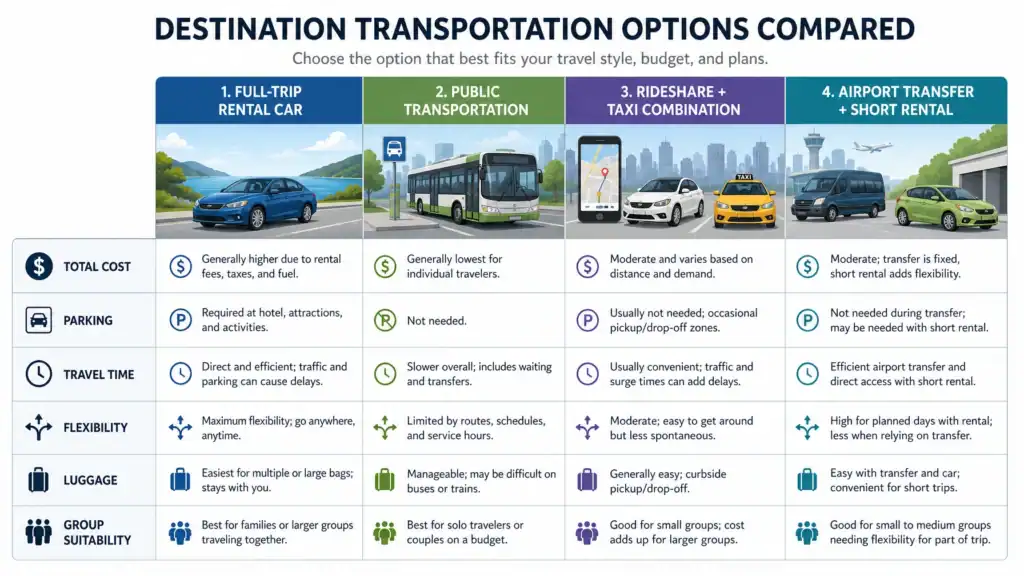
Use Public Transportation When It Fits the Itinerary
“Public transportation” covers a lot of ground: airport trains, metro and subway systems, local buses, streetcars, commuter rail, regional trains, ferries, and public airport shuttle routes.
Where it tends to shine:
- No parking to find or pay for
- No fuel or toll costs
- Predictable, published fares
- Direct access to city centers where driving is difficult
- No driving required in unfamiliar conditions
- Airport connections that drop you near your lodging
Where it can fall short:
- Limited operating hours, especially late at night
- Reduced weekend and holiday service
- Transfers that add time and hassle
- Stairs at older stations
- Crowding at peak hours
- Luggage restrictions on some services
- Accessibility that varies station by station
- Weather exposure while waiting
- Planned or unplanned service disruptions
- Long waits in lower-frequency suburban areas
- Routes that simply don’t reach where you’re going
Before you rely on it, verify the details through the destination’s official transportation authority—the transit agency’s own website, the airport’s ground transportation page, or the rail or ferry operator. Look up route maps, operating hours, airport connections, the fare system, pass options, accepted payment methods, transfer rules, accessibility details, elevator outage notices, current service alerts, luggage policies, holiday schedules, and the time of the last departure.
Mapping apps are good for a rough plan. They’re not the operator’s live schedule. Check both.
Compare Individual Fares With Transit Passes
A multi-day pass feels like the frugal choice. Sometimes it isn’t.
Before buying, compare:
- How many trips you realistically expect per day
- The single-ride fare
- Transfer rules (does a transfer count as a new fare?)
- Whether a daily fare cap exists
- Multi-day pass price
- Airport supplements, which some systems charge separately
- Which zones are included
- Which transportation types the pass covers
- Activation rules—does the clock start at purchase or first use?
- Expiration terms
- Reduced fares for children, seniors, or riders with disabilities
- Whether each traveler needs a separate pass
- Whether the pass covers the specific routes you’ll use
A three-day pass looks tidy. But if you’re taking one round trip a day and walking the rest, individual fares may cost less. On the other hand, a family bouncing across the city six times a day may clear the pass price by lunch on day one.
Run the numbers with your actual itinerary and the operator’s current published fares. Don’t guess.
Compare Airport Transportation Before Arrival
Your airport transfer is often the single most expensive transportation decision of the trip, and it’s the one people plan last.
Options usually include an airport train, a public bus, a hotel shuttle, a shared van shuttle, a taxi, a rideshare, a private transfer, a rental car, a pickup from friends or family, or—in rare airport-adjacent cases—walking.
Compare them on:
- Total cost
- Cost per traveler
- Operating hours at your actual arrival time
- Advance-reservation requirements
- Luggage capacity
- Child-restraint requirements
- Accessibility
- Where pickup happens
- Travel time
- Number of transfers
- Late-night availability
- Cancellation terms
- Expected waiting time
- Walking distance from the final stop to your hotel door
That last item catches people. An airport train that saves money is a poor deal if the station leaves you dragging luggage six blocks uphill in the rain.
A solo traveler landing midafternoon at an airport with direct rail service will often do best on the train. A family of five landing at 11:40 p.m. with a car seat and four suitcases usually won’t.
About hotel shuttles: don’t assume anything. Some are complimentary, some are paid, some are shared with neighboring properties, and some require a phone call or an advance reservation. Confirm directly with the hotel:
- Whether it’s free or paid
- Which airport and which terminals it serves
- Operating hours
- Exact pickup instructions and curb location
- Whether reservations are required
- Luggage limitations
- Accessibility
- Whether it makes stops at other hotels first
Then plan how you’d get to the hotel if the shuttle isn’t running when you land. To smooth out the rest of the arrival, prepare for airport arrival and hotel check-in before you go.
Use Taxis and Rideshare Strategically
Taxis and rideshare services are tools, not a default. They tend to work well for:
- Airport transfers when transit doesn’t line up
- Late-night trips after transit has stopped
- Short hops that transit doesn’t serve directly
- Groups splitting a single fare
- Trips with luggage
- Getting back after an evening event
- Avoiding parking at a venue where parking is a headache
Costs and limitations to keep in mind:
- Demand-based pricing during busy periods, bad weather, and event lets-out
- Airport pickup surcharges at many airports
- Tolls added to the fare
- Waiting time before your ride arrives
- Larger-vehicle upgrades for groups
- Needing two vehicles instead of one
- Child-restraint requirements
- Thin or nonexistent service in rural areas
- App and mobile-data requirements
- Restricted pickup zones at airports and stadiums
- Accessible vehicle availability that varies by market and time of day
The math is entirely about trip volume. Two rideshare trips over a weekend will almost certainly cost less than renting and parking a car for a week. Four rides a day for six days can easily flip that result. Estimate your realistic number of rides—including the ones you’ll take because you’re tired—before deciding.
Check current fare estimates in the app for your actual route and time, and use the airport’s official ground transportation page for pickup instructions, since designated zones change.
A few basic precautions, without drama: confirm the vehicle description and driver information shown in the app before getting in, use designated pickup areas, share your trip details with someone when it makes sense, don’t enter a vehicle that doesn’t match your reservation, and use official taxi queues where they exist.
Consider a Private or Shared Airport Transfer
Private transfers get dismissed as a luxury. For some travelers they’re the practical choice, and occasionally the cheaper one.
They tend to work for:
- Large families
- Groups traveling together
- Anyone with a lot of luggage
- Late-night arrivals
- Rural resorts far from any transit
- Cruise port transfers with tight timing
- Travelers who need accessible transportation
- Destinations where the transit connection involves several confusing steps
- Anyone who wants a confirmed, named pickup waiting
Compare on:
- Price per person
- Total group price
- Waiting policy after landing
- Flight-delay policy
- Cancellation terms
- Vehicle size and seat count
- Actual luggage capacity
- Child-restraint arrangements and whether they must be requested
- Accessibility details
- Number of stops for shared shuttles
- Meeting location
- How you’ll contact the driver
- Gratuity expectations
A private van that costs more than one train ticket may cost less per person than five train tickets plus a taxi for the luggage. Run it both ways—total and per person.
Book through the airport’s official ground transportation listings, your hotel’s recommended providers, or a company you’ve researched properly. Don’t accept unsolicited offers inside the terminal.
Let Hotel Location Reduce Transportation Costs
This is where the biggest savings usually hide, and it’s the section most people skip.
A lower nightly rate can quietly generate:
- Daily rideshare trips in both directions
- A rental car you wouldn’t otherwise need
- Nightly parking charges
- Fuel
- Tolls
- Long transit rides that eat your day
- More expensive airport transfers
- An impossible midday return to the room
A central hotel may cost more per night but allow:
- Walking to a meaningful share of your activities
- Shorter, cheaper transit trips
- Skipping the rental entirely
- Easy access to food that isn’t hotel food
- Going back to the room midday
- Simpler airport transportation in both directions
- Fewer paid rides overall
Compare hotel price plus transportation, not hotel price alone.
Picture a couple weighing a downtown hotel against a suburban one that’s noticeably cheaper per night. The suburban choice requires a rental car, five nights of hotel parking, and fuel. Once all of that goes on the sheet, the downtown room—where they’d walk to dinner and take one airport train each way—can easily come out ahead, and they’d spend less time in traffic.
It doesn’t always work out that way. Sometimes the suburban hotel wins by a mile, especially when your activities are outside the city anyway. The point is to actually run it.
To make that comparison easier, choose a hotel location that reduces transportation needs, review some practical hotel savings tips, and browse destination-based hotel guidance for the specific place you’re visiting.
Include Parking in the Decision
If you’re renting a car, parking is not a footnote. It’s a line item that can rival the rental itself.
Parking may include hotel self-parking, valet, attraction lots, event parking, metered street parking, public garages, airport parking if you’re driving to your departure airport, resort parking, and overnight restrictions in residential areas.
Verify before you book:
- Daily or nightly price
- Whether taxes are included in the quoted figure
- Valet gratuity expectations where applicable
- In-and-out privileges, and whether each reentry costs extra
- Garage height clearance if you’re renting an SUV or van
- Operating hours of the garage
- Reentry rules after hours
- EV charging availability and fees
- Security procedures
- Whether reservations are required or recommended
- Walking distance from the garage to the hotel or attraction
- Overnight street parking restrictions
- Whether the vehicle must be moved for street cleaning
Get these numbers from the hotel’s own website or front desk, the attraction’s official page, the airport’s parking page, the garage operator, or the municipal parking authority. Not from a forum post from three years ago.
Estimate Fuel, Charging, and Tolls
A rough estimate beats no estimate. Work out:
- Expected total driving distance across the trip
- The fuel efficiency of the class you’re renting
- Current local fuel cost at the destination
- Charging network access if you’re renting an EV
- How long charging will take and where it fits in your day
- Whether the hotel charges for charging
- Toll roads on your planned routes
- Bridges and tunnels with separate tolls
- Congestion or low-emission zone charges in some cities
- The rental company’s toll program terms
- Administrative charges attached to that program
- Cashless toll systems that have no cash lane at all
Toll programs are convenient—you drive through and it’s handled—but they often carry a per-day or per-use administrative charge on top of the toll. On a long trip with light toll use, that convenience fee can exceed the tolls themselves. Read the rental agreement’s toll section and check the official toll agency’s website for the roads you’ll actually use, since some agencies offer visitor payment options.
Avoiding tolls entirely is sometimes worth it and sometimes not. A five-minute detour to skip a toll is fine. A forty-minute detour through stop-and-go traffic to save a modest toll usually isn’t, once you count fuel and your own time.
Combine Transportation Methods
You are not required to pick one method and marry it. Mixed plans are often the practical answer.
Some combinations that work:
- Airport train plus walking for a compact city stay
- Transit on city days plus a one-day rental for a rural excursion
- Taxi after a late arrival, transit for everything after that
- Private van transfer for a group, then walking near the hotel
- Rental car for the first half of a trip, intercity train for the second
- Public transit during the day, rideshare after service ends at night
- Hotel shuttle on arrival, downtown rental pickup two days later
The easiest way to build this is to plan transportation by day, not by trip:
- Arrival day—how do you get from the airport to your bed?
- City sightseeing days—what covers the day-to-day movement?
- Day-trip days—what reaches places transit doesn’t?
- Event days—parking, late returns, crowd dispersal
- Departure day—early morning options, rental return timing
Then look at the seams. The transitions between methods are where plans break—the rental pickup you assumed was walkable, the transit ride to the car branch that closes at 5 p.m., the shuttle that runs hourly. Price and time each handoff, not just each method.
For intercity legs, comparing a flight against a train sometimes changes the whole structure of a trip. If you’re weighing that, understanding how airline pricing works helps you see when a short flight is genuinely competitive with ground transportation once transfers and airport time are counted.
Account for Families, Groups, and Luggage
The cheapest option for one traveler is frequently the most expensive option for five.
Think through:
- How many fares you’re actually buying
- How many vehicles a group requires
- Child restraints—how many, what type, who supplies them
- A stroller
- A wheelchair or other mobility equipment
- Number and size of suitcases
- Sports or hobby equipment
- Whether you’ll return to the hotel midday
- Group members arriving on different flights
- Group members with different activity plans
- The likelihood that the group splits up during the day
Concrete comparisons that come up constantly:
- Five train fares each way versus one van transfer
- One rental vehicle versus two rideshare vehicles for every trip
- A transit route with three flights of stairs and four suitcases
- A midsize car that seats five but cannot hold five people’s luggage plus a stroller plus two car seats
That last one deserves emphasis. Seat count is not luggage capacity. A family that books a midsize sedan because it seats five may find themselves at the counter paying for an upgrade they didn’t budget for. Check the vehicle’s stated luggage capacity, and when in doubt, size up before you travel rather than at the counter.
For broader logistics, our family travel planning tips cover how transportation interacts with nap schedules, meal timing, and everything else that shapes a family trip.
On child restraints: review the NHTSA car-seat and booster-seat guidance for general information about seat types and proper installation. Requirements differ by jurisdiction, and rules for taxis, rideshare vehicles, and shuttles vary as well. Confirm the applicable law at your destination and ask each provider directly what they require and what they can supply. If a rental company offers seats, availability isn’t guaranteed—reserve early and have a plan if the seat isn’t there.
Confirm Accessibility Before Relying on a Transportation Option
If any part of your group has mobility, vision, hearing, or stamina considerations, verify the specifics rather than trusting a symbol on a map.
Research:
- Step-free routes from entrance to platform to exit
- Elevator locations
- Current elevator outages
- Which stations are designated accessible
- Wheelchair spaces on vehicles
- Boarding assistance procedures and whether advance notice is needed
- Accessible taxi or rideshare availability in that market
- Accessible rental vehicles
- Hand-control availability
- Shuttle accessibility, including lift-equipped vans
- Mobility-equipment storage on transfers
- Walking distance at each end
- Sidewalk and curb conditions
- Service-animal policies
- Advance-notice requirements and deadlines
Contact the transit authority, the airport, the hotel, the rental provider, the shuttle company, the transfer operator, and the attraction. Yes, that’s a lot of phone calls. It’s less trouble than discovering the problem at 11 p.m. with your luggage on the curb.
Here’s the trap worth naming: an accessibility symbol describes a station, not a journey. A station can be fully step-free while the eight-minute walk from that station to your hotel involves broken sidewalks and a steep grade. The route has to work end to end.
No article can promise availability. Confirm essential arrangements directly with each provider, get confirmation numbers, and build a backup—a phone number for an accessible taxi service, or a transfer company that can be booked on short notice.
Plan Around Arrival and Departure Times
Every dollar you save disappears if the service isn’t running when you need it.
Verify:
- The last airport train of the night
- The first train of the morning
- Hotel shuttle operating hours
- Rental counter hours at your specific branch
- Weekend transit schedules, which often differ substantially
- Holiday schedules
- Ferry departure times
- Private transfer waiting limits after a delayed flight
- Taxi availability at your arrival hour
- Rideshare availability in that area at that hour
- Time needed to return a rental and reach the terminal
- Airport parking shuttle frequency early in the morning
Say your flight lands at 11:50 p.m. If the airport train’s last departure is well before that—and many systems stop earlier than travelers expect—your entire hotel comparison changes. That “cheaper” hotel twenty minutes out of town now requires a late-night taxi, and the total shifts.
Same thing on the way out. A 6:15 a.m. departure may fall before the first train, before the shuttle starts, and before the rental counter opens. Confirm both directions.
Our guide to packing and travel timing tips helps you build realistic buffers into these transitions.
Prepare for Transportation Disruptions
Things go sideways. Flight delays, cancellations, missed connections, transit service disruptions, road closures, weather, rental vehicles unavailable at pickup, counters already closed, shuttle delays, heavy traffic, canceled ferries, patchy mobile service, and dead phone batteries all happen to ordinary travelers on ordinary trips.
Keep these accessible without an internet connection:
- Hotel phone number
- Rental location phone number
- Transit authority contact and service alert page
- At least one alternative airport transportation option
- Offline maps of your destination
- Confirmation numbers for every reservation
- Chargers and a power bank
- More than one payment method
- Cancellation terms
- A backup route to your lodging
On the airline side, two official resources are worth bookmarking. The Department of Transportation airline cancellation and delay dashboard shows commitments that participating U.S. airlines have made for certain controllable delays and cancellations. Separately, Department of Transportation airline refund guidance explains refund rights, which are a different question from optional amenities an airline may offer.
Some important clarifications:
- Airline commitments vary from carrier to carrier.
- The cause of the disruption often determines what applies.
- Your hotel, rental car, shuttle, parking, and activity reservations follow their own separate cancellation terms.
- Airline rules do not automatically reimburse missed ground transportation, prepaid transfers, or a rental you couldn’t pick up.
- You’ll need to contact each affected provider individually, and the sooner the better.
That last point is the practical one. If your flight slips four hours, call the transfer company and the rental branch while you’re still sitting at the gate. Our guide to last-minute travel savings and backup strategies covers how to regroup when plans change on short notice.
Transportation Comparison Table
| Transportation option | Total costs to include | Best suited for | Limitations to check |
|---|---|---|---|
| Full-trip rental car | Base rate, taxes, airport and facility charges, parking every night, attraction parking, fuel or charging, tolls, toll-program fees, additional driver, child seats | Rural regions, national park areas, multi-stop road trips, larger groups, gear-heavy travel | Hotel parking costs, driving comfort, garage height, counter hours, days the car sits unused |
| Short-term rental car | Same as above, but only for the days rented, plus transportation to the pickup branch | Trips with one or two excursion days from a walkable base | Branch hours, weekend closures, inventory limits, downtown pickup logistics |
| Public transportation | Individual fares or pass, airport supplements, occasional taxi to fill gaps | Dense cities with connected attractions, solo travelers and couples, budget-focused trips | Operating hours, transfers, stairs, luggage policies, accessibility by station, service alerts |
| Airport train or bus | Fare, any airport supplement, transfers, walk from the final stop | Solo travelers and couples with manageable luggage arriving during service hours | Last departure of the night, first departure of the morning, distance to your hotel door |
| Hotel shuttle | Fare if it isn’t complimentary, gratuity where customary | Airport-area hotels, travelers with flexible arrival timing | Whether it’s actually free, operating hours, reservation requirements, shared stops, luggage and accessibility limits |
| Shared airport shuttle | Per-person fare both directions, luggage charges on some services, tips | Solo travelers and small groups without transit access | Multiple stops, wait for the van to fill, longer total travel time, advance booking |
| Taxi | Metered fare, airport surcharge, tolls, tip | Late arrivals, short trips, luggage-heavy trips, travelers not using apps | Fares vary by traffic and route, availability in rural areas, accessible vehicle availability |
| Rideshare | Fare, demand-based pricing, airport pickup fee, tolls, tip, larger-vehicle upgrades | Filling gaps in transit, evening returns, splitting among a few people | App and data requirements, restricted pickup zones, multiple vehicles for groups, child seats |
| Private transfer | Total vehicle price, gratuity, waiting charges | Groups, families, late arrivals, rural resorts, cruise ports, accessible transportation needs | Flight-delay and waiting policy, cancellation terms, luggage capacity, meeting point |
| Walking | Free, plus appropriate footwear and weather gear | Compact city centers, central lodging, short distances | Weather, hills, sidewalk conditions, distance limits, luggage, nighttime lighting |
| Bicycle or bike-share | Rental or membership, per-minute charges, helmet, docking rules | Flat cities with bike infrastructure, short hops, good weather | Weather, traffic, helmet laws, dock availability, not practical with luggage or small children |
| Mixed transportation plan | Every method used, plus each transition between them | Most multi-part trips combining a city stay with excursions | Handoff timing, branch hours, luggage storage between segments, added complexity |
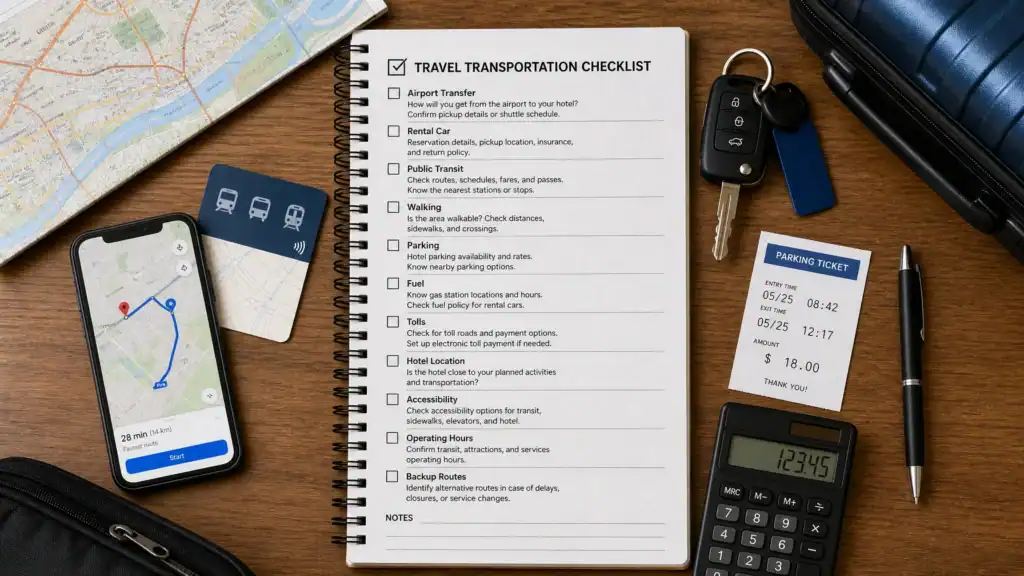
Common Transportation Planning Mistakes
Comparing only the rental-car daily rate
The daily rate is the smallest part of the story. Taxes, airport concession charges, facility fees, parking, fuel, tolls, toll-program administrative charges, and optional add-ons all attach to that number. Two rentals with the same headline rate can finish far apart. Always compare the all-in total for your exact dates, and then add the parking you’ll pay at your hotel every night.
Choosing a cheaper hotel without adding transportation
A hotel that saves you money per night can cost more per day once you’re paying for rides, parking, or a rental you’d otherwise skip. Location changes your daily transportation spending more than almost any other decision. Add the transportation column before you compare room rates.
Assuming public transportation operates all night
Most systems reduce or stop service overnight, and weekend and holiday schedules often differ from weekdays. A late arrival or a predawn departure can put you outside the service window entirely. Check the last departure and the first departure on the operator’s own site, for your actual travel dates.
Renting a car for the entire trip when it’s needed for two days
If four of your six days are spent in a walkable area, you may be paying for four days of rental plus four nights of parking to have a vehicle sit still. A two-day rental—or a downtown pickup after the city portion—can cost meaningfully less. Price both structures.
Assuming a hotel shuttle is free
Some are complimentary. Some are paid. Some require an advance reservation, run only on a fixed schedule, serve only certain terminals, or are shared with several nearby properties. Confirm price, hours, reservation requirements, and pickup instructions with the hotel directly before you build your arrival around it.
Using rideshare for every trip without estimating the total
Individual fares feel small. Twenty of them don’t. Count your realistic daily rides across the full trip, factor in higher pricing during peak periods and bad weather, and compare that total against a rental with parking or a transit pass. Sometimes rideshare wins easily. Sometimes it’s the most expensive plan on the table.
Ignoring luggage and vehicle capacity
A vehicle that seats your group may not hold your group’s luggage. Add strollers, car seats, and any equipment, then check the vehicle’s stated luggage capacity. It’s cheaper to book the right size in advance than to upgrade at the counter with a tired family behind you.
Forgetting parking at the hotel
Nightly parking can rival the daily rental rate in some city centers, and valet may be the only option at certain properties. Confirm the price on the hotel’s own site or by phone, ask about in-and-out privileges, and add the full stay’s parking to your rental total before deciding.
Ignoring toll-program charges
Rental toll transponder programs are convenient, but they frequently carry a per-day or per-use administrative charge separate from the tolls. On some itineraries that fee exceeds the tolls. Read the toll section of your rental agreement and check the official toll agency’s site for visitor payment options on the roads you’ll use.
Choosing transit without reviewing transfers and accessibility
A route that looks efficient on a map may involve two transfers, a long platform change, and stairs. With luggage, a stroller, or limited mobility, that changes everything. Review the actual station layouts, elevator status, and transfer points before you commit to a transit-based plan.
Using an off-airport rental without planning how to reach it
A lower rate at a neighborhood branch is only a savings if you account for the ride there. Include the cost both directions where relevant, the branch’s operating hours, and what happens if your flight arrives after it closes.
Planning only the arrival transfer
People research the airport-to-hotel trip carefully and then improvise the return. Departure day usually has tighter timing, earlier hours, and less service available. Confirm your return transportation with the same care, and check whether it runs at the hour you’ll actually need it.
A Simple Transportation Planning Process
- Mark the airport, your hotel, and every planned activity on a map.
- Identify which days actually require transportation and which don’t.
- Compare hotel location and transportation costs together, as one decision.
- List every realistic transportation option for your destination.
- Calculate the complete trip cost of each option, not the advertised rate.
- Include parking, fuel or charging, tolls, transfers, and airport charges.
- Check operating hours against your real arrival and departure times.
- Factor in group size, luggage, child restraints, and accessibility needs.
- Compare a full-trip rental against a short rental for only the days you need it.
- Consider combining several transportation methods across different days.
- Review cancellation and payment terms for everything you reserve.
- Confirm essential services directly with the provider, especially shuttles and accessible arrangements.
- Save route maps, addresses, and contact numbers offline on your phone.
- Create a backup plan for both arrival and departure.
- Recheck schedules and service alerts a day or two before you travel.
To tie the pieces together, coordinate your airport, hotel, and rental-car arrangements as a single timeline, and browse more practical travel-planning guides when you’re ready to work on the rest of the trip. If you haven’t locked in the big pieces yet, our guide to what to reserve early when planning a trip explains which transportation decisions benefit from booking ahead.
Transportation Savings Checklist
- ✅ Airport, hotel, and activities are marked on a map
- ✅ Hotel location has been compared with transportation costs
- ✅ Airport transfer is planned in both directions
- ✅ Arrival and departure operating hours are checked
- ✅ Public transportation routes and schedules are verified with the official operator
- ✅ Transit pass has been compared with individual fares
- ✅ Full-trip rental has been compared with a short rental
- ✅ Rental total includes taxes and required charges
- ✅ Airport and off-airport rental options are compared
- ✅ Cost of reaching an off-airport branch is included
- ✅ Rental vehicle fits travelers, luggage, and equipment
- ✅ Parking costs are included for every night and every attraction
- ✅ Fuel or charging costs are estimated
- ✅ Tolls and toll-program charges are reviewed
- ✅ Additional-driver and one-way terms are reviewed
- ✅ Taxi and rideshare estimates reflect the expected number of trips
- ✅ Shuttle cost and reservation requirements are confirmed
- ✅ Group price is compared with per-person fares
- ✅ Child-restraint arrangements are researched and confirmed
- ✅ Accessibility is confirmed for each part of the route
- ✅ Late-night and early-morning alternatives are identified
- ✅ Return transportation to the airport is confirmed
- ✅ Cancellation terms are saved
- ✅ Addresses and contact information are available offline
- ✅ Backup transportation is identified
- ✅ Schedules and service alerts will be rechecked before travel
Frequently Asked Questions About Transportation Savings
What is the cheapest way to get around while traveling?
There isn’t one answer that holds everywhere. It depends on how spread out your destination is, where you’re staying, how many people are traveling, how much luggage you have, and when you arrive. Walking and public transportation are often least expensive in dense cities with good networks. A rental car frequently wins in rural regions where attractions sit far apart. The reliable method is to price two or three complete plans—airport to hotel, around town all week, and back to the airport—and compare the totals.
Is it cheaper to rent a car or use public transportation?
Compare the full rental total, including taxes, airport charges, nightly parking, fuel, and tolls, against your expected transit fares or pass price for the same days. In a city center with connected attractions and expensive parking, transit usually costs less. In a region where sights are twenty miles apart with limited bus service, the rental often costs less and saves hours. Many trips land in between, which is why renting for only part of the trip works well.
Is it cheaper to rent a car or use rideshare?
It comes down to how many trips you’ll take and how long each one is. Two or three rides over a weekend generally cost less than a week’s rental plus parking. Four or five rides every day for a week usually costs more, especially with peak-period pricing and airport surcharges. Estimate a realistic daily ride count, check current fare estimates for your actual routes, and compare that against the all-in rental total including parking at your hotel.
Should I rent a car at the airport?
Airport locations offer longer hours, larger inventory, easier luggage handling, and better accommodation for delayed flights. They also carry concession and facility charges that off-airport branches often avoid. If you’re landing late, traveling with a family, or need a specific vehicle class, airport convenience frequently justifies the extra cost. If your schedule is flexible and a neighborhood branch is genuinely easy to reach, compare both totals before assuming the airport is the default.
Are off-airport rental cars cheaper?
The base rate often is. Whether the trip is cheaper depends on what it costs and takes to get there. Add the ride to the branch—and back, if you’re returning there—plus any time lost. Check the branch’s operating hours carefully, since many close earlier than airport counters and some close entirely on weekends or holidays. Off-airport locations also typically don’t track delayed flights, so a late arrival can leave you without a car.
How can I save money on airport transportation?
Look at every option before you land: airport train, public bus, hotel shuttle, shared van, taxi, rideshare, private transfer, and rental car. Compare total cost and cost per traveler, since the ranking often flips between one person and five. Check operating hours for your actual arrival time. Verify the walk from your final stop to the hotel door. And plan the return trip at the same time—departure day usually has fewer options at earlier hours.
Is a hotel shuttle always free?
No. Some hotel shuttles are complimentary, some charge a per-person fare, and terms vary widely by property. Many also require an advance reservation or a phone call after you land, run only during set hours, serve specific terminals, or share the route with neighboring hotels. Confirm the price, hours, pickup location, reservation requirements, luggage limits, and accessibility directly with the hotel before you rely on it, and know what you’d do if it isn’t running.
Is a transit pass worth buying?
Sometimes. Compare the pass price against the single fares for the trips you realistically expect. Check whether the system has a daily fare cap that gives you pass-like pricing automatically, whether transfers count as new fares, whether the airport connection carries a supplement, and which zones and modes the pass covers. A traveler making one round trip per day may spend less on individual fares. A family riding six times a day will usually clear the pass price quickly.
How do I know whether I need a rental car?
Map your activities first. If most of them cluster in one area connected by transit or short walks, you probably don’t need a car for the whole trip. If you’ve planned day trips into rural areas, national park regions, or small towns with limited service, a car becomes hard to replace. Also weigh your own comfort driving in unfamiliar conditions, your hotel’s parking situation, and whether the car would sit unused for several days.
Can I rent a car for only part of my trip?
Yes, and it’s often the smarter structure. Many travelers spend their city days without a car, then pick one up from a downtown or neighborhood branch for two days of excursions. Check the branch’s operating hours, confirm it has the vehicle class you need, factor in how you’ll reach it, and compare the total against a full-trip airport rental. Sometimes the shorter rental plus a transfer costs less than the longer one plus parking.
How do I estimate parking costs before a trip?
Go to the source. Check the hotel’s own website or call the front desk for the nightly self-parking and valet rates, and ask whether taxes are included and whether in-and-out privileges apply. For attractions and events, check their official pages. For street parking and overnight restrictions, check the municipal or parking-authority website. Multiply the nightly figure by your number of nights and add it to the rental total before comparing options.
How do rental-car toll programs work?
Arrangements differ by company, location, and vehicle, so the details you need are in your specific rental agreement rather than in general advice. Broadly, these programs let you use electronic toll lanes and bill you afterward, often with an administrative charge in addition to the tolls. Read the toll section of your agreement before you drive off, and check the official toll agency’s website for the roads on your route—many offer visitor payment options that may cost less depending on how much you’ll drive.
What transportation is best for a family?
It depends on luggage, restraints, schedule, and how fares scale. Five individual transit fares each way add up differently than one vehicle. Car seats create real constraints for taxis and rideshare, and requirements vary by location and provider. Families also tend to return to the hotel midday, which increases trip counts. Compare a rental with parking, a private or shared transfer plus transit, and a rideshare-heavy plan using your actual daily movement.
How should I plan transportation for a late-night arrival?
Check whether the airport train, public bus, or hotel shuttle is still operating at your scheduled landing time—then check again for an hour or two later, since delays happen. If service ends before you’d arrive, price a taxi, rideshare, or prebooked transfer as your primary plan rather than your emergency plan. Have the hotel’s phone number saved, know the official pickup area for your chosen service, and keep a second payment method available.
How do I compare a central hotel with a cheaper suburban hotel?
Build two columns. Under each hotel, list the nightly rate times the number of nights, then add airport transportation both directions, daily transportation to your activities, parking if a car is involved, fuel, and tolls. Include travel time as a separate line, even if you don’t assign it a dollar value. Then compare the bottom of each column. The central hotel sometimes wins outright; other times the suburban option is clearly better, especially if your activities are outside the city.
What should I do if my flight delay affects my ground transportation?
Contact each provider separately and as early as you can—ideally from the gate. Airline commitments and refund rules apply to the flight, not to your rental car, transfer, shuttle, hotel, or parking reservation, and each of those follows its own cancellation and no-show terms. Some rental branches close before late arrivals and some transfer companies have limited waiting policies. Keep confirmation numbers and phone numbers accessible offline, and know your backup route to the hotel.
Conclusion
Transportation savings almost never come from finding one cheap fare. They come from seeing the whole picture at once—the airport transfer in both directions, where your hotel actually sits, the full rental total rather than the daily rate, parking, fuel, tolls, transit fares, the rides you’ll take when transit stops running, how many people are splitting the cost, how long each option takes, whether it’s even operating at your arrival hour, whether it works for every traveler in your group, and what you’ll do if something goes wrong.
The goal isn’t to pick the option with the lowest advertised price. Plenty of travelers have done that and paid more.
The better choice is the one that gets you to the places you’re actually going, runs at the times you need it, fits your travelers and your luggage, works with where you’re staying, fits your budget, and doesn’t make the trip harder than it needs to be.
For some trips that’s a rental car. For others it’s a transit pass and comfortable shoes. Often it’s a mix—a train from the airport, walking for three days, and a rented car for the one excursion that transit can’t reach.
What matters is knowing the full cost before you leave, rather than discovering it one parking charge and one airport transfer at a time.
Continue Planning Your Trip
How to Choose the Right Travel Destination
Work through budget, timing, weather, interests, and how easy a place is to get around before you commit to it.
How to Compare Travel Prices
A practical method for comparing the complete cost of flights, lodging, rental cars, parking, and local transportation instead of individual line items.
What to Reserve Early When Planning a Trip
Which transportation arrangements and other reservations genuinely benefit from booking ahead, and which can wait.
Airport, Hotel, and Rental Car Preparation
How to line up arrival timing, rental pickup, hotel check-in, parking, and backup plans so the pieces don’t collide.
Family Travel Planning Tips
Transportation with children, including car seats, luggage, realistic schedules, and family budgets.
Packing and Travel Timing Tips
Organizing luggage, airport timing, hotel checkout, and rental-car returns without last-minute scrambling.
Last-Minute Travel Savings
Handling short-notice transportation, changed plans, and disruptions without overspending.
Travel Tips Hub
Browse the full SavingsScoutTravel planning collection in one place.
You can also compare related savings guidance across the network: cheap flight strategies for the air portion of your trip, the best time to book hotels for lodging timing, and destination-based flight guidance when you’re still deciding where to go.
Keep Planning Your Trip
Browse the complete SavingsScoutTravel planning collection or explore destination ideas before choosing how you will get around.