

Family Travel Planning Tips for a Smoother Trip
Plan a realistic family trip around budget, travel time, lodging, seating, car seats, meals, rest, documents, and backup plans.
The destination looks great. The airfare seems manageable. Someone in the family has already started a list of things to see. Then the practical questions arrive all at once: Where is everyone actually sleeping? Does the rental car hold the stroller and the suitcases? Will the kids be seated next to an adult on the plane? And what happens between a 9:00 a.m. arrival and a 4:00 p.m. hotel check-in?
The most useful family travel planning tips have very little to do with building a perfect schedule. They have to do with building a trip that has enough structure to function and enough slack to recover when something shifts—because something usually does.
Here’s the principle worth carrying through every decision below:
Plan for Your Family’s Real Pace
Plan around your family’s real pace, not the maximum number of activities that fit on a calendar.
A family trip isn’t an adult itinerary with children attached to it. It involves longer transitions, more luggage, different energy levels, meal timing that can’t slide by two hours, bathroom breaks, caregiving responsibilities, strollers or mobility equipment, car seats, sleeping arrangements, and a group of people whose interests don’t line up neatly. Planning for those realities from the start is what makes the rest of the trip easier.

Start With the Family’s Needs and Priorities
Most planning starts with a place. It works better when it starts with the people.
Before you look at flights or hotels, write down what you’re actually working with:
- Number of travelers and who is responsible for whom
- Ages of children—and the fact that two kids the same age can need completely different things
- Sleeping needs, including nap and bedtime routines
- Mobility and accessibility needs
- Dietary considerations and medical needs
- Activity interests, including the adults’ and teenagers’
- Tolerance for long travel days
- Who needs quiet time, and how much
- Budget expectations
- Fixed dates: a wedding, a school break, a reunion, a work deadline
- Nonnegotiable activities
- Things you’re genuinely willing to skip
That last line matters more than people expect. A trip where nothing can be skipped is a trip with no room to breathe.
Once the list exists, narrow it to three shared priorities. Not fifteen. Three. Common ones include easy transportation, a hotel with enough space, one major attraction, pool or beach time, a kitchen, walkable dining, a nonstop flight, outdoor time, time with relatives, or simply a slower schedule than last year.
Choose Three Shared Priorities
For this family trip, the three things that matter most are __________, __________, and __________.
Those three answers will settle almost every tradeoff that comes up later. When the suite costs more than two standard rooms, or the nonstop costs more than the connection, you won’t be debating from scratch—you’ll be checking the decision against what you already agreed mattered.
If you’re still comparing places, it helps to choose a destination that fits your group before locking in dates. You can also browse the complete travel-planning library if you’d rather work through the process in order.
Build a Complete Family Travel Budget
The advertised airfare and the nightly hotel rate are the beginning of a family budget, not the shape of it.
A fuller list looks like this:
- Getting to the departure airport, plus parking
- Airfare for every traveler, including seat-selection costs when they apply
- Baggage
- Lodging, plus any required property fees and parking
- Rental car, child seats or other equipment, fuel, and tolls
- Public transportation and airport transfers
- Meals, snacks, and groceries
- Activities and admission
- Stroller or equipment rentals
- Travel documents and travel-health preparation
- Laundry
- Emergency purchases—the forgotten charger, the replacement rain jacket
- A buffer for changed plans
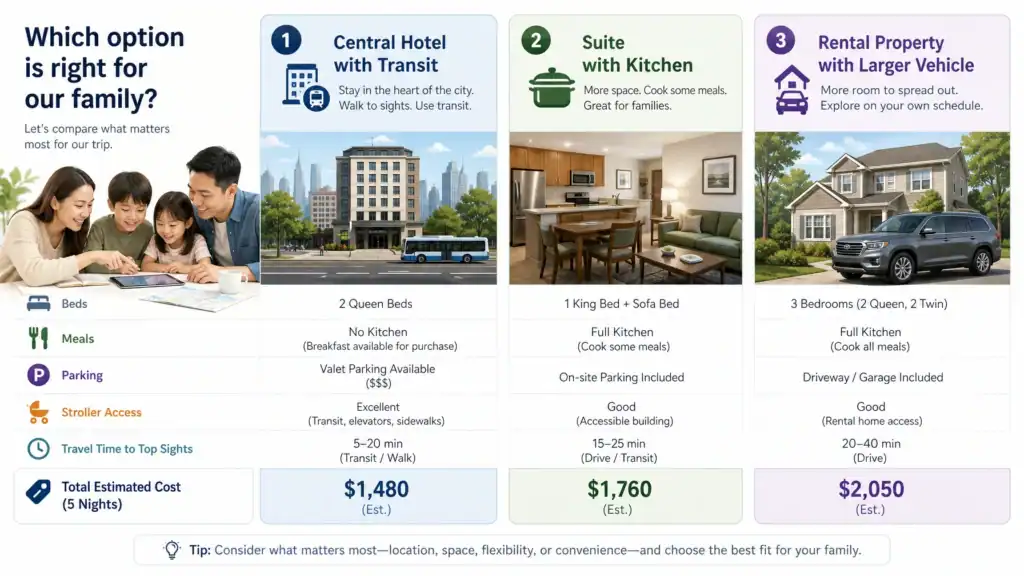
Here’s the part that catches families off guard: costs don’t rise in a straight line. A suite sometimes costs less than two rooms. A kitchen may cost more per night and still lower the total trip cost by absorbing breakfasts and a few dinners. A centrally located hotel can eliminate a rental car entirely. A more expensive nonstop can erase an airport meal, a long transfer, and—in some cases—an overnight hotel near the airport. And a larger rental vehicle may stop being optional the moment you count two car seats, a stroller, and everyone’s luggage.
Set three numbers: a preferred budget, a firm maximum, and a contingency amount you hope not to touch.
Then compare the complete cost of your family trip rather than the individual line items. It’s also worth taking a few minutes to understand how airline prices change, to understand the complete hotel price including fees and parking, and to understand rental-car pricing before you assume the quoted daily rate is the number you’ll pay.
Match the Trip Length to the Travel Effort
Flight duration is a poor measure of how hard a travel day will be. Door-to-door time is the honest one.
Count all of it: getting everyone dressed and out the door, driving to the airport, parking or drop-off, check-in, security, boarding, the flight itself, any connections, baggage claim, rental-car pickup or ground transportation, hotel check-in, time-zone adjustment, and recovery once you arrive.
A four-night trip with two connections in each direction can leave a family with roughly two comfortable days at the destination. That’s not automatically wrong—sometimes the destination is the entire point, or you’re visiting family, or the route is the only one available. But it’s worth seeing clearly. A nearby city reached by one nonstop flight or a manageable drive may deliver far more usable vacation time for the same money.
None of this means families should avoid long flights or international travel. Plenty of children travel long distances well. The right call depends on age and temperament, trip length, schedule flexibility, the reason for the trip, previous travel experience, accessibility needs, which routes exist, and what you can spend.
Once the shape of the trip is settled, review what to reserve early for a family trip—the pieces that are hardest to replace usually deserve attention first.
Choose Lodging Based on How the Family Will Use It
For a family, the room isn’t just where you sleep. It’s where someone naps, where a bag gets repacked, where a kid decompresses after a loud afternoon, and where breakfast might happen.
Before booking, verify:
- Maximum occupancy and the actual number of sleeping surfaces
- Bed types—”sleeps four” and “two double beds” are not the same claim
- Crib or rollaway availability, and whether one fits in the room
- Whether connecting rooms are guaranteed or only requested
- Suite layout and whether a door separates the sleeping area
- Kitchen or refrigerator access
- Laundry
- Bathtub versus shower only
- Accessibility features and elevator access
- Noise—street side, near elevators, near a nightclub
- Pool rules and hours
- Breakfast, parking, and distance to your main activities
- Public transportation, grocery stores, and restaurants nearby
- Check-in and checkout timing
- Cancellation terms
Then think about format. A standard hotel room, a family suite, two rooms, connecting rooms, an aparthotel, a vacation rental, a cabin, a resort, or staying with relatives all solve different problems. None is universally best.
A common example: a standard room technically sleeps four. It works fine until one child naps at midday and three other people have to sit in the dark in silence. A suite or a rental with a separate sleeping area may cost more per night and still be the decision that makes the whole trip function.
For location tradeoffs, this guide on how to choose a convenient hotel location is a good starting point, along with practical hotel savings tips and destination-based hotel guidance. If your dates are flexible, it’s also worth reading about the best time to book hotels.
One caution: confirm essential room features directly with the property. A crib, a connecting room, a specific bed configuration, an accessible bathroom, or an early check-in is a request until the hotel confirms it. Get the confirmation in writing when you can.
Compare Flights Based on the Whole Family’s Travel Day
The lowest fare and the easiest itinerary are sometimes the same flight. Often they aren’t.
Compare departure and arrival times, nonstop versus connecting routes, total travel time, connection length, airport distance from home and from your lodging, baggage allowance, seat-selection and family-seating policies, aircraft type (and whether it might change), how the timing lines up with meals and sleep, ground transportation after arrival, and the refund and change terms.
A few situations families run into:
- A 6:00 a.m. departure looks inexpensive until it requires an airport hotel or a very early wake-up that ends the night before it’s finished.
- A four-hour connection adds two meals and a lot of entertainment.
- A late arrival can land after the rental counter closes or after the front desk is thinly staffed.
- A nonstop costs more but removes the missed-connection scenario entirely—which matters more with a group that can’t sprint across a terminal.
- A cheaper secondary airport can add ninety minutes of driving on both ends.
For timing and fare strategy, see the best time to book flights and these practical cheap-flight strategies. If you’re building the trip around a fare, these budget travel tips for flight planning and the flight destination guides can help you compare routes before committing.
Review Family Seating Before Travel Day
Family seating policies differ by airline, and they change. Treat seat assignments as something to verify, not something to assume.
Practical steps:
- Book adults and children on the same reservation where possible.
- Read the airline’s current family-seating policy on its own website.
- Check your seat assignments right after booking—not the week of travel.
- Recheck if the aircraft or schedule changes, which can reshuffle seats.
- Contact the airline if children aren’t seated beside an accompanying adult.
- If you booked through a third-party platform, confirm the seats directly with the airline.
- Don’t assume unassigned seats will land your family together automatically.
- If a seating issue is still unresolved, speak with an airline representative at the airport before boarding rather than hoping to sort it out onboard.
Two official resources are worth reviewing before you book: the Department of Transportation family-seating dashboard and the DOT’s tips for families flying together, which links out to individual airline pages.
Because airline commitments can be added or withdrawn, check the dashboard yourself close to your travel dates rather than relying on what a policy looked like last year. And be aware that no single rule guarantees a particular seat arrangement for every child in every circumstance.
Understand Child Restraint Options for Air Travel
How an infant or young child travels on the aircraft is a decision to research early, not at the gate.
Things families typically weigh:
- Whether to purchase a separate seat for a child who could otherwise travel on an adult’s lap
- The airline’s current policy for children under two
- Whether a child restraint system is approved for use on aircraft—approved restraints carry labeling indicating this, and the FAA describes what to look for
- Where an approved restraint may be placed in the cabin, including exit-row restrictions and window-seat conventions that vary by airline
- The physical reality of carrying a restraint through an airport and installing it in a narrow row
- Whether the restraint fits the seat on your specific aircraft
- The difference between a restraint approved for aircraft use and a vehicle-only booster seat, which generally is not usable during flight
- Keeping the manufacturer’s instructions with you
The FAA’s guidance for flying safely with children is the right starting point, and your airline’s own page is the second stop, because airline rules can be more specific than the general federal guidance.
Not every car seat is approved for airplane use, and the only reliable way to know is to check the label, the manufacturer’s instructions, and the airline’s requirements together. This article can’t tell you what’s appropriate for a particular child—that depends on their age, size, and the equipment you own.
Prepare Children for the Airport and Security Screening
An airport is loud, crowded, and full of instructions from strangers. Walking through the sequence beforehand often does more good than anything you pack.
Talk through: checking bags, waiting in line, showing documents, putting belongings in bins, walking through screening, how a stroller gets screened, repacking on the other side, finding the gate, boarding, unfamiliar aircraft sounds, seat-belt expectations, and the fact that waiting is part of it.
Check identification requirements in advance using TSA’s current identification guidance. Keep in mind that an airline’s document requirements are not necessarily identical to TSA screening rules—airlines set their own policies for things like proof of age for infants and lap children, so confirm with the carrier as well.
For anything you’re unsure about—formula, breast milk, baby food, ice packs, medication, strollers, car seats, electronics, or a specific children’s item—use TSA’s What Can I Bring tool rather than a secondhand list. Guidance changes, and the official tool is the current version.
If you want to line up the whole travel day in order, this guide on how to coordinate airport, hotel, and rental-car preparation covers the sequencing.
Decide How the Family Will Get Around
There’s no default answer here. A rental car, public transportation, airport or hotel shuttles, taxis, rideshare, walking, a private transfer, or some combination can each be the right choice depending on where you’re going.
Work through the practical questions:
- How many people, and how many car seats or booster seats?
- Stroller, wheelchair, or other mobility equipment?
- How much luggage?
- Parking availability and cost at the hotel and at attractions
- Fuel and tolls
- Transit accessibility, including elevators and step-free routes
- Distance between the places you actually plan to go
- Operating hours—some transit and shuttle services thin out at night
- Weather
- Late arrivals and closed counters
- How well your group tolerates long transfers
- Whether you’ll want to return to the room midday
The cheapest option on a spreadsheet isn’t always the practical one. A transit day pass costs less than parking downtown, but not if it means three transfers with a stroller and a tired six-year-old. Conversely, a rental car is dead weight in a dense city where parking runs more than the car does.
Start by comparing transportation options and costs side by side. If a car makes sense, it helps to plan an airport car rental deliberately, review practical car rental savings tips, and check destination-based rental-car guidance for local quirks.
Plan Car Seats and Booster Seats Before Pickup
Car-seat decisions made at a rental counter are made under time pressure, with tired travelers, and with whatever happens to be in stock.
The realistic options include bringing your own restraint, renting one from the rental company, arranging one through a transportation provider, using public transportation where it fits, booking a private transfer that confirms suitable equipment in advance, or buying or borrowing a restraint at the destination after doing the research. Each has tradeoffs in cost, hassle, and certainty.
Whichever direction you go, verify:
- Your child’s age, size, and restraint needs
- Manufacturer requirements for the specific seat
- The laws that apply at your destination
- Vehicle compatibility
- Whether the rental location actually stocks the seat type you need
- Who is responsible for installation—many companies leave it to you
- The condition of any rented equipment when you receive it
- Whether your request is confirmed or merely noted
- What the provider will do if the equipment isn’t available on arrival
For general safety information on selection and installation, NHTSA car-seat and booster-seat guidance is the authoritative U.S. resource. For travel outside the U.S., check the destination’s own rules—a seat sold and certified in the United States is not automatically approved everywhere, and local requirements vary.
One more thing worth measuring: a vehicle’s listed passenger capacity says nothing about cargo space. A seven-seat SUV that fits everyone may not fit two car seats plus adults across the second row, or may leave almost no trunk space once a stroller and four suitcases go in. Count seats, restraints, and luggage as three separate problems.
Build a Realistic Daily Schedule
Family itineraries fail on transitions, not attractions.
Build time for getting dressed, breakfast, bathroom stops, travel between locations, parking, folding and unfolding a stroller, ticket lines, bag checks at venues, meals, naps, rest, weather, a trip back to the room, unplanned discoveries, and simple recovery—for the adults too.
A framework many families find workable: one main activity, one optional activity, and one flexible period per day. That’s a starting shape, not a rule. Some families comfortably do more; some days should hold less.
Different travelers need different things from the same day.
Infants and toddlers
Feeding windows, naps, diaper changes, stroller or carrier logistics, a quiet space to reset, and an early bedtime that may end the adults’ evening plans.
School-age children
Shorter explanations, hands-on rather than observational activities, snack and bathroom timing that doesn’t drift, a real say in at least one choice, and breaks from standing and waiting.
Teenagers
Genuine input into the itinerary, time for things they actually care about, personal space, an appropriate amount of independence, charging and connectivity, and a sleep schedule that may not match anyone else’s. A teenager wanting an unscheduled afternoon and a younger sibling needing a predictable one is a normal conflict—often solved by splitting the group for a few hours.
Multigenerational groups
Different walking speeds, planned rest periods, accessible routes checked in advance, optional side activities so nobody has to do everything, clear meeting points and times, and permission for people to spend part of the trip apart. Don’t assume any particular generation is the limiting factor—ask everyone what kind of day they want.
A centrally located hotel is often the quiet hero of a multigenerational trip: less walking, fewer transfers, and an easy return to the room for anyone who wants one.
Plan Meals and Snacks Without Scheduling Every Bite
Food affects your budget, your energy, and your schedule—usually all three at once.
Research before you go: breakfast availability at your lodging, nearby grocery stores, whether you have a kitchen or just a refrigerator, restaurant hours (which vary a lot by country and season), reservations for any meal that matters, what food exists near your main activities, options at the airport and after a late arrival, dietary needs, how you’ll communicate allergies, familiar backup foods, water access, and anything that needs cold storage.
A practical mix tends to look like: a few planned meals, groceries or simple room meals for the rest, flexible restaurant choices, snacks for transitions, and one backup for the night dinner falls apart.
For serious allergies or medical dietary needs, contact airlines, hotels, and restaurants directly and work with the appropriate healthcare professional—general travel advice isn’t a substitute for that.
The reason this matters: hungry, tired travelers make expensive and inconvenient decisions. The overpriced airport meal, the taxi back to the hotel, the abandoned afternoon—most of those trace back to a food plan that was treated as an afterthought.
Pack by Person, Activity, and Travel Day
Family packing gets easier when it stops being one giant list.
Each traveler
Clothing, shoes, sleep items, toiletries, medication, comfort items, entertainment.
Shared items
Chargers, first-aid supplies, sunscreen, laundry supplies, snacks, documents, child equipment.
By activity
Beach, pool, hiking, a formal event, cold weather, a theme park day, a long drive. Packing by activity catches the things a per-person list misses—the water shoes, the one dress shirt, the rain layer.
Carry-on essentials
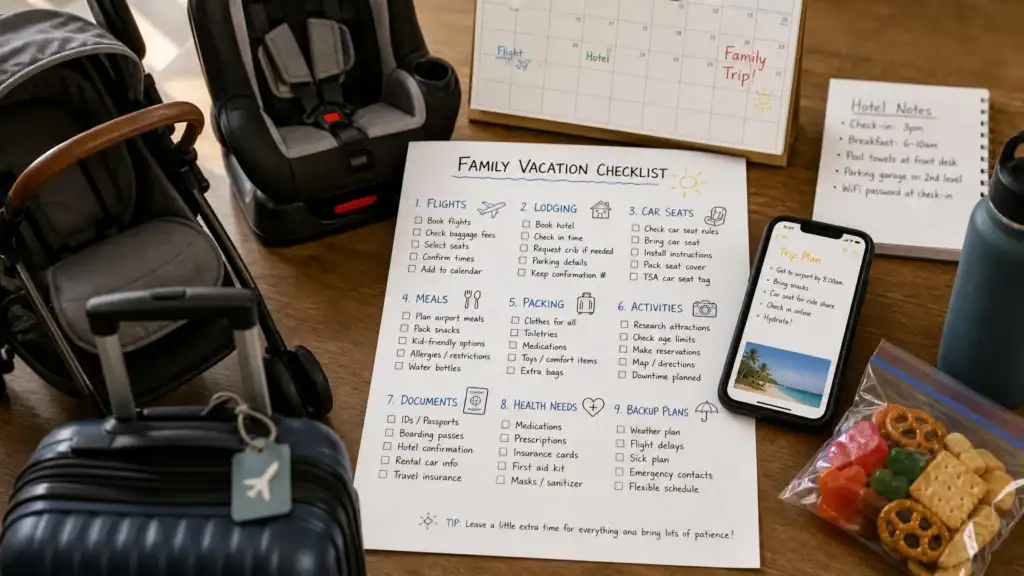
Identification and documents, medication, chargers, at least one change of clothing per person who might need it, diapers and childcare supplies, snacks, comfort items, essential electronics, copies of reservations, and anything you’d want during a four-hour delay.
If everything essential lives in one checked bag, a single delayed bag becomes the whole family’s problem. Distribute the important things—a few outfits per person spread across bags, medication and documents always in the cabin.
When you reach the final stage, these packing and travel timing tips cover departure-day sequencing in more detail.
Review Health, Medication, and Accessibility Needs Early
These are the items that go badly when they’re handled in the last week.
Think through prescriptions and refill timing, medication storage (including anything that needs to stay cold), medical devices and their power requirements, how you’d access healthcare at the destination, routine care needs, dietary needs, mobility, sensory needs, communication needs, accessible lodging and transportation, where quiet spaces might be, airport assistance, service animal documentation, and emergency contacts.
For destination-related health preparation, the CDC maintains guidance for traveling with children. Check it close to your departure, and talk with a healthcare professional about what’s appropriate for your family and your destination—vaccination, medication, and preventive care decisions are individual, and no article should make them for you.
For screening support, travelers can submit a TSA Cares assistance request. It’s a helpful resource, though submitting a request doesn’t guarantee every service or remove screening requirements.
Anything essential should be confirmed directly with the airline, the airport, the hotel, the rental provider, any tour operator, the attraction, and your ground transportation. A note in a reservation is not the same as a confirmation from the people who have to deliver it.
Prepare International Travel Documents for Children
International travel with minors can involve more than a ticket and a passport, and the requirements depend heavily on where you’re going and who’s traveling.
Research well ahead of time:
- Passport requirements for each child and how long processing currently takes
- Passport validity rules for your destination
- Visa or electronic travel authorization requirements
- Entry and exit rules, which are sometimes different
- Documentation showing your relationship to the child
- Consent requirements when one parent or guardian, or neither, is traveling with the child
- Custody documentation where applicable
- Dual-nationality considerations, which can change entry and exit rules
- The airline’s own document requirements
- Return-entry requirements for your home country
Start with the State Department’s guidance for international travel with minors, its child-passport information, and its general international travel planning guidance.
A few honest caveats. Requirements vary by country. They can depend on who is traveling with the child. They change. Airline requirements and government entry rules are not always the same thing, and satisfying one doesn’t guarantee the other. There is no single consent-letter format accepted everywhere.
If one parent is traveling internationally with a child, check the destination’s specific documentation expectations through official destination, embassy, or consulate sources—and consult a qualified professional for anything involving custody or legal status. That’s not a question a travel guide can answer.
Give Older Children and Teenagers a Role
Children often handle travel better when they know what’s happening and have some say in it.
Roles that tend to work: choosing one activity for the trip, picking between two restaurants, carrying a personal checklist, tracking the next gate or stop alongside an adult, packing their own small bag, choosing entertainment for the flight, helping compare destination options early on, taking photos, keeping a journal, managing a reasonable personal spending amount, or helping identify meeting points.
Match the responsibility to the person—their age, maturity, and needs, not just their birthday. Independence isn’t a requirement, and some kids would rather not be in charge of anything. That’s fine.
It’s also worth calmly reviewing a few basics together: what to do if someone gets separated, the name of the hotel, an adult’s phone number written down somewhere, where to meet, who’s holding the documents, and which employees or officials to approach for help. Handled matter-of-factly, this is just information—the same as knowing which gate you’re leaving from.
Create a Family Backup Plan
Backup planning isn’t pessimism. It’s a way of reducing the number of decisions you have to make while tired, delayed, and holding two bags and a sleeping child.
Think through what you’d do about a flight delay, a missed connection, a delayed bag, a closed rental counter, a room that isn’t ready, bad weather, someone getting sick, a canceled activity, an overtired child, a transportation disruption, a dead phone, or no internet access.
Then prepare the things that make those situations easier:
- Airline contact information saved in your phone
- The hotel’s direct phone number, not just the booking platform’s
- The rental location’s phone number and hours
- A backup way to get from the airport to your lodging
- Essential items in carry-on luggage
- Confirmations saved offline as screenshots or PDFs
- Chargers and a power bank
- Basic snacks
- Your cancellation and change terms written down
- One low-effort backup activity—a park, a pool, a nearby café
- A plan for splitting the group if that becomes the sensible move
For handling short-notice changes and rebooking, see these last-minute travel savings and backup strategies.
Family Trip Planning by Travel Stage
This is a planning framework, not a universal timeline. Some families book eight months out; others book in three weeks. Adjust the order to fit your circumstances.
| Planning stage | Main family decisions | Details to verify | What can usually wait |
|---|---|---|---|
| Choosing the destination | Who’s coming, traveler count, age-related needs, three shared priorities, realistic travel time | Passport status and validity, seasonal weather, accessibility of the destination, distance between activities | Specific restaurants, daily order of activities, souvenir budget |
| Setting the budget | Preferred budget, firm maximum, contingency amount, who is paying for what | Baggage and seat fees, hotel fees and parking, activity admission ranges | Exact meal spending, optional excursions, shopping |
| Booking transportation | Nonstop versus connecting, departure and arrival times, driving versus flying | Baggage allowance, change and refund terms, aircraft and schedule stability, family-seating policy | Onboard entertainment plans, airport meal choices |
| Choosing lodging | Room type, number of rooms, suite versus rental, location relative to activities | Occupancy limits, actual bed count, crib availability, separate sleeping areas, kitchen, elevator, accessibility, cancellation terms | Room number preferences, pool schedule, housekeeping timing |
| Arranging ground transportation | Rental car, transit, transfers, or a mix | Vehicle size for restraints and luggage, car-seat availability and confirmation, counter hours, parking at lodging | Daily route details, transit card purchase |
| Reserving major activities | Which one or two things really matter | Age and height requirements, accessibility, stroller policies, timed-entry rules, refund terms | Optional secondary activities, backup-day plans |
| One month before travel | Confirming the plan holds together | Passports and visas, seat assignments, crib and accessibility requests, prescription refills, car-seat plan | Packing, snack shopping, entertainment downloads |
| One week before travel | Final confirmations and packing lists | Flight times (recheck for changes), seat assignments after any aircraft change, hotel confirmation, rental reservation, weather forecast | Last-minute activity additions |
| Day before departure | Packing, charging, printing or saving documents | Carry-on essentials, medication, documents, offline confirmations, airport timing | Anything nonessential |
| Travel day | Timing, transitions, meals, patience | Terminal and gate, bag drop cutoffs, security wait, seat assignments at check-in | Destination itinerary details |
| Arrival day | Getting settled, food, sleep | Room setup on arrival, car-seat installation, nearest grocery or pharmacy | Any major attraction—leave room to recover |
Common Family Travel Planning Mistakes
Building an adult itinerary and adding children afterward
An itinerary designed for adults and then handed to a family usually breaks on the second morning. Pace, meals, sleep, and transitions aren’t add-ons—they set the maximum number of things a day can hold. Build the day around them from the start and the rest fits more honestly.
Choosing the lowest fare without reviewing the whole travel day
A cheaper fare can carry a 5:00 a.m. departure, two connections, a distant airport, no included bags, and paid seat selection. Add those costs and hours and the “expensive” nonstop sometimes wins outright—and even when it doesn’t, you’ll know what you traded.
Assuming the hotel room setup will work
“Sleeps four” describes an occupancy limit, not a sleeping arrangement. Two double beds, no crib space, and no separating door is a very different room from a suite. Verify bed types, crib availability, and layout before booking, and confirm requests with the property directly.
Planning every hour
A fully booked day has no room for a delayed lunch, a rainstorm, a long line, or a nap that runs late. When one thing slips, everything after it slips too. Leave gaps on purpose—they’re what let the plan survive contact with reality.
Reserving a vehicle based only on passenger count
Seven seats doesn’t mean seven people plus luggage. Two car seats can eat a row. A stroller or wheelchair takes real cargo space. Count passengers, restraints, and bags separately, then choose the vehicle.
Waiting until pickup to think about car seats
Suitability, local law, availability, and installation all take research. Arriving at a counter and asking what they have is how families end up with equipment that doesn’t fit the child, the vehicle, or their comfort level. Decide the approach before you book the car.
Assuming airline seating will resolve itself
Policies differ by airline and change over time. Aircraft swaps reshuffle assignments. Third-party bookings don’t always pass seat requests through. Check your assignments after booking and again before travel, and contact the airline if children aren’t next to an accompanying adult.
Keeping all essential supplies in checked luggage
A delayed bag shouldn’t mean no medication, no diapers, no change of clothes, and no chargers. Your carry-on should be able to carry the family through a long delay and a night without the checked bags.
Ignoring the needs of adults and teenagers
Planning only around the youngest traveler produces a trip nobody else enjoys. Teenagers need input and downtime. Adults need something they actually wanted to do. A day that includes one thing for each person is usually more workable than a day aimed entirely at one age.
Treating a special request as a confirmation
Cribs, connecting rooms, accessible rooms, early check-in, specific child restraints—these are requests until someone confirms them. Call, email, get it in writing, and have a plan B for the ones that matter most.
Forgetting recovery time after arrival
A long travel day plus a major attraction on the same afternoon is a lot to ask of anyone. A child who’s been through an airport and a flight may need quiet time more than a museum. Leave arrival day light and start the real itinerary the next morning.
A Simple Family Travel Planning Process
- Confirm who is traveling and identify individual needs.
- Choose three family priorities.
- Set a preferred budget, a maximum budget, and a buffer.
- Choose a destination that fits the time you actually have.
- Compare the complete cost of transportation, lodging, and ground travel.
- Reserve the hardest-to-replace parts first.
- Confirm flight seating and your child-restraint plan.
- Choose lodging based on sleeping arrangements and location.
- Decide how the family will move around at the destination.
- Build a schedule with one main activity and flexible time.
- Plan meals, snacks, naps, and rest.
- Confirm documents, health needs, and accessibility arrangements.
- Pack essential supplies where they stay accessible.
- Save confirmations offline.
- Create backup plans for delays and changed conditions.
- Review the plan with the family before departure—including the kids.
Steps six through nine are where most of the moving parts collide. It helps to coordinate airport, hotel, and rental-car arrangements as one connected sequence, then prepare for the final packing and timing stage in the last week.
Family Travel Planning Checklist
- ✅ Everyone traveling is included in the budget
- ✅ Ages and individual needs have been reviewed
- ✅ The family’s top three priorities are clear
- ✅ Preferred and maximum budgets are set
- ✅ Travel time fits the length of the trip
- ✅ The complete cost has been estimated, not just airfare and room rate
- ✅ Flight times work with the family’s schedule
- ✅ Family-seating policies and current seat assignments are reviewed
- ✅ Child-restraint plans for the flight are confirmed with the airline
- ✅ Hotel occupancy and bed arrangements are verified
- ✅ Cribs, connecting rooms, or accessibility requests are confirmed with the property
- ✅ Lodging location works with the daily itinerary
- ✅ Transportation at the destination is planned
- ✅ The rental vehicle fits passengers, restraints, and luggage
- ✅ Car-seat or booster-seat arrangements are researched, including local rules
- ✅ Meal and snack options are identified
- ✅ The itinerary includes rest and flexible time
- ✅ Major activities suit the ages and interests traveling
- ✅ Passports and international documents are checked against official sources
- ✅ Medication and health preparations are addressed
- ✅ Accessibility and sensory needs are confirmed with each provider
- ✅ Carry-on luggage contains essential supplies
- ✅ Confirmations are saved offline
- ✅ Children understand the basic travel sequence
- ✅ Backup transportation and delay plans are identified
- ✅ Important contact information is accessible without internet
- ✅ The first day allows time to settle in
Frequently Asked Questions About Family Travel Planning
How do I start planning a family vacation?
Start with the travelers rather than the destination. Write down who’s coming, their ages, sleeping and mobility needs, dietary and medical considerations, and how much travel time the group can handle. Then pick three shared priorities—maybe a nonstop flight, a room with a separate sleeping area, and one major attraction. Set your budget range next. Only after that should you compare destinations, because now you’ll be comparing them against something specific instead of picking whatever looks appealing in photos.
How far ahead should I plan family travel?
There’s no single right lead time. It depends on the destination, the season, whether you need passports, how many rooms you need, and how flexible your dates are. Items that are hard to replace—passports, accessible rooms, suites for larger groups, timed-entry tickets, popular holiday dates—generally deserve earlier attention. Things that can be adjusted later, like restaurant choices or optional activities, can wait. Work backward from whatever has the longest processing or shortest supply.
How can I keep a family vacation within budget?
Estimate the full cost before booking anything: transportation to the airport, parking, fares for every traveler, baggage, seat fees, lodging plus fees and parking, ground transportation, meals, activities, and a buffer. Then look for the structural savings rather than small ones. A kitchen, a central location that removes a rental car, or a suite instead of two rooms can each shift the total meaningfully. Set a firm maximum, and decide in advance what gets cut if you approach it.
Is a hotel or vacation rental better for families?
Neither is universally better. Hotels often win on location, daily housekeeping, front-desk support, breakfast, and easier cancellation. Rentals often win on space, separate bedrooms, kitchens, and laundry—which matters a lot with infants, large groups, or longer stays. The right answer depends on your destination, how much time you’ll spend in the unit, whether you need a kitchen, how you’re getting around, and how many separate sleeping areas the group needs. Compare total cost, not nightly rate.
How do I make sure my family sits together on a flight?
Book everyone on one reservation when you can, then check the airline’s current family-seating policy on its own website. Review your assignments right after booking and again before travel, since aircraft changes can reshuffle seats. If you booked through a third party, confirm the seats directly with the airline. The DOT’s family-seating dashboard and its tips page for families flying together are useful starting points, but policies vary and change, so verify with your carrier.
Should I bring a car seat on the airplane?
That’s a decision to make with current, official information rather than general advice. Review the FAA’s guidance on flying with children and approved child restraint systems, check your restraint’s label and manufacturer instructions to see whether it’s approved for aircraft use, and confirm your airline’s specific rules about placement and seat requirements. Also weigh the practical side: carrying the restraint through the airport, whether it fits your aircraft’s seat, and whether you’ll need it at the destination anyway.
Should I bring or rent a car seat at my destination?
Both approaches have real tradeoffs. Bringing your own means known equipment and a familiar installation, but it’s one more thing to carry and it can be damaged in transit. Renting reduces what you haul, but availability, model, and condition aren’t always predictable, and installation is often your responsibility. Some families use private transfers that confirm equipment, or rely on transit where that works. Check destination laws, confirm any reservation directly, and consult NHTSA guidance on selection and installation.
How many activities should a family plan each day?
There’s no correct number for every family. A useful starting structure is one main activity, one optional activity, and one genuinely flexible block—then adjust based on how your first day actually goes. Some families comfortably do more; some days need less. What matters more than the count is the transition time between things: travel, parking, lines, bathrooms, and meals often take longer than the activities themselves.
How do I plan a trip for children of different ages?
Look for activities with multiple entry points—a beach, a park, a market, a zoo—where a toddler and a fifteen-year-old can each find something. Then accept that some things won’t work for everyone, and plan to split up occasionally. One adult takes the teenager to something they chose while another handles nap time. Give older children input into the itinerary, keep meal and rest timing predictable for younger ones, and let each person have at least one thing they picked.
What should go in a family carry-on bag?
Anything you’d need if the checked bags didn’t arrive or the flight was delayed for hours: medication, identification and documents, chargers and a power bank, a change of clothing for anyone likely to need one, diapers and childcare supplies with extra beyond your estimate, snacks, water bottles to fill after screening, comfort items, entertainment, and offline copies of your confirmations. Spread essentials across bags rather than concentrating them, so one lost bag doesn’t affect the whole family.
How do I plan family travel with grandparents?
Ask, don’t assume. Some grandparents want long hiking days; others want a slower pace; the preferences vary as much as they do in any other age group. Have a direct conversation about walking distances, preferred activities, sleep schedules, dietary needs, and how much time they want with everyone versus on their own. Then build in optional activities so no one has to opt out of the whole day, agree on meeting points, and consider lodging that reduces transfers for everyone.
What documents do children need for domestic flights?
Requirements come from more than one place, and they aren’t identical. TSA publishes its own identification guidance for screening, and adults should check it for current requirements. Airlines set separate policies—many ask for proof of age for infants and lap children, for example, and those rules are the airline’s, not TSA’s. Check both your airline’s website and TSA’s identification page before travel rather than relying on what was true on a previous trip.
What documents do children need for international travel?
It depends on the destination and on who is traveling with the child. Common considerations include a valid passport for each child, passport validity rules for the destination, visas or travel authorizations, documentation of your relationship to the child, and consent documentation when one or both parents or guardians aren’t traveling. Requirements vary and change, and airline rules may differ from government entry rules. Verify through the State Department’s resources plus the destination’s embassy or consulate and your airline.
How do I prepare children for their first flight?
Walk through the sequence out loud a few days ahead: bag drop, waiting in line, showing documents, putting things in bins, screening, finding the gate, boarding, engine noise, the seat-belt sign, takeoff pressure, and the fact that a lot of flying is waiting. Let them pack a small bag with their own entertainment and a comfort item. Bring snacks and something to chew or drink for pressure changes. And keep expectations modest—a first flight doesn’t have to go perfectly.
What should I do when a child becomes overtired during the trip?
Reduce input before adding anything. Find a quieter space—a park bench, the hotel room, a corner of a café—and let the schedule slip. Food and water often help. Go back to the room if you can; a canceled afternoon usually costs less than pushing through and losing the evening too. Simplify the next day rather than trying to make up lost ground. If you’re concerned about a child’s health rather than tiredness, contact a healthcare professional.
Bringing It Together
Family travel planning works when the pieces connect: the budget matches the trip, the travel time matches the length of the stay, the room actually holds everyone comfortably, the transportation fits the passengers and the gear, meals and rest are on the schedule instead of squeezed around it, the activities suit more than one person, the documents are verified through official sources, health and accessibility needs are confirmed with the people responsible for them, and there’s a backup for the parts most likely to change.
That’s not the same as a flawless itinerary. No amount of planning guarantees a smooth trip, and no schedule satisfies every person at every moment. What a good plan actually delivers is narrower and more useful: a comfortable place to sleep, a realistic way to get around, enough food and rest, a few things worth doing, and room to change course.
A family trip doesn’t have to run exactly as planned to be worth taking. It just needs enough preparation that when something shifts—and something will—you can adjust the afternoon instead of rebuilding the vacation.
Continue Planning Your Trip
How to Choose the Right Travel Destination
Compare destinations by budget, travel time, weather, available activities, and how easy it is to get around once you arrive—useful when the group can’t agree on where to go.
How to Compare Travel Prices
Look at the complete cost of a trip, including flights, lodging, rental cars, parking, and local transportation, instead of comparing headline rates that leave things out.
What to Reserve Early When Planning a Trip
Sort out which reservations are hardest to replace and deserve attention first, and which ones can safely wait until closer to departure.
Airport, Hotel, and Rental Car Preparation
Coordinate travel-day timing, hotel check-in, rental pickup, parking, and backup plans so the pieces line up instead of competing.
Packing and Travel Timing Tips
Organize luggage, documents, departure timing, and the final round of preparation in the week before you leave.
Transportation Savings Tips
Compare rental cars, public transportation, airport transfers, shuttles, taxis, and rideshare services based on cost and practicality for your group.
Last-Minute Travel Savings
Handle short-notice bookings, rebooking after a disruption, and plans that change after everything is already reserved.
Travel Tips Hub
Browse the full SavingsScoutTravel planning collection, or start with our destination guides if you’re still deciding where to go.
Continue Planning Your Family Trip
Browse the full SavingsScoutTravel planning collection, or explore destination ideas before choosing the trip that fits your family.