

What to Reserve Early When Planning a Trip
Prioritize the documents, transportation, lodging, permits, and special arrangements that could make or break your trip—without booking every detail too soon.
The destination is settled. The dates are close enough. And now there are twelve browser tabs open—flights, hotels, a rental car, a walking tour, a park pass, a restaurant someone mentioned, airport parking—and no clear sense of which one actually needs attention today. Figuring out what to reserve early for a trip is less about speed and more about sequence. Some arrangements decide whether the trip works at all. Others can comfortably wait until the shape of the trip is clear.
Here’s the principle that makes the rest of this guide easier: reserve the hardest-to-replace parts first, and leave flexible decisions until the trip structure is stable.
That’s it. Not “book everything immediately.” Not “wait for a magic price drop.” Just protect the pieces that would be painful or impossible to replace, then fill in the rest.

Do Not Book Until the Basic Trip Details Are Clear
Research early. Commit once the framework holds together.
Before you make a major nonrefundable reservation, you want reasonable clarity on:
- The destination—and whether you are firmly settled on it
- Approximate or fixed dates
- Number of travelers, including children and their ages
- Trip length
- A preferred budget and a maximum budget
- Your departure airport, or whether you are driving
- Any event, wedding, cruise, or activity anchoring the trip
- Passport and entry-document status for everyone traveling
- Group needs—one room or several, connecting rooms, kitchen access
- Accessibility needs
- A general transportation plan at the destination
Your dates do not have to be locked to the hour while you are researching. What matters is knowing which details are flexible and which are not. “We can leave Thursday or Friday” is useful information. “We must be in the room by Friday at 4 p.m. for a rehearsal dinner” is a different kind of constraint, and it changes what you should reserve first.
A concrete example: do not reserve a nonrefundable hotel for an international trip before confirming that every traveler has a usable passport and can meet the destination’s entry requirements. That includes the teenager whose passport expired quietly two years ago and the relative whose passport is technically valid but may not satisfy a destination’s validity rules. Passport processing and mailing times change, so check the current U.S. passport processing information directly rather than trusting a number from an older article.
If the destination itself is still a little soft, work that out first. It is much easier to choose a destination that fits your trip before money is committed, and easier still to compare the complete cost of your options while you can still change your mind without paying for the privilege.
Reserve the Parts That Hold the Trip Together
Most trips have an anchor reservation—the one piece that determines everything else. Identify it early, because the rest of your itinerary hangs off it.
- A wedding
- A cruise departure
- A concert, festival, or sporting event
- A guided tour with fixed departure dates
- A national park permit or timed-entry slot
- A family reunion
- A limited flight route with only a few weekly departures
- A small destination with very little lodging
- Holiday-week accommodation
- A specific medical, accessibility, or mobility arrangement
The anchor should usually be confirmed before you start filling in optional sightseeing. If the reason you are traveling is a Saturday wedding, the venue and date are already fixed—your job is to secure suitable lodging and transportation around that commitment. The Sunday afternoon tour can wait.
Ask This First
“If this one reservation became unavailable, would I still take the trip?”
If the answer is no, it belongs near the top of your priority list.
That single question sorts most planning confusion. A refundable hotel two blocks farther away is an inconvenience. A cruise that sails without you is a canceled vacation.
Reserve Flights Early When Your Options Are Limited
Flights deserve early attention in specific situations rather than as a blanket rule. Move them up your list when:
- Your dates are fixed and cannot shift
- Travel falls during a holiday period or school break
- The destination has limited air service
- You need a nonstop flight
- Several people must travel together on the same itinerary
- Specific arrival or departure times matter
- The trip connects to a cruise, wedding, tour, or ticketed event
- You are using miles and award-seat availability is the constraint
- You need wheelchair assistance or another special arrangement
- The international routing is complicated, with multiple carriers or long layovers
Here is the distinction that saves people money and regret: looking early is not the same as buying immediately. Start watching schedules early so you understand what exists on your dates. Then decide when the fare and terms make sense for you.
Before you purchase, compare the things that do not show up in a headline price: total cost with taxes and fees, baggage allowance for your actual luggage, fare restrictions, nearby alternate airports, connection times that leave room for a delay, which airline operates each segment, and the change and cancellation terms. Know whether your ticket is refundable, credit-only, or fully nonrefundable—those describe very different levels of commitment.
For timing and strategy, the specialist guides go deeper: review the best time to book flights, understand how airline prices change, and compare practical cheap-flight strategies that do not depend on luck.
It is also worth reading the U.S. Department of Transportation guidance on buying an airline ticket, which covers ticket restrictions, optional service and baggage-fee disclosures, direct versus agency purchases, and airline booking protections.
One thing this guide will not tell you is that buying early always produces the lowest fare. Airfare does not work that way. Early attention is about availability and suitability—not a guaranteed price.
Reserve Lodging Early When the Right Room Is Scarce
Lodging climbs the priority list fast when the right room—not just any room—is what you need. Consider reserving early when:
- The destination has limited accommodation overall
- Your dates overlap a festival, convention, big game, graduation, or holiday
- You need a family suite or a single room that sleeps five
- Several rooms must be near one another
- A vacation rental has to fit a large group
- An accessible room is required
- You need a kitchen or in-unit laundry
- The lodging must be near a wedding venue, cruise port, hospital, event, or transit station
- The destination has a short operating season
- You are visiting a national park, island, rural area, or small town
- You want one specific neighborhood
General availability tells you almost nothing about your availability. A city may still show hundreds of open rooms while the affordable ones near the event are gone, along with every room that sleeps five. A family needing one room for five people has a dramatically smaller inventory than a couple needing a standard king.
When you compare options, look at the total stay price rather than the nightly rate. Add required property fees, parking, and breakfast when relevant. Check the cancellation deadline, prepayment requirement, room occupancy, bed configuration, accessibility details, and distance from the things you plan to do. A cheaper hotel that requires two rideshares a day may not be cheaper.
For timing and total-cost questions, see the best time to book hotels, learn to understand the complete hotel price, and use the guide to choose a convenient hotel location. For city-specific context, browse destination-based hotel guidance.
A flexible reservation can help preserve a suitable room while you compare flights. But “flexible” only means something if you know the exact cancellation deadline and place it on your calendar. A refundable booking you forget about becomes a nonrefundable booking.
Reserve Rental Cars Early When Supply Matters
Rental cars are often treated as an afterthought, which works fine in a large market during a quiet week and badly in a thin market during a busy one. Give them earlier attention when:
- The destination has limited rental inventory
- Travel falls during a busy holiday period
- The airport or town has only a few rental locations
- Your group needs a minivan, large SUV, or passenger van
- You need hand controls or another accessibility arrangement
- You need a one-way rental
- Pickup or return falls outside normal counter hours
- The itinerary involves remote areas
- The entire trip depends on having a vehicle
- Multiple drivers, car seats, or special equipment are involved
A basic compact car often remains available long after the specific vehicles disappear. A family of six traveling over a holiday week is not competing for “a car”—they are competing for the small number of minivans at that location.
Compare the total rate rather than the daily rate. Check the vehicle class, pickup and return locations, mileage terms, fuel policy, additional-driver charges, one-way fees, airport facility charges, deposit and card requirements, cancellation terms, operating hours, and the cost of reaching an off-airport location.
The specialist guides cover the details: the best time to book car rentals, how to understand rental-car pricing, practical car rental savings tips, and how to plan an airport car rental around your arrival time.
Before assuming you need a car at all, compare transportation options at your destination. In some cities, parking and fees make driving the more expensive and stressful choice.
Check Passports, Entry Requirements, and Health Planning Early
Applications and appointments are not ordinary reservations. You cannot rebook a passport the way you can rebook a hotel. These items belong near the front of your planning because they can quietly invalidate everything else.
For international trips, check:
- Passport validity for every traveler, including remaining validity required by the destination
- Current processing status if a renewal or new application is needed
- Visa or electronic travel-authorization requirements
- Entry and exit requirements
- Requirements affecting children
- Local driving-document requirements
- Destination-specific health information
- Lead time needed for a travel-health appointment
- Prescription and medication planning
- Current travel advisories
Start with the current passport processing times and the U.S. Department of State international travel planning guidance. Entry rules are set by the destination, can change with little warning, and may differ by nationality—so treat any article as a prompt to check official sources, not a substitute for them.
For health preparation, use the CDC guidance for preparing before travel as a starting point. The CDC advises allowing lead time for destination-specific health preparation; verify the current guidance and use an appropriate healthcare professional for anything specific to you. This article does not tell you which vaccines or medications you need.
The practical takeaway is simple: if an international trip requires document or health action, handle that before a major nonrefundable purchase.
Reserve Major Attractions, Tours, Permits, and Park Access
Some activities can be sorted out the morning you want to do them. Others determine whether the trip delivers the experience you traveled for. The difference matters.
- National park timed entry or entrance reservations, where they apply
- Campsites
- Popular guided tours with small group sizes
- Museum timed-entry tickets and special exhibits
- Observation decks
- Boat tours and ferries
- Scenic rail trips
- Theme-park reservations
- Sporting events, concerts, and theater performances
- Food or cultural tours
- Limited hiking permits
- Seasonal wildlife excursions
- Holiday events
- Restaurant experiences tied to a celebration
Reservation systems vary by destination, season, and year. A park that required timed entry one summer may not the next; a tour that accepted walk-ups in April may sell out in July. Release schedules also vary—some open on a fixed date months ahead, some use rolling windows, and some hold a small number for short-notice booking.
For parks, start with the National Park Service trip-planning information, then check the specific park’s official page for entrance reservations, permits, tours, campground availability, fees, and seasonal conditions. Not every national park requires an advance reservation, and the ones that do do not all use the same system.
A traveler may find a lovely cabin near a park and still miss the cave tour, campsite, or timed-entry reservation that motivated the visit. Lodging was the easy part; the experience was the anchor.
If you are still weighing places to go, choose a destination based on the experience you want—because the experience is often what has limited capacity, not the city itself.
Reserve Special Arrangements Before Routine Extras
Anything serving a specific need should be handled early because the supply is smaller than the general inventory. That can include:
- Accessible hotel rooms
- Connecting rooms
- Ground-floor rooms
- Airport wheelchair assistance
- Accessible rental vehicles or hand controls
- Medical equipment rental or delivery
- Pet-friendly rooms
- Service-animal documentation where applicable
- Infant bassinets
- Rental car seats
- Large-group transportation
- Dietary arrangements on an organized tour
- Mobility-friendly excursions
- Rooms with kitchens
- Lodging near a medical facility
- Equipment rentals for seasonal activities
When an arrangement is essential rather than merely convenient, contact the provider directly. Selecting a checkbox during online booking often creates a request, not a confirmed feature. Call, explain what you need, ask whether it is confirmed or requested, and keep a written record.
No provider can guarantee availability, and a request is not a promise. Asking early, directly, and specifically gives you the best chance and leaves time to find an alternative if the answer is no.
Use the guide on how to coordinate airport, hotel, and rental-car arrangements, and review the family travel planning tips when you are juggling naps, car seats, bed configurations, and mixed-age needs.
What Can Usually Wait Until the Main Reservations Are Set?
Plenty of decisions become easier—and better—once flights, lodging, and transportation are settled. These can often wait:
- Routine restaurant choices
- Flexible sightseeing
- Shopping plans
- Most casual meals
- Detailed hour-by-hour schedules
- Packing lists
- Airport meals
- Small local purchases
- Flexible transit passes
- Optional low-demand activities
- Souvenirs
- Weather-dependent outdoor plans
Waiting is not laziness here. You cannot choose a good dinner spot until you know where you will be at 7 p.m., and you cannot plan a hiking day sensibly until you know the forecast.
Exceptions are real. A famous restaurant may open reservations weeks ahead. A limited ferry may require advance booking. A holiday meal may need a reservation. An ordinarily flexible activity can become scarce during a major event weekend.
Keep the Main Principle in View
Do not fill every hour before the trip’s basic structure is stable. Reserve what is scarce, then leave room for the decisions that improve when you have more information.
Closer to departure, use these packing and travel timing tips once you know what your days actually look like.
Use a Flexible Reservation When It Preserves a Good Option
Holding a flexible reservation can make sense when you need to protect something you may not find again: a suitable hotel, a scarce room type, a specific rental vehicle, a refundable tour, or lodging near a fixed event.
But “flexible” covers a wide range of terms:
- Fully refundable: refundable before the stay or service under the stated terms
- Refundable until a deadline: common for hotel bookings
- Changeable with a price difference: value retained, but a higher new rate may apply
- Travel credit: value stays with the provider and may expire
- Partially refundable: a portion is retained
- Nonrefundable: no refund under the ordinary terms
- Pay now: payment collected at booking, often with stricter terms
- Pay later: payment collected at the property or pickup
- Deposit required: part of the amount charged in advance
- Free cancellation with conditions: the phrase that needs the most reading
“Free cancellation” tells you very little on its own. Before relying on it, know the exact deadline and time zone, whether taxes and fees are refunded, whether you booked through a third party, who must process the cancellation, and whether no-show penalties apply.
For airline tickets, the U.S. Department of Transportation airline refund information explains the situations in which refunds are owed. Do not extend those rules to hotels, rental cars, tours, cruises, or vacation rentals; those follow their own contract terms.
Reduce avoidable risk by saving confirmation emails, screenshots of cancellation terms, receipts, reservation numbers, provider contact information, and calendar reminders for every deadline.
Book in the Right Order
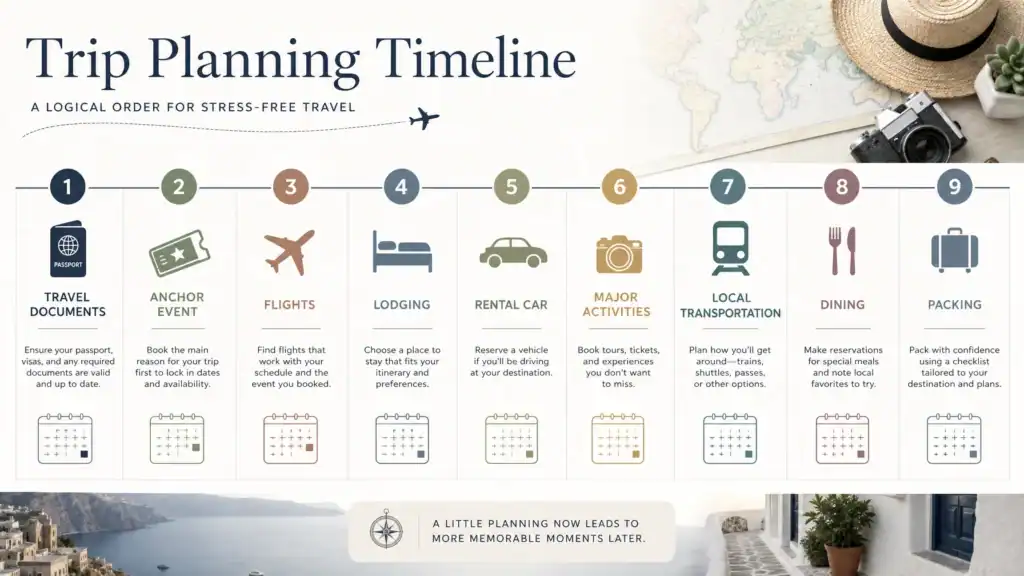
This general sequence works for many trips:
- Confirm the destination, dates, travelers, and budget.
- Check passports, entry requirements, and major practical barriers.
- Identify the anchor event, tour, cruise, permit, or commitment.
- Research flight, lodging, and transportation availability together.
- Reserve the hardest-to-replace major component.
- Reserve lodging that works with the transportation plan.
- Reserve a rental car or other essential ground transportation.
- Reserve limited activities, permits, and timed-entry attractions.
- Confirm special accommodations and accessibility arrangements directly.
- Add flexible activities and meals.
- Recheck reservation details before cancellation deadlines.
- Complete packing, documents, and final preparation.
Now stop treating that sequence as a rigid rule. The order shifts with the trip:
- A cruise departure usually makes the cruise the first reservation.
- A fixed wedding date can make lodging the first priority.
- A rare park permit may need to be secured before flights.
- An international trip may require passport action before any nonrefundable purchase.
- A large family may need to secure the one property that sleeps everyone before choosing among several acceptable flights.
Researching flights and lodging together prevents the classic mistake of buying a cheap fare into a weekend where every suitable room is booked or far beyond your budget. Look at the pieces side by side and compare the complete cost of your options.
A Practical Travel Reservation Timeline
Treat this as a planning framework, not a universal deadline. Every row depends on your destination, season, group size, and flexibility.
| Planning window | Reservations to consider | Why they may need attention | What to verify |
|---|---|---|---|
| Six months or more | Passport applications or renewals; large-group or holiday lodging; cruises, weddings, and major events; limited permits; highly seasonal destinations; specialized accessible arrangements | Document processing takes time, and the smallest inventories—large rentals, accessible rooms, and permits—can disappear first | Official passport information; permit release dates; occupancy limits; whether accessibility features are confirmed or requested |
| Three to six months | Flights for fixed or complicated itineraries; lodging; rental cars in limited markets; popular tours; campsites; event tickets | Fixed dates reduce flexibility, and scarce vehicle classes and small-group tours can thin out | Total fare including bags; cancellation terms; vehicle class; tour departure dates and group size |
| One to three months | Airport transportation; remaining activities; special-occasion dining; equipment rental; child-related arrangements; transit research | Enough of the itinerary is settled to make good decisions while moderate-demand items may still be available | Pickup logistics; deposits; whether requests are confirmed; transit rules |
| Two to four weeks | Confirm reservations; recheck entry requirements; review cancellation deadlines; reserve remaining flexible activities | Details can change, and this is a useful window for correcting problems | Reservation numbers; name spellings; current entry rules; refund deadlines |
| Final week | Check weather; confirm pickup and check-in instructions; download tickets; save offline copies; reconfirm critical reservations; finish packing | Small logistical failures cause much of travel-day stress | Operating hours; terminal information; document validity; offline access to passes |
One clarification: two to four weeks before departure is not the ideal time to begin destination-specific health preparation. Review the current CDC before-travel guidance much earlier when relevant. If you are already inside the recommended window, contact an appropriate healthcare professional rather than assuming it is too late.
Peak dates may require more lead time than the table suggests. Flexible dates may require less. Small destinations can fill earlier than large cities. Large groups have fewer suitable options. For permits and popular tours, the exact release date often matters more than a broad month range—always check the official provider page.

Common Travel Reservation Mistakes
Booking a Nonrefundable Option Before Confirming the Trip
The discount on a prepaid, nonrefundable rate looks appealing until a date shifts, a passport is expired, or a traveler drops out. Commit to nonrefundable terms only when the underlying details—dates, documents, and travelers—are genuinely settled.
Reserving the Cheapest Flight Before Checking Lodging
A great fare into a convention weekend is not a great deal if every suitable room is gone or priced beyond your budget. Look at flights and lodging side by side and compare the total trip cost.
Waiting on the One Reservation the Trip Depends On
If the trip exists because of a permit, cruise, tour, accessible room, or event ticket, that item goes first—even before the familiar items that feel more urgent.
Booking Every Activity Before Understanding the Destination
An itinerary with something reserved every two hours ignores travel time, weather, jet lag, and the possibility that you will want to stay somewhere longer. Reserve what is scarce. Leave the rest open.
Forgetting Cancellation Deadlines
Flexible bookings quietly become nonrefundable. Put the deadline on your calendar the moment you reserve, with a reminder several days early.
Assuming a Request Is Confirmed
Selecting “accessible room,” “connecting rooms,” or “crib” during checkout often creates a request rather than a confirmation. Contact the provider directly for anything essential and keep written proof.
Using the Same Booking Timeline for Every Trip
The lead time for a quiet weekend in a large city will not fit a holiday week near a national park with eight relatives. Destination, season, group size, and trip purpose change the timeline.
Failing to Verify Reservations Directly
For critical bookings made through a third party, confirm that the actual provider has the correct dates, traveler names, room type, vehicle class, or special arrangement in its own system.
A Simple Process for Prioritizing Reservations
- Write down the fixed parts of the trip—dates, events, people, and hard constraints.
- Check passports, entry requirements, and practical barriers.
- Identify the one reservation the trip cannot work without.
- Research flights, lodging, and transportation together.
- Compare total costs and cancellation terms.
- Reserve the hardest-to-replace component.
- Add the remaining major trip components around it.
- Confirm special arrangements directly with the provider.
- Reserve limited activities, permits, and timed-entry attractions.
- Deliberately leave flexible time for lower-priority decisions.
- Put every cancellation deadline on a calendar.
- Reconfirm critical reservations before departure.
Once the big pieces are booked, shift into logistics mode and prepare your airport, hotel, and rental arrangements. Browse the complete travel-planning library for the next steps, or explore destination guides for location-specific context.
Working with a short lead time instead? Use the last-minute travel savings guidance rather than trying to force a long-range timeline onto a trip that is already close.
What to Reserve Early Checklist
- ✅ Destination and dates are reasonably clear
- ✅ Traveler count is confirmed, including children and their ages
- ✅ Preferred and maximum budgets are set
- ✅ Passports and entry requirements have been checked on official sources
- ✅ The trip’s anchor reservation has been identified
- ✅ Flight availability and schedules have been reviewed
- ✅ Suitable lodging—the right room type, not just any room—is available
- ✅ Transportation needs at the destination are understood
- ✅ Rental-car availability has been checked when a vehicle is needed
- ✅ Limited permits or timed-entry requirements have been researched on official pages
- ✅ Major tours and events have been reviewed for release dates
- ✅ Accessible and special arrangements have been requested and confirmed directly
- ✅ Cancellation and refund terms have been read and saved
- ✅ Cancellation deadlines are on the calendar with reminders
- ✅ Reservation confirmations are stored together
- ✅ Critical reservations have been verified with the actual provider
- ✅ Flexible activities have been left flexible where practical
Frequently Asked Questions About Reserving a Trip Early
What should I reserve first when planning a trip?
Start with whatever the trip cannot survive without. For an international trip, that may be document readiness—passports and entry requirements—because those cannot be rebooked. After that, identify the anchor: a cruise, a wedding-weekend room, an event ticket, or a limited permit. The test is simple: if a particular reservation vanished, would you still go? Anything you would cancel the trip over belongs at the front of the line.
Should I book the flight or hotel first?
It depends on which is scarcer for your specific trip. If your dates are fixed and the route has few flights, airfare may be the constraint. If you need one room that sleeps five during a festival weekend, lodging may be tighter. Research both together before committing so you know that both halves exist and what the complete trip costs. Then reserve the harder-to-replace option first.
How early should I book a vacation?
There is no single timeline. Peak dates, small destinations, large groups, permits, and fixed commitments all push you earlier. A flexible weekend in a large city with abundant hotels may require much less lead time. The more constraints you have, the earlier you should begin. Focus on when the scarce items become available rather than on a generic countdown.
Is it always cheaper to book travel early?
No. Early booking reliably improves availability and choice; it does not reliably produce the lowest price. Airfares and hotel rates move in both directions depending on demand, season, and remaining inventory. The dependable reason to reserve early is to protect something difficult to replace—a family suite, an accessible room, a limited permit—not because early always equals cheap.
What travel arrangements usually sell out first?
The narrow-supply items tend to go first: limited permits, timed-entry slots, campsites, small-group tours, accessible rooms, rooms that sleep five or more, connecting rooms, minivans, large vehicles during holiday weeks, and lodging in small towns near major events. A destination can look wide open while the exact item you need is already gone.
Should I reserve a rental car early?
Reserve early when your needs are specific or the market is thin: a minivan for a holiday week, hand controls, a one-way rental, a small airport with few counters, or an itinerary that cannot work without a vehicle. A standard compact car in a large city during a quiet week is generally less urgent. Review cancellation terms so you understand the cost of holding the option.
How early should I book activities and tours?
Separate activities into two groups. Anything with real capacity limits—permits, timed entry, small-group tours, ferries, campsites, or ticketed events—deserves attention as soon as the official release schedule allows. Flexible sightseeing can wait until flights and lodging are settled. Check the official attraction or park page because systems change between seasons and years.
Should I book a refundable hotel while deciding?
It can be a sensible way to hold a good option, particularly when the right room type is scarce. Confirm the exact cancellation deadline and time zone, whether taxes and fees are refunded, whether a deposit is retained, and whether you or a third-party platform must process the cancellation. Set a calendar reminder several days before the deadline.
What should I check before booking an international trip?
Check passport validity for every traveler, destination-specific entry or authorization requirements, and current processing times if a passport application is needed. Review official destination information and current health-planning guidance. Requirements vary by nationality and can change, so verify them before making nonrefundable purchases and again before departure.
What can I wait to reserve until later?
Most routine meals, flexible sightseeing, shopping, souvenirs, packing decisions, and weather-dependent outdoor plans can usually wait. These choices often improve once you know your neighborhood, daily schedule, energy level, and forecast. Exceptions include famous restaurants, holiday meals, limited ferries, timed entry, or activities affected by a major event. Reserve what is scarce and leave the rest flexible.
The Short Version
Reserving early is not about moving fast. It is about knowing which few pieces of your trip are genuinely hard to replace—and handling those before anything else.
Check documents and practical requirements before major nonrefundable purchases. Look at flights, lodging, and ground transportation together because they only make sense as a total. Protect the one reservation that makes the trip possible, whether that is a permit, a cruise, a wedding-weekend room, or a suite that fits everyone. Read the cancellation terms before agreeing to them, and record every deadline.
Then let the flexible parts stay flexible. You do not need to reserve every dinner and afternoon months ahead. Identify the handful of arrangements that could make or break the trip, take care of those, and let the rest fall into place as departure gets closer.
That is a manageable amount of work—and far less than twelve open browser tabs suggest.
Continue Planning Your Trip
How to Choose the Right Travel Destination
Compare destinations by budget, timing, weather, transportation access, and the experiences you want before committing money.
How to Compare Travel Prices
Compare the full cost of flights, lodging, rental cars, and local transportation so a cheap-looking option does not become the expensive one.
Airport, Hotel, and Rental Car Preparation
Coordinate arrival times, check-in windows, vehicle pickup, and the practical details that shape travel day.
Family Travel Planning Tips
Plan sleeping arrangements, realistic schedules, group budgets, transportation, and activities for mixed ages.
Packing and Travel Timing Tips
Organize the final stage once the major reservations are done: what to pack, when to leave, and where to keep documents.
Travel Tips Hub
Browse the full collection of SavingsScoutTravel planning guides, from destination research through post-booking logistics.
Keep Planning in the Right Order
Use the Travel Tips hub to move from destination selection and price comparison into reservations, preparation, packing, and transportation planning.