

How to Compare Travel Prices and Find the Best Overall Value
Compare flights, hotels, rental cars, transportation, fees, and booking terms as one complete trip—not a collection of unrelated prices.
You find a flight that looks almost too cheap to pass up. Then you add a carry-on bag, pick a seat so your family isn’t scattered across three rows, and watch the total climb past the “expensive” option you dismissed ten minutes earlier. Learning how to compare travel prices starts right there—at the gap between the number on the search page and the number on your credit card statement.
Comparison isn’t about hunting for the smallest figure on a results screen. It’s about understanding what a whole trip actually costs once flights, lodging, rental cars, local transportation, and required fees are added together. Those pieces affect each other, too. A cheaper hotel across town can quietly add rideshare trips. A cheaper airport can add a tank of gas and a parking bill. When you look at them as one connected budget instead of four separate purchases, the better choice usually becomes obvious.

Start With the Total Trip Cost
Advertised prices are a starting point, not a conclusion. A useful way to think about any trip is this:
Flight costs + lodging costs + transportation costs + required fees + optional extras = estimated total trip cost
You don’t need a complicated spreadsheet. A page in a notebook, the notes app on your phone, or a basic calculator handles this fine. What matters is writing the numbers down so you’re not comparing from memory.
The other half of the job is making sure you’re comparing the same thing on both sides. Before you decide one option beats another, check that you’ve matched:
- Travel dates and length of stay
- Number of travelers
- Room type and bed configuration
- Vehicle class and rental period
- Baggage you actually plan to bring
- Cancellation and change terms
- Deposit or prepayment requirements
- Taxes and required fees
- Included services such as breakfast, parking, or Wi-Fi
That’s what “apples-to-apples” means in practice. A room that sleeps two isn’t comparable to a room that sleeps four, and a nonrefundable rate isn’t comparable to a flexible one. It also helps to know what to reserve early when planning a trip, because some components—especially during busy seasons—get more expensive or disappear entirely the longer you wait.
Compare Flight Prices Beyond the Base Fare
Airfare is the category where the displayed price and the final price drift apart most often. When you’re weighing two flights, look at more than the headline number:
- Base fare plus taxes and required charges
- Carry-on and checked baggage fees
- Seat selection, especially if you’re traveling with others
- Change and cancellation restrictions
- Which airport you’re flying from and into
- Getting to and from the airport on both ends
- Long layovers, red-eye departures, or arrivals after transit shuts down
- Separate tickets on different airlines, which can leave you unprotected if the first flight is delayed
- Whether a cancellation produces a travel credit or an actual refund
A flight from an airport two hours away can look like a clear winner until you add fuel, tolls, a week of parking, and possibly a hotel night before an early departure. Sometimes it still wins. Sometimes it doesn’t—and you only know once you write it out.
Convenience carries real value, too. A nonstop that gets you there mid-morning may be worth more to you than a two-stop itinerary that saves money but eats an entire day. That’s a personal call, not a rule. Just make the tradeoff consciously instead of by accident.
Airfare pricing has its own logic, and it deserves a deeper explanation than this overview can provide. Visit FlightSavingsScout to understand how airline prices change, review the best time to book flights, and explore practical cheap flight strategies.
Compare the Full Cost of a Hotel Stay
Nightly rate is the number hotels advertise. Total stay cost is the number you pay. The difference can be significant once you account for:
- Taxes and occupancy charges
- Required resort, destination, or property fees
- Parking, especially self-park versus valet in city centers
- Breakfast—whether included or à la carte
- Wi-Fi, if it isn’t complimentary
- Extra-person charges above a set occupancy
- Pet fees, if you’re traveling with one
- Cancellation deadlines and prepayment requirements
- Distance to the places you actually plan to spend time
- Transportation costs from the property each day
- Kitchen or laundry access on longer stays
- Check-in and checkout times that fit your flights
Here’s the classic comparison. Hotel A has the lower nightly rate but charges for parking, doesn’t include breakfast, and sits fifteen minutes outside the area you came to visit. Hotel B costs more per night, includes breakfast and parking, and is within walking distance of most of your plans. For a family of four staying five nights, Hotel B can end up cheaper—and it saves you two rideshare trips a day. For a solo traveler who’ll be out of the room from dawn to midnight, Hotel A might be exactly right.
The point isn’t that included amenities always win. It’s that you can’t judge until you price the whole stay. For more depth, learn how to understand hotel pricing, review the best time to book hotels, use these practical hotel savings tips, and see how to choose a convenient hotel location.

Compare Rental-Car Prices and Conditions
Daily rate is probably the least reliable indicator in all of travel. A rental quote can include:
- Base rate and length-of-rental pricing tiers
- Taxes and required surcharges
- Airport concession and facility charges
- Vehicle class—and whether it fits your group plus luggage
- Mileage limits, which appear more often on certain rates and locations
- Fuel policy: return full, prepaid fuel, or refueling charges
- Additional-driver fees
- Young-driver surcharges where they apply
- One-way drop-off charges
- Toll transponder programs and their daily service fees
- Child seats, ski racks, or other equipment
- Pickup and return times, since going a bit over can trigger another day
- Deposit holds and card requirements
- Cancellation terms on prepaid versus pay-later rates
- Optional protection products offered at the counter
- The cost and hassle of reaching an off-airport branch
Airport locations carry facility charges that neighborhood branches usually don’t, which is why an off-airport rate can look dramatically better. Whether it is better depends on what the rideshare ride costs and whether the branch is open when your flight lands. A low base rate with restrictive mileage or a prepaid fuel option you won’t fully use can also erase its own advantage.
A note about optional coverage: This is genuinely personal. Your existing auto policy, your credit card’s benefits, the rental agreement’s terms, and where you’re traveling all matter, and they vary. Review those sources before your trip and decide based on your own situation rather than on a counter conversation at 11 p.m.
For the mechanics behind the quotes, see how to understand rental-car pricing, review the best time to book car rentals, browse these car rental savings tips, and use the dedicated airport car rental strategy guide.
Include Local Transportation in Your Comparison
Not every trip needs a rental car. Before you book one out of habit, sketch out how you’ll actually move around:
- Rental car, plus fuel and parking at both your hotel and your destinations
- Public transportation passes, often the cheapest option in dense cities
- Airport trains, express buses, or shuttles
- Free hotel shuttles, where offered
- Rideshare or taxi trips, counted round-trip and multiplied by days
- Walking, which costs nothing but depends heavily on where you stay
- Parking your own vehicle at your home airport for the duration
- A hybrid approach—transit in the city, a rental for two days of countryside driving
That last option is underused. Renting a car only for the days you need it, rather than for the entire trip, often trims both the rental cost and the nightly hotel parking charge.
A well-placed hotel can quietly reduce three line items at once. Our guides on ways to save on transportation while traveling and how to prepare for your airport, hotel, and rental arrangements go further into the logistics.
Use an Apples-to-Apples Travel Comparison
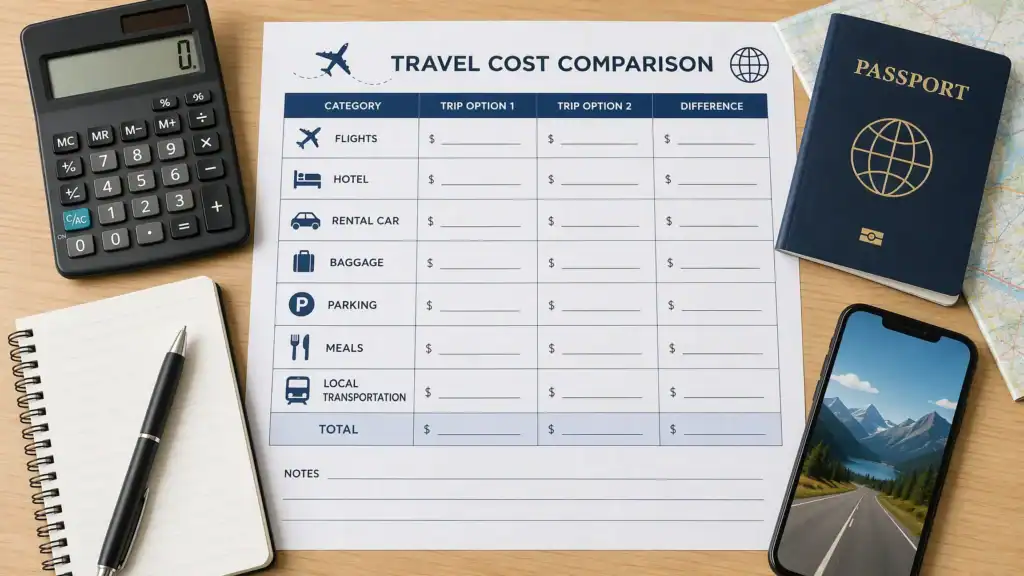
Put your two leading options side by side. This table is a template—fill it in with your own numbers.
| Item to compare | Option A | Option B | What to check |
|---|---|---|---|
| Flight | Fare plus taxes, airport used, layovers, arrival time | ||
| Baggage | Carry-on, checked bags, and seat selection for your party | ||
| Hotel | Nightly rate × nights, taxes, room type, occupancy limits | ||
| Required hotel fees | Resort or destination fees, Wi-Fi, extra-person charges | ||
| Parking | Hotel parking per night, airport parking, valet vs. self-park | ||
| Rental car | Vehicle class, all-in daily rate, airport surcharges, extra driver | ||
| Fuel or transit | Fuel policy and estimated fill-ups, transit passes, rideshare trips | ||
| Cancellation terms | Refundable, credit only, or nonrefundable; deadlines | ||
| Total estimated cost | Compare final totals, then weigh convenience and risk |
How to work through the comparison
- Lock in the same dates and the same number of travelers for both options.
- Record the complete displayed price, including taxes and mandatory fees.
- Add the extras you’ll genuinely use—bags, parking, a second driver, or a child seat.
- Subtract the value of inclusions you’d otherwise pay for, such as breakfast for four.
- Read the cancellation and refund terms on both sides.
- Compare the final estimated totals.
- Then weigh convenience and risk before you book.
Remember: Prices and availability shift, so treat your worksheet as a snapshot. If a few days pass before you book, re-check the numbers.
Compare Booking Directly With Third-Party Options
You’ll see the same flight, room, or car offered through airlines, hotels, rental companies, online travel agencies, comparison tools, and package providers—sometimes at different prices, sometimes with different terms attached.
Neither channel is universally better. What changes is who stands behind the reservation. Before you pay, check:
- The final price after all fees, not the teaser rate
- Who processes the payment and who appears on your statement
- Who you contact for a change, cancellation, or refund
- Whether loyalty points and elite benefits still apply
- Who owns customer service if something goes wrong at 6 a.m.
- Cancellation deadlines, which may differ from the provider’s own policy
- Package restrictions that bundle components you can’t modify separately
- Whether you can select seats, request a specific room type, or choose a vehicle
- Whether the booking actually shows up in the provider’s system
That last item is worth a phone call. A confirmation email from a booking site doesn’t always mean the hotel or airline has processed the reservation on its end, and a quick verification a few days out costs you nothing.
Bundled packages can genuinely reduce a total, particularly for flight-plus-hotel trips. They can also lock you into terms that are harder to unwind. Read what you’re agreeing to. For airline purchases specifically, the U.S. Department of Transportation guidance on buying an airline ticket explains how ticket sales and disclosures work.
Review Cancellation and Refund Terms Before Booking
A slightly more expensive refundable rate isn’t a waste of money—it’s a hedge. Whether it’s worth it depends on how likely your plans are to change and how much money is exposed if they do.
Points worth confirming before you commit:
- Is the reservation refundable, changeable, or neither?
- If you cancel, do you get money back or a travel credit—and when does that credit expire?
- What’s the deadline to change without a fee?
- What’s the cancellation window on the hotel, and is it different from the flight’s?
- What happens if you simply don’t show up?
- Are partial refunds possible, and on what basis?
- Who processes the refund—the provider or the booking site?
- Are add-ons like seats, bags, or prepaid fuel refundable separately?
- Have you saved the confirmation email and a screenshot of the terms?
Airline refund obligations depend on the circumstances—a cancellation by the airline is treated differently from a change of heart by the passenger. Review the current airline refund information from the U.S. Department of Transportation alongside the specific terms of your own ticket, since official guidance is updated over time. Hotel and rental-car policies operate under their own contracts, not airline rules.
Flexibility matters even more when you’re booking close to departure. Our last-minute travel savings tips cover how to handle short-notice trips without overcommitting.
Watch for Travel Offers That Are Not What They Seem
Most travel businesses are legitimate. A few aren’t, and a handful of signals are worth noticing:
- Heavy pressure to book in the next few minutes
- A price that jumps sharply between the search result and the payment page
- A site whose address is slightly off from the brand it appears to be
- Required charges that aren’t clearly disclosed anywhere
- Requests for wire transfers, gift cards, or payment apps
- Cancellation terms written vaguely or missing entirely
- A vacation rental you can’t verify through any independent source
- An offer far outside what similar options cost
- No phone number, physical address, or clear company identity
Simple protections go a long way. Check the URL character by character. Read the full price breakdown before entering card details. Look at recent reviews on more than one platform. Confirm the reservation directly with the hotel or airline. Pay with a method that offers dispute protection. Keep receipts and confirmations somewhere you can find them. And don’t let a countdown timer make the decision for you—those clocks are usually a design element, not a real deadline.
The Federal Trade Commission maintains plain-language guidance for avoiding travel scams that is worth reviewing before a large booking.
Decide What “Best Value” Means for Your Trip
Value isn’t a fixed number. It depends on what you’re optimizing for, which changes from trip to trip:
- The lowest final cost, when the budget is firm
- The shortest total travel time, when you have limited days off
- Flexibility, when plans might shift
- A location that keeps you near what you came to see
- Fewer connections, especially with kids or tight schedules
- Breakfast or parking included, which simplifies daily spending
- A vehicle that actually fits your group and luggage
- Less time in transit between activities
- Lower financial exposure if something falls through
The cheapest option isn’t automatically the wrong one. Plenty of trips call for exactly that. It just deserves the same scrutiny as everything else—priced fully, terms read, and tradeoffs understood.
Value starts even earlier than booking, at the destination itself. If you’re still deciding, our guide on how to choose the right travel destination can help, and our family travel planning tips address the extra math that comes with a group.
A Simple Travel Price Comparison Process
- Establish your dates, destination, and number of travelers.
- Search each major component—flight, lodging, and car—separately.
- Record the total displayed price for each, taxes included.
- Add required fees and the extras you personally need.
- Compare cancellation and refund terms side by side.
- Estimate local transportation for the whole trip, not one ride.
- Check both direct and third-party booking channels.
- Calculate the complete trip cost for each combination.
- Review every detail on the payment page before confirming.
- Save your confirmations, and verify the booking with the provider.
Once your major reservations are in place, use these packing and travel timing tips to organize the practical details before departure.
Travel Price Comparison Checklist
- ✅ Same travel dates compared
- ✅ Same number of travelers
- ✅ Same room type or vehicle class
- ✅ Taxes and required charges included in both totals
- ✅ Baggage costs checked for your actual packing plan
- ✅ Hotel parking and mandatory property fees checked
- ✅ Rental mileage limits and fuel policy reviewed
- ✅ Airport and local transportation estimated
- ✅ Cancellation deadlines reviewed for every component
- ✅ Refundability versus travel credit understood
- ✅ Payment, deposit, and card requirements checked
- ✅ Final total written down for each option
- ✅ Reservation confirmed in the provider’s own system
For more planning resources across every stage of a trip, browse our travel tips hub or explore ideas by destination.
Frequently Asked Questions About Comparing Travel Prices
What is the best way to compare travel prices?
Compare complete trip totals rather than individual advertised rates. Choose your dates and traveler count, then price each component—flight, lodging, car, or transit—with all taxes and mandatory fees included. Add the extras you’ll actually use, such as bags, parking, or a second driver, and subtract the value of anything genuinely included. Write both options down side by side. The written comparison matters more than the tool you use because it forces you to account for costs that search results tend to display separately or later in the process.
Should I compare flights, hotels, and rental cars separately?
Price them separately, then evaluate them together. Searching each category on its own gives you a clear read on what each component costs. But the decisions interact: a hotel near the transit line may eliminate a rental car, and an airport farther from home may add parking and fuel. After you’ve gathered individual prices, build two or three complete trip scenarios and compare their totals. Packages are worth checking too, though you’ll want to confirm what the bundle restricts before assuming it’s the better deal.
Is the lowest advertised travel price always the cheapest?
Not reliably. Advertised prices often exclude baggage fees, seat selection, resort or destination fees, hotel parking, airport rental surcharges, and equipment charges. Two options that look far apart on a search page can finish within a few dollars of each other once everything is added. Sometimes the low advertised price genuinely does win. The only way to know is to carry both options through to a full estimated total, including the transportation costs each choice creates.
Is it better to book travel directly or through a third party?
Neither is automatically better, and it varies by trip. Direct bookings often make changes simpler, keep loyalty benefits intact, and give you one clear point of contact. Third-party sites sometimes surface lower prices or convenient bundles. What matters is knowing who processes your payment, who handles a change or refund, and whether the provider can actually see your reservation. Compare final prices and the terms attached to each channel, then choose based on how much flexibility your trip is likely to need.
What travel fees should I check before booking?
On flights, check taxes, carry-on and checked baggage, seat selection, and change or cancellation charges. On hotels, check taxes, resort or destination fees, parking, Wi-Fi, extra-person charges, and pet fees. On rental cars, review airport facility surcharges, additional-driver fees, young-driver surcharges, one-way drop charges, toll programs, equipment rentals, and fuel policy. Then add trip-level costs such as airport parking at home, rideshare trips from the hotel, and transit passes.
How often should I check travel prices?
Often enough to spot movement, not so often that it takes over your week. Checking every few days once your dates are set is reasonable for many trips, and price alerts can do the watching for you. Availability and pricing change for reasons outside your control, so no schedule guarantees the best number. Set a decision point in advance and book when an option meets your criteria rather than waiting for a bottom you cannot identify.
Should I book a refundable option?
It depends on how much the flexibility costs and how likely your plans are to change. If the refundable rate is only modestly higher and the trip involves uncertain schedules or connecting travel, the reduced financial exposure can be worthwhile. If your dates are firm and the flexible rate carries a large premium, a nonrefundable rate may make more sense. Also check what “refundable” means on that reservation—some options return money, while others issue credits with expiration dates.
How can I compare the cost of driving, renting a car, and using public transportation?
Estimate each option across the full trip, not per day. For driving your own vehicle, count fuel, tolls, parking, and any vehicle costs you personally factor in. For a rental, use the all-in rate including surcharges, plus fuel and nightly hotel parking. For transit, price a multi-day pass and add the airport connection at each end. Then weigh the non-financial side: how far you’ll walk, how much you’ll carry, and how much time each choice takes.
Bringing It Together
Comparing travel prices well comes down to a single habit: refusing to judge an option until you know what it costs from your front door to your return home. That means fares plus bags, room rates plus parking and fees, rental rates plus surcharges and fuel, and every ride in between.
Match your options fairly. Add what you’ll actually pay. Read the cancellation terms while you still have a choice. Then weigh convenience and flexibility against the number, because those have real value even though they don’t appear as line items.
Prices move, availability shifts, and no method produces the lowest possible number every time. What a careful comparison does give you is confidence that you understood the trip you booked—and that’s usually worth more than shaving a few dollars off a fare.
Continue Planning Your Trip
How to Choose a Travel Destination
Narrow down where to go based on budget, timing, and what you actually want out of the trip.
What to Reserve Early for a Trip
Learn which components tend to get scarce or expensive when you wait too long.
Airport, Hotel, and Rental Car Preparation
Handle the practical details before departure so nothing catches you off guard on arrival.
Transportation Savings Tips
Compare rentals, transit, shuttles, and rideshare to find what fits your destination.
Last-Minute Travel Savings
Use practical approaches for booking on short notice without overpaying for urgency.
Travel Tips Hub
Browse the full library of planning, packing, and booking guides in one place.
Plan the Whole Trip, Not Just One Price
Use SavingsScoutTravel to organize the big picture, then visit each SavingsScout specialist site for deeper flight, hotel, and rental-car guidance.